

Choosing a Montessori Kitchen Step Stool for Barefoot Use
Your toddler wants to rinse a strawberry, but you’re lifting them to the sink again while their bare feet search for somewhere to land. A montessori kitchen step stool can make that routine easier, provided its surface feels comfortable, its base stays steady and its height suits your child.
For barefoot use, look for a dry, splinter-free standing surface with secure traction, enough room for both feet and a stable base. Follow the manufacturer’s footwear instructions. Bare feet alone do not make a stool safe, and an anti-slip surface cannot replace supervision.
Start with the right type of support
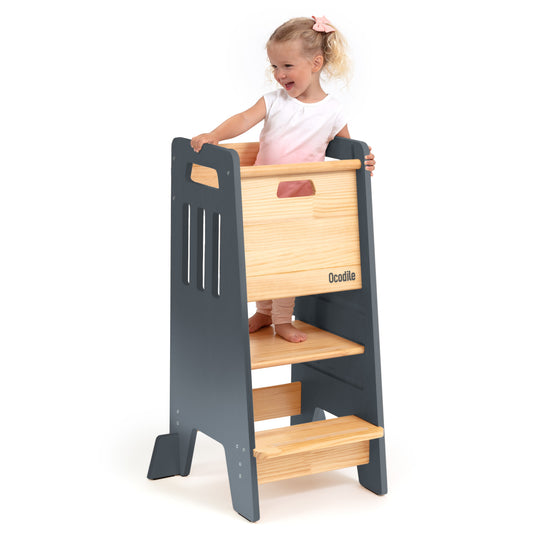
A step stool and a learning tower are not interchangeable. A stool provides raised steps or a platform, usually without surrounding rails. A learning tower typically surrounds more of the standing area, but those barriers do not eliminate falls or climbing risks.
| Option | When to consider it | Main limitation |
|---|---|---|
| Open step stool | A child who meets the product’s age guidance and can manage its steps | No surrounding barrier |
| Learning tower | Counter activities where a surrounding structure may be helpful | Larger footprint, with openings and possible moving parts to inspect |
| Child-height table | Food preparation that does not require sink or counter access | Does not help a child reach fixed kitchen fixtures |
If your child needs continuous hands-on help to stay upright, do the activity at a child-height surface instead. Tearing lettuce at a low table still gives them a real job without requiring an elevated platform.
What makes a montessori kitchen step stool comfortable barefoot?
Bare feet touch details that shoes can hide: a raised adhesive edge, a sharp corner or grit stuck to a step. Look beyond whether a product description simply says “non-slip.”
Grip should not come at the expense of comfort
Inspect every surface your child will step on, including the lower tread. Look for splinters, chipped finish, exposed fasteners and peeling traction strips. Check accessible edges carefully with your hand before inviting your child to try the stool.
A very coarse texture may feel unpleasant under bare soles. A glossy surface may feel smooth but offer insufficient traction under certain conditions. Neither appearance proves performance.
Ask the manufacturer whether the surface is intended for barefoot use and how it should be cleaned. Product photos alone cannot establish how abrasive a tread feels.
Dry feet matter as much as tread texture
Water, soap, flour and food residue can change how a surface behaves. A stool that feels secure during dry food preparation may feel different beside a splashing sink.
For barefoot use, choose a montessori kitchen step stool whose standing surfaces you can inspect and clean easily. Wipe up spills promptly, dry your child’s feet and pause the activity whenever the steps become wet or dirty.
Do not assume ordinary socks or grip socks solve a slippery-surface problem. Follow the product’s footwear guidance and address the moisture or contamination first. Avoid adding homemade tread coverings unless the manufacturer approves them, since loose edges can create another problem.
Check stability on your actual kitchen floor
A sturdy-looking stool may rock if one foot sits across a tile joint or the floor is uneven. Before your child climbs, place the assembled stool on a level, dry surface with all its intended floor-contact points supported.
With the stool empty, check for rocking and confirm that its feet, pads and fasteners are intact. Use the manufacturer’s inspection instructions rather than inventing a tipping or load test. Never test stability by rocking the stool while your child stands on it.
When assessing a montessori kitchen step stool, distinguish between foot traction on the platform and base traction against the floor. Anti-slip strips on top do not tell you whether the base will slide on your flooring.
Avoid positioning the stool partly on a rug or loose mat. A wider base may provide a larger support footprint, but it also needs space clear of cabinet doors, walkways and other people’s feet. Do not wedge a stool into place as a substitute for proper stability.
Match the height to your child’s reach and balance
A comfortable barefoot stance means your child can place both feet fully on the standing surface without curling their toes around an edge. They should reach the activity without standing on tiptoe, leaning far forward or hanging their weight from the counter.
Measure the working surface and compare it with the product’s published dimensions. Think about the actual task: reaching a bowl near the counter’s edge is different from stretching toward a faucet at the back of a sink.
The right montessori kitchen step stool should suit your child’s current abilities, not just promise room to grow. Follow both the minimum age and weight guidance, then consider whether your child can climb, stand and step down with control. Meeting an age label does not establish readiness by itself.
If the stool has an adjustable platform, use only the approved positions and hardware. Never add a cushion, box or second stool to gain height. Ask the manufacturer about fit if the correct platform position is unclear.
Inspect openings, hardware and recall history
Before buying, find the instructions and check the exact model’s age limits, weight limit, assembly requirements and maintenance guidance. This matters especially for secondhand furniture, which may be missing labels or original hardware.
Look for accessible openings, damaged joints and places where a foot could slip through. For a tower, also inspect barriers and entry openings. Do not use your child’s head, hands or feet to test whether a gap could trap them. Ask the manufacturer about anything unclear and stop using the product until it is resolved.
For folding or adjustable designs, confirm that locks engage as directed and that moving parts do not remain accessible during use. Do not make structural changes or substitute fasteners without manufacturer approval.
Search the U.S. Consumer Product Safety Commission recall database using the brand and product name, then check the manufacturer’s current repair or safety notices. If a recall applies, follow its instructions rather than trying your own fix.

Where Ocodile’s two-step stool fits
For families comparing open stools, Ocodile’s 2-Step Wooden Stool for Toddlers, for children ages 2+ includes five clear anti-slip strips across the step and platform. Those strips provide a traction feature to consider where little feet land, rather than relying only on the wood’s finish.
That feature does not establish how the surface will feel to every barefoot child or how it will behave when wet. Check the current product instructions for footwear guidance, dimensions, weight limits and cleaning requirements before deciding whether it fits your kitchen routine.
When considering this option as a montessori kitchen step stool, remember that it is an open step stool, not a surrounding learning tower. Your child’s balance and ability to stay within the standing area remain central to the decision.
If you are also comparing materials, Ocodile’s guide to choosing a natural wood step stool offers more detail on wood and finish considerations. For barefoot use, bring that comparison back to the actual surfaces your child will touch, not simply whether the stool is wood or plastic.
Make the first barefoot trial short and supervised
Start with dry feet, a dry stool and an uncomplicated activity away from heat. Washing a piece of fruit in a bowl at the counter can be easier to manage than reaching across a deep sink.
Before each session, make these checks:
- Surface: Steps and platform are clean, dry and free of damage or lifting traction strips.
- Base: All floor-contact points are supported, with no rocking or sliding during the manufacturer’s prescribed checks.
- Fit: Your child can stand with both feet fully supported and reach without stretching.
- Surroundings: Hot liquids, knives, appliance cords and other hazards are out of reach.
- Supervision: An adult can stay close and intervene immediately throughout the activity.
During the first use of a montessori kitchen step stool, watch for toe gripping, repeated foot shifting or reluctance to stand on the tread. These can be reasons to stop and reassess comfort or fit, not behavior your child needs to push through.
Do not turn the first trial into a balance test. Help as needed, keep it brief and stop if your child is tired, distracted or trying to climb onto the counter. Put the stool away when you cannot supervise access.
Frequently asked questions
Is barefoot use safer than wearing socks? There is no blanket answer for every stool and surface. Ordinary socks can slide on some finishes, but bare feet can also slip when wet or soapy. Follow the manufacturer’s footwear guidance and keep the standing surface clean and dry.
Does a Montessori label mean a stool has been safety tested? No. The word describes an educational approach, not proof of a particular safety test or certification. Evaluate the exact product’s instructions, construction, limits and recall history.
What age can a child use a montessori kitchen step stool? Follow the specific model’s minimum age and other limits, then assess your child’s balance and ability to use its steps with control. Ocodile’s two-step model is labeled for ages 2+, but age alone does not determine readiness.
Should I choose a learning tower instead of an open stool? A tower’s surrounding structure may suit some counter activities, but it introduces its own openings, barriers and possible moving parts to inspect. Neither design replaces close adult supervision. A child-height work surface is another option when counter access is unnecessary.
What if my child says the anti-slip strips hurt? Stop using that surface barefoot and ask the manufacturer about approved footwear or replacement parts. Do not peel off safety-related tread or cover it with fabric unless the manufacturer specifically permits that change.
Compare fit before you buy
Measure your counter, check the space available for the base and read the exact model’s instructions. Then compare surface comfort, traction and your child’s readiness together. A useful choice lets your child stand comfortably for a manageable task while you stay beside them, with fewer awkward lifts and no need to improvise with a dining chair.