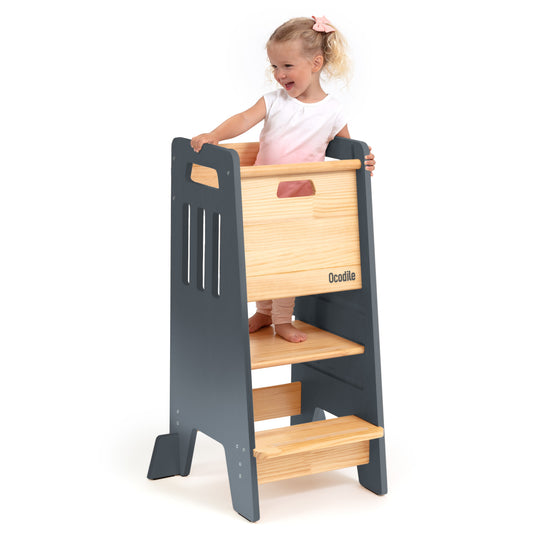


How to Read Montessori Standing Tower Reviews Before Buying
You’re lifting your toddler to the counter again, trying to rinse strawberries while they insist, “I do it!” A tower sounds helpful, but Montessori standing tower reviews leave you with competing messages: one parent calls a model sturdy, another says it wobbles and a third mostly praises the color.
The most useful reviews describe specific conditions, not just satisfaction. Before buying, look for details about the exact model, the child using it, stability, assembly and everyday kitchen fit. Then check those observations against the manufacturer’s instructions and current specifications. A star rating can help you find feedback, but it cannot establish whether a tower is appropriate for your child.
Start with the exact model, not the average rating
A toddler tower is a raised standing platform with surrounding barriers that lets a child reach a work surface with adult supervision. Its usefulness depends on the design and how your family uses it, so feedback about a similar-looking tower may not answer your questions.
First, confirm that a review refers to the version you are considering. Product listings sometimes group different sizes, configurations or earlier designs together. A complaint about an older folding mechanism may not describe the current model, while praise for a fixed tower tells you little about a foldable version.
Look for a model name, purchase date and photos that match the current listing. If something looks different, ask the seller whether the design or hardware has changed.
When reading Montessori learning stools reviews, give more weight to families describing circumstances similar to yours. A preschooler using a tower occasionally presents a different picture from a newly confident toddler who constantly shifts position.
A reviewer’s kitchen matters, too. “Fits perfectly” means little without knowing whether the tower sits beside a spacious island or blocks a narrow walkway. Useful feedback gives you enough context to decide whether the experience applies to your home.
Translate safety praise into observable details
“Safe,” “solid” and “secure” are understandable parent language, but they are conclusions. Look for the observations behind them.
Stability, barriers and standing space
A useful stability review describes ordinary supervised use: whether the feet sit evenly on a level floor, whether the frame moves at its joints and whether hardware stays secure after repeated use. “Heavy” alone does not establish stability. Base geometry, construction, assembly and permitted use also matter.
Distinguish between movement in the frame and uneven contact with the floor. Both deserve attention, but they point to different questions. A recurring report of loose joints needs a different response from a single review describing an uneven tile surface.
Montessori standing tower reviews should also help you understand the standing area and surrounding barriers. Look for photos showing the platform setting and entry opening, then compare them with the manual. A child’s age or height in a review does not establish that the same setting is suitable for your child.
Do not copy a reviewer’s improvised restraint, added weight or modified rail. Likewise, do not perform deliberate tipping tests with a child aboard. If a tower rocks, loosens or appears damaged during normal use, stop using it and contact the manufacturer.
Verify safety language outside the review section
“Montessori” describes an educational approach, not a product safety certification. Similarly, “non-toxic,” “tested” and “anti-tip” need supporting detail. A finish claim does not establish structural stability, and an anti-tip feature does not mean a tower cannot overturn.
Ask which requirements or standards apply to the exact model, what testing supports the claim and whether documentation identifies that product. A Children’s Product Certificate, when required, documents certification to applicable U.S. children’s-product rules. It is not a government endorsement or a guarantee against injury. The CPSC’s explanation of Children’s Product Certificates clarifies their purpose.
Search the CPSC recall database using the brand and model, particularly when considering a secondhand tower. No recall result is not proof of safety, but an applicable recall is information you need before proceeding.
For a fuller explanation of positioning, barriers and supervision, Ocodile’s kitchen helper tower safety guide can help you turn review comments into specific questions.
Read Montessori standing tower reviews for everyday fit
A tower can feel well made and still be awkward in your kitchen. Reviews are especially valuable for details that product photos do not show: moving around it, wiping food from joints and finding somewhere to store it.
Measure the complete floor footprint, including any projecting feet. Check the counter height and the space required for your child to enter, following the manufacturer’s placement instructions. Leave room for adults to pass without repeatedly bumping or moving the tower.
Use this table to turn broad praise into information you can verify. The phrases are illustrative, not actual customer testimonials.
| Review phrase | More useful detail to find | What to check yourself |
|---|---|---|
| “Really sturdy” | Level-floor placement, secure joints and repeated use | Assembly instructions and stability-related features |
| “Perfect for small kitchens” | Open dimensions and where it is stored | Full footprint and walkway clearance |
| “Grows with my child” | How adjustment works and which settings were used | Permitted settings, limits and adjustment steps |
| “Easy to fold” | Adult-operated steps, locking mechanism and storage position | Whether folding is practical in your space |
| “Easy to clean” | Access to corners, seams and the platform | Approved cleaning methods |
| “Easy to assemble” | Clear instructions, aligned holes and complete hardware | Tools, assembly steps and hardware checks |
For foldable designs, distinguish “can fold” from “we actually fold it every evening.” A mechanism that is inconvenient for your routine may mean the tower stays open permanently.
Fixed designs avoid the folding task but need a dedicated place. Neither format is automatically the better choice; the useful question is which one you can position, use and store as instructed.
Read low-star reviews for patterns, not just alarm
Low ratings often contain the most specific information, but they need interpretation. A late delivery, a damaged package and recurring frame movement are different problems. Avoid letting the overall score blur them together.
Sort complaints by what they affect: product condition, assembly, everyday use, safety concerns or customer service. Then look for independent descriptions of the same issue on the same version. Repetition deserves attention, especially when reviewers provide consistent details rather than identical wording.
When Montessori learning tower reviews repeatedly mention loose hardware, difficult-to-engage locks or similar structural concerns, pause the purchase and ask the manufacturer directly. Do not average a potentially serious issue away because other parents like the appearance.
Customer-service responses can provide additional context. A response that identifies the model and explains the next step is more informative than a generic apology. Still, a replacement part or refund does not prove that the underlying design concern has been resolved.
Review dates matter as well. Recent feedback can reveal current assembly or fulfillment issues, while longer-term reviews can show how a product holds up. Ideally, your shortlist has both. One enthusiastic review written immediately after unboxing tells you little about repeated cleaning, adjustments or months of use.
Recognize useful reviews without trying to detect every fake
A “verified purchase” badge is helpful context, not proof that every claim is accurate. Likewise, receiving a free product or another incentive does not automatically make feedback false, but that relationship should be disclosed and considered.
The FTC’s guidance on evaluating online reviews recommends looking across sources and considering the reviewer’s circumstances. For a tower purchase, prioritize descriptions of actual use over promotional language or broad superlatives.
Useful Montessori toddler tower reviews often include an ordinary tradeoff: the tower is easy to wipe down but awkward to move, or assembly is straightforward once two similar parts are distinguished. Specificity helps you evaluate the claim; it does not guarantee authenticity.
Photos can confirm visible details such as footprint or platform position, but they cannot verify load capacity or testing. A photo may also show unsafe placement. Do not treat a tower beside a stove, or a child climbing a rail, as evidence that the setup is acceptable.

Separate practical benefits from developmental promises
A review saying, “My child helps wash produce now,” describes a concrete use. A claim that a tower makes children more advanced, more coordinated or independent sooner goes much further than one family’s experience can establish.
The practical mechanism is straightforward: reaching an appropriate work surface can give a child more opportunities to participate. They might stir a cool mixture, tear lettuce or rinse fruit while an adult stays close. Repetition gives them opportunities to practice those particular tasks.
That does not prove the furniture itself causes broader developmental gains. A tower is an access tool, not a requirement for learning by doing. Many activities also work at a child-height table.
When evaluating Montessori learning tower reviews, ask whether the reported benefit matches something your family actually wants to do. If your goal is less lifting during a supervised food-preparation routine, look for descriptions of that routine rather than promises about lifelong confidence.
Access also creates new responsibilities. Keep hot liquids, sharp tools, appliance cords and other hazards out of reach. Stay close and attentive, never move an occupied tower and store it away from hazards when it is not being supervised. Barriers do not replace an adult.
Decide whether a tower is better than an alternative
A tower may be worth considering when your child frequently participates at a counter and you have room to use it correctly. The surrounding barriers distinguish it from an open step stool, but they do not make every child or activity suitable for elevated standing.
A lower-cost step stool may be adequate for an older, steadier child completing a brief task, provided the stool is intended for that use and you follow its instructions. It offers less surrounding containment and should not be treated as interchangeable with a tower.
For mixing, sorting or transferring ingredients, a child-height table may solve the problem without elevation. Moving the activity down can be the better choice when kitchen space is tight or your child repeatedly tries to climb the tower’s sides.
Montessori learning tower reviews are most helpful after you have decided that counter-height participation is the right goal. Otherwise, a highly rated product can distract you from a simpler solution that fits your family better.
Avoid treating a dining chair as an equivalent substitute. It was not designed to provide a toddler standing platform with surrounding barriers, and climbing or leaning introduces risks that enthusiastic anecdotes cannot resolve.
Turn your research into a short buying decision
Keep your final comparison small. For each shortlisted model, record the verified dimensions, permitted use, adjustment instructions, unresolved concerns and return terms. Mark missing information as “needs confirmation” rather than filling gaps with assumptions from a similar product.
For example, Ocodile’s Montessori Toddler Tower - Adjustable Kitchen Stool Helper is an adjustable option to compare. Adjustment can help maintain a useful standing position as a child grows, but check the current instructions for how its adjustment system works and which configurations are permitted.
Compare the product documentation with reviews describing actual adjustments and daily use. “Grows with my child” is more useful when a parent explains what changed and whether making that change was straightforward.
Before ordering, confirm return eligibility, packaging requirements and who pays return shipping. A tower can arrive exactly as described yet still occupy more kitchen space than you expected. Warranty coverage matters too, but it is not a substitute for confirming suitability before use.
Your decision should rest on verified fit and clear instructions, with reviews supplying practical context. If a safety-related question remains unanswered, wait rather than interpreting silence as reassurance.
Frequently asked questions
How many reviews should I read before buying? There is no reliable minimum. Read across recent reviews, longer-term accounts and low ratings until you understand the recurring strengths, complaints and missing details. Relevance to the exact model matters more than reaching a particular number.
Are five-star Montessori learning tower reviews enough to establish safety? No. Customer feedback cannot replace product instructions, applicable compliance documentation or recall checks. Reviews are useful for identifying experiences and questions, not certifying a product.
What age should my child start using a tower? Follow the manufacturer’s age, size and use requirements, then consider your child’s ability to stand steadily and follow simple directions. A reviewer’s child starting at a particular age does not establish readiness for yours. Supervision is still necessary.
Is a wooden tower automatically sturdier than a plastic one? No. Material alone does not determine stability or durability. Construction, base design, joints, condition and intended use all matter. Look for model-specific evidence rather than assuming one material guarantees better performance.
Make the next step a comparison, not a leap
Choose two or three plausible options, measure your space and resolve the questions reviews cannot answer. The right shortlist is not the one with the most stars. It is the one that fits your child’s current abilities, your kitchen and the routines you can supervise consistently.