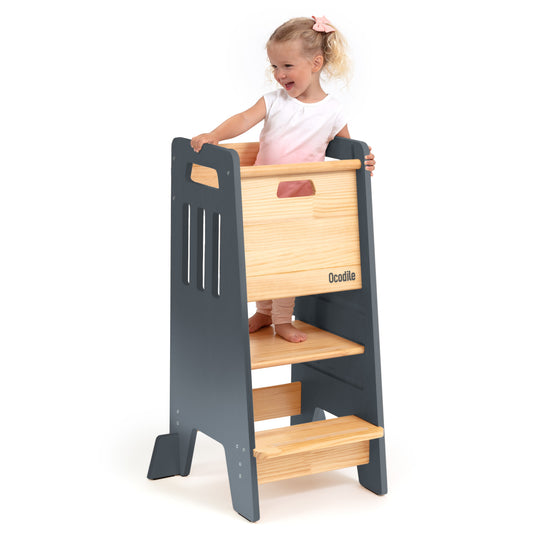


Is a Little Helper Tower Worth It for a Reluctant Toddler?
You keep lifting your toddler to the counter because they want to see what you’re doing. Then you offer a little helper tower, and suddenly they want nothing to do with it. They cling to your leg, ask to be picked up or climb down before you’ve even handed them a spoon. Is this something worth buying, or another bulky item they’ll ignore?
A tower can be worth it for a reluctant toddler if they want to participate but need a gentler introduction. It is less likely to be useful right now if they aren’t physically ready, dislike elevated activities or have no interest in counter-height tasks. Buying a different model won’t necessarily change those things.
Here, the term describes toddler standing towers generally, not one particular brand. If you’re looking at a listing called “Little Helper,” check the manufacturer and exact model. Designs, instructions and limits differ, even when the names sound similar.
When is a little helper tower worth it?
The strongest reason to buy is a recurring problem: your child wants to wash hands, watch food preparation or help at the counter, but you cannot comfortably hold them through the whole activity.
A tower provides a raised standing platform with surrounding barriers. Those barriers offer more support around the child than a basic open stool, but they do not eliminate falls, climbing or tipping risks. Close adult supervision remains necessary.
For a hesitant child, look at what happens before you introduce the equipment.
| What you notice | What it suggests | A sensible next step |
|---|---|---|
| They repeatedly ask to see the counter | The activity interests them | Try a brief, pressure-free introduction |
| They enjoy helping at a low table but avoid climbing | Height or entry may be the issue | Keep activities low while assessing readiness |
| They reject the task at every height | The activity may not interest them | Try a different household job |
| They cannot stand steadily or repeatedly climb the rails | Elevated use is not appropriate right now | Pause and reassess against the model’s instructions |
The purchase makes more sense when it solves a problem you already have, rather than creating a routine you hope your child will enjoy.
Work out what your toddler is refusing
A little helper tower solves a reach problem. It does not automatically solve tiredness, fear of unfamiliar equipment or a toddler’s understandable preference for being held.
They want to help but feel unsure about climbing
A child might happily stir at a low table yet hesitate at a narrow entrance or unfamiliar step. Watch where they stop: approaching the tower, entering it, standing on the platform or reaching toward the counter.
That detail helps you respond without guessing. If they approach willingly but stop at the entrance, demonstrate how entry works according to the instructions. If they become upset once elevated, help them down promptly rather than distracting them into staying.
Avoid treating hesitation as something to push through. Being willing to approach today can be enough, especially when the furniture is new and the kitchen is busy.
They like watching more than doing
Some toddlers want to see you cut an apple, not prepare an entire snack. Others are interested only in running water or putting spoons into a container.
Before deciding a little helper tower is a poor fit, separate interest in the activity from interest in the furniture. Offer the same simple task at a child-height table. If it still gets a firm “no,” the tower probably isn’t the missing ingredient.
A different job may work better: carrying napkins to the table, matching container lids or wiping a low shelf. Participation does not have to happen at your kitchen counter.
They want closeness or control
“Up!” can mean “hold me,” not “give me a better view.” A tower cannot replace that contact. Trying it when your child is hungry, tired or seeking reassurance may tell you very little about whether they’ll enjoy it another day.
Offer a genuine choice between two acceptable activities. “Would you like to rinse this cup with me or put napkins on the table?” leaves room for participation without making climbing the goal.
Separate reluctance from physical readiness
Before encouraging a little helper tower trial, confirm that your child meets the specific model’s age, size, weight and ability requirements. There is no single birthday that makes every toddler ready for every tower.
Look for steady standing, controlled changes in position and the ability to participate without repeatedly trying to sit on or climb over the barriers. Follow the manufacturer’s directions for entry, exit and adult assistance.
Understanding a short instruction such as “feet on the platform” is useful, but it is not a substitute for supervision. Toddlers can understand a rule and still act impulsively when excited.
For a closer look at those distinctions, Ocodile’s guide to assessing learning tower readiness can help you separate physical skills from temperament.
Pause elevated use if your child repeatedly loses balance, pushes away from the counter, climbs the rails or becomes distressed. Do not add cushions, makeshift steps or other modifications to make the setup seem more inviting.
If your child has balance or mobility concerns, ask their pediatrician or treating therapist for individualized advice before introducing elevated equipment. For now, a low work surface lets them practice the same household tasks without needing to manage height at the same time.
Try a low-pressure introduction before committing
The aim is not to persuade your child to stay up longer. It is to discover whether the setup makes an activity they already enjoy easier to access.
Start with the task at floor level
Choose one familiar activity: wiping an unbreakable bowl, tearing lettuce or transferring clean spoons between containers. Offer it at a low table first.
This gives you a useful comparison before introducing a little helper tower. A child who enjoys the task down low but refuses it up high is giving you different information from a child who dislikes the task everywhere.
If you already own a tower, let your child see it during a calm moment. You can show where feet go without asking them to climb immediately. Keep it inaccessible when you cannot supervise, especially if it gives access to counters or other elevated surfaces.
Offer one short, appealing job
Set up the activity before inviting your child over. Waiting on an elevated platform while you search for supplies adds frustration and opportunities to climb.
Try a specific invitation: “Would you like to rinse your cup?” works better than a vague promise to “help cook.” Choose a task with an obvious finish, and accept that finishing one cup may be the whole session.
Stand close enough to intervene immediately. Keep knives, hot appliances, cords, breakables and cleaning products beyond reach, including anything your child could reach by stretching sideways.
For sink activities, control water temperature yourself and address splashes promptly. A wet platform or floor can change an otherwise suitable setup.
Make getting down an ordinary option
Tell your child they can stop. Help them exit as the instructions require, without disappointment or bargaining for another minute.
A little helper tower is more likely to become useful when it remains an invitation, not a place your toddler feels stuck. Avoid lifting a resisting child into position or blocking the exit to finish an activity.
Try again on another calm occasion if your child seems interested. Watch for voluntary signs: approaching the tower, asking to join you or returning to a familiar job. You do not need a fixed number of practice days, and repeated distress is a reason to pause rather than increase the effort.
Judge value by realistic use, not hoped-for use
For a reluctant toddler, “worth it” depends on how often the tower helps in your actual home. One dependable routine may be more valuable than a long list of activities you rarely attempt.
Think about your week. Perhaps your child wants to rinse a breakfast cup most mornings, but dinner preparation happens when everyone is tired. Count the breakfast routine, not an imagined hour of peaceful evening cooking.
Also count the work the furniture creates. If you must unfold it, relocate other furniture and clear a narrow walkway for every use, you may offer it less often. Storage convenience matters because it affects whether a useful routine is practical.
A simple budgeting check is to divide the purchase price by a conservative estimate of use. Use the current price of the model you’re considering, and assume occasional refusals rather than perfect daily participation.
A little helper tower can still be worthwhile for short sessions if it replaces repeated lifting and gives your child a job they enjoy. It is harder to justify when the main benefit depends on their personality changing.
If you borrow one before buying, verify the exact model, instructions, complete hardware and condition. Check whether it has been recalled. A borrowed tower is only a useful trial if it is suitable and correctly assembled.
Would a step stool or low table work better?
A tower is not automatically the best option for every household task. The right choice depends on the height needed, your child’s abilities and the product’s intended use.
| Option | Where it may help | Main limitation |
|---|---|---|
| Toddler tower | Supervised counter-height activities | Takes space and still requires close supervision |
| Step stool | Brief reaching tasks for a child ready to use that model | Usually lacks surrounding barriers |
| Child-height table | Mixing, sorting, wiping and other seated or standing tasks | Does not provide access to the adult counter |
A low table is a useful alternative, not a lesser version of helping. Your child can practice pouring, stirring and cleaning up without being elevated.
A step stool may be enough for some bathroom routines, provided the model and setup suit your child. It is not necessarily a good substitute for longer kitchen activities. An ordinary dining chair is also a poor trial setup: it lacks tower-style barriers and may encourage leaning against a chair back not intended for that use.

Which features matter for a hesitant child?
Check fit in your kitchen before comparing extras
Measure the tower’s full footprint, including any projecting supports. Check the space needed for entry and exit, nearby drawers and the route other family members use through the room.
On a correctly assembled, empty tower, all feet should contact the intended floor surface without rocking. Follow the manufacturer’s placement and stability instructions. A level, dry floor matters; do not improvise shims or forceful tipping tests.
For a little helper tower to be comfortable, the platform setting must suit both the child and the work surface. Your child should not need to perch on tiptoes, lean far forward or climb a barrier to reach the activity.
Ocodile’s explanation of tower height and counter fit provides more detail on evaluating that relationship.
Check the counter itself, too. Nearby drawers can become handholds, and an appealing appliance may suddenly be within reach. Assess the entire reachable area, not just the small patch where you plan to put the bowl.
Compare adjustability, folding and safety information
Adjustability can help maintain a suitable fit as a child grows, provided the available settings match their needs. Check how adjustments are secured and whether changing settings requires tools. “Grows with your child” is only useful when the configuration remains appropriate.
A folding design may suit a small kitchen, but inspect the locking procedure, pinch-point warnings and storage instructions. Never fold, adjust or move a tower while a child is on it.
Convertible designs deserve the same practical scrutiny. Extra functions add value only if you will use them and can configure them correctly. They do not necessarily make a reluctant child more interested.
Before buying, find the manual, weight limit, assembly instructions and manufacturer contact details. Ask which U.S. requirements and product standards apply to the exact model. For products subject to children’s product safety rules, the CPSC’s explanation of children’s product certification clarifies what certification means.
A general “safe” badge is not enough information by itself. Named requirements and model-specific documentation are more useful than reassuring wording alone.
Consider cleaning, assembly and everyday wear
A little helper tower used near food will collect sticky fingerprints, crumbs and occasional spills. Look at whether you can reach corners and clean around the platform without difficult disassembly. Follow the manufacturer’s cleaning directions rather than assuming any wood finish tolerates soaking or strong cleaners.
Assembly also affects the experience. Read the instructions before starting, identify all hardware and check that adjustable parts are secured as directed. Do not let your child use an incomplete assembly while you locate a missing piece.
Afterward, inspect the tower at the intervals the manufacturer recommends. Stop using it if you find loose hardware, cracks, damaged barriers or a locking mechanism that no longer works correctly. Ask the manufacturer about approved replacement parts instead of improvising a repair.
For secondhand purchases, check the CPSC recall database using the manufacturer and model. Missing instructions or unknown modifications can make a bargain difficult to assess. Solid-looking furniture is not proof that every connection and component is sound.
Decide whether to buy, wait or skip it
Buy or trial a suitable model when your child meets its requirements, repeatedly wants access to the counter and shows some willingness to approach or use it. A realistic place to keep it and a dependable adult-supervised routine strengthen the case.
Wait when your child wants to participate but is not physically ready, becomes distressed at height or is struggling with entry and exit. Keep offering similar jobs at a low surface, then reassess when their abilities or interests change.
Skip it for now when your child prefers floor-level activities, your kitchen cannot accommodate it safely or you would need to pressure them to use it.
None of these choices says anything about how independent your child will become. A little helper tower is one access tool, not a developmental requirement. Carrying napkins, washing a low table and putting toys away are meaningful chances to practice everyday skills too.
Before ordering, check the return policy for assembled or used items and any return-shipping costs. A warranty and a return window address different problems; neither guarantees your toddler will like the furniture.
Frequently asked questions
Should I buy a tower if my toddler refuses to try one? Not immediately. First check readiness and whether your child enjoys the intended activity at a lower surface. If possible, try an appropriate, correctly assembled model before buying. Persistent refusal is a reasonable reason to wait.
Does refusing a tower mean my toddler isn’t ready? Not necessarily. A physically ready child may dislike unfamiliar equipment, prefer being held or be uninterested in the task. Physical unreadiness, such as unsteady standing, is a separate reason to postpone use regardless of enthusiasm.
How long should I encourage my child to stay in it? There is no required session length. One brief task can be enough. Let your child stop, help them exit according to the instructions and avoid using treats or pressure to extend time on the platform.
Can my child use a little helper tower independently? They may eventually manage permitted entry and exit or complete parts of a task with less help, but elevated use still needs close adult supervision. Being able to climb into the tower does not make the kitchen safe to access alone.
Is a more expensive tower more likely to suit a reluctant toddler? Not necessarily. Price does not tell you whether your child will enjoy standing at the counter. Fit, appropriate entry, stability, clear instructions and practical placement matter more than extra functions they may never use.
Compare a suitable option when your child shows interest
If your child is ready and wants to join counter-height routines, Ocodile’s Montessori Toddler Tower - Adjustable Kitchen Stool Helper is one option to evaluate. Its adjustable design is relevant when comparing how a setup could accommodate changing needs; confirm the available settings, dimensions and usage requirements on the product page and in its instructions.
Choose a little helper tower around a task your child already wants to try, not a promise that they will suddenly love helping. If that task works better at a low table today, start there. You can revisit the purchase when reaching the counter becomes a recurring need.