



8 Montessori Nursery Ideas for a Child-Led Space
You're probably staring at a nursery that looks sweet on Pinterest but doesn't yet work for real life. The changing station is set up for adults, the toys are piled high in bins, and the room may still revolve around keeping your child contained rather than helping them participate. That's the point where a lot of parents start searching for Montessori nursery ideas and feel torn between a beautiful aesthetic and a practical setup.
A Montessori nursery works best when it changes the way your child uses the room. The room becomes easier to move through, easier to understand, and easier to help maintain. Your child can reach what they need, rest without unnecessary barriers, and join daily routines instead of waiting to be managed through them. That shift matters more than buying a perfectly matching set.
This is also why it helps to look at the room as a whole instead of collecting random Montessori accessories. A child-led space doesn't come from one shelf or one wooden toy. It comes from a series of small choices about sleep, movement, storage, self-care, and family routines. If you're still shaping the overall feel of the room, this SouthShore Fine Linens nursery guide can help with visual inspiration while you build a setup that functions well day to day.
1. Floor Beds for Independent Sleep
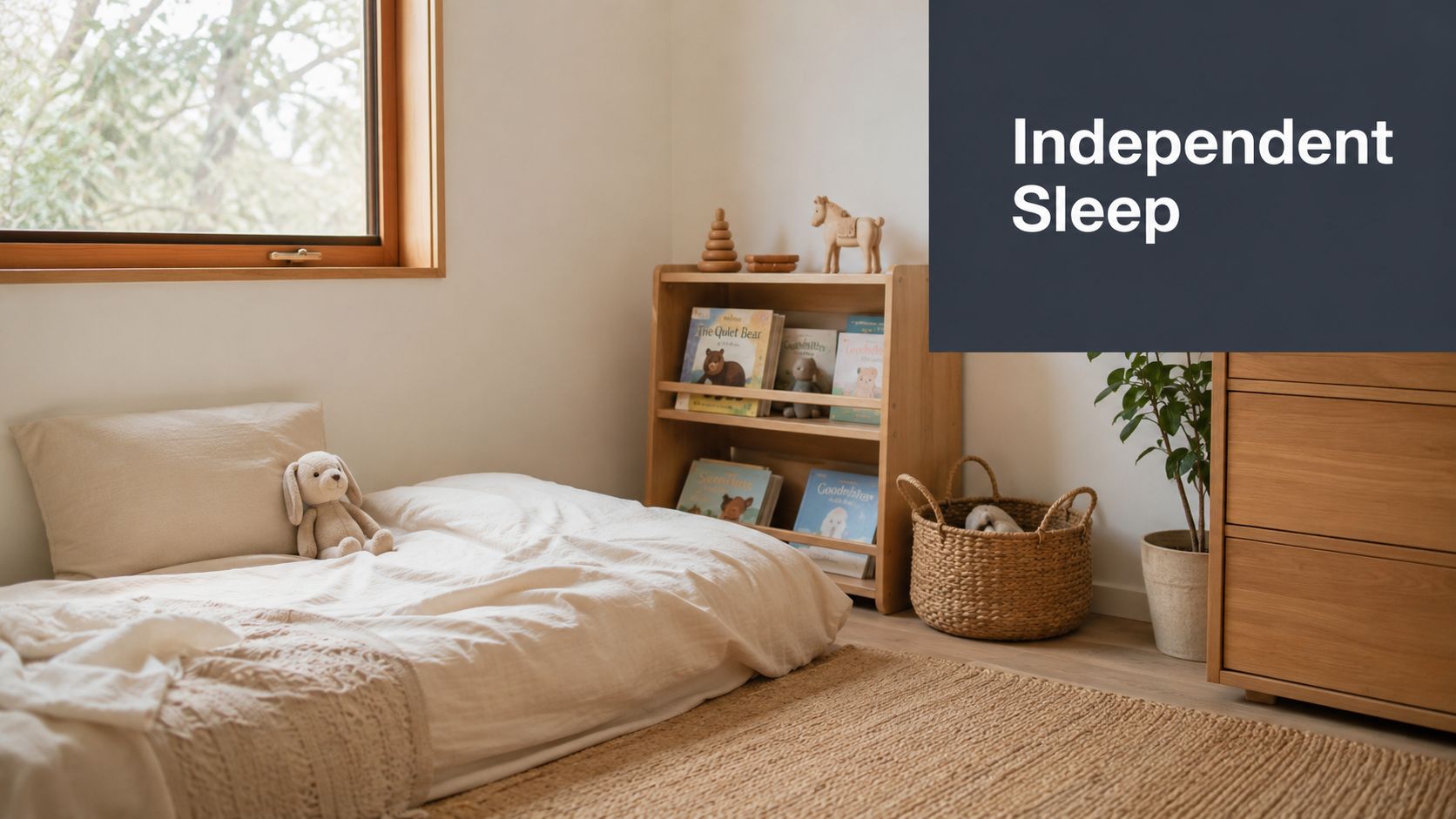
A floor bed changes more than bedtime. It changes how your child enters the room, how they wake up, and how sleep fits into the rest of the environment. Instead of lifting a child in and out of a crib, you give them a sleep space they can access on their own when developmentally appropriate.
That independence is the main reason floor beds stay central in many Montessori nursery ideas. They support freedom of movement, but only when the entire room is treated like part of the sleep environment. If the bed is safe but the room isn't, the setup doesn't work.
What works in practice
A low mattress or low-profile frame keeps the room visually open and physically accessible. Some families prefer a mattress directly on the floor, while others want a frame with minimal height and guardrails. If you want examples of layout and furniture choices, Ocodile's guide to a Montessori bedroom for toddlers is useful for seeing how the bed fits into the rest of the room.
The biggest practical advantage is that bedtime can feel less like a transfer and more like a routine. You can sit on the bed for stories, help settle your child, and step away without the awkward reach over crib rails.
Practical rule: If you choose a floor bed, child-proof the whole room as if your child may use it unsupervised after waking.
What doesn't work
A floor bed isn't a shortcut for every family. If the room has cords, unstable furniture, reachable lamps, or shelves that can tip, the bed becomes the least important safety issue in the room. The setup also takes emotional adjustment for parents who feel more secure with a contained sleep space.
A few decisions matter more than the bed itself:
- Anchor furniture: Dressers, bookshelves, and wall units need to be secured.
- Clear the perimeter: Keep the mattress away from wall gaps and bulky decor.
- Simplify the room: Fewer accessible objects usually means fewer bedtime distractions.
- Set expectations slowly: Some children explore before they settle. That's normal.
When floor beds work, they feel calm and uncomplicated. When they don't, it's usually because the room was designed around the bed instead of around the child.
2. Kitchen Step Stools and Learning Towers
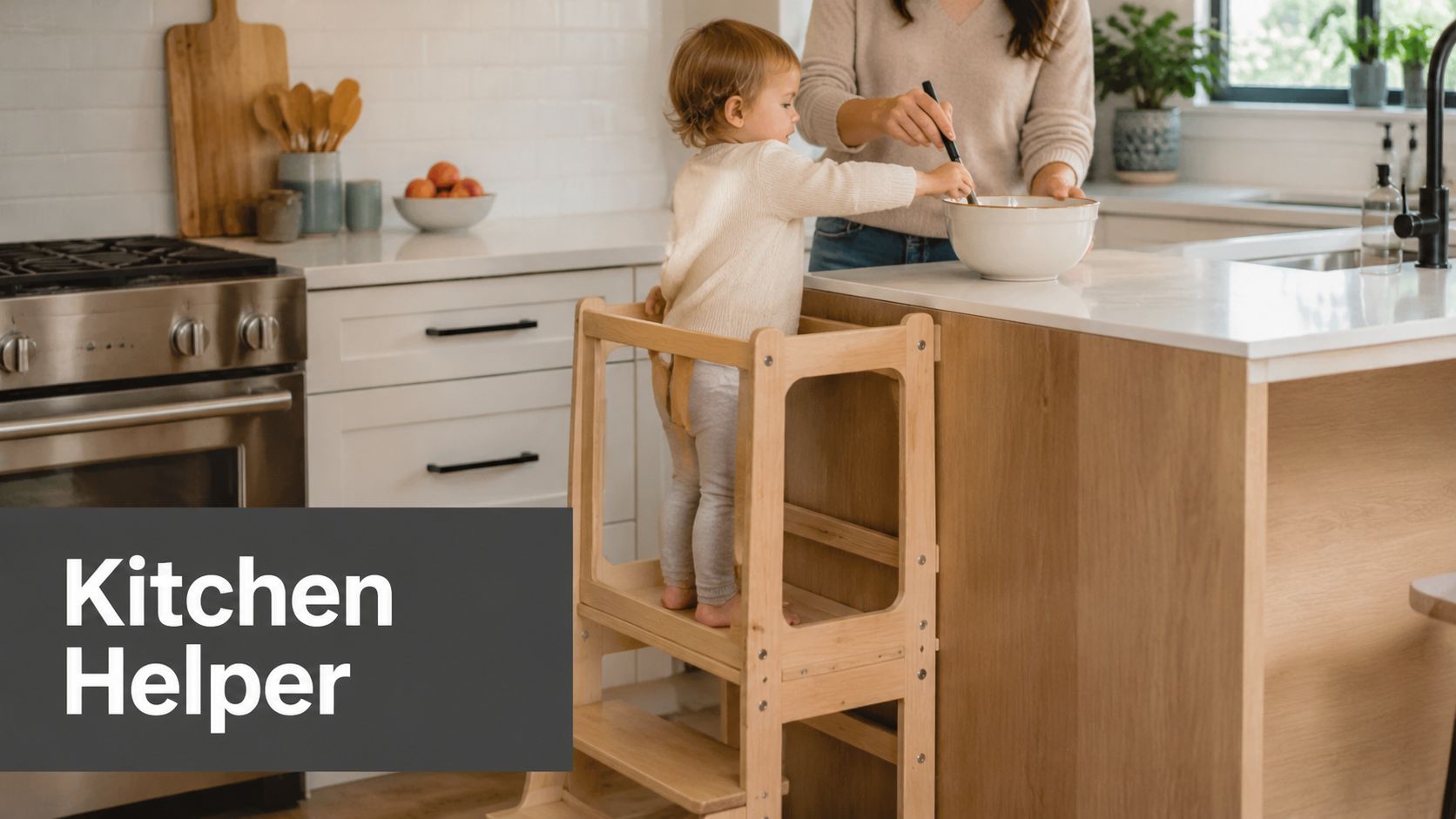
The nursery doesn't stop at the nursery door. If you want a child-led home, the kitchen is one of the most important extensions of it. A learning tower or step stool gives your child a safe way to join real work instead of watching from the floor.
That's why this belongs on a list of Montessori nursery ideas, even though it lives outside the bedroom. Montessori works best when the same principles show up across the house. Children gain confidence faster when independence isn't limited to playtime.
Why a tower often works better than a stool
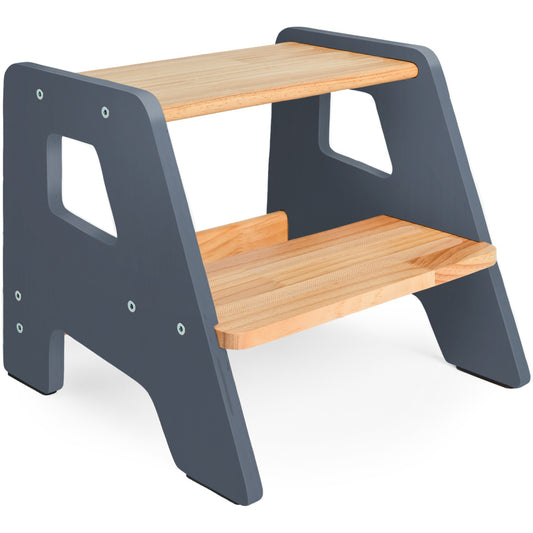
A standard step stool can be enough for older toddlers with solid balance, but many families do better with a helper tower because it creates a more defined standing area. The enclosed sides can make kitchen participation feel safer and more focused, especially at the sink or prep counter.
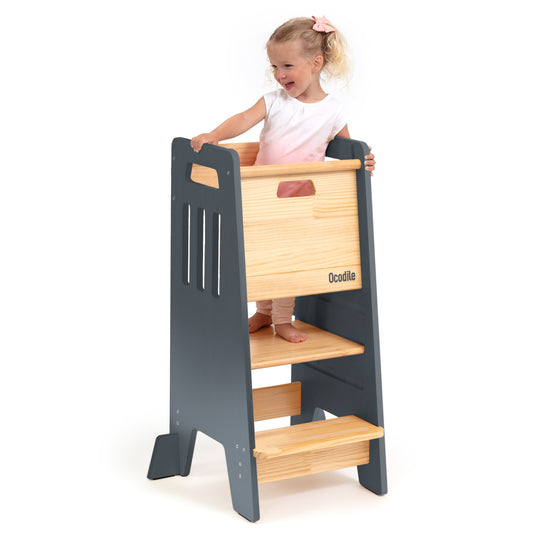
If you're comparing designs, Ocodile's article on what a learning tower is breaks down the practical role it plays in everyday family routines.
Use it for small, repeatable jobs:
- Washing produce: A short task with clear beginning and end.
- Stirring batter: Great for coordination and patience.
- Hand washing at the sink: A practical life habit built into the day.
- Transferring ingredients: Beans, oats, and chopped fruit all work well.
A tower is useful when it replaces unsafe climbing on dining chairs, not when it becomes one more oversized object with no daily job.
The trade-offs parents notice quickly
Learning towers can be bulky. In a narrow kitchen, they may block traffic or live in the wrong spot because there's no natural home for them. They also slow things down at first. If you're trying to rush through dinner, involving your child usually means accepting more mess and more time.
Still, the slower pace often pays off because children start understanding routines from the inside. They don't just hear “I'm making lunch.” They help make lunch.
For buying decisions, check these details before style:
- Stable base: It shouldn't wobble when your child shifts weight.
- Easy-to-clean finish: Flour, banana, and soap residue show up fast.
- Reasonable footprint: Smaller kitchens need compact designs.
- Simple entry: Children should climb in with minimal help once ready.
3. Prepared Environment and Accessible Storage
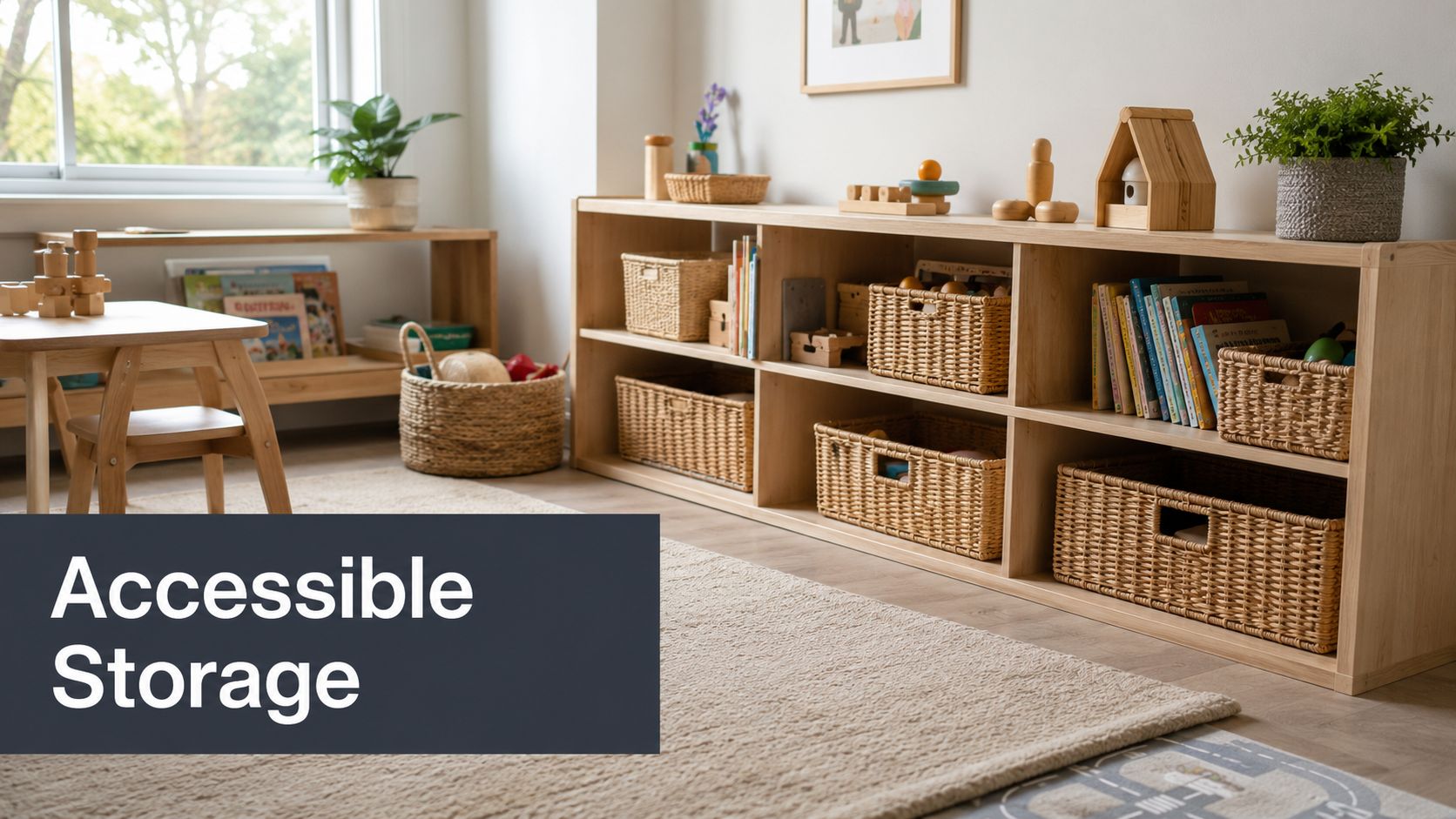
If a room feels chaotic to you, it usually feels chaotic to your child too. One of the strongest Montessori nursery ideas is also one of the least flashy: make everything visible, reachable, and limited.
Low open shelving does more for independent play than large toy boxes. A toy box hides choices. A shelf presents them. That sounds simple, but it changes behavior. Children can see what's available, choose with intention, and return items to a clear place.
Set up the room so your child can read it
A prepared environment should tell the child what belongs where. That doesn't require expensive furniture. It requires low surfaces, enough breathing room between materials, and restraint. A room packed with options rarely leads to better play.
For room layouts and shelf arrangements, Ocodile's ideas for a Montessori playroom are a helpful starting point. Air quality matters too when you're choosing flooring, rugs, and soft furnishings. If you're evaluating materials for a child's room, this piece on Phoenix air quality solutions is worth reading before you bring more fabric or carpeted storage pieces into the space.
What to put out and what to put away
The most common mistake is putting every toy on display. Montessori shelving works because it edits the room.
A solid setup usually includes:
- One activity per spot: A tray, basket, or defined place keeps choices clear.
- Front-facing books: A few visible covers invite use better than a packed shelf spine-out.
- Natural cleanup cues: When there's one place for each item, tidying makes sense.
- Rotated materials: Store the rest out of sight and switch them based on interest.
Room test: Sit on the floor at your child's eye level. If the room looks crowded, the shelf is probably doing too much.
This approach does require maintenance. You'll reset shelves, remove broken pieces, and rethink what stays out. But the payoff is real: less overstimulation, fewer scattered messes, and more purposeful play. Accessible storage isn't about making the room look minimalist. It's about making the room usable.
4. Sensorial Activities and Exploration Materials
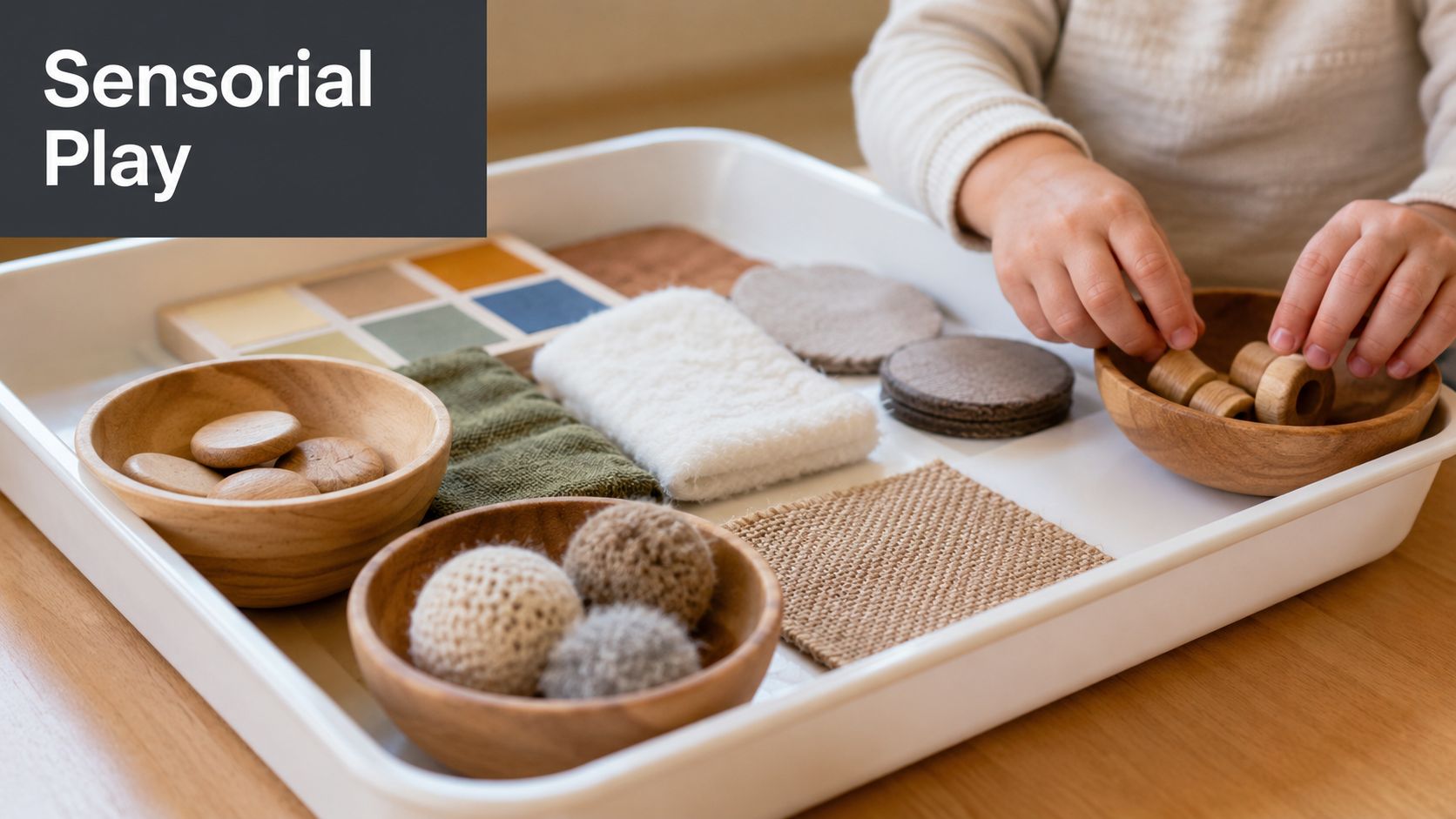
Some of the best Montessori nursery ideas don't look like lessons at all. They look like a child rubbing fabric between their fingers, comparing wooden shapes, opening and closing containers, or listening to subtle differences in sound. That's sensorial work.
The key is not to flood the room with “educational” toys. Children concentrate better when the material isolates one idea at a time. Texture, weight, sound, shape, temperature, or color can each stand on their own.
Better choices than overstimulating toys
Battery-operated toys usually do too much. They light up, sing, flash, and direct the experience for the child. Sensorial materials should do the opposite. They should invite the child to act on the object and notice what changes.
Good options include:
- Texture boards or fabric swatches: Focus on rough, smooth, soft, and bumpy.
- Wooden shape puzzles: Clear forms help children refine visual discrimination.
- Simple sound containers: Paired jars or shakers encourage listening.
- Object baskets: Real household items with safe variety often work better than novelty toys.
How to keep sensorial play useful
Curate lightly. If you place six different texture materials, three shape sorters, and a basket of sensory balls on one shelf, the room starts competing with itself. Offer fewer items and let repetition do the work.
Plain materials often outperform highly themed ones because they leave more room for concentration. A small tray with two wooden cylinders and a folded cloth can hold attention longer than a loud toy packed with buttons.
A few practical filters help:
- Choose real materials: Wood, metal, cotton, wool, and silicone each offer different feedback.
- Watch for one clear purpose: If you can't tell what the child is meant to notice, skip it.
- Keep maintenance realistic: Items that can't be cleaned easily won't stay in rotation.
- Match the child, not the trend: A younger baby may need grasping and visual contrast. An older toddler may want sorting, matching, and transferring.
Sensorial materials work when they slow the room down. If a toy turns the room noisier and more frantic, it's probably not helping concentration.
5. Montessori Bathroom Setup for Independence
Morning routines show very quickly whether a room supports independence. A toddler who can climb up safely, reach the faucet, find a washcloth, and check the mirror needs far less adult handling than a child who has to be lifted through every step.
The bathroom often gets overlooked because it feels harder to adapt than the nursery or play area. In practice, it usually takes a few well-chosen changes, not a remodel. Start with the routine you want your child to do most often, then set the room around that sequence.
Handwashing is usually the easiest place to begin. The child needs a stable way to reach the sink, a clear spot for soap, and a towel they can return without help. If any one of those pieces is missing, the adult ends up doing the routine for them.
Useful setup pieces include:
- Stable step stool: Choose one with good grip underfoot and on the base, especially if your bathroom floor gets slick.
- Low towel hook or bar: Place it where your child can reach it from the sink without twisting or dripping across the room.
- Child-height mirror: This helps with handwashing, face wiping, toothbrushing, and noticing when a job is finished.
- Small tray or basket: Keep a washcloth, hairbrush, and child-safe toothbrush together so the routine stays predictable.
Bathroom choices need tighter safety standards than the rest of the nursery. A stool that works well in the kitchen may be too wide for a narrow vanity or too easy to bump near the toilet. If you use a standing aid from a brand like Ocodile, check the actual footprint in your space and make sure an adult can still move around the child comfortably.
Keep only everyday care items within reach. Store medicine, razors, electrical tools, and cleaning products fully out of access.
I also recommend watching the routine once from the child's height. Can they turn on the water without overreaching? Can they put the towel back without pulling down other items? Small friction points matter here because bathroom routines happen several times a day.
A half-accessible setup usually creates more frustration than progress. If the full toileting or brushing routine is still too complicated for your space, prepare one part well and let repetition build skill there first.
6. Practical Life Skills Activities
Practical life is where Montessori often feels most different from mainstream nursery setups. Instead of focusing only on toys, you give your child real tasks with real outcomes. They pour water, wipe spills, sweep crumbs, fold cloths, water plants, and carry laundry.
That sounds ordinary, and that's exactly why it works. Children usually care more about meaningful work than adults expect. They're not pretending to help. They're helping, slowly and imperfectly.
Start with tasks your family already does
The easiest practical life activities are the ones that already happen every day. If you have to invent a whole new system, it probably won't last. Use your own routines as the curriculum.
Good nursery-adjacent practical life options include:
- Laundry basket carrying: Light loads build coordination and body awareness.
- Wiping a low table: A small sponge or cloth gives a visible result.
- Watering a plant: A child-sized watering can makes cause and effect obvious.
- Sock matching or cloth folding: Simple sorting tasks build order and focus.
What adults often get wrong
The biggest mistake is making the task too hard or too decorative. A beautiful pouring set is less useful than a small pitcher your child can control. A tiny broom that sheds bristles and can't move dust won't invite real work.
Use tools that function:
- Child-sized but real: The tool should fit the child's body and still do the job.
- Limited steps: Early success depends on clear, short sequences.
- Visible purpose: Children engage more when they can see the result.
- Easy reset: If setup takes too long, the activity won't stay in use.
“Help me do it myself” works best when the adult has already removed the unnecessary obstacles.
Practical life also requires patience from adults. Tasks take longer. Water spills. Towels end up folded into odd rectangles. But children build coordination and confidence through that repetition. In a Montessori home, useful work is not a side activity. It's part of the nursery's job.
7. Language Development Through Environmental Immersion
Language in a Montessori nursery doesn't come from flashcards on the wall. It comes from the way adults name the world, the way books are presented, and the way the room supports conversation. The best language-rich spaces feel calm and specific.
A child learns words more easily when the environment gives those words a home. “Brush,” “basket,” “window,” “sock,” “pour,” and “wash” all become more meaningful when the child can see or do the thing being named. That's one reason a prepared environment supports language so well.
Make the room worth talking about
You don't need to label every object in the house. In fact, too many labels can make a nursery feel busy and performative. A few thoughtful labels, clear book displays, and responsive conversation go further than turning the room into a print wall.
Focus on:
- Front-facing books: Covers help children choose and revisit favorites.
- Real-image vocabulary cards or objects: These tend to be clearer than overly stylized illustrations.
- Narrated routines: “You're putting the washcloth in the basket” is more useful than nonstop chatter.
- Songs and rhymes: Repetition helps language settle naturally into daily life.
What supports language best
Conversation during care routines matters more than formal teaching in the early years. Diaper changes, dressing, meals, bath time, and cleanup all create repeated chances to hear words connected to action. Slow down enough for your child to respond, even if the response is a gesture, sound, or look.
Avoid one common trap: quizzing. Asking “What's that? What color is that? Can you say spoon?” all day can create pressure where there should be connection. It's often better to model language clearly and let the child absorb it.
A useful balance looks like this:
- Name objects accurately: Use real vocabulary, not only baby talk.
- Pause after speaking: Give your child time to process and attempt a response.
- Read the same books often: Familiarity supports participation.
- Follow interest: If your child keeps returning to animals, vehicles, or kitchen objects, lean into that theme.
Language grows best in an environment that feels respectful, not performative.
8. Movement and Gross Motor Development Spaces
Movement belongs at the center of Montessori nursery ideas because young children learn through their bodies first. If the room is designed only for sitting, sleeping, and being carried, it limits a major part of development.
A movement-friendly nursery doesn't need to become a mini gym. It needs clear floor space, safe opportunities for climbing and pulling up, and furniture that doesn't punish normal motion. The room should invite movement instead of interrupting it.
Build movement into the layout
Before buying anything, look at the floor. Is there enough open space for rolling, crawling, cruising, carrying, and turning around with an object in hand? A nursery crowded with oversized furniture can block the very skills you want your child to practice.
Useful movement features may include:
- Open floor area: Leave room for crawling, stretching, and carrying.
- Low mirror with pull-up support: Helpful for children practicing standing.
- Soft rug with stable traction: Too slippery or too plush can both create problems.
- Simple climbing structure: Only if you have the space and can supervise it properly.
Safe challenge beats constant restriction
Children need manageable physical challenge. If every climb is stopped and every unstable attempt is redirected immediately, they get fewer chances to judge distance, balance, and effort. The better approach is to offer safer ways to do what they already want to do.
That could mean a low climbing triangle in one home, floor cushions for stepping across in another, or more outdoor movement time when indoor space is tight. Apartment living doesn't cancel movement work. It just changes the setup.
What doesn't work is stuffing the room with large motor equipment because it looks Montessori. If the structure dominates the room and leaves no open floor, the room becomes less usable, not more. Start with space, then add one challenge that fits your child's stage and your supervision reality.
8-Point Montessori Nursery Comparison
| Item | 🔄 Implementation Complexity | ⚡ Resource Requirements | ⭐📊 Expected Outcomes / Impact | 💡 Ideal Use Cases | ⭐ Key Advantages |
|---|---|---|---|---|---|
| Floor Beds for Independent Sleep | Moderate, requires thorough childproofing and consistent routine | Low–Moderate: firm low mattress, bedding, safety-proofing | ⭐📊 Greater independence, improved self-soothing; variable transition time | Toddlers transitioning from crib; Montessori nurseries; safe floor plans | Promotes autonomy, safer low-fall option, simple room aesthetic |
| Kitchen Step Stools and Learning Towers | Moderate, assembly, supervision protocols, integrate into kitchen flow | Moderate: quality tower, child-safe utensils, space adjustments | ⭐📊 Enhanced practical skills, confidence, family engagement | Families who cook together; snack prep; childcare kitchens | Safe counter access; builds motor skills and real-life competence |
| Prepared Environment and Accessible Storage | Moderate–High, initial overhaul and ongoing maintenance | Moderate: low shelving, baskets, labels, time for rotation | ⭐📊 Stronger independence, organization, reduced toy conflicts | Playrooms, classrooms, homes aiming for self-directed learning | Encourages choice, focus, tidy habits; visually calm spaces |
| Sensorial Activities and Exploration Materials | Moderate, careful curation and supervised presentation | Moderate–High: diverse materials, trays, storage, caregiver time | ⭐📊 Improved sensory discrimination, concentration, cognitive growth | Early development sessions; sensory-focused play; alternatives to screens | Multisensory engagement; supports varied learning styles |
| Montessori Bathroom Setup for Independence | Moderate–High, may need fixture changes and safety planning | Moderate: step stools, child fixtures, mirrors, possible renovation | ⭐📊 Better self-care, hygiene habits, toileting autonomy | Homes or schools prioritizing independent hygiene routines | Builds routine and dignity; reduces power struggles over care |
| Practical Life Skills Activities | Low–Moderate, routine integration and patient demonstration | Low: household items, child-sized tools, caregiver time | ⭐📊 Practical competence, motor control, responsibility | Daily chores, mealtime involvement, gardening, cleaning tasks | Cost-effective real-world learning; fosters contribution and concentration |
| Language Development Through Environmental Immersion | Moderate, requires sustained adult modeling and labeling | Low–Moderate: books, picture-word labels, consistent interaction | ⭐📊 Gradual vocabulary growth, literacy foundation, communication skills | Homes/classrooms focused on natural language acquisition; bilingual settings | Encourages reading, conversational skills; adaptable to child pace |
| Movement and Gross Motor Development Spaces | Moderate–High, dedicated space, safety setup, supervision | Moderate: low climbing elements, mats, clearance, maintenance | ⭐📊 Improved coordination, strength, balance, physical confidence | Active children, indoor movement areas, outdoor play spaces | Promotes healthy activity, risk assessment, reduces behavior from restraint |
Your Montessori Nursery Checklist
Bringing Montessori home usually starts with a mismatch. You want a calmer, more child-led room, but the current setup still asks your child to wait for help with everything. The good news is that you don't need to redo the entire house at once. Most families get better results by changing one area, using it consistently, and then expanding from there.
Start with safety first. Child-proof the whole room before you make anything more accessible. Low shelves, floor beds, mirrors, and self-care stations only work when the environment is prepared for freedom. If your child can reach it, assume they eventually will.
Then choose one primary area to focus on. Sleep and play are often the easiest starting points because they affect so much of the day. A floor bed can simplify bedtime and morning routines. Open shelving can reduce toy clutter and help your child make clearer choices. If your family spends a lot of time cooking together, the kitchen may be the best first step instead.
After that, pick one key piece of furniture. Keep it practical. A floor bed, a learning tower, a stable step stool, or a low shelf will usually do more than a long shopping list of small accessories. If you're looking at child-sized furniture, Ocodile is one option for products like floor beds, standing towers, and step stools that align with this kind of setup.
Next, curate a short rotation of activities. Keep it manageable. Choose a few age-appropriate materials that your child can use with minimal help. Think one tray for transferring, one basket of books, one sensorial item, and one practical life task. Fewer well-chosen options usually work better than a room full of “good” ideas competing for attention.
Use this simple checklist as you begin:
- Child-proof the entire room: Secure furniture, remove hazards, and simplify what stays within reach.
- Choose one focus area: Start with sleep, play, movement, bathroom routines, or kitchen participation.
- Pick one foundational furniture piece: A floor bed, low shelf, or learning tower can reshape daily routines.
- Offer a small activity rotation: Keep only a few materials available and rotate based on interest.
The most useful Montessori nursery ideas aren't the most decorative ones. They're the ones that help your child do more for themselves, with less frustration and more confidence. If the room supports movement, choice, order, and participation, you're not just decorating a nursery. You're building a space your child can live in.
If you're ready to start with one practical change, explore Ocodile for child-focused furniture like floor beds, standing towers, and step stools designed to support independence at home.