



How to Inspect Hinges on a Foldable Montessori Toddler Tower
Your toddler is ready to help rinse berries, but the tower feels different when you open it. A hinge squeaks, a screw looks raised or one side seems loose. The joints that make a Montessori tower foldable deserve a closer look before your child climbs up.
Inspect hinges with the tower empty, on a level floor and away from your child. Look for damaged hardware, loose mounting points and cracked wood. Then check the folding movement and open-position locks exactly as the manufacturer directs. If anything binds, shifts unexpectedly or fails to secure, stop using the tower until the problem is resolved according to the manufacturer’s instructions.
Hinge warning signs that mean stop using the tower
A home inspection can reveal visible problems, but it cannot rule out hidden damage or certify that a tower is safe. These findings are reasons to keep it out of use while you seek guidance:
| Area | Warning signs |
|---|---|
| Hinge body | Bent metal, cracks, separation or a pin that appears displaced |
| Mounting hardware | A missing fastener, a screw backing out or a mounting plate pulling away |
| Surrounding wood | Splitting, crumbling, swelling or an enlarged screw hole |
| Folding movement | New binding, scraping, jerking or unexpected movement |
| Open-position hardware | A required lock, brace or latch that will not engage or stay engaged |
Do not put your child on the platform to “see whether it holds.” An adult standing on it is not an appropriate test either.
Identify what makes a Montessori toddler tower foldable
Before adjusting anything, distinguish the hinge, which allows movement, from the locking or bracing hardware, which holds the tower in its intended open position. Some designs combine these functions; others use separate components.
Find the instructions for your exact model and version. Locate the folding joints, their mounting screws and any required locking parts. Do not assume that a mechanism should click, snap or sit flush unless the instructions show that it should.
An unused hole is not automatically a missing-screw location. Likewise, two sides are not necessarily identical. Compare what you see with the manufacturer’s illustrations rather than another brand’s tower or an online assembly video.
How to inspect the hinges, step by step
1. Prepare the empty tower and inspection area
Choose a dry, level floor with enough room to follow the complete folding sequence. Remove toys, towels and anything else resting on the platform. Keep children away throughout the inspection, including while the tower is folded.
Before examining the parts that make a Montessori learning tower foldable, gather the manual and a flashlight. A phone camera can help you view awkward areas without balancing the tower on its edge.
If the tower has visible damage already, stop here. You do not need to cycle a suspect mechanism to confirm that something is wrong. Photograph the issue and ask the manufacturer what to do next.
2. Inspect the metal, fasteners and surrounding wood
Start with the tower stationary in a position permitted by its instructions. Look at each accessible hinge and mounting point without putting your fingers between moving parts.
Check for bent hinge sections, cracks, corrosion and unusual gaps. If the design has a visible hinge pin, look for displacement or missing retaining hardware. Do not tap the pin back into place or attempt to remove it.
Next, inspect the fasteners. A screw head that has changed position, a gap beneath a mounting plate or fresh wood dust around a screw hole warrants attention. A screw sitting proud of the surface may be intentional, so check the assembly drawing before deciding it needs tightening.
Look beyond the metal, too. A hinge can appear intact while the wood holding it has split or deteriorated. An intact screw does not make a damaged mounting point sound.
3. Observe one normal folding and opening sequence
Only proceed if the visual inspection reveals no damage and you have the correct operating instructions. Use the designated handholds and support the tower as directed while its shape changes.
The movement that makes a Montessori learning tower foldable should follow its intended path without forcing the joints. Watch for a hinge plate lifting away from the wood, a fastener shifting or one section catching unexpectedly.
Keep your fingers out of closing gaps, even if you are trying to locate a noise. Ocodile’s pinch point safety guide explains why folding joints need particular care around small hands.
If movement is stiff or uneven, stop rather than pushing harder. A trapped object, misalignment or damaged component may be responsible. Repeatedly forcing the mechanism can make the problem worse.
4. Confirm the fully open position and required locks
Open the tower completely according to the manual. Check every required latch, brace, pin or other securing component that applies to your model. Do not rely on friction or the tower’s weight to keep it open.
Verify that the platform and any adjustable parts are installed in the correct positions. Misassembly elsewhere can affect alignment and may look like a hinge problem.
Once assembled, the tower should sit as intended on the level floor. New rocking, visible frame distortion or a locking part that disengages during normal handling needs investigation. Do not compensate with folded towels or improvised wedges.
If the manual specifies a final stability check, follow that procedure. Avoid inventing a forceful push, pull or loading test of your own.

Can you tighten a loose hinge screw yourself?
Only tighten hardware that the manufacturer identifies as user-adjustable or user-serviceable. Use the specified tool and follow any tightening instructions. Do not guess a torque setting or use a power driver unless the instructions explicitly permit it.
A loose screw is not always just an assembly issue. If it turns without tightening, repeatedly loosens or sits in cracked wood, stop using the tower. Tightening harder can damage the mounting point further.
Avoid longer screws, extra washers, household glue, replacement hinge pins or tape over a faulty latch unless the manufacturer specifically approves the repair. Similar-looking hardware can differ in dimensions and function.
Keeping a Montessori learning tower foldable does not justify spraying its joints with oil. Lubricate only if the manufacturer specifies a product and application method. Lubricant will not repair a loose mounting point, damaged hinge or unreliable lock.
For crumbs or sticky residue, use only the cleaning method permitted in the care instructions. Inspect again after cleaning rather than assuming the obstruction was the only problem.
When to check and what to document
Make a brief visual and setup check part of getting the tower ready for use. Look more closely after an event that could affect its hardware:
- Initial assembly or reassembly
- A move, drop or hard knock
- A new squeak, wobble or change in folding resistance
- A spill that reaches the hardware or surrounding wood
There is no single detailed-inspection schedule that suits every folding design. Follow the manufacturer’s maintenance interval, if one is provided. Do not wait for that interval when something changes.
Clear photos help document the hardware that makes a Montessori learning tower foldable. Capture the whole tower, the affected joint and a close-up of the mounting point. Record the model information and describe when the change started. Photograph damage without repeating a movement that could worsen it.
Between uses, keep the tower in a location consistent with its care instructions. These foldable learning tower storage tips can help you plan a spot away from busy walkways and unwanted handling.
Frequently asked questions
Does a squeaky hinge mean the tower is unsafe? A squeak alone does not identify the cause or establish whether the tower is safe. Pause use if the sound is new and inspect for looseness, damage, binding or trapped debris. Follow the manufacturer’s troubleshooting advice rather than automatically adding lubricant.
Should every screw be completely flush with the wood? Not necessarily. Hardware placement varies by design. Compare it with the correct assembly instructions, and do not tighten a screw simply because its head is visible.
How often should I inspect a foldable Montessori kitchen tower? Check its condition and correct setup before use, follow any manufacturer maintenance schedule and inspect more closely after damage, reassembly or a change in how it moves.
Can I use the tower if one locking part is broken but the hinges look fine? No. If that part is required to secure the tower, intact hinges do not replace its function. Keep the tower out of use until the manufacturer’s approved remedy is complete.
What if I bought the tower secondhand? Identify the brand and model, obtain the correct instructions and check for missing or altered hardware. Search the CPSC recall database and follow any applicable recall instructions before use.
Get guidance for your specific tower
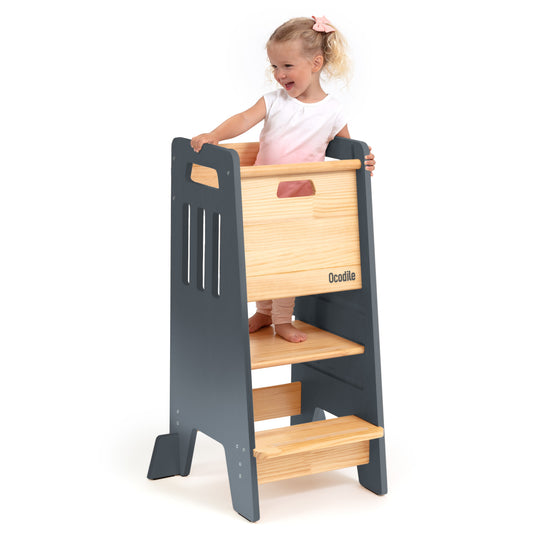
If you own Ocodile’s Adjustable Foldable Kitchen Tower, use the instructions for your specific unit rather than applying another model’s hardware advice. If those instructions are missing or a hinge concerns you, contact Ocodile with the model details and clear photos.
The next step is not to make the joint feel tighter by any available means. It is to establish whether the tower is correctly assembled, whether a permitted adjustment is needed or whether it should remain out of use pending an approved remedy.