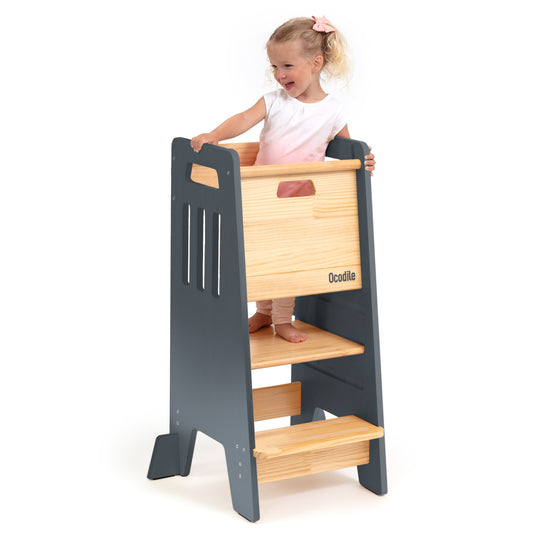


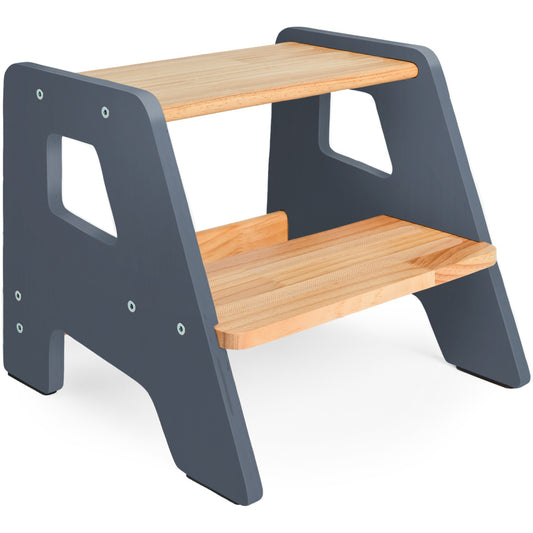


How to Position a Children’s Kitchen Tower at the Counter
Your toddler wants to help rinse strawberries, stir pancake batter or wash their hands without being lifted every two minutes. A children’s kitchen tower can make those everyday moments easier, but only if it is placed in the right spot. Too far from the counter and your child leans forward. Too close to the stove and the risk changes completely. In a busy kitchen, a few inches can matter.
The best place to position a children’s kitchen tower at the counter is on a flat, dry floor with the side your child faces close to the counter, centered on the task area, away from heat, sharp tools, open drawers and heavy traffic. Your child should be able to stand upright with the activity directly in front of them, not stretching sideways or climbing onto the counter.
This guide is for parents who already have a toddler tower or are deciding how one would work in their home. The goal is simple: a sturdy, stable setup that helps your child participate while giving you a clear way to supervise.
Start with the task, not the tower
Before moving the tower into place, decide what your child is actually doing. Washing hands, spreading peanut butter, pouring dry ingredients and helping wipe the counter all need slightly different setups.
A tower is not just a way to add height. It creates a defined standing space, so the job should be placed within that space. If the bowl, faucet or cutting board is too far left or right, your toddler will twist, reach or shift their weight toward the edge.
| Everyday task | Best tower position | What to avoid |
|---|---|---|
| Washing hands or rinsing fruit | Centered in front of the sink with the faucet and towel within easy reach | Hot water handles, slippery floor mats or crowded sink edges |
| Mixing or baking | At a clear stretch of counter with the bowl directly in front of your child | Counter space next to the stove, knives or glass dishes |
| Snack prep | At an island or counter section where an adult can stand nearby | Letting the child reach across the counter for food |
| Brushing teeth at a bathroom counter | Close to the sink with a dry floor and toothbrush placed in front | Wet tile, open drawers or cluttered counter items |
If you are still comparing different ways to help your child reach the counter, Ocodile’s guide to choosing a kid kitchen stand explains how these stands differ from regular step stools for kitchen use.
How to position a children’s kitchen tower at the counter
A good counter setup should feel boring in the best way: steady, predictable and easy for both of you to use. Use the same placement routine each time so your child learns where to climb, where to stand and where to step down.
Place it on a flat, dry floor
Start with the floor, not the counter. The tower should sit with all feet flat on the ground. Avoid thick rugs, bunched mats, uneven thresholds and wet spots near the sink. Even a well-made tower can feel less secure if one side sits on a soft mat and the other sits on hard flooring.
In real life, this often means pulling the tower slightly away from the sink rug or moving the rug before your child climbs in. It is a small habit, but it helps the tower feel more solid when a toddler shifts weight, bounces a little or turns to look at you.
Keep the working side close to the counter
The side your child faces should be close to the counter or cabinet front, with the tower straight rather than angled. The goal is to reduce leaning. If your child has to bend forward to reach the work surface, move the activity closer or adjust the tower position.
A small gap can be normal depending on the tower design and cabinet shape, but avoid a large space that encourages your child to step, kneel or climb forward. The counter should be close enough that your child can use their hands comfortably while staying inside the standing area.
Center the task directly in front of your child
Toddlers do not have adult balance or judgment. If the bowl is off to the side, they will probably reach for it instead of asking you to move it. Place the item they need directly in front of their belly button: bowl, sponge, toothbrush, cup or snack plate.
This also makes supervision easier. When the task is centered, you can see their hands, the counter and their body position without constantly correcting them.
Leave room for an adult to stand close
A tower should not be wedged into a corner where you cannot help. Leave space beside or slightly behind the tower so you can guide climbing, hand over ingredients, block access to something unsafe and help your child step down.
This matters most with younger toddlers who are still learning how to climb in and out calmly. Even if your child is steady on their feet, counter activities involve water, food, utensils and excitement. Staying close is part of the setup.
Keep the climbing path clear
Your child needs a simple way in and out. Do not position the tower where the entry side is blocked by a trash can, island stool, open cabinet door or another child passing through. If the exit feels awkward, a toddler may twist, rush or try to climb out sideways.
Once the tower is in place, show your child the same routine every time: climb in, face the counter, keep feet on the platform, ask for help to get down if needed. Repetition helps the tower become part of the routine rather than a new climbing challenge.
Places to avoid in the kitchen
Some spots are not worth using, even if they seem convenient. A children’s kitchen tower should not be placed next to the stove, oven, toaster oven or air fryer. Heat, steam and hot handles can turn a helpful moment into a risky one very quickly.
Also avoid placing the tower in front of drawers that hold knives, peelers, graters or heavy tools. Toddlers are fast, and being at counter height gives them access to items they could not normally reach. Before your child climbs up, scan the counter and nearby drawers the same way you would scan a playground before letting them run.
High-traffic areas are another common problem. If the tower blocks the path between the sink, fridge and stove, adults may step around it while carrying hot food or heavy dishes. Choose a quieter section of counter whenever possible, even if that means moving the mixing bowl to a less convenient spot.
Check the height and reach
The right height depends on your child, your counter and the task. Standard kitchen counters in many U.S. homes are around 36 inches high, but children vary a lot in size. What matters is how your child stands once they are in the tower.
Your toddler should be able to look at the work surface and use their hands without standing on tiptoes, hunching over the front rail or leaning their upper body onto the counter. If they look uncomfortable, the tower may need a different platform setting, a different task location or a lower work surface such as a child table for that activity.
| What you notice | What it may mean | What to try |
|---|---|---|
| Your child stands on tiptoes | The work surface is too high or the task is too far back | Move the item closer or adjust the tower if the design allows |
| Your child leans over the rail | The tower may be too far from the counter or the item is out of reach | Bring the tower closer and center the task |
| Your child twists to one side | The activity is not directly in front of them | Move the bowl, plate or towel to the center |
| Your child stands upright with relaxed shoulders | The setup is likely a better fit | Keep the same placement routine for similar tasks |
For more detail on matching reach height to your child’s size, Ocodile’s step stool height guide can help you think through counter, sink and task height more carefully.

Children’s kitchen tower vs. step stool at the counter
Parents often ask whether a regular step stool can do the same job. Sometimes it can, especially for quick tasks like washing hands with an adult right there. But for longer counter activities, many families prefer a kitchen tower because it creates a more defined standing area.
| Situation | Kitchen tower | Step stool |
|---|---|---|
| Stirring, pouring or helping prep food | Often better because the child has a contained standing space | Can work for brief tasks, but may invite stepping off or turning around |
| Small bathroom tasks | Useful if the bathroom has enough floor space | Often practical for quick handwashing or toothbrushing |
| Tight kitchens | A foldable tower may help with storage after use | Usually easier to move and store |
| Older preschoolers with strong balance | Still helpful for focused counter work | May be enough for short, simple routines |
The main question is not which option sounds more educational. It is which one feels sturdy, stable and realistic in your kitchen. If your child is helping for more than a minute or two, a tower often gives you more control over where they stand and what they can reach.
How tower design changes the best position
The way a tower is built affects how you use it at the counter. A folding design, an adjustable platform, guardrails or a door can all change the daily routine.
If your kitchen is small or you do not want the tower available all day, the Adjustable Foldable Kitchen Tower can make sense because it is designed to adjust for growing children and fold away when not in use. The benefit is practical: you can bring it out for snack prep, handwashing or baking, then store it so it is not sitting in the middle of the kitchen as an invitation to climb.
If your toddler wants to climb in on their own, the Standing Toddler Tower with Sliding Safety Door is designed to let little ones join kitchen and household activities with a sliding safety door as part of the setup. A door can help create a clear routine around getting in, standing inside the tower and getting back down with your help nearby.
No tower design replaces supervision. The safest tower is still the one positioned well, used for an age-appropriate task and paired with an adult who is close enough to step in.
If you want a broader overview of when and how toddlers use towers, Ocodile’s parent handbook for toddler towers covers the basics in more depth.
A quick positioning checklist before every use
Before your child climbs in, take ten seconds to check the setup. This is especially helpful when you are cooking, cleaning or trying to get breakfast on the table.
- The floor is flat and dry.
- All tower feet are fully on the floor.
- The tower is straight and close to the counter.
- The task is centered in front of your child.
- Hot appliances, sharp tools and breakable items are out of reach.
- Drawers and cabinets nearby are closed or child-safe.
- An adult can stand close without blocking the exit.
- The tower can be moved or stored after use if unsupervised climbing is a concern.
This checklist is not about making the kitchen perfect. It is about avoiding the common problems parents already know too well: toddlers leaning for the bowl, stepping onto a chair, grabbing for the faucet or trying to help near something hot.
Common positioning mistakes parents can fix quickly
One common mistake is placing the tower where the adult wants to work instead of where the child can safely work. If you need to chop vegetables near the stove, set up a separate toddler job at a clearer section of counter. Your child can tear lettuce, stir dry ingredients, wipe a spill or move fruit from one bowl to another.
Another mistake is letting the tower drift during the activity. Toddlers push, wiggle and lean. If the tower shifts away from the counter, pause and reset it rather than reminding your child to reach less. The environment should do some of the work for you.
A third mistake is keeping too much on the counter. At toddler height, everything looks available. Clear the space first, then invite your child up. A calmer counter usually leads to a calmer helper.
Frequently Asked Questions
How close should a children’s kitchen tower be to the counter? It should be close enough that your child can reach the task while standing upright inside the tower. Avoid a large gap that encourages leaning, stepping forward or climbing onto the counter.
Can I put a toddler tower by the stove? No. A tower should be kept away from the stove, oven and hot appliances. If your child wants to help while you cook, set up a safe job at a separate counter area, such as stirring cool ingredients or washing produce.
Is a kitchen island a good place for a tower? It can be, if the floor is flat, the tower is not in a walkway and the activity is centered in front of your child. Avoid placing the tower under a deep overhang where your child cannot stand comfortably or where adults may bump into the tower.
Should the tower touch the cabinets? It should sit close to the counter or cabinet front, but all feet need to stay flat and stable on the floor. Do not force the tower into a position that makes it tilt, rock or sit unevenly.
Do I still need to supervise if the tower has guardrails or a door? Yes. Guardrails and doors can add structure to the standing space, but toddlers still need close supervision around counters, water, food, utensils and appliances.
Make counter time easier, not more stressful
A children’s kitchen tower works best when it has a clear job, a consistent place and an adult close by. Start with one simple routine, such as washing hands before meals or stirring pancake batter on Saturday morning. Once the placement feels easy and stable, your child gets more chances to practice real tasks and you get less lifting, fewer improvised chair setups and a calmer way to include them in daily life.
If you are choosing a tower, think about your actual counter space, your child’s climbing style and whether foldable storage or a door would make everyday use easier in your home. The right setup should feel safe, solid and simple enough to use again tomorrow.