


Perfect Step Stool Height for Kids: 2026 Guide
Your child is standing at the bathroom sink on tiptoes, fingers just barely reaching the faucet. A minute later, they're at the kitchen counter saying, “I help.” You want to say yes. You also want to make sure that “yes” doesn't turn into a slip, a wobble, or a stool that feels too tall for their small body.
That's why step stool height matters more than many parents expect. It isn't just about whether your child can reach. It's about whether they can reach with balance, control, and confidence.
As a product designer, I've seen how one small change in height can make a child look steady and capable, or tense and wobbly. As a parent, I know the bigger feeling behind the purchase. You're not just buying a stool. You're trying to support independence without making everyday routines feel risky.
The Quest for Independence Why Step Stool Height Matters
A toddler who wants to wash hands alone usually doesn't care about ergonomics. They care that they can't quite get there. They lean forward, lift their heels, and stretch their arms because the world is still built for adult bodies.
That little stretch is where many parents start shopping for a step stool. The challenge isn't finding any stool. It's finding one that helps a child join family life safely, whether that means brushing teeth, rinsing berries, or stirring pancake batter beside you.
Independence starts with access
Children build confidence through repetition. If they can climb up, stand well, and reach the task surface without strain, they're more likely to keep trying. If they feel unstable, they often grip, twist, or ask to be picked up instead.
A good stool turns an “adult-only” space into a shared space. The kitchen counter becomes a place to peel bananas. The sink becomes a place to wash hands without waiting for help. For families also thinking about the layout of the room itself, these ideas in SouthRay Kitchen & Bath accessible remodels can help you think beyond the stool and consider how surfaces, clearances, and daily routines work together.
Practical rule: A child doesn't need the tallest stool that “works.” They need the lowest height that lets them do the task comfortably.
Why parents get stuck
Most shopping pages talk about color, material, or whether a stool folds. Parents are usually asking a different question. “Will this height feel safe for my child's body?”
That question matters because kids aren't small adults. Their balance is still developing. Their movements are quicker and less predictable. A stool that seems modest to us can still feel high to them if it places their body in a forward-leaning position.
Here's the part that often gets overlooked. The right step stool height supports posture, not just reach. When a child stands on a stool that's too low, they stretch up and forward. When it's too high, they may feel perched and unstable. In both cases, their center of gravity shifts in ways that make everyday tasks harder.
The stool is part of the learning environment
Parents often think of safety as a separate issue from independence. For young children, they're connected. A child learns best when they feel secure enough to focus on the activity instead of the effort of staying upright.
That's why choosing a stool can feel surprisingly emotional. You're trying to make room for growth while still setting wise limits. That instinct is a good one. With the right height, a step stool becomes less like a piece of furniture and more like a bridge between “I need help” and “I can do it myself.”
Measuring for Success Finding Your Childs Perfect Fit
The best step stool height for a child isn't picked from a generic product label. It's measured from the task they want to do and the body they have right now.
Many guides stop at broad recommendations. That's a start, but it misses something important. Current safety writing mostly centers on adult stool heights and workplace rules, while child-specific guidance is far thinner. One cited pediatric ergonomics note says children ages 3 to 5 have a 30% higher fall risk on platforms exceeding 10 inches because of underdeveloped knee stability, even though many consumer guides still describe 12-inch stools as safe for general use, as summarized in this child step stool safety discussion.
That's why I prefer a simple fit test instead of buying by age alone.
Use the elbow-above-the-counter rule
When your child stands on the stool at the target surface, their elbows should sit a little above the work area. That gives them room to bring hands down onto the counter or sink edge without shrugging shoulders or leaning their whole body forward.
If elbows sit far below the surface, they'll reach up and out. If the stool is too high, they may press their tummy into the counter and lose stable footing.

How to measure at home
You don't need special tools. A tape measure and a calm minute are enough.
-
Measure the target surface.
Check the height of the bathroom sink, kitchen counter, or craft table where the stool will be used most. -
Measure your child's elbow height while standing on the floor.
Have them stand naturally with arms bent. You're trying to estimate where their elbows land in a relaxed working position. -
Calculate the gap.
The difference between the surface height and elbow height tells you roughly how much lift they need. -
Test for posture, not just reach.
Once they're on the stool, watch their body. Their feet should stay planted. Their shoulders should stay relaxed. They shouldn't need to arch upward or drape over the edge.
A well-fitted stool lets a child work with bent elbows and a steady chest, not stretched fingers and a wobbling torso.
Here's the biomechanical reason in plain language. Young children have a higher center of gravity relative to their body size than adults do, and they don't yet make the same quick balance corrections. A stool that places them too high or too low asks their body to solve a stability problem before they can even wash hands or crack an egg.
Why adjustable designs make sense
Children grow fast, but not always in ways that match product categories. One child may need a lower platform for the sink and a slightly different height for kitchen activities. That's where adjustable designs can be useful because they let you fine-tune fit instead of settling for “close enough.”
If you want to see how adjustable platforms are designed around changing reach and posture, this guide to an adjustable-height step stool is worth reviewing.
A Practical Guide to Step Stool Heights by Age
Age-based guidance is useful as a starting point, especially when you need a quick sense of what's normal. For household use, children's step stools typically fall in the 6 to 12 inch range, according to this step stool height guide for adults and children.
That said, age doesn't tell you everything. Two children of the same age can have different leg length, confidence, balance, and preferred tasks. Use the table below as a first filter. Then check the fit using the measuring method above.
Recommended Step Stool Height by Age

| Child's Age | Typical Height Range (in) | Key Consideration |
|---|---|---|
| 1 to 2 years | 4 to 6 | Best for very low tasks and closely supervised use. Stability matters more than extra reach. |
| 3 to 5 years | 6 to 9 | Often suits sink access and simple kitchen participation if posture stays upright. |
| 6 to 8 years | 9 to 12 | Can help with taller counters, but only if the child still stands securely and doesn't lean forward. |
How to read this table correctly
The table helps you narrow options quickly. It doesn't replace observing your child in the actual setting.
A younger toddler may do better with a lower height than a product page recommends because lower platforms usually feel calmer and easier to climb. An older child may technically fit a taller stool but still prefer a lower one for daily bathroom routines where quick up-and-down movement matters more than maximum reach.
Designer's note: If you're torn between two heights, start lower unless the task clearly requires more lift.
Fixed height versus adjustable height
A fixed-height stool works well when one child uses it for one main purpose. Think handwashing at the same bathroom sink every day. It's simple, predictable, and easy to place.
An adjustable stool solves a different problem. It's helpful when:
- One stool serves multiple rooms: The right height at a vanity may not be the right height at a kitchen counter.
- Siblings share the same stool: Children close in age still move differently and often need different working positions.
- You want longer usefulness: As your child grows, you can adapt the stool instead of replacing it immediately.
When a learning tower is the better choice
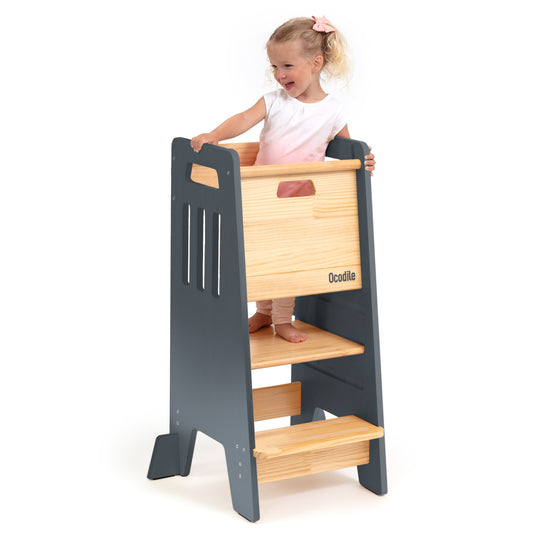
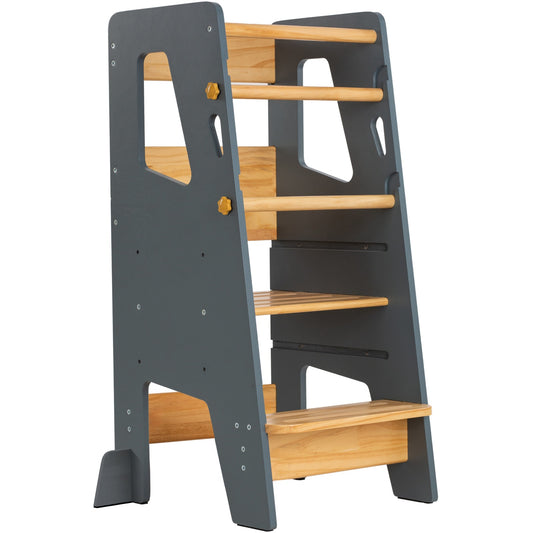
For short tasks, a simple stool may be all you need. For longer kitchen activities, many families prefer a learning tower because it surrounds the child more fully and supports steadier standing during mixing, washing produce, or helping with meal prep.
That decision usually comes down to duration and movement. If your child will stand for several minutes and shift side to side while working, more enclosure can feel much more secure than a basic platform.
More Than Just Height Critical Safety and Stability Features
A perfect step stool height won't help much if the stool slides, flexes, or tips. Height gets attention because it's easy to compare. Stability is what keeps the experience safe in daily use.
Parents benefit from thinking like inspectors. Don't just ask, “Can my child reach?” Ask, “What happens when they step up quickly, turn their hips, or lean one hand on the counter?”
What counts as a step stool
The official definition helps draw a useful boundary. OSHA defines a step stool as a self-supporting, portable ladder that must be 32 inches or less in overall size under OSHA's step stool interpretation. That distinction matters because low-profile step stools are designed for low-level access, while taller climbing products fall into different categories.
For parents, the practical takeaway is simple. A child's stool should stay in the low-access world, not drift toward taller, more ladder-like designs that ask for more climbing control than a young child may have.

The features worth checking before you buy
- Non-slip contact points: Look for grip on the standing surface and on the feet that touch the floor. Little socks and smooth tile are a bad combination without traction.
- A wide, planted base: A stool should feel settled, not narrow and perched. Wider contact with the floor usually means less side-to-side wobble.
- Solid construction: Whether the stool is wood or another material, it should feel rigid under load. Creaking, flexing, or visible sway are warning signs.
- Secure folding hardware: If the stool folds, the locking mechanism should feel obvious and dependable. Parents shouldn't have to guess whether it's fully engaged.
- A surface large enough for two feet: Children balance better when both feet can stand comfortably without hanging over edges.
Stability matters in motion
A child rarely uses a stool like an adult would. They climb, pause, turn, look at you, then return to the task. That's normal behavior. A safe stool should tolerate those ordinary shifts without feeling lively underfoot.
If you want a closer look at what designers and testers examine when they evaluate wobble, load, and base behavior, this overview of stability testing methods gives helpful context.
The best stool is boring in the best possible way. It stays put, feels predictable, and lets the child focus on the task instead of the platform.
A quick in-home check
Before regular use, place the stool where it will live and test it on that exact floor surface.
Try this short checklist:
- Press from the sides: Does it rock?
- Step on the edge with your hand supporting it lightly: Does one side lift?
- Slide it gently across the floor: Do the feet grip or skate?
- Watch your child climb once or twice: Do they place feet confidently, or hesitate because the top feels small or slippery?
Those small observations often tell you more than the product description.
The Right Stool for Every Room Kitchens Bathrooms and Beyond
The same child may need different support in different rooms. That surprises many parents at first, but it makes sense once you think about what the child is doing.
At a bathroom sink, the task is usually brief. Climb up, wash, rinse, climb down. In a kitchen, the task often lasts longer and involves more side movement, more objects, and more distractions.
In the kitchen, protection around the child often matters more
Kitchen participation sounds simple until you watch what it includes. Reaching for a bowl. Turning to grab a spoon. Looking over at you. Waiting while something gets mixed.
Those moments favor a more enclosing structure, especially for toddlers and younger preschoolers. A learning tower can give more side support and make longer standing tasks feel secure. For parents comparing options for food prep spaces, this guide to a kids step stool for kitchen is a useful reference.

A simple stool can still work well in the kitchen for older children or quick tasks. The key question is how long your child will be up there, and whether they'll stay mostly facing forward.
In the bathroom, compact and grippy usually wins
Bathroom use is different. Floors may be wet. The child is often climbing up and down quickly. The goal is usually direct access to the sink rather than a longer activity.
That's why a smaller stool often makes more sense there, provided it has good traction and a comfortable standing surface. Bathroom layout also plays a role. If cabinetry, toe-kick depth, or sink overhang changes how close your child can stand, those dimensions affect the practical fit. Parents planning around built-ins may find this explanation of ADA compliant toe kick rules helpful when thinking about foot placement near cabinets.
A stool that works beautifully at the sink may feel too exposed at the counter. Room use changes the safety equation.
Other places parents forget to evaluate
A stool sometimes migrates around the house. That's convenient, but it can hide new risks.
Consider these spots before you let the stool travel freely:
- Closets and mudrooms: Hard items above shoulder height can tempt overreaching.
- Bookshelves: Children may climb to reach something and then turn while holding it.
- Bedrooms: Soft rugs can change how a stool sits on the floor.
- Laundry rooms: Smooth flooring and nearby appliances can make the area less forgiving.
Matching the stool to the room often matters as much as matching it to the child.
A Step Ahead Choosing and Using Your Stool with Confidence
Most parents don't need a more complicated shopping list. They need a calmer way to decide. The clearest approach is still the best one. Measure first, check stability features next, and think about where the stool will be used.
If you remember only one fit principle, keep the elbows above the counter rule. It helps you look beyond generic labels and judge whether your child can work in a relaxed, steady posture. That's the difference between merely reaching and actually being ready to use the space.
A few habits make any good stool safer
A well-designed stool still depends on everyday use. Small routines matter.
- Teach facing forward: Show your child how to climb up and down while facing the stool.
- Keep tasks close: Position the stool so they don't need to twist or stretch sideways.
- Choose calm locations: Keep it away from stovetops, sharp tools, and rushed traffic paths.
- Check the floor first: Dry, level flooring gives the stool the best chance to stay stable.
Confidence comes from fit, not guesswork
Parents sometimes feel pressure to choose the “best” stool once and be done with it. In practice, the right choice is the one that fits your child's body, your home, and your routines right now.
That's a thoughtful decision, not a perfect one. When a stool matches your child's developmental stage and gives them a secure way to participate, you're doing something meaningful. You're making independence easier to practice and safer to enjoy.
If you're looking for child-friendly furniture designed around safe independence at home, Ocodile offers step stools, standing towers, and other family-focused pieces made to help children join everyday routines with confidence.