


Toddler Tower Guide: A Parent's Handbook for 2026
Dinner starts the same way in a lot of homes. You turn to the counter for one minute, and your toddler is already at your knee, reaching up, asking to see, help, stir, touch, or climb. They don't want to be sent away. They want in.
That can be sweet and exhausting at the same time. You're trying to chop vegetables without tripping. They're frustrated because everything interesting happens above their eye level. You keep lifting them up, putting them down, and wondering if there's a better way.
That's usually the moment parents start looking at a toddler tower.
A toddler tower can turn that clingy, underfoot phase into something more workable. Instead of hanging off your leg, your child gets a defined place to stand near you. Instead of being told “not now” over and over, they can wash a strawberry, stir pancake batter, or just watch what you're doing. If you're also trying to make evenings feel less chaotic, a simple meal planning system can help reduce the last-minute rush that often makes kitchen time harder with little kids.
Safety still comes first, of course. If kitchen participation is part of your goal, it also helps to think about the rest of the space, not just the tower itself. This guide on kitchen safety for toddlers is a useful companion because the tower only works well when the surrounding setup works too.

The Kitchen Dance with a Toddler at Your Feet
Most parents don't start researching a toddler tower because they love buying kid furniture. They start because ordinary moments have turned into a shuffle.
You move left to grab a pan. Your toddler follows. You turn toward the sink. They press into your calf. You open the fridge, and they try to look inside from somewhere around knee height. They're not trying to make things hard. They're telling you, in the loudest way they know, that they want to belong in what you're doing.
Why this phase feels so intense
Toddlers are pulled toward real work. The kitchen has motion, noise, tools, water, food, and your full attention. From their point of view, it's the most interesting room in the house. The problem is that curiosity and counter height don't mix well when a child is stuck on the floor.
That's where the idea of a tower starts to make sense. Not as a magic fix. Not as a parenting requirement. Just as a practical way to give a small child a safer place in a room built for adults.
Sometimes the biggest benefit isn't that your child "helps." It's that they can stay close without you constantly lifting, redirecting, or worrying that they'll climb something unsafe.
What parents are really asking
A search for a toddler tower often reveals a bigger underlying question:
- Can my child be near me safely while I work?
- Will this reduce the constant grabbing and climbing?
- Is this better than using what I already have?
- How long will it even be useful?
Those are good questions. They deserve more than a list of product features.
A toddler tower makes the most sense when you see it as a tool for a short but important window. Your child wants access, but still needs structure. They want independence, but not full freedom at counter height. Used well, a tower can support that stage. Used carelessly, it can become just another thing in the kitchen that parents have to monitor closely.
What Exactly Is a Toddler Tower
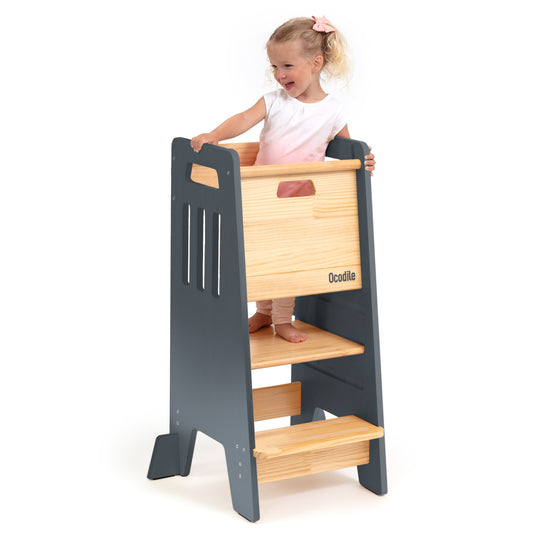
A toddler tower is a raised standing platform with surrounding rails that brings a young child up to counter height. The easiest way to think about it is as a child's personal observation deck. It lets them be part of what's happening without needing to stand on a regular chair or be held on a hip the entire time.
That enclosure is what separates it from a simple step stool. A stool lifts a child up, but it doesn't contain their body. A tower is meant to do both.
More than a step stool
A regular stool works well when a child can get up, balance, and step down with good control. A toddler usually isn't there yet. They lean, twist, shift their feet, and get distracted. In the kitchen, that matters.
A tower gives them a more defined place to stand while they pour, watch, or wash produce at the sink. That can make everyday routines feel calmer because the child has a job and a place, instead of hovering at your legs or trying to climb a chair.
When children usually start using one
Toddler towers are generally introduced around 18 months to 2 years old, once a child is walking confidently enough to climb in and out with support, according to this guidance on what a toddler tower is and key safety basics. The same source highlights several features parents should look for: a wide base, high rails on all four sides, non-slip surfaces, and rounded edges.
That safety guidance matters because this product category isn't risk-free. The same source notes that 16 safety incidents were reported to the U.S. database between 2011 and 2024, with most involving children aged 1 or 2. Those reports included falls, tip-overs, loose screws, and entrapment hazards.
A simple way to picture its job
Here's the plainest distinction:
| Tool | Main purpose | What it doesn't do well |
|---|---|---|
| Chair | Gives temporary height | Encourages climbing, shifting, and awkward standing |
| Step stool | Helps a bigger child reach | Doesn't surround the child |
| Toddler tower | Brings a young child up and helps contain them | Still requires thoughtful setup and supervision |
A good toddler tower supports participation. It lets a child rinse blueberries, hand you ingredients, or watch bread dough being mixed. It can also reduce the endless “up, down, up again” cycle that wears everyone out.
But it only helps if the design matches the child's stage. That's why the next question isn't “Which one looks nice?” It's “What makes one safer?”
The Anatomy of a Safe Toddler Tower
A safe toddler tower should do two jobs at once. It should raise your child to counter height, and it should limit the kinds of movement that make a fall more likely.
That second job is where many parents get tripped up.

Start with stability, then containment
The base is the foundation of the whole setup. If it is narrow, easy to slide, or light enough to shift when a child leans, the tower starts losing its safety value. Toddlers rarely stand still for long. They twist to watch, reach sideways for a spoon, and bounce with excitement when they get involved.
That is why a broad footprint matters so much. A tower should stay planted while your child moves inside it.
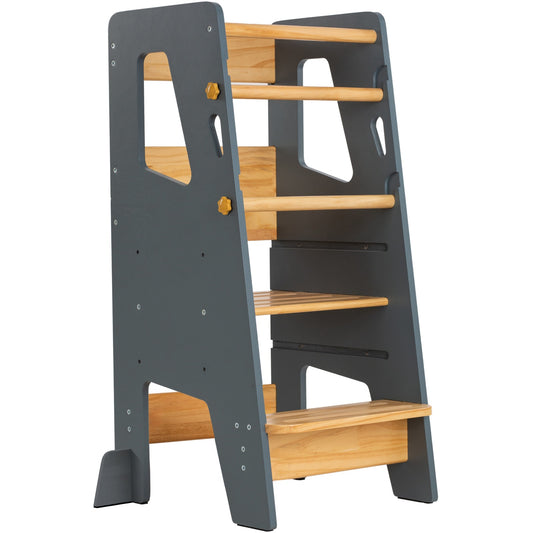
After the base, look at the rails. A useful rule is simple: the standing area should feel contained, not exposed. High rails on all four sides help keep a child centered over their feet. Side pieces alone are often not enough, especially for younger toddlers who still sway, crouch, or turn their whole body instead of just their head.
If the tower looks like a small ladder with a guard attached, rather than a defined standing space, I would pass.
Openings and gaps deserve close attention
Many safety problems are hard to spot in a styled product photo. The risky part may be a side cutout, a gap near the platform, or an opening that looks decorative until you picture a curious toddler trying to climb through it.
According to this summary of safety coverage on toddler tower age and testing concerns, there is no category-specific safety standard for toddler towers, and Consumer Reports testing found serious concerns around head and neck entrapment in many models. That is why gap size, rail spacing, and the shape of cutouts matter as much as the overall look.
Parents sometimes assume, “If my child can fit in, they are fine.” A more significant concern is partial slipping. A child may get their body through partway, lose footing, and become stuck at the neck, torso, or limb. That is the kind of risk you want to rule out before the tower ever enters your kitchen.
The platform height changes how the tower works
The standing platform is not just there to make the sink reachable. It also affects posture, balance, and how well the rails still protect your child as they grow.
An adjustable platform is helpful because children do not grow in neat, predictable jumps. One month your child is standing comfortably with the rail around their middle. A few months later, the same setup may place them too low to work easily or too high for the rail to offer much containment. The goal is a height that lets them participate without constantly stretching, leaning, or pressing their stomach against the front bar.
A good way to picture it is a bike helmet. A helmet only helps when it sits in the right place. A tower railing works similarly. If the platform puts the child too high relative to the rails, the protective design is doing less of its job.
Small build details matter in daily use
Some of the most boring features are the ones you will appreciate most after week three of real kitchen life.
Look for non-slip surfaces where your child steps and stands. Check that edges and corners are smooth. Notice whether the tower feels solid at the joints, not wobbly or creaky. If hardware loosens easily, safety can change over time, not just on day one.
Those details matter because toddler towers get used in busy moments. You may be draining pasta, loading the dishwasher, or wiping a spill while your child climbs in. A safer design gives you more margin for ordinary family chaos.
A quick checklist before you buy
Use this list before you decide:
- Base shape: Does the tower look broad and steady on the floor?
- Rail coverage: Does the child stand inside rails on all four sides?
- Grip: Do the steps and standing platform help prevent slipping?
- Platform position: Can you set the child at a height that supports both reaching and containment?
- Edges: Are corners and surfaces smooth to the touch?
- Openings: Are there gaps, cutouts, or spaces where a head, arm, or body could get partly stuck?
A toddler tower is safest when it matches a very specific stage. Your child is steady enough to climb in with support, but not yet ready to use an ordinary stool with the judgment and body control of a bigger kid. That is the window this design is meant to serve.
Is a Toddler Tower Right for Your Family
Parents often ask whether a toddler tower is safer than a chair. The honest answer is frustrating, but useful. Not automatically.
A tower is only safer when the design is sound, the floor is level, the child is supervised, and the way your family uses it matches what the tower was built to do.

The hard truth about towers versus chairs
Many articles get too simple. They imply that buying a tower settles the safety question. It doesn't.
Consumer-focused safety coverage points out that a tower is only safer than an improvised solution when it is wide, heavy, used on a level floor, and the child is supervised. The same article also notes 16 reported safety incidents from 2011 to 2024 and that many models failed tip-over and entrapment tests in evaluation, which is why “toddler tower” should never be treated as a guarantee on its own. You can read that full framing in this article on whether toddler towers are safer than chairs.
So if you already have a stable setup and a child who rarely uses it, you might decide you don't need another piece of furniture. On the other hand, if your toddler keeps climbing unsafe things to be near you, a properly designed tower may solve a daily problem that a chair never will.
Questions that make the decision clearer
Ask yourself these before buying:
- What does my child do now? If they constantly drag chairs, climb cabinets, or demand to be lifted, they're already telling you they want access.
- What is my kitchen like? A tight kitchen with uneven flooring may limit where a tower can be used safely.
- How does my child move? Some toddlers stand calmly and focus on one task. Others bounce, twist, and test limits every minute.
- Will I stay within arm's reach? A tower isn't a parking spot for independent play while you leave the room.
A toddler tower works best when it matches both the child and the room. A mismatch on either one creates problems.
When it makes sense, and when it might not
A toddler tower often makes sense for families who cook daily, involve children in routines, and want a defined, repeatable place for kitchen participation. It can also be a thoughtful registry item for families who value practical gifts, especially if they're already thinking ahead about home setup alongside things like baby shower gift planning.
It may not be the right fit if storage is a constant battle, the child resists confined standing spaces, or the available spot in the kitchen isn't stable and level. In those homes, the better answer may be waiting, simplifying, or using another approach for a while.
The point isn't to own a tower. The point is to create a safer, calmer way for your child to join family life.
Bringing Montessori Principles Home with a Tower
The developmental value of a toddler tower becomes obvious the first time your child stops whining at your feet and starts doing something purposeful with their hands.
In Montessori-style home routines, children are invited into real tasks rather than being given only pretend ones. A tower supports that by placing a child where the action is. They can rinse lettuce, transfer chopped fruit into a bowl, tear basil leaves, wipe a spill, or watch how you move through a recipe. If you want more ideas in that direction, this guide to a Montessori learning tower shows how families use the concept in everyday life.
What children learn while "helping"
Most toddler help isn't efficient, and that's fine. The value is in repetition.
A child standing safely near the counter gets to practice:
- Hand control while scooping, pouring, stirring, and transferring
- Attention by following a sequence like wash, peel, place
- Language as you name tools, foods, and actions
- Belonging because they're included in real family work
What looks like “helping make muffins” is often a full lesson in coordination, patience, and confidence.
A small moment that teaches a lot
One common kitchen scene says it all. You're making scrambled eggs. Your toddler climbs into the tower, watches you crack the eggs, then stirs with both hands because the bowl feels a little big. Some shell drops in. You fish it out. They keep stirring. A little egg dribbles over the side. You hand them a cloth and they wipe it up.
Nothing about that is polished. Everything about it is useful.
Children don't need perfect activities. They need real ones, sized to their stage.
The hidden benefit for family life
A tower can also change the emotional tone of daily routines. Toddlers often act out less when they feel included. Instead of being managed from the sidelines, they get a role. Instead of hearing “move back” all evening, they hear “can you hand me that?” and “your turn to stir.”
That's one reason many parents end up using the tower for more than cooking. Brushing teeth at the sink, watering plants, washing hands, and simple cleanup all become easier when a child has safe access to the height they need.
Your Child's Journey with a Toddler Tower
The most helpful way to think about a toddler tower is as a tool for a developmental window. There's an entry point, a useful middle stretch, and a clear time to move on.
When to start
Parents usually hear an age first, but age alone doesn't tell you enough. What matters most at the start is function.
A child is generally ready when they can stand independently, move with reasonable control, and follow simple direction with support. Some families reach that stage earlier in the range, while others wait longer. The safer question isn't “How old is my child?” It's “Can my child stand hands-free and stay stable while focused on one activity?”
The signs that the tower still fits
In the middle stage, a toddler tower should still contain the child comfortably while letting them work at the counter without overreaching.
Look for these signs:
- Good body position: Your child stands upright instead of stretching hard to reach.
- Contained torso: Their middle stays within the protective rail area.
- Calm movement: They can climb in, stand, and participate without turning the tower into climbing equipment.
- Predictable use: They understand that the tower is for standing and helping, not for bouncing or leaning out.
When to stop using it
This is the question more articles should answer. Guidance on stopping is often vague, but one practical rule is clear. A child should transition away from the tower when they are around 44 inches tall or when their belly button is no longer below the top safety rail, according to this guide on when children outgrow a learning tower. That usually happens around ages 5 to 6, when many children are ready for a regular step stool instead.
That belly-button rule is easy to remember because it reflects what the rail is supposed to do. If the child's body sits too high above it, the tower is no longer containing them the way it should.
What to watch for: If your child seems perched above the rails rather than enclosed by them, it's time to rethink the setup.
The transition out of the tower
Moving on doesn't mean your child is losing independence. It usually means they've gained it.
A regular step stool often becomes the next tool because the child no longer needs as much enclosure. They still want access to the sink, the counter, or the bathroom mirror. They just need a different kind of support now.
This shift can feel surprisingly emotional for parents. The tower often marks a season when your child wanted to do everything with you. Outgrowing it is one more sign that the toddler stage is changing.
How We Build for Safety and Style
You can feel the difference between a tower made for daily family life and one that only looks good in photos.
After parents decide a toddler tower fits their child's current stage, the next question is usually practical. Will this thing feel secure during the breakfast rush, and will I still want it sitting in my kitchen every day? Safety and appearance are often treated like separate categories, but in a real home they affect each other. If a tower is awkward, bulky, or frustrating to use, families are less likely to use it consistently and correctly.

What we prioritize
Ocodile's design centers on the basics that matter most in everyday use: enclosed support, steady footing, and a shape that does not overwhelm the room. The Ocodile standing toddler tower includes a sliding safety door, which changes how many parents experience the tower from day to day. Instead of relying on a child to stay perfectly positioned on an open platform, the setup creates more of a defined workspace around them.
That matters for a simple reason. Toddlers are still learning body boundaries. A more enclosed design can reduce the urge to step sideways, back out unexpectedly, or treat the tower like open furniture.
Why these design choices matter at home
A good tower should work a bit like a well-fitted bike helmet. You hope you never test its limits, but the design should account for normal toddler movement, not perfect behavior.
Families often notice a few things right away. The tower should feel planted when a child climbs in. The entry should be straightforward enough that the child is not twisting, scrambling, or improvising. The overall look matters too, especially in homes where the kitchen and living space blend together. Parents are more likely to keep a useful tool accessible when it does not feel like visual clutter.
What to inspect before choosing any tower
Even if you are comparing several brands, I would use the same checklist:
| What to inspect | Why it matters |
|---|---|
| Enclosure around the standing area | Helps keep the child more contained during normal reaching and shifting |
| Platform height options | Lets the tower fit the child during the period when they still need rails to do the job properly |
| Stable base and solid joinery | Reduces wobble and helps the tower feel predictable under movement |
| Entry design | Makes safe climbing habits easier to repeat |
| Finish and overall footprint | Affects cleaning, durability, and whether the tower works in your actual kitchen |
The goal is not to find the prettiest tower or the most feature-heavy one. It is to choose a tower that matches the developmental window you are in right now, supports safer participation than a chair would, and still fits the flow of family life.
Frequently Asked Questions About Toddler Towers
How do I clean a toddler tower after messy cooking?
Most families do best with simple, frequent wipe-downs. Clean splatters after use so dried batter, fruit, or grease doesn't build up on the standing surface or rails. Pay extra attention to corners, step edges, and hardware areas where sticky residue can collect.
Can two children use a tower at the same time?
That depends on the specific product design and intended use. If a tower is built for one child, treat it as a one-child tool. Even siblings who usually cooperate can shift weight suddenly, crowd each other, or turn standing time into climbing time.
Are toddler towers hard to assemble?
Some are straightforward. Some are more involved. What matters most is not speed, but accuracy. Tighten hardware properly, recheck it over time, and stop using the tower if anything loosens, wobbles, or looks damaged.
What's the best way to introduce a hesitant toddler?
Start with a calm, low-pressure task. Washing one apple, stirring dry ingredients, or watching you slice bananas works better than asking them to stay there through an entire meal prep session. Stay close, keep the first uses short, and let them build confidence gradually.
Can I leave my child in the tower while I step away?
I wouldn't. A tower is a supervised participation tool, not a place to park a toddler while you leave the room.
Is it only for the kitchen?
Not necessarily. Many families use a toddler tower at the bathroom sink, for handwashing, or for simple household tasks where the floor-to-work-height gap is the main barrier.
If you're comparing options and want a tower that fits into everyday family routines with a child-focused design, take a look at Ocodile. Their collection centers on practical furniture that helps children join daily life more safely, while still working in a real home.