

Is a Foldable Tower Easy Enough to Use Every Day?
You’re trying to rinse strawberries while your toddler asks to be picked up again. A foldable tower sounds useful: your child can stand beside you at the counter, then you can put it away when the kitchen gets crowded. But will you actually want to unfold it, check it and fold it back up every day?
Yes, a folding toddler tower can be practical for daily use, provided its setup, safety checks and storage fit your routine. The deciding factor is not simply how flat it folds. It’s whether you can move it into place, fully secure it and supervise your child without turning a small activity into a project.
A tower that works well for breakfast might be inconvenient during dinner prep. And a compact folded shape won’t help much if retrieving it means moving three other things first. Before choosing one, look at the whole routine rather than the folding feature alone.
What makes a foldable tower easy to use every day?
A toddler learning tower is a raised standing platform with surrounding support that lets a child participate at counter height. Folding models are designed to reduce their footprint between uses, but the operating steps vary by design.
For everyday use, three things need to work together: manageable handling, a clear securing mechanism and a convenient place to keep it. None replaces close adult supervision.
Imagine setting up for a simple task, such as stirring pancake batter. You should be able to retrieve the tower without rearranging the kitchen, open it according to the instructions and confirm that every required locking part is engaged. Your child then needs enough room to enter and exit with your help as needed.
Afterward, cleanup and putting it away should feel reasonable for the value you got from the activity. If the process is cumbersome, you may stop using it even if the tower itself feels sturdy and well made.
Test the complete routine, not just the folding motion
The most useful way to evaluate a foldable tower is to walk through an entire use cycle. If you can see a demonstration before buying, ask to see retrieval, opening, securing and putting it away, not only a quick folding clip.
If you’re evaluating one at home, assemble it correctly first and follow its instructions. Initial assembly and everyday setup are different jobs. A tower may take some effort to assemble but be straightforward to operate afterward.
| Part of the routine | What to check | What can make daily use frustrating |
|---|---|---|
| Retrieving it | Can you reach it without moving other furniture? | Storage behind chairs or pantry items |
| Moving it | Can you handle it comfortably using the intended grip points? | Awkward carrying or dragging across the floor |
| Opening it | Are the instructions and securing steps clear? | Having to guess whether it is fully open |
| Using it | Can you stay close without blocking a walkway? | Repeatedly moving it during the activity |
| Putting it away | Can you clean, dry and secure it in its storage spot? | A folded tower that has nowhere suitable to go |
Try this walkthrough for an ordinary busy moment, not just when the kitchen is empty. Your storage plan should also keep the folded tower from falling or becoming a climbing opportunity. This guide to storing a learning tower between uses covers that part in more detail.
Make the safety check part of setup
Convenience matters, but a setup step that keeps the tower secured is not a step to skip. Build a consistent check into each use so it becomes familiar rather than optional.
Confirm the folding mechanism is fully secured
Before your child approaches, open the foldable tower completely and engage every latch, brace or other securing component specified by the manufacturer. Designs differ, so don’t assume a click or a particular appearance proves it is ready.
Check that the parts are in their intended positions and that nothing is damaged, loose or obstructed. Never let a child stand in the tower while you open, close or adjust it. Keep fingers clear of hinges and moving joints, including during cleanup.
If a locking part won’t engage, the frame starts folding unexpectedly or hardware repeatedly loosens, stop using it until the issue is resolved with the manufacturer. Don’t improvise a repair or rely on the counter to hold it open.
For ongoing maintenance, use the manufacturer’s instructions alongside this guide to inspecting learning-tower hinges and hardware.
Check the floor and everything within reach
A secure folding mechanism does not tell you whether the setup location is suitable. Place the tower on the level surface specified by its manufacturer, with all intended floor-contact points properly supported.
Tile, wood and vinyl can behave differently when wet or greasy. Before each session, check for water, crumbs and other debris under the feet. Avoid rugs, uneven transitions or improvised padding that could change how the tower sits.
With the tower empty, check for unexpected rocking or sliding during normal handling. This is a basic setup check, not proof that a product is tip-proof. If it feels unstable, keep your child off it and investigate the location, assembly or condition.
A foldable tower also changes what your child can reach. Move knives, hot drinks, cords and cleaning products away from the entire reachable area. Set up well away from the stove and hot appliances, then remain within arm’s reach. Guardrails do not make it safe to step away.
Build it around a few useful activities
You don’t need a different learning activity every day to make a tower worthwhile. Start with one or two moments when your child already wants to join you.
At breakfast, that might mean peeling a banana or stirring cooled oatmeal. Before lunch, your child could tear lettuce into a bowl. Choose tasks you can supervise closely without simultaneously handling hot pans or sharp tools.
Keep the first activity short enough that you can help your child down before they become tired, distracted or eager to climb. Have the materials ready before they step up, so you don’t need to leave to fetch something.
It may be reasonable to leave the tower open between closely spaced activities only if it can remain inaccessible to your child without adult help and does not obstruct the room. Otherwise, put it away after use. A tower should not become unrestricted access to the kitchen counter.
The practical benefit is more time doing something together and potentially less lifting, not an expectation that your child will work alone.

Would a fixed tower or step stool be easier?
A foldable tower earns its place when clearing floor space solves a real problem. If you have a suitable dedicated location and use the tower throughout the day, a fixed design may involve fewer setup steps.
Neither format is automatically safer. Stability depends on the individual design, correct assembly, condition and use. A folding model needs particular attention to its securing mechanism, while a fixed model still needs routine hardware and stability checks.
| Option | When it may suit your routine | Main everyday consideration |
|---|---|---|
| Folding learning tower | You need the floor space back between activities | Opening, securing and storing it each time |
| Fixed learning tower | You have a suitable place to keep it ready | Its footprint remains in the room |
| Step stool | Your child can use the particular stool appropriately for the intended task | Usually offers less surrounding support than a tower |
A step stool is not a direct substitute for every toddler or counter activity. Follow its intended use and consider your child’s balance, behavior and need for support. Don’t choose a smaller option solely because it is easier to tuck away.
What to verify before choosing a model
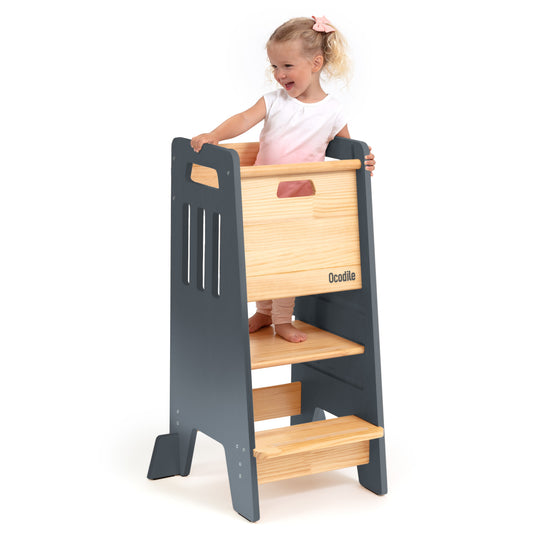
If you’re comparing products, Ocodile’s Adjustable Foldable Kitchen Tower is relevant because it combines folding with height adjustment. Folding addresses between-use space, while adjustment lets you change the standing height as your child grows, within the product’s specified limits.
Those features are a starting point, not a complete answer about fit. Before choosing this or any foldable tower, verify the open and folded dimensions, available height settings, recommended age, weight limit and operating instructions. Check whether height changes require tools, since occasional adjustment is different from daily folding.
Also look for clear information about materials, finishes, maintenance and replacement parts. If a listing mentions independent testing or certification, ask which requirements were assessed and whether documentation applies to the exact model. A general phrase such as “safety tested” does not explain the scope of testing.
You can check the U.S. Consumer Product Safety Commission’s recall database for recalls affecting a specific product. An absence of recalls is not a certification or a guarantee of safety.
The strongest buying decision combines documented product information with a realistic plan for how your family will use it.
Frequently asked questions
Can I unfold a tower while holding my toddler? Plan to have your hands free and your child safely away from the moving parts. Follow the manufacturer’s handling instructions rather than assuming one-handed setup is appropriate. Have everything secured before helping your child approach.
Is a foldable tower suitable for a small kitchen? It can be, but it must fit while open as well as folded. Check that you can supervise beside it without blocking an essential walkway or placing your child near heat, cords or other hazards. Compact storage cannot fix an unsuitable activity space.
What age can a child start using a learning tower? Follow the specific model’s age and weight requirements, then consider your child’s standing balance, ability to follow simple directions and climbing behavior. Meeting an age recommendation alone does not establish readiness. Help with entry and exit as needed and supervise every session.
Does adjustable height mean I need to change it every day? Usually, height adjustment is something to reassess as your child grows rather than part of every setup. Follow the product instructions and check that the selected position provides the intended fit and surrounding support. Never adjust it with your child standing inside.
Choose the option you’ll use consistently
Before buying, picture tomorrow’s breakfast: where the tower will come from, how you’ll secure it, what your child will do and where it will go afterward.
If those steps are manageable without shortcuts, a folding design may fit your family well. If retrieving and setting it up feels like another chore, compare a fixed option or a different location. The right choice is the one that makes supervised participation practical in your actual home.