



Step Stool Chair Guide for Safe Little Climbers
You're standing in the kitchen, one hand on the sink, while a toddler stretches up from behind you and says they want to help. That moment feels small, but it's usually when families start looking for a step stool chair, something that bridges the gap between “too short” and “let me do it myself” without turning the kitchen into a scramble.
A good one should let a child reach safely, stand independently, and step down without a tumble.
Table of Contents
- The Moment Your Toddler Wants to Help in the Kitchen
- What a Step Stool Chair Actually Is
- Safety Features That Actually Matter
- Choosing the Right Size and Material
- Using and Maintaining It Safely Every Day
- Step Stool Chair vs Other Helpers
- A Short Checklist Before You Buy
- Parent Questions Answered
The Moment Your Toddler Wants to Help in the Kitchen
The scene is familiar. You're rinsing vegetables or stirring something at the counter, and a little hand keeps reaching up, trying to be part of it. For many families, that's the exact point where the kitchen starts asking for a better solution than lifting a child, balancing them on a chair, or saying “not yet” every five minutes.
A step stool chair sits in that middle space between furniture and climbing aid. It gives a child a place to stand or sit while they watch, help, wash, or sort, and it helps adults keep the setup more controlled than a regular chair dragged over to the counter. If you're comparing options for a child around the toddler years, this is the kind of product that can make a busy room feel more workable, especially in homes that value child-sized independence. For a related look at making the kitchen safer around little helpers, see Ocodile's toddler kitchen safety guide.
Parents, caregivers, Montessori households, and gift buyers usually come to this product for the same reason. They want a piece that feels like real furniture, but behaves more like a climbing aid when a child needs to wash hands, reach a sink, or join an activity.
Practical rule: if the product helps a child get up, stay balanced, and get down without adult rescue every time, it's doing the job families actually need.
What a Step Stool Chair Actually Is

A step stool chair is a hybrid. It combines two ideas that shoppers often separate in their heads, a place to sit and a place to climb. That's why the label can be confusing, because some products are really stools you sit on, some are step stools you climb, and some are toddler towers marketed with softer furniture language.
The two common forms
One version looks close to a small chair with a single step or a low platform. It may have a backrest or side arms, which makes it feel more like furniture in the room.
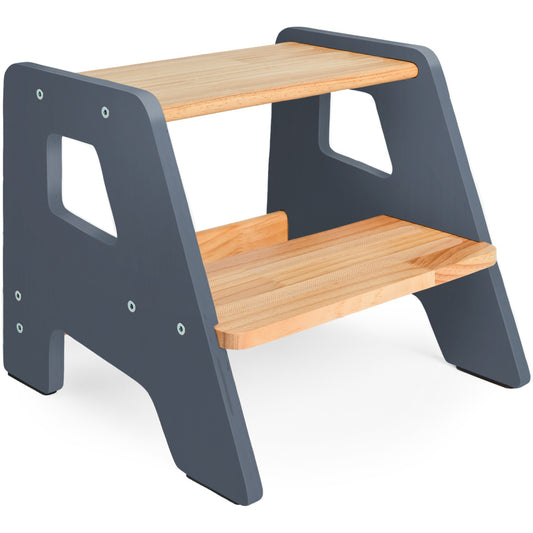
Another version folds or converts into a small staircase with two steps. In that form, it leans harder toward climbing support, but it still carries the chair-plus-stool idea because it gives a child a familiar place to perch when it's not being used for reaching.
The simplest way to think about it is this. If a child can sit on it and climb it without tipping, it's acting as a step stool chair. If it only supports sitting, it's a chair. If it only supports climbing, it's a step stool.
A product label can be misleading. The child's actual use tells you more than the marketing line does.
That's why intended use matters more than the name. A stool that looks cute in a nursery photo may be a poor choice if a child will turn sideways, reach across, or pivot to grab something off to the left. The hybrid category only works when the geometry matches the way little climbers move.
Safety Features That Actually Matter

Safety starts with the parts you can see. Deep steps matter because they give a child more foot space and reduce the chance of half-foot placement. Non-skid surfaces help when socks, damp feet, or quick movement make balance less predictable.
Check the base before the finish
A base wider than the top helps resist tipping when a child leans, twists, or shifts weight fast. That matters more than a polished shape or a trendy silhouette. Sturdy legs with rubber tips help the stool grip the floor, especially on hard surfaces where movement can happen fast.
Side rails extending above the top step give small hands something real to hold. Contrasting edge markings help define where one step ends and the next begins, which is especially useful in homes with bright light, tile floors, or a child who's still learning where to place their feet.
The standards side matters too. ASTM F2613-22 says children's chairs and stools should be tested for structural integrity, performance, and labeling in order to count as a consumer safety specification, which means the product should be judged for load-bearing behavior, joint durability, and tip resistance, not just appearance. BS EN 14183:2003 also treats step stools as their own product category, which is a useful reminder that this isn't ordinary furniture dressed up in a new shape.
One rule keeps showing up
Keep three points of contact and face the steps when climbing. Don't lean forward or stretch sideways to grab the object from the stool, because that's where stable looking setups turn into quick, ugly slips.
Choosing the Right Size and Material
Size comes first, because a safe stool that's the wrong height still doesn't work well. Many child-focused stools sit in the 8.75 to 12 inch range, while the goal in a kitchen is usually to meet a counter without forcing a child to stretch awkwardly. Household models often list 350 to 500 lb capacity, and that higher rating gives more safety margin when a child steps up off-center or shifts fast. See Ocodile's height guide when you're matching platform height to real counter use.
| User | Typical Height | Load Capacity | Best For |
|---|---|---|---|
| Toddler | 8.75 to 12 inches | Household range often 350 to 500 lb | Sink help, hand washing, short kitchen tasks |
| Growing child | Adjustable platform works well | Higher rating adds stability margin | Families wanting one piece to last longer |
| Household use | Varies by design | Commonly 350 to 500 lb | Shared use in kitchen, bath, or art space |
Materials are part of safety, too
I'd steer buyers toward solid wood or quality plywood over MDF. Wood tends to age better in a family room, and it avoids the moisture and durability concerns that often make MDF a weaker choice in daily child use. Plastic can be easy to wipe down, but many families also skip it for environmental and visual reasons.
Look for finishes that are water-based and low-VOC. Toddlers touch everything, and many will chew the rails sooner or later.
That's the key buying point. A stool that looks right on paper but feels flimsy, slick, or awkward in a kitchen will get used less, and used worse. Good sizing and good materials make the stool easier to trust.
Using and Maintaining It Safely Every Day
A safe product still needs a safe routine. Put the stool on a flat, clutter-free surface, then place it as close as possible to the sink or counter so the child doesn't need to lean across empty space. If the design has a lock or brace point, use it before the child climbs.
The University of Kentucky's guidance is clear, if a child needs to stand on the top step to reach something, it's time to switch to a stepladder instead. That line matters because overreaching is where people get tempted to “just stretch a little farther,” and that's exactly when balance gets compromised.
Daily use that stays simple
- Level floor first: A stool on uneven ground can rock before anyone notices.
- No sharing on the climb: One child at a time keeps movement predictable.
- Face forward while climbing: Turning sideways makes the body easier to tip.
- Keep it close to the task: The farther away it sits, the more the child leans.
- Check for loose parts: A quick glance before use catches wobbles early.
A short maintenance habit helps too. Wipe it with a damp cloth and mild soap, especially around cut-outs and corners where grime can hide. Check the rubber tips monthly for wear, and tighten visible hardware every few months so small loosening doesn't become a wobble.
For a wood-focused approach to care and stability, Ocodile's toddler tower material and cleaning guide lines up with the same practical mindset families use for step stools.
Video can help here, too. A quick visual on body position and foot placement is often easier to remember than a written checklist.
Most accidents come from misuse or skipped upkeep, not from a product that was designed badly.
Step Stool Chair vs Other Helpers

A regular step stool is the simplest option. It's usually built for climbing, not comfortable seating, so it works well when the only goal is reaching something quickly.
Where the hybrid wins
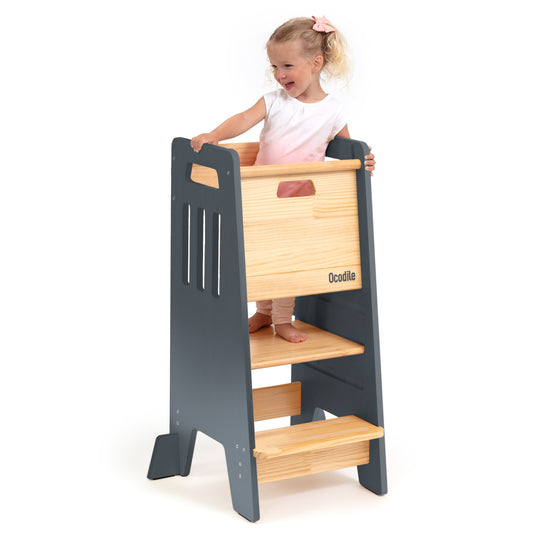
A toddler learning tower gives a fuller enclosure. That's helpful for standing play at a counter, but it usually has no seat and takes more visual and physical space. A booster seat belongs at mealtimes, not climbing tasks, so it's the wrong tool for sink help or shelf access.
The step stool chair sits in the middle. It gives families one piece that can handle kitchen helping, bathroom sink reach, and art-table seating without the footprint of a tower. That makes it appealing in homes where space matters and furniture needs to earn its place.
Ocodile's 1-Step Stool For Kids is one example in that general category, and it fits the idea of a child-sized helper built for everyday household use. The important thing isn't the brand name. It's whether the design matches the behavior of the child using it.
The main hazard isn't height by itself. It's the mismatch between intended use and real child movement, especially when a toddler pivots, twists, or leans sideways.
That's why two products with similar photos can behave very differently in a real kitchen. The safest choice is the one that still feels stable when a child forgets to stand perfectly still.
A Short Checklist Before You Buy

- Confirm the standard: Look for ASTM F2613-22 or EN 14183, because standards tell you the product was tested as a stool, not just styled like one.
- Measure the platform height: Match it to your child and your counter so the child can reach without overreaching.
- Check the base width: A base wider than the top helps the stool stay planted when weight shifts.
- Look for grip features: Non-skid treads and rubber-tipped feet reduce slipping on smooth floors.
- Choose the material well: Solid wood or quality plywood usually holds up better in a family space than MDF.
A stool that adjusts or converts between seat and step usually gives more long-term use, which matters when you want one piece to grow with the child.
Parent Questions Answered
What age is a step stool chair right for?
A child is usually ready when they can stand steadily and follow simple rules, often somewhere around 12 to 24 months. Readiness matters more than age alone, because a child who can't stay balanced or listen to “hold on” isn't ready for a climbing aid yet.
Can it be used in the bathroom?
Yes, but only with extra care on wet floors. Use a non-slip mat if the room gets slick, and keep the stool away from standing water so the feet can stay planted.
How do I keep it from sliding on hardwood?
Rubber feet help, and a small rug gripper underneath can add another layer of hold. Hardwood is beautiful, but it gives less natural friction than textured flooring, so the base needs help staying put.
Can it double as nursery seating?
Yes, for short supervised sessions. It shouldn't act as a primary seat for long periods, because the shape is built for climbing support first and comfort second.
If you want a wood design built around these same safety principles, take a look at Ocodile's line of step stools and toddler towers, then choose the piece that fits your child's movement, your room, and the way you live.
If you're ready to pick one with safety, height, and material in mind, visit Ocodile and compare the child-focused step stools and towers side by side. Their designs are built for everyday family use, and that makes it easier to choose a piece that works in your kitchen, bathroom, or play space.