



Water Sensory Table: A Guide to Setup, Play & Safety
If you're reading this while eyeing a puddle on the patio, a stack of mismatched cups, or a toddler who has already discovered that dumping is more exciting than pouring, you're in the right place. A water sensory table can be one of the most loved pieces of play equipment in early childhood. It can also become the fastest route to slippery floors, tipped tubs, and murky water if the setup is rushed.
That's why the best water table advice has to go beyond activity ideas. Parents don't just need inspiration. They need a setup that stays upright when children lean in with their full body weight, and a cleaning routine that holds up once water gets mixed with mud, leaves, or snack leftovers. Those two issues, stability and hygiene, decide whether a water sensory table becomes a daily favorite or an outdoor headache.
Used well, a water sensory table supports independence, concentration, and hands-on learning in a way few toys can. Used carelessly, it creates mess that adults start avoiding. The difference usually comes down to smart design choices, simple boundaries, and repeatable routines.
More Than Just Splashing The Developmental Benefits of Water Play
Water play earns its place because it holds a toddler's whole attention. Hands get busy. Eyes track movement. The child repeats the same action again and again, then changes one small thing to see what happens.
That repetition is where much of the learning sits.
What children learn while they pour
Scooping, filling, tipping, squeezing a sponge, or aiming water into a narrow funnel may look simple from the patio chair. In practice, these are full-body learning tasks. Children are coordinating both hands, adjusting grip strength, watching the water level change, and correcting their movements in real time.
According to Step2's article on STEM learning through water tables, water table play supports neural connections linked to memory, focus, reasoning, cognitive growth, and problem-solving. Step2 also notes that shared water play encourages social interaction and communication, which experienced parents and educators see quickly once two children are reaching for the same scoop.
In ordinary play, that can look like:
- Pouring from one cup to another and noticing cause and effect
- Using a scoop and funnel to build hand-eye coordination
- Waiting for a turn with a ladle and practicing language and frustration tolerance
- Filling containers of different sizes and beginning to notice volume and comparison
Practical rule: If the child can do something with their hands and immediately see the result, the activity usually has real developmental value.
Why water play fits Montessori so well
Water play naturally supports self-directed repetition. Children do not need much instruction to begin. They choose an action, repeat it, refine it, and often stay with it far longer than adults expect. That is how concentration develops in the toddler and preschool years.
It also supports independence when the setup respects the child's size and reach. A shallow basin, a few open-ended tools, and enough room to stand steadily are often more useful than lots of noisy accessories. In group care, I have seen children return to the same simple pouring work for weeks because the materials stayed accessible and predictable.
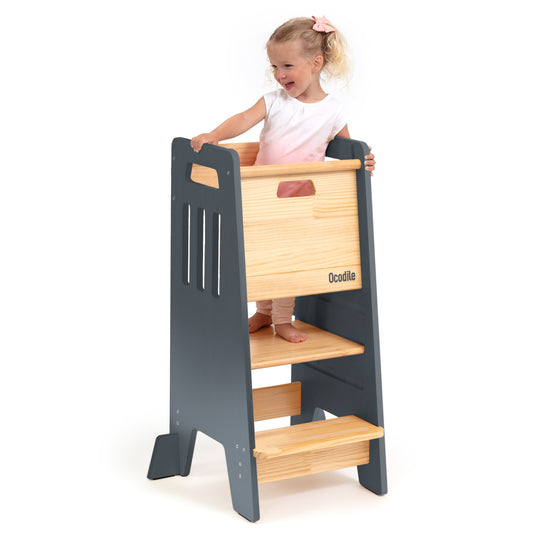
Children under 18 months need very close supervision with water. Older toddlers usually begin managing scoops, cups, and funnels with much less help, which is one reason a well-chosen table can stay useful across several years of early childhood. For families creating a more intentional play space, Ocodile's ideas about the sand and water table for everyday childhood play pair well with this focus on independence, beauty, and child-led use.
The academic value adults often miss
A water table introduces early science and math in a form young children can use. They feel resistance. They notice that some containers empty fast and others pour slowly. They test floating and sinking without needing those words first. They begin to understand more, less, full, empty, heavy, and light through direct experience.
The strongest learning happens because it is physical. Young children remember what their hands discover.
Water play also gives adults a useful window into development. A child who dumps everything may still be studying volume and force. A child who carefully fills to the top may be working on control, patience, and visual judgment. Both are learning. The adult's job is not to make it look tidy. The adult's job is to offer a safe, stable, clean setup that lets that learning happen often enough to stick.
Finding the Perfect Water Table Store-Bought vs DIY Solutions
Some families want a ready-to-go table with a drain and stable legs. Others would rather turn a storage bin or repurposed furniture into a play station that fits their home exactly. Both routes can work. They just solve different problems.

When store-bought makes more sense
A commercial water sensory table usually wins on predictability. You know the basin depth, the leg structure, the finish, and whether it includes extras like pumps, lids, drain plugs, or multiple compartments.
For Montessori-aligned options, Wood Designs' product specifications point to three useful benchmarks: a 9-inch depth tub, a 25-inch height for 3 to 5 year old biomechanics, and GREENGUARD Gold-certified materials that reduce VOC emissions to <0.5 ppm. Those details matter more than flashy accessories. A well-sized tub is easier for children to reach into without climbing. A child-appropriate height helps them work steadily instead of awkwardly hunching or reaching. Lower-emission materials are worth noticing when a play surface lives close to small bodies every day.
Store-bought is often the better fit when you want:
- Less setup guesswork. Assembly may still take time, but the design has already been tested as a children's product.
- Integrated features. Built-in drains, lids, or molded channels save work later.
- More polished aesthetics. If the table will stay visible in a playroom, patio, or classroom, finish quality matters.
Where DIY wins
DIY shines when your needs are highly specific. Maybe you need a narrower table for an apartment balcony. Maybe you want two removable tubs inside a low wooden frame. Maybe you're trying to match existing furniture or build around a child's current height.
DIY also gives you freedom to make a sensory station that transitions between dry and wet play. A storage-bin setup can become a rice bin one week and a water lab the next. For many families, that flexibility matters more than buying a dedicated product.
But DIY has trade-offs. Most homemade builds look easier online than they are in practice. The weak point is usually not the basin. It's stability. Lightweight frames, narrow footprints, and loose-fit inserts often wobble once children lean, push, or dump with force.
A pretty DIY table that shifts under a toddler's hands won't get used for long. Adults stop trusting it, and children test it even harder.
A side-by-side view
| Option | Best for | Main strengths | Main risks |
|---|---|---|---|
| Store-bought | Families wanting convenience and tested features | Ready-made design, integrated drains, cleaner finish | Can be bulky, less customizable |
| DIY bin setup | Small spaces and flexible sensory play | Easy to adapt, simple to replace parts | Often weak on anchoring and drainage |
| DIY custom build | Families comfortable building furniture | Tailored height and layout | Stability and hygiene details are easy to miss |
What I'd prioritize either way
Choose the table that lets your child work independently without creating constant adult worry. That usually means a reachable height, a basin deep enough for real play but not so deep it encourages climbing, and materials that clean well.
If you're deciding between “good enough for now” and “something we'll use for years,” lean toward the one that will stay stable, drain properly, and still look calm in your space after months of daily use.
Your First-Time Setup Guide for Safe Water Exploration
The first setup shapes everything that follows. If the table slides, leaks, or leaves the floor dangerously slick, children lose freedom because adults have to interrupt constantly. Safe water play starts before the first scoop goes in.

Start with the location
Outdoors is easiest, especially on a level surface where splashing won't create a slipping path. Indoors can work too, but only if you treat it like a real wet zone. Put the table on a waterproof mat and keep enough surrounding space for your child to move around it without backing into furniture.
If the table lives near a doorway, hallway, or patio step, rethink that placement. Wet feet travel. A calm setup gives children freedom because the environment already contains the risk.
For whole-home safety thinking, Benny Bradley's room-by-room guide is a useful companion. It helps parents see the water table not as an isolated toy, but as one part of a child-safe movement path through the home.
The three checks that matter most
Constructive Playthings' guidance on choosing a sensory table outlines a practical three-step method for implementation: surface preparation with non-slip mats, leakproof enclosure verification, and sanitization. Their guidance notes that non-slip mats are 90%+ effective in reducing slip and fall incidents, and that proper sanitization with quaternary ammonium disinfectants at 200 ppm for 10 minutes can eliminate 99.9% of E. coli and Staphylococcus aureus.
That sounds technical, but the home version is straightforward.
1. Stabilize the base
Before adding water, push on the rim from a few angles. Then push lower at leg level. A table can feel fine when empty and still wobble when filled.
Look for these red flags:
- Rocking on one corner. This usually means the surface isn't level or the legs aren't tightened evenly.
- Forward tilt when pressed. A child will notice this immediately and lean into it more.
- Sliding feet. Even a sturdy table becomes unsafe on smooth flooring without grip underneath.
For toddlers who lean hard or dump with enthusiasm, anchoring matters more than most guides admit. If you're using a lightweight table or a DIY frame, reinforce it before play becomes rough play.
2. Test for leaks before children see it
Fill the basin and let it sit. Check underneath, around plugs, and around any seam where a tub rests in a frame. A slow leak is worse than an obvious one because it creates a slick patch that adults may not notice right away.
3. Set simple rules in positive language
Children do better with short, concrete expectations than with repeated warnings.
Try:
- Water stays in the table as much as it can
- Feet stay on the ground
- Tools are for scooping, not throwing
- When the water is done, we help empty it
These rules work because they tell the child what to do, not just what to stop.
How much water is enough
You don't need a full basin. Less water usually means better control, more focused scooping, and fewer giant dumps. Warm or cool water can both work, but comfort matters. If the water feels unpleasant on first touch, some children pull back immediately.
A strong first setup also includes accessible tools. A few sturdy cups, a ladle, a sponge, and one funnel are plenty at the beginning. Too many accessories create clutter, not richer play.
A short visual demo can help if you're setting up for the first time:
For more ideas on building a calm, child-led station, Ocodile's guide to the water play table at home offers a helpful design-minded perspective.
From Scooping to Science Age-Appropriate Water Table Activities
A good water table activity starts with the child in front of you. A 20-month-old who wants to fill, dump, and repeat needs something very different from a four-year-old who wants to compare, test, and organize.

The right match matters because water play gets messy fast when the task is too hard, too busy, or too open-ended. Children lean farther, scoop faster, and start dumping when their bodies or attention can't manage the setup. Good activity planning supports learning, but it also helps keep the table steadier and the play calmer.
For young toddlers who need repetition
Young toddlers usually want one clear action they can master with their hands. Repetition is productive here. It builds wrist control, hand strength, visual tracking, and early problem-solving.
Useful starting points include:
- Scooping and pouring with one cup and one bowl
- Sponge transfer from one side of the basin to the other
- Floating objects such as large boats or balls
- Simple retrieval using a ladle to lift toys from the water
Keep the setup spare. One or two tools are often enough.
I've found that toddlers stay with play longer when the materials are large, sturdy, and easy to control. Tiny containers and novelty gadgets look appealing to adults, but they often create spills without adding much learning. If a child is leaning hard over the edge to reach items, move the materials closer or reduce the number of objects in the basin.
For preschoolers who are ready to test ideas
Preschoolers often want water play to do something. They like cause and effect, simple predictions, and real tasks with a visible result.
Jonti-Craft's benchmark data from 127 preschools found that age-appropriate table height was associated with stronger participation. That lines up with what many educators see every day. When the table fits the child's body, children can focus on the activity instead of bracing, stretching, or hanging on the rim.
That opens up richer invitations.
Sink or float
Set out a few objects with clearly different properties. A wooden spoon, a stone, a leaf, and a plastic animal work well. Ask for a prediction, then let the child test it. Keep the selection small so the child can notice patterns instead of racing through a pile.
Color mixing
Use lightly tinted water in small pitchers or cups. Children can pour one into another and watch the change happen step by step. This builds attention, sequencing, and language around more, less, darker, lighter, same, and different.
Washing station
A basket of toy dishes, washable animals, or doll clothes turns water play into practical work. Children scrub, rinse, squeeze, and sort. This kind of activity often holds attention longer than flashy add-ins because the purpose is clear.
Some of the calmest, longest sessions come from washing work. It feels real, and children respond to that.
Montessori-friendly variations that stay orderly
Montessori-inspired water play usually works best with real tools and a restrained layout. A small pitcher, metal measuring cup, turkey baster, sponge, scrub brush, or funnel gives a child a clear job and a clear way to do it.
Try:
- Pitcher-to-pitcher transfer for control and concentration
- Natural object sorting with leaves, stones, and shells
- Ice with warm water for observation and vocabulary
- Funnel and bottle filling for patient hand coordination
Order matters here. Place tools beside the table on a tray or in a basket instead of dropping everything into the water. Children are more likely to use materials carefully when each item has a place. For families building a calmer setup at home, Ocodile's guide to a sensory table in preschool-style learning offers helpful examples.
Activities that need extra hygiene caution
Some popular water table ideas deserve more restraint than they usually get online. Mud, cooked pasta, fruit slices, shaving mixtures, and other sensory add-ins can be engaging, but they change the hygiene demands immediately. They also leave residue in seams, plugs, and textured surfaces, which matters if the table will be used again the next day.
If you want the science of mixing and transformation without the cleanup burden, use clean water with ice, bubbles made for child play, washable plastic items, or natural objects that can be removed and rinsed. Save food-based play for times when you can fully wash and dry the table afterward.
That trade-off is worth naming plainly. The most exciting setup is not always the one a family or classroom can maintain safely.
What usually works least well
Elaborate themes tend to fade quickly. So do overcrowded bins full of droppers, toys, glittery extras, and six different containers fighting for space.
Children do better with a simple invitation they can understand at a glance. A water sensory table is most useful when the child can enter the play independently, repeat an action long enough to learn from it, and leave the table without the whole experience tipping into chaos.
The Practical Guide to Cleanup Storage and Maintenance
Cleanup decides whether water play remains part of family life. If the end of play feels overwhelming, adults delay it, the table sits wet, and hygiene gets compromised fast.

The end-of-play routine children can help with
Children can participate in cleanup long before they can do it alone. Keep the routine the same each time so it becomes part of the play cycle.
A workable sequence looks like this:
- Empty the water into the proper drain area or outdoor spot.
- Collect the tools into one basket or bin.
- Rinse the basin to remove debris.
- Wipe visible residue with a cloth or sponge.
- Leave everything open to dry before covering or storing.
This teaches responsibility without turning cleanup into a lecture. Even a young toddler can carry cups to a basket or help wipe the edge.
When rinsing isn't enough
Many guides fall short in this area. Mud play, food items, leaves, shaving mixtures, and other organic additions change the hygiene picture completely.
As noted by Pocket of Preschool's discussion around water sensory ideas and the hygiene gap, a major pitfall is that many activity lists promote messy mixtures without addressing the high risk of bacterial growth in wet, organic play. The same source notes there is minimal guidance on disinfection cycles or drainage requirements needed to prevent stagnant water and biofilm formation.
That means two practical rules matter:
- Plain water play can usually end with emptying, rinsing, and thorough drying.
- Messy mixed-material play needs a more serious wash and full dry-out before the next use.
If the water table smells off, feels slimy, or has bits trapped in corners, skip the quick rinse. Clean it fully before offering it again.
Drying and storage matter more than people expect
A water sensory table doesn't stay clean just because it was washed. It has to dry well too. Moisture trapped in seams, plugs, accessories, or stacked cups creates the conditions parents dislike discovering later.
Store accessories separately from the basin when possible. Let sponges dry completely or replace them often. Don't leave a fitted cover on a damp table. That traps moisture exactly where you don't want it.
For seasonal storage, clean the basin, dry every removable part, and keep small tools together in a breathable container. If the table lives outdoors, check it routinely for grime in the drain area, under edges, and around hardware.
The goal isn't perfection. It's a routine simple enough that you'll keep doing it.
Answering Your Top Water Table Questions
Some water table problems are so common that almost every parent faces them. The good news is that most of them have a calm, practical fix.
What if my child keeps trying to drink the water
This is common with toddlers. Don't panic, but don't ignore it either. Treat the water as play water, not drinking water.
Keep the language simple. “This water is for playing. Drinking water is in your cup.” Then offer a real cup nearby. If a child keeps trying to drink from the table, shorten the session and stay close. That's usually a sign they aren't ready for more independent water play yet.
Can I use a water sensory table indoors
Yes, but the setup has to do more work. Use a waterproof mat underneath, keep the materials minimal, and place the table well away from traffic paths. Indoor water play is usually best with smaller quantities of water and fewer tools.
For many families, the winning formula is one basin, two or three tools, and a towel within reach. Indoors is not the place for overloaded play invitations.
My children fight over the tools. What should I do
Water tables invite social play, and social play includes conflict. Duplicate the most desirable tool if you can. Two ladles often solve what adult mediation can't.
If there's only one special item, turn it into a predictable routine. One child uses it, then places it back in a shared spot for the next turn. Young children handle waiting better when the sequence is visible and consistent.
Is it safe to add soap, bubbles, food, or mud
Safe depends less on the ingredient itself and more on supervision, cleanup, and the child's age. The messier and more organic the mixture, the more carefully you need to manage cleanup afterward.
For regular use, simpler is better. Plain water, a few washable tools, and occasional natural additions such as ice or smooth stones are easier to supervise and maintain. If you use food items or muddy mixtures, treat that as a higher-maintenance session and clean promptly.
What if my child only dumps the water
Dumping is part of learning. It shows that the child is exploring force, gravity, and effect. The answer isn't to stop all dumping. It's to shape it.
Offer smaller amounts of water, sturdier containers, and one clear place where pouring is meant to happen. If the child is tipping the whole table or trying to climb into it, the setup may be too unstable, too full, or too stimulating. Change the environment before assuming the child is “using it wrong.”
How long should a water table session last
Follow the child's regulation, not the clock. Some children do beautifully with a short session and clean stop. Others settle into focused work for much longer. End while the child is still regulated enough to help with cleanup.
That preserves the water table as a satisfying rhythm instead of letting it slide into overtired chaos.
A thoughtful play space doesn't need to be loud, crowded, or complicated. If you're building a home that supports safe exploration, independence, and everyday family life, Ocodile offers child-centered furniture designed to help little ones participate confidently in the world around them.