


What Is Montessori Method of Teaching? what is montessori method of teaching
At its core, the Montessori method is a way of looking at education that trusts children to be the curious, capable learners they are born to be. Instead of pushing a rigid curriculum, it focuses on self-directed learning and hands-on discovery within a thoughtfully prepared space.
Think of a gardener tending to a plant. You don't force it to grow; you provide the right soil, light, and water, and allow it to flourish on its own. That’s the essence of Montessori—creating the perfect conditions for a child’s mind to blossom.
Understanding the Child-Centered Philosophy
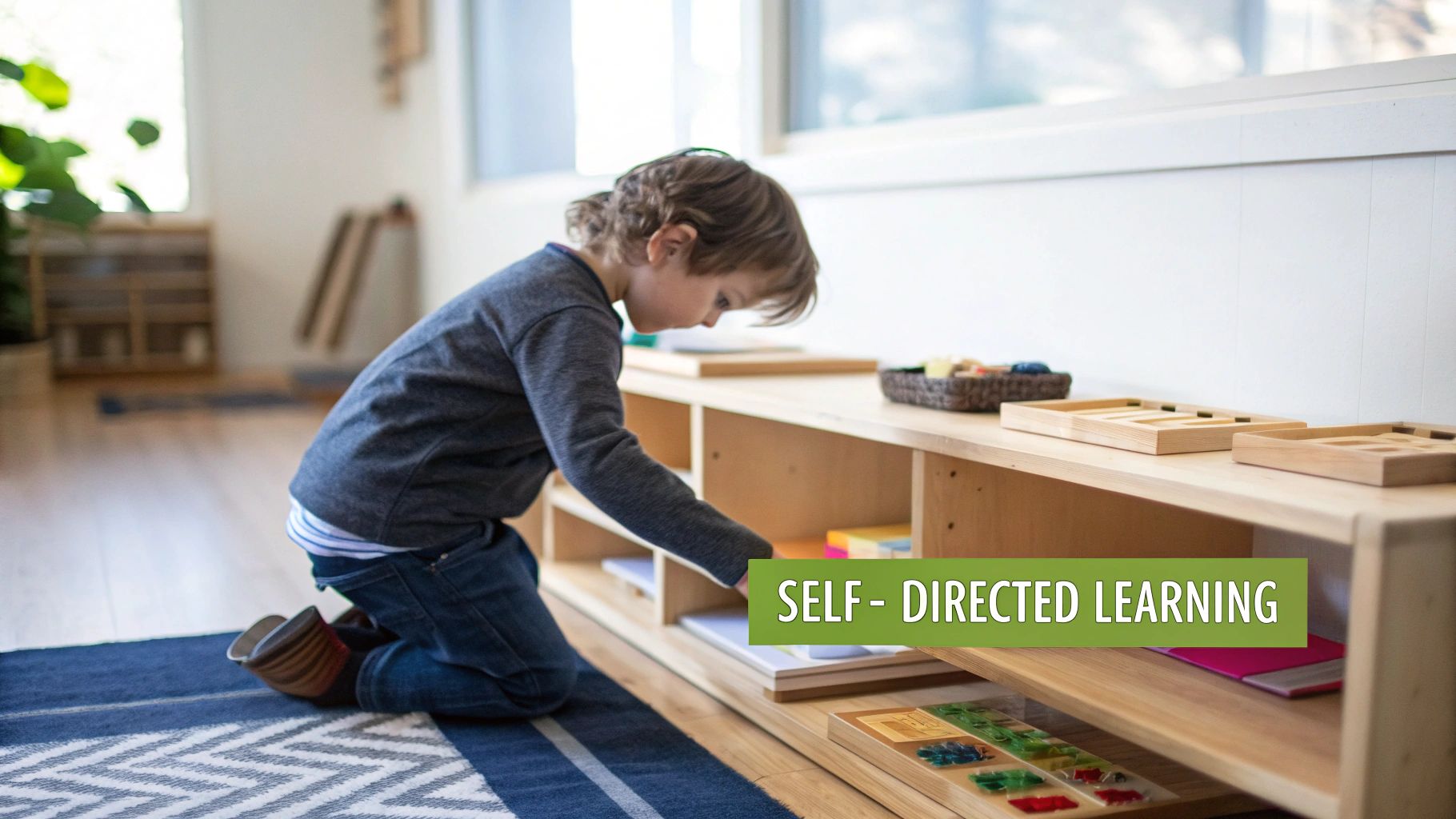
The Montessori method flips the traditional classroom on its head. It’s a self-directed model where teachers act more like guides, steering children through work they choose for themselves. This is a far cry from the conventional setup where an instructor stands at the front, delivering the same lesson to everyone at once.
Developed by Dr. Maria Montessori, an Italian physician, this approach was built on her belief that education should support a child’s total development—not just their academic side.
The goal is to build a strong foundation, helping children become motivated, independent learners who can confidently find their way in the world. By providing a safe and nurturing environment, a Montessori classroom helps kids develop trust in themselves and their own abilities.
Key Components of the Approach
This philosophy isn't just a vague idea; it's built on several key components that work together to create a truly enriching experience for children. These are the things that really set it apart from other teaching styles.
- Child-Directed Work: Kids have the freedom to pick their own activities. This simple shift fuels their natural motivation and helps them develop an incredible ability to focus.
- Prepared Environment: Classrooms are meticulously organized with accessible, child-sized furniture and specific learning materials that just beg to be explored.
- Multi-Age Classrooms: You’ll often find children grouped in three-year age spans. This allows younger students to learn from their older peers, while the older kids step into leadership and mentoring roles.
- Hands-On Materials: Specially designed materials give children a concrete, physical way to grasp abstract concepts, from math to language.
While you're exploring structured learning philosophies, it’s interesting to compare it to other powerful models like the Reggio Emilia Approach. Both share a deep respect for the child, but they go about it in different ways.
The Montessori method is fundamentally about auto-education, or self-education. It trusts that children will educate themselves when provided with the right guidance, encouragement, and environment.
With this foundational understanding of its child-centered philosophy, we can dive deeper into the principles and practical ways to bring this amazing approach to life.
Montessori vs Traditional Education at a Glance
To really see the difference, it helps to put the two approaches side-by-side. Here’s a quick look at how Montessori stacks up against a more conventional classroom on some key pillars of education.
| Core Pillar | Montessori Approach | Traditional Approach |
|---|---|---|
| Learning Pace | Child-led and individualized | Teacher-led; one pace for all |
| Curriculum | Flexible and interest-based | Standardized and pre-determined |
| Teacher's Role | A guide or facilitator | An instructor or lecturer |
| Assessment | Observation and portfolios | Standardized tests and grades |
| Classroom Setup | Multi-age groups; open layout | Same-age groups; rows of desks |
| Core Motivation | Intrinsic curiosity and interest | External rewards and grades |
This table makes it clear that Montessori isn't just a slightly different way of teaching—it's a fundamentally different way of viewing learning and the role of the child in their own education.
The Story Behind the Montessori Revolution
To really get what the Montessori method is all about, you have to go back to the beginning. This isn’t some abstract theory cooked up in an academic lab; it’s an entire approach to childhood that grew from real-world observation and a profound respect for kids.
It all started with Dr. Maria Montessori, one of Italy's very first female physicians back in the early 1900s.
Her first job wasn't actually in education. She started her career in psychiatry, working with children who had intellectual and developmental disabilities. Through careful, scientific observation, she began designing learning materials and methods that helped these children make incredible progress.
This experience cemented a core belief for her: that every child has an innate drive to learn. The secret, she realized, was to create an environment that simply gets out of their way and supports that natural curiosity. Her methods worked so well that it got her thinking—what would happen if this approach was used for all children?
The First Children's House
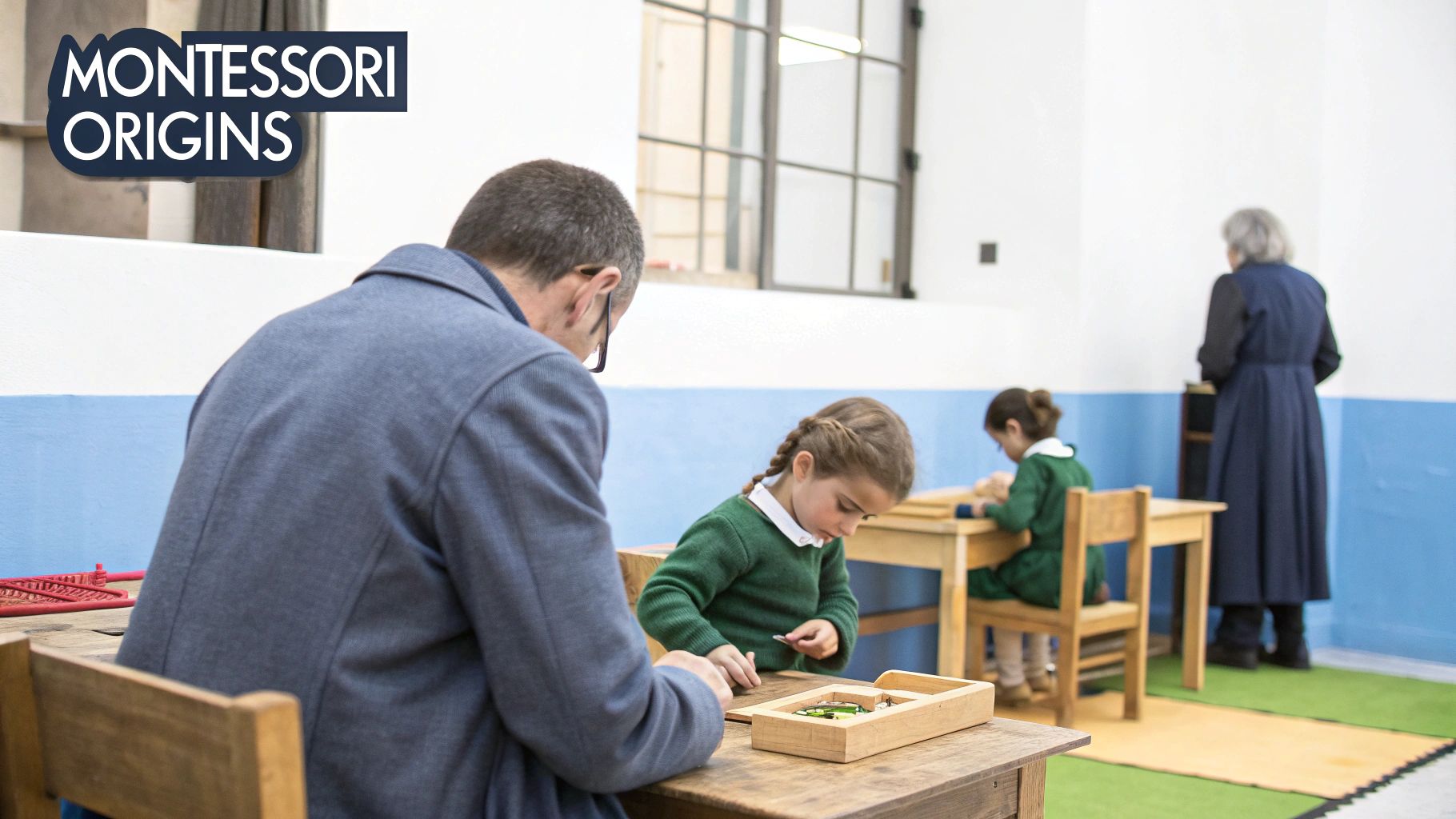
That question led her to an incredible opportunity. In 1907, Dr. Montessori opened her very first classroom, which she called the Casa dei Bambini—the "Children's House"—in a low-income housing project in Rome. This was no fancy, privileged school; it was a community where kids were often left to fend for themselves while their parents worked long hours.
Instead of setting up a traditional, rigid curriculum, she did something different. She filled the room with child-sized furniture and the hands-on materials she’d developed. Then, she took a step back and just watched.
What she saw was nothing short of amazing. The children showed deep, intense concentration and a natural love for order. They had a stunning ability to teach themselves. They would pick their own activities, work for long stretches without being interrupted, and even started taking care of their classroom by cleaning and tidying up on their own.
“The greatest sign of success for a teacher... is to be able to say, ‘The children are now working as if I did not exist.’” - Maria Montessori
This hands-on experience became the foundation of her entire philosophy. The Montessori method wasn't invented—it was discovered by observing how children learn and grow when you give them the right environment.
From a Small Classroom to a Global Movement
Word about the success of the Casa dei Bambini spread like wildfire. Educators from all over the world flocked to Rome to see this new approach for themselves. What began in a small room in a housing project quickly grew into a global movement built on self-directed learning and hands-on exploration.
Today, there are over 20,000 Montessori schools across the globe. In the United States alone, there are more than 600 public programs serving children from every walk of life. You can read more about the long-term outcomes of these programs on phys.org.
This history shows that Montessori is so much more than a teaching technique. It’s a time-tested philosophy, grounded in the simple but powerful belief in the potential of every single child.
The Five Core Principles of Montessori Learning
To really get what the Montessori method is all about, we have to look at the big ideas holding it all together. These aren’t just dusty old educational theories; they’re a deeply felt philosophy about how kids naturally figure things out and grow up. Dr. Maria Montessori built her entire approach on five core principles that all click together beautifully.
Think of these principles as a compass for everything that happens in a Montessori space, from the way the classroom is set up to how the teacher interacts with the kids. They’re the “why” behind what makes Montessori so special, turning learning from a chore into a joyful journey of discovery.
Let’s unpack each of these powerful ideas.
1. Respect for the Child
First up, and most importantly, is Respect for the Child. This is the absolute foundation of everything. It’s about seeing kids not as little empty buckets we need to pour information into, but as whole, unique people with their own thoughts, big feelings, and personal timetables for development.
In a Montessori setting, this respect shows up in a million small ways. A teacher won’t interrupt a child who’s completely lost in a task. The room is filled with child-sized furniture, sending the message that their comfort and independence are a top priority. Kids get to choose what they want to work on, trusting that they have an inner guide telling them what they need to learn next.
This idea completely flips the traditional top-down dynamic between adults and children. It’s about honoring their focus, validating their choices, and truly believing in their built-in ability to learn and grow without us constantly stepping in.
2. The Absorbent Mind
Dr. Montessori noticed that children, from birth to about age six, have what she famously called The Absorbent Mind. Picture a sponge soaking up water without any effort at all—that’s exactly how a young child’s brain absorbs everything from their environment. It’s how they learn their native language, figure out social cues, and understand how the world works, just by being in it.
This kind of learning just happens. It's unconscious and effortless. A child doesn’t need flashcards to learn to talk; they just absorb language from hearing it spoken all around them. This is precisely why the environment is so critical in Montessori. Everything a child sees, hears, and touches becomes a part of who they are.
3. Sensitive Periods
Building right on that idea of the absorbent mind, Dr. Montessori identified what she called Sensitive Periods. These are specific windows of time when a child is intensely, almost magnetically, drawn to learning a particular skill. During one of these periods, picking up that skill feels almost easy because the child is so internally driven to master it.
You’ve probably seen this in action. Maybe you’ve noticed a toddler who is suddenly obsessed with tiny specks of lint on the carpet—that’s a sensitive period for small details. Or maybe a child is fascinated with lining up all their toys, a sign of a sensitive period for order.
A Montessori guide is trained to spot these sensitive periods and make sure the right materials are available at just the right time. For example:
- Order (ages 1-3): A predictable room where every single toy has a home.
- Language (birth to 6): Lots of rich conversation, reading books together, and using hands-on materials like Sandpaper Letters.
- Movement (birth to 4): Plenty of chances for both fine motor skills (like pouring water) and big gross motor skills (like climbing).
- Sensorial Exploration (birth to 5): Materials that isolate one sense at a time, like matching sounds with cylinders or feeling different types of fabric.
4. The Prepared Environment
So, if kids have absorbent minds and go through these powerful sensitive periods, it only makes sense that their learning space needs to be carefully designed to support them. This brings us to the fourth principle: The Prepared Environment. This is about so much more than just a tidy classroom; it’s about creating a space where every single thing has a purpose.
The environment is child-sized, accessible, and orderly. All the learning materials are placed on low, open shelves that just beg to be explored. It's what we call a "yes space," where children can move around freely and safely, which builds their independence. Everything they might need, from a tiny broom to clean up a spill to a small pitcher for pouring their own water, is right where they can reach it. This setup empowers them to take care of themselves and their space.
5. Auto-Education (or Self-Education)
When you put all the other principles together—respect for the child, the absorbent mind, sensitive periods, and a prepared environment—the final principle happens all on its own: Auto-Education. This is the beautiful idea that children can, and will, teach themselves.
The learning materials in a Montessori classroom are brilliantly designed to be self-correcting. If a child makes a mistake, the material itself shows them. For instance, if a puzzle piece doesn't fit, the child immediately knows to try another one. This lets them learn through their own trial-and-error and problem-solving, without needing an adult to point out their mistakes.
Many hands-on practical life tasks, like pouring and spooning, are perfect examples of this self-education in action. For more ideas, take a look at our guide to Montessori practical life activities you can easily set up at home. This kind of self-directed learning is what builds deep confidence, incredible concentration, and a genuine, lifelong love for learning.
Creating a Prepared Montessori Environment
This is where the Montessori philosophy really comes to life. The "Prepared Environment" is how we take all those beautiful ideas and turn them into a real, tangible space where a child can thrive. It’s not just about having a neat playroom; it's about thoughtfully designing a world that empowers them to be independent, confident, and curious.
Think about it this way: imagine trying to cook a meal in a kitchen built for a giant. You’d struggle to reach the counters, heave open heavy drawers, or use tools that are too big for your hands. That’s often what our world feels like to a small child. A Prepared Environment flips the script, creating a space that whispers, "You belong here. You can do this yourself."
It’s the physical expression of respecting the child, built from the ground up to support their absorbent mind and natural developmental stages. This environment stands on three simple, yet powerful, pillars that work together to create a truly nurturing space.
Characteristics of the Prepared Environment
The real magic of a Prepared Environment is in its intentionality. Every single item has a purpose, and every detail is considered from the child's perspective, fostering a deep sense of capability and calm.
- Order and Accessibility: Everything has a home on low, open shelves. This external order helps children build internal mental order. It lets them easily choose their activities and—just as importantly—put them away on their own.
- Beauty and Simplicity: Montessori spaces are known for being calm and uncluttered. They often feature natural materials like wood and soft, neutral colors. This minimalist vibe reduces overstimulation and helps children focus deeply on whatever has captured their interest.
- Child-Sized Tools: From tiny pitchers for pouring water to tables and chairs that actually fit their bodies, every piece of furniture is scaled down. This practical approach is fundamental; it removes the physical barriers that get in the way of independence.
This isn't just a random assortment of principles; they all connect to support the child's growth, as this visual shows.
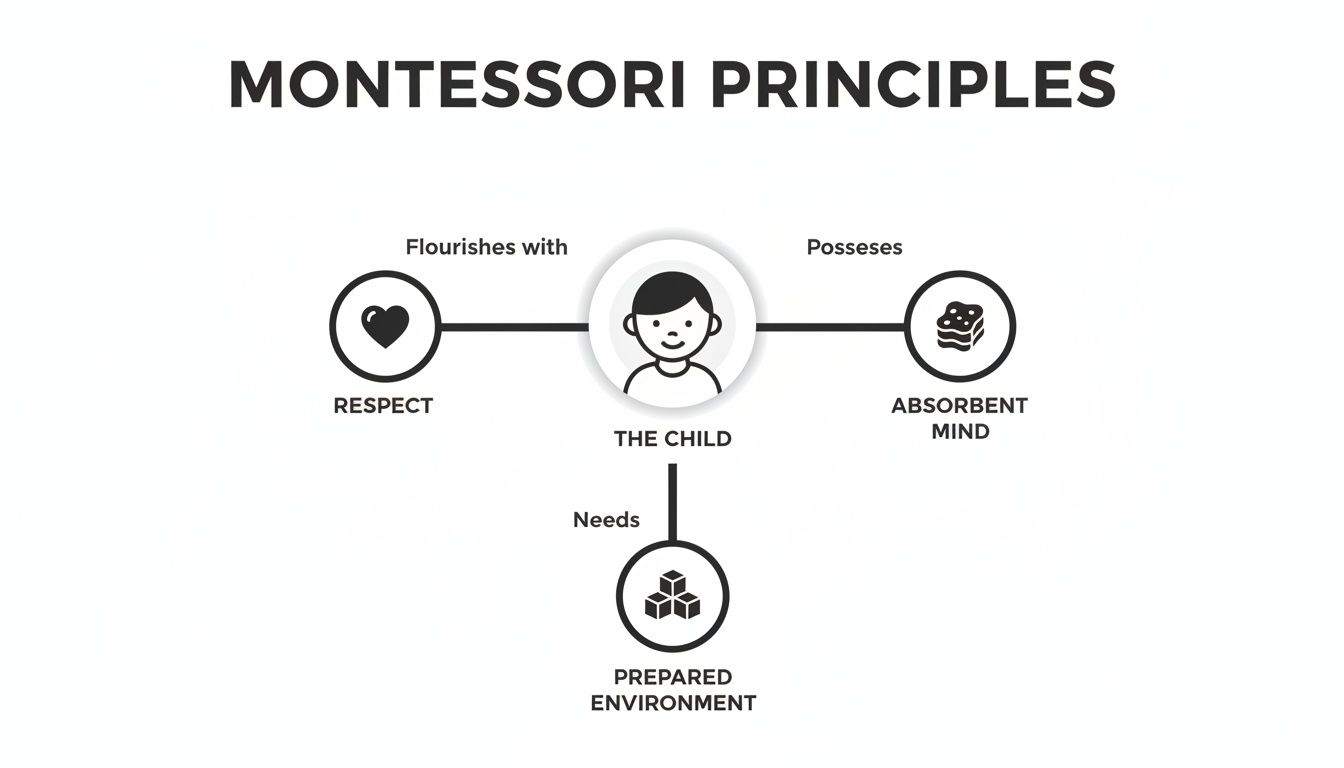
As you can see, the Prepared Environment is a crucial pillar, working hand-in-hand with respect for the child and their absorbent mind to create the ideal foundation for learning.
The Five Learning Areas
Within this carefully organized space, activities are grouped into five key areas. Each one targets specific skills, allowing a child to learn and grow in a balanced, holistic way. The flow between them is seamless, so a child’s natural curiosity can lead the way.
- Practical Life: These are the purposeful jobs of daily living. Tasks like pouring, spooning, buttoning a shirt, or wiping up a spill help develop fine motor skills, concentration, and a genuine sense of responsibility.
- Sensorial: This area is full of beautiful materials designed to isolate and refine the five senses. Activities like matching sounds, grading shades of color, or feeling different textures help kids classify and understand the world around them.
- Language: Language comes alive here, starting with oral skills before moving to reading and writing. Using materials like Sandpaper Letters, children trace the shape of a letter while saying its sound, making the process of learning to read feel completely natural and intuitive.
- Mathematics: Abstract math concepts become concrete and hands-on. Children can physically hold a "thousand" cube or arrange number rods, building a deep, physical understanding of numbers long before they see them on a worksheet.
- Culture: This is where children are introduced to the wider world. It includes geography (like puzzle maps), science (botany and zoology), art, and music, sparking a lifelong curiosity about our planet and all its wonders.
The whole point is that the environment becomes a "third teacher." It guides a child's exploration, provides instant feedback through self-correcting materials, and fosters a deep love of learning without an adult having to constantly step in.
And this isn't just a nice theory—it works. A massive meta-analysis of over 2,000 research articles confirmed that Montessori education leads to strong positive outcomes in both academic and social-emotional skills. On average, students in these programs often outperformed their peers by a full school year by the sixth grade, especially in language and math.
This evidence really drives home how a thoughtfully prepared space does so much more than just keep kids busy; it actively supports and accelerates their development. By providing the right tools and a supportive structure, you can create a powerful learning ecosystem right in your own home. If you're wondering where to start, you can learn more about finding the right Montessori materials for home in our detailed guide.
Bringing Montessori Principles Into Your Home
You don't need a formal classroom to see the incredible effects of the Montessori method. The real beauty of this philosophy is how its core ideas—fostering independence, respecting the child, and preparing an environment for discovery—can be woven right into the fabric of your daily family life.
It's all about making small, intentional shifts that empower your child to become a more capable and confident person. These changes turn your home into a supportive learning ground where your child can practice real-life skills. It’s not about buying expensive materials, but about changing your perspective. When you start seeing your home through your child’s eyes, you can create spaces that invite them to participate, explore, and learn in a hands-on way.
Let's look at how you can apply these ideas, room by room.
Creating an Independent Kitchen
The kitchen is the heart of the home, making it a fantastic place for practical life learning. Getting your child involved in meal prep not only teaches them valuable skills but also gives their self-esteem a huge boost. Of course, safety and accessibility are everything.
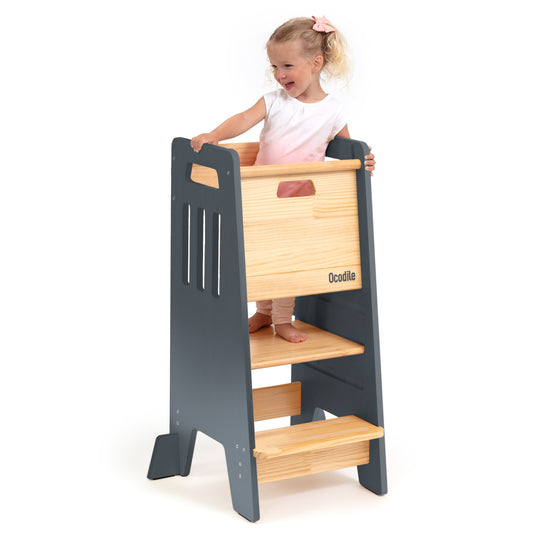
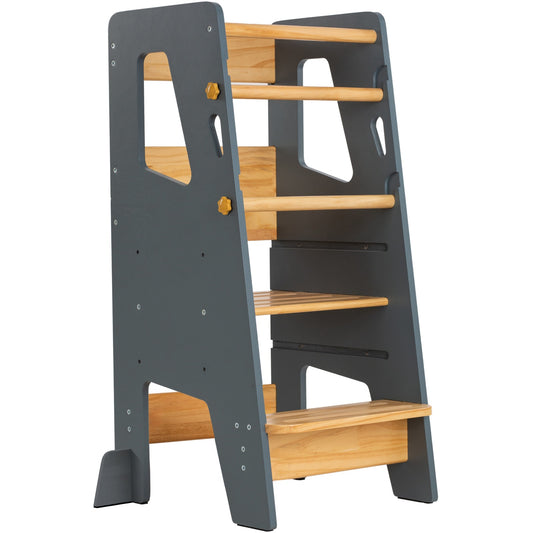
A learning tower or kitchen helper is a perfect example of Montessori in action. This sturdy, enclosed stool safely raises your child to counter height, letting them wash vegetables, stir ingredients, or help set the table without the risk of falling off a wobbly chair. It turns a "no zone" into a "yes space," inviting them to be part of the family's daily rhythm.
You can also set aside a low drawer or cabinet for their own child-safe utensils, plates, and cups. This simple setup empowers them to grab their own snack or a drink of water, reinforcing that growing sense of autonomy.
Fostering Autonomy in the Bedroom
A child's bedroom should be their sanctuary—a place of rest, comfort, and independence. Traditional cribs and high beds can really limit a child's freedom of movement, making them totally dependent on an adult to get in and out of bed. The Montessori approach offers a simple yet profound alternative.
A floor bed—literally a mattress on the floor or a very low frame—is a cornerstone of the Montessori bedroom. It gives even the youngest toddlers the freedom to get into bed when they're tired and get out when they wake up. This respects their natural rhythms and builds bodily awareness from an early age.
Other simple tweaks include:
- A low-hanging closet rod with just a few accessible clothing choices.
- Open, low shelving for toys and books, which allows them to choose their own activities.
- A small, child-sized chair and table for drawing or quiet time.
These elements all work together to create an environment where the child feels in control, which cuts down on frustration and fosters a sense of ownership over their personal space.
By designing spaces that are accessible, you are non-verbally communicating to your child, "I trust you. You are capable." This message is far more powerful than words alone and builds a deep foundation of self-confidence.
Embracing Practical Life Skills Everywhere
Beyond specific rooms, the Montessori method encourages involving children in the real work of maintaining a home. This isn’t about assigning chores; it’s about offering them the chance to contribute in a meaningful way. Young children have this innate desire to imitate adults and feel helpful, so why not lean into it?
Start by providing child-sized tools that actually work. A small broom and dustpan, a lightweight watering can for the plants, or their own sponges for wiping up spills allows them to genuinely participate in caring for their environment.
When it comes to self-care, focus on making tasks manageable. For example, a sturdy step stool by the bathroom sink is a game-changer, letting them wash their hands and brush their teeth all by themselves. Set up a low hook by the door for their coat and a small bench for putting on their own shoes. Each adjustment removes a physical barrier to their independence.
The goal is to follow your child's lead and provide support without taking over. By integrating these principles, you do more than just apply a teaching method; you cultivate a home that nurtures a capable, curious, and self-assured child. To dive deeper into this topic, explore our complete guide to Montessori education at home.
The Proven Benefits of a Montessori Education
The ideas behind the Montessori method aren't just a nice philosophy; they deliver real, measurable advantages for a child’s development. Once you move past the theory, the results truly speak for themselves, showing powerful gains in everything from cognitive skills to social-emotional intelligence. This isn't about teaching facts for a test. It's about building the foundation for a lifetime of successful learning.
One of the most incredible outcomes is the development of strong executive functions. Think of these as the mental toolkit we all use to plan, focus, remember instructions, and juggle different tasks. Because kids in a Montessori classroom are constantly choosing their own work and managing their time, they’re getting a daily workout for these essential brain functions.
Enhanced Academic and Cognitive Skills
The hands-on, self-directed style of Montessori learning leads to a much deeper, more permanent understanding of tricky subjects. Instead of just memorizing abstract rules, children get to internalize concepts with their own two hands.
Take math, for example. A child doesn’t just see the number 1,000 written on a worksheet. They get to hold a heavy, thousand-bead cube, giving that number a real, tangible meaning. This builds a sturdy mental framework that makes future learning feel more natural and a lot less scary.
The data backs this up, too. Research has shown that by the end of kindergarten, kids in Montessori programs scored significantly higher in reading and executive function than their peers in traditional schools. And these advantages didn't just disappear over time—they grew, with the strongest effects showing up after three years in the program. You can dig into the details of this powerful study on early childhood outcomes and see the numbers for yourself.
Nurturing Social and Emotional Growth
The way a Montessori classroom is set up, especially with its mixed-age groups, is a powerhouse for social development. It creates a natural, family-like community where working together is more important than competing.
In this environment, older children organically step into mentorship roles, reinforcing their own knowledge by teaching younger peers. Younger children, in turn, are inspired by watching their older friends, and they learn to seek help from one another.
This dynamic helps cultivate a remarkable set of social skills:
- Empathy: Children learn to understand and respond to the needs of others who are at different developmental stages.
- Leadership: Older students gain confidence and a sense of responsibility as they guide their younger classmates.
- Collaboration: The focus on shared goals teaches children how to work together effectively and appreciate everyone's contribution.
Ultimately, a Montessori education nurtures a deep sense of intrinsic motivation. When children get to follow their own curiosity without the pressure of grades or sticker charts, they develop a genuine love for learning itself. They learn to be persistent, resilient, and self-reliant—qualities that set them up not just for the next grade, but for a successful and fulfilling life.
Still Have Questions About the Montessori Method?
Even after diving into the principles and seeing the benefits, it's natural for parents to have some practical questions. You might be wondering about academics, how kids fare in traditional schools later on, or if this approach is even accessible. Let's tackle some of the most common questions head-on.
Our goal is to clear up any confusion and help you feel confident about what this child-centered philosophy really looks like in practice.
Is Montessori Only for Preschoolers?
While it’s definitely famous in the early childhood world, the Montessori method is a complete educational journey that goes all the way through elementary, middle, and even high school. The core ideas—letting kids direct their own work, learning with their hands, and having a thoughtfully prepared space—simply evolve with the child.
For instance, a preschooler uses that independence to master pouring water without a single spill. An elementary student might use it to dive into a month-long research project on ancient Rome. The philosophy stays the same, building a deep love for learning at every age.
How Do Children Transition to Traditional Schools?
This is a huge question for many parents, but the good news is that children from Montessori backgrounds tend to transition beautifully. They've spent years managing their time, making choices, and working with kids of different ages, so they usually have amazing self-control, adaptability, and a genuine curiosity.
These skills are like gold in any classroom. They know how to learn, not just what to memorize for a test. This helps them navigate new social scenes and academic rules with a quiet confidence that makes them focused, resilient students in more structured settings.
A key takeaway is that Montessori doesn't just prepare children for the next lesson; it prepares them for life. The emphasis on problem-solving and self-motivation equips them to thrive no matter where their educational journey takes them.
Does the Lack of Grades Mean They Aren't Learning?
In a Montessori classroom, a teacher tracks progress through careful observation and one-on-one guidance, not with A's and B's. This takes the pressure off, allowing kids to really dig into a concept until they master it—not just until the test is over.
This builds a real passion for learning that’s driven by curiosity, not the fear of getting a bad grade. The learning materials themselves are cleverly designed with a built-in "control of error," so kids can spot their own mistakes and correct them. Research shows this approach often leads to stronger long-term academic success, proving that deep understanding is a far better measure of progress than a letter grade.
Is This Method Just for Wealthy Families?
It's true that many private Montessori schools have a hefty price tag, but the method itself isn't exclusive. A growing number of public and charter Montessori schools are popping up, making the approach much more accessible for families from all walks of life.
And you don't even need a formal school to bring the best parts home. The most powerful principles can be applied right in your living room with little to no cost. It's all about creating an organized space, encouraging independence in everyday chores, and respecting your child's natural drive to explore.
At Ocodile, we believe in creating environments that support your child’s independence and curiosity, right in your own home. Our thoughtfully designed furniture, from standing towers to floor beds, helps you bring the core principles of Montessori to life, turning everyday moments into opportunities for growth.
Explore our collection to see how you can build a safe and empowering space for your child to learn and thrive: https://ocodile.com