

Why a Learning Toddler Tower Is Not for Infants Yet
If you have ever tried to cook dinner with a baby pulling on your leg, reaching up to be held, or crying because they want to see what you are doing, searching for an infant tower makes complete sense. You want a safer way to include your child at the counter without holding them on your hip or setting them on a chair for “just a second.”
The clear answer is this: a learning standing tower is not for infants yet. Learning towers are designed for toddlers and preschoolers who can stand steadily, climb with control and follow simple safety directions with close adult supervision. An infant, even a strong baby who pulls to stand, is still developing the balance and body control needed for an elevated standing platform.
That does not mean you have to keep your baby completely away from family routines. It means the right setup for an infant is different from the right setup for a toddler.
Quick answer: why a learning kitchen tower is not for infants
A toddler tower is a raised platform that helps a young child stand at counter height. Because it is elevated, it should only be used by a child who is developmentally ready to stand, shift weight, climb in or out safely and respond to simple instructions like “hands on the rail” or “stay on your feet.”
Infants are usually still working on those skills. According to the CDC’s developmental milestones, babies build toward pulling up, cruising, standing and walking gradually during the first year and beyond. A learning tower assumes those skills are reliable, not brand new.
A baby who can pull up on furniture may look “almost ready,” but pulling up is not the same as standing calmly on a raised step while a parent chops food, washes dishes or reaches into a cabinet. For infants, the safer choice is a floor-level, age-appropriate space where they can watch, play and practice movement without the added fall risk.
What a toddler tower is actually designed to do
A learning tower, sometimes called a kitchen helper tower or toddler tower, gives a child a stable standing spot at counter height. For a ready toddler, that can make everyday tasks easier and more enjoyable for everyone.
Instead of lifting your child to the sink every time they want to wash hands, a tower can help them reach the counter with both feet supported. Instead of trying to balance a toddler on a dining chair, a tower gives them a more purpose-built place to stand while they rinse berries, stir cool batter, watch you make lunch or brush their teeth at the bathroom sink.
That is the key difference: a learning standing tower is for standing participation, not containment. It is not a baby seat. It is not a feeding chair. It is not a safe place to park an infant while you cook.
For toddlers, the benefit is practical. They can do small real-life tasks beside you, and you do less lifting. The mechanism is simple: the tower raises the child to a useful height while giving them a defined place to stand. The proof shows up in daily routines, like a toddler reaching the sink without being held or helping pour pre-measured ingredients without climbing onto furniture.
Why babies and “infant towers” do not mix
The phrase “infant tower” sounds helpful, but it can be misleading. A baby’s body and behavior are not the same as a toddler’s, and the kitchen is not a low-risk place to test new standing skills.
Infants are still developing balance
Standing in a tower requires more than leg strength. A child needs core stability, foot placement, coordination and the ability to recover if they wobble. Infants often shift suddenly, lean with their whole body or drop into sitting without warning. On the floor, that is normal movement practice. On a raised platform, it becomes a bigger risk.
A baby who stands while holding the couch may still depend heavily on that support. In a tower, they may grab, twist, bounce or lean over a side because they do not yet understand where their body is in relation to the edge.
Climbing adds another layer of risk
Toddlers are not perfectly predictable either, but a toddler who is ready for a tower can usually climb with more control, place feet intentionally and understand repeated safety reminders. Infants are often in the early experimenting phase. They may pull up, let go, sit down hard or try to crawl into spaces without knowing how to back out.
That experimentation is healthy, but it belongs on the floor or in other age-appropriate environments, not on an elevated standing platform.
Babies explore by grabbing first
At counter height, an infant suddenly has access to things that were never meant for them: mugs, bowls, knives, cords, soap, glass, hot pans, raw ingredients and small objects. A toddler also needs supervision around these hazards, but infants are even more likely to grab quickly, mouth objects or swipe without understanding “hot,” “sharp” or “wait.”
A learning tower can bring a ready toddler closer to useful work. For an infant, it may bring them closer to hazards before they have the control or understanding to be there.
Infant vs. toddler readiness: what parents should look for
Age can help you decide when to start thinking about a tower, but readiness matters more. Many families begin considering a learning tower during the toddler stage, often after walking is well established. If your child is still an infant, cruising along furniture or needing help to stand, it is too soon.
| What you see | What it usually means for tower use |
|---|---|
| Baby pulls to stand but wobbles or drops suddenly | Not ready yet, because standing balance is still emerging |
| Baby cruises along furniture but does not walk independently | Not ready yet, because movement still depends on support |
| Child walks steadily across the room and can stop without falling | Closer to readiness, but still needs other safety signs |
| Child can climb a low step with control and get down with help | A possible readiness sign when paired with steady standing |
| Child follows simple directions like “stand still” or “hands down” | Helpful for supervised tower routines |
| Child tries to climb out, bounce or lean over edges repeatedly | Wait or pause tower use, even if the child is old enough |
A good readiness check is simple: would you trust your child to stand next to you on a low step for a calm task, with you right there, without constant wobbling, sitting, leaning or trying to climb away? If not, a tower should wait.
What to use while your baby is still an infant
If your baby wants to be near you during kitchen routines, you still have options. They just need to be age-appropriate and floor-level whenever possible.
Try creating a safe kitchen-adjacent zone with a soft mat, a few toys and clear boundaries away from oven doors, pet bowls, cords and foot traffic. Some parents keep a low drawer or basket with baby-safe kitchen items, such as soft silicone utensils or lightweight containers, so the baby can explore nearby without being at counter height.
A high chair can work for short, supervised moments away from cooking hazards, especially if your baby is eating or watching while you do a simple task. Use it only as intended by the manufacturer, with the restraint system properly fastened. Avoid placing a high chair close to counters, tables or walls where a baby can push off with their feet.
If you babywear, be careful about the task. Babywearing near hot pans, boiling water, sharp knives or splattering oil can create a different set of risks. It may be fine for simple, cool prep, like putting away dry goods, but it is not a substitute for a safe infant cooking setup.

When your child becomes toddler-ready, choose the tower carefully
Once your child is no longer an infant and shows true readiness, the right tower can make daily routines feel less improvised. Instead of pulling over a dining chair or lifting your toddler again and again, you can give them a more stable place to stand for short, supervised tasks.
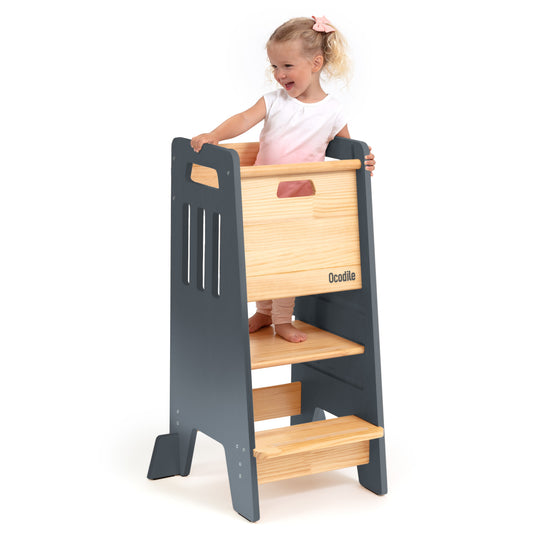
This is where a toddler-focused product makes more sense than an “infant tower.” Ocodile’s Montessori Toddler Tower - Adjustable Kitchen Stool Helper is designed for active toddlers who want to help, watch and participate in everyday kitchen routines. It is a better fit for the stage when your child can stand reliably and is ready for guided practice at the counter, not for infancy.
When comparing toddler towers, look for features that solve real parent concerns:
| Feature | Why it matters in daily use |
|---|---|
| Sturdy, well-made construction | Helps the tower feel more stable when a toddler shifts weight during a task |
| Safety guardrails | Add a defined boundary so your child has a clearer standing space |
| Adjustable design | Helps the tower fit your growing child more comfortably over time |
| Child-safe coating | Matters because kids touch, lean and place hands on the surfaces they use every day |
| Foldable design | Helpful for families who need to store the tower between routines or save kitchen space |
No feature replaces supervision. A tower can add structure and stability, but a toddler still needs an adult close by, especially near water, utensils, appliances or anything hot.
For a broader look at timing, features and everyday uses, Ocodile’s toddler tower parent handbook is a helpful next read once your child is past the infant stage.
How to start safely when your toddler is finally ready
The first tower routines should be short, calm and low-risk. Think handwashing, rinsing fruit, watching you spread cream cheese on toast or stirring something cool in a bowl. Skip tasks with heat, sharp tools, raw meat, heavy dishes or breakable glass.
Set the tower on a flat, dry floor and keep it away from the stove, oven, dishwasher, trash can, dangling cords and busy walkways. Center the tower in front of the task so your child is not twisting, reaching sideways or leaning across the counter.
If you are unsure about placement, this guide on how to position a children’s kitchen tower at the counter explains how to choose a safer spot, keep hazards out of reach and make the setup easier for your toddler to use.
A few good starter tasks include:
- Washing hands at the sink with you standing beside them
- Rinsing blueberries or strawberries in a small colander
- Pouring pre-measured oats, flour or cereal into a bowl
- Stirring cool batter with a child-safe utensil
- Brushing teeth at the bathroom sink with supervision
Keep the first sessions brief. If your toddler starts bouncing, climbing, leaning or refusing directions, end the activity and try again another day. Readiness can come in stages, and that is normal.
Frequently Asked Questions
Can a 9-month-old use a learning tower? No. A 9-month-old is still an infant and is generally not ready for an elevated standing platform. Even if the baby pulls to stand, they are still developing the balance, coordination and safety awareness needed for tower use.
What age is safe for a learning tower? There is no single perfect age. Learning towers are generally for toddlers and preschoolers, not infants. Look for steady walking, controlled climbing, the ability to stand calmly and the ability to follow simple directions with close supervision.
Is a learning tower safer than using a chair? For a ready toddler, a purpose-built learning tower is usually a more appropriate option than a dining chair because it is designed for standing at counter height. It still requires adult supervision and safe placement.
Can I use a learning tower for my baby if I stand right next to them? It is still not recommended. Standing close helps, but it does not give an infant the balance or coordination they have not developed yet. A quick lean, grab or slip can happen faster than a parent can correct.
What should I use instead of an infant tower? Use a safe floor-level play area, a properly used high chair for short supervised moments or simple kitchen-adjacent activities that keep your baby away from heat, sharp tools and counter hazards.
A safer next step for your child’s stage
If your child is still an infant, the best next step is to wait on the learning tower and create safe ways for them to be near you at floor level. That choice may feel less exciting than bringing them up to the counter, but it matches where their body and judgment are right now.
When your child becomes a steady, curious toddler who wants to wash hands, help rinse fruit or stand beside you for simple routines, then it is time to compare toddler towers. Look for something sturdy, stable, easy to use in your home and designed for supervised toddler participation, not infant containment.