



Pikler Triangle Montessori A Child Development Guide
Even though the Pikler triangle wasn't invented by Maria Montessori, you’ll find one in almost any Montessori-inspired home. Why? Because its entire philosophy is a perfect match for self-directed, child-led learning. It’s so much more than a toy; it’s a developmental tool designed by Dr. Emmi Pikler to empower children to explore movement and build physical confidence, all on their own timeline. This shared focus is what makes the Pikler triangle Montessori connection so powerful.
What Connects the Pikler Triangle to Montessori?
To really get why the Pikler triangle is so beloved in Montessori circles, you have to look at the thinking behind it. At its core, the triangle is a simple, open-ended climbing frame. It doesn't have flashing lights, loud sounds, or a "right way" to play. Instead, it’s an invitation for a child to explore, solve problems, and discover their own physical abilities without an adult stepping in.
This whole approach was pioneered by Hungarian pediatrician Dr. Emmi Pikler back in the mid-20th century. Her work was built on the foundation of child-led play, which led her to design this simple wooden frame. It encourages toddlers to master motor skills through unstructured, self-initiated movement. You can dive deeper into these core ideas in our complete guide to Montessori education at home.
The Shared Philosophy of Pikler and Montessori
Dr. Pikler’s ideas run on a track parallel to Dr. Maria Montessori's. Both of these incredible educators believed in respecting the child as a capable, whole person. They both championed creating a "prepared environment" where children could learn independently. Just think of the triangle as a miniature prepared environment, but for physical development.
Here are the core principles they have in common:
- Respect for the Child: Both philosophies put immense trust in a child's natural ability to learn and grow. The triangle embodies this by letting children gauge their own risks and climb only as high as they feel comfortable and ready.
- Freedom of Movement: Unrestricted movement is absolutely vital for both physical and cognitive development. The Pikler triangle offers a safe, appropriate outlet for that innate urge to climb, pull up, and explore the world.
- Self-Directed Activity: We know that learning sticks best when it comes from within. A child gets to decide how and when they interact with the triangle, which builds independence and true, intrinsic motivation.
This visual really helps illustrate how the philosophies of Dr. Pikler and Dr. Montessori come together in the Pikler triangle.
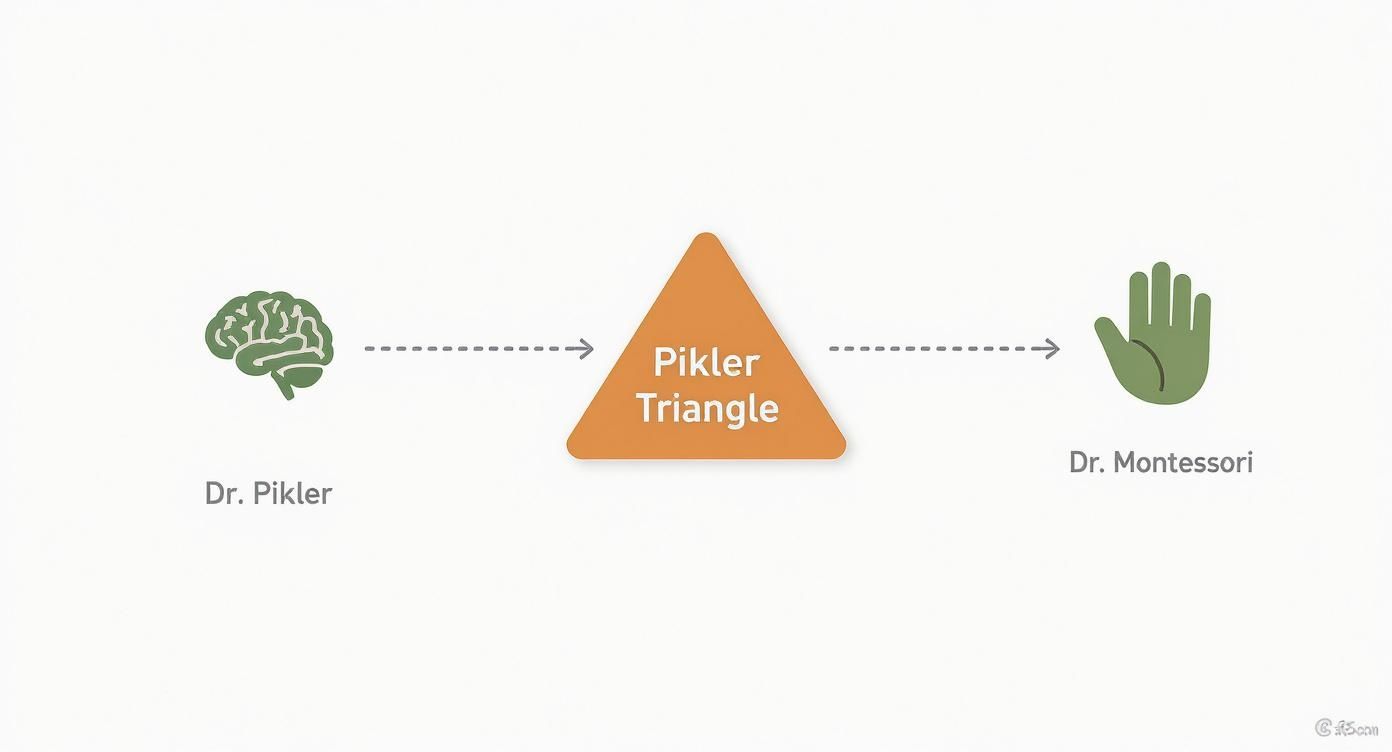
You can see how Pikler's principles of self-initiated movement and Montessori's prepared environment merge perfectly in this one simple, brilliant tool.
To show just how in sync these two educational approaches are, here’s a quick comparison of their foundational beliefs.
Pikler vs Montessori Core Principles Alignment
| Core Principle | Pikler's Philosophy | Montessori's Philosophy |
|---|---|---|
| Child-Led Learning | Emphasizes self-initiated motor development and letting children discover physical skills at their own pace. | Centers on self-directed activity and allowing the child to choose their work based on internal motivation. |
| Respect and Trust | Trusts the infant's ability to solve problems and master movement without adult interference or "help." | Views the child as a capable individual who should be respected and given freedom within limits. |
| Prepared Environment | Focuses on creating a safe physical space with tools (like the triangle) that encourage natural movement. | Involves a meticulously organized environment with specific materials that invite exploration and learning. |
| Role of the Adult | The adult is a patient observer who provides a secure, loving base but does not direct the child's play. | The adult acts as a guide or "directress" who observes the child and connects them to the environment. |
Seeing them side-by-side, it's clear they were speaking the same language—one of deep respect for the child's innate wisdom.
The Pikler triangle's approach to child-led exploration is a practical application of Constructivist Learning Theory, where children actively build their own understanding of the world through direct experience.
Ultimately, the synergy between these two educational giants is what makes the Pikler triangle Montessori combination so effective. It’s not just about climbing; it’s about nurturing a confident, independent, and physically capable child.
How Play Unlocks Key Developmental Benefits
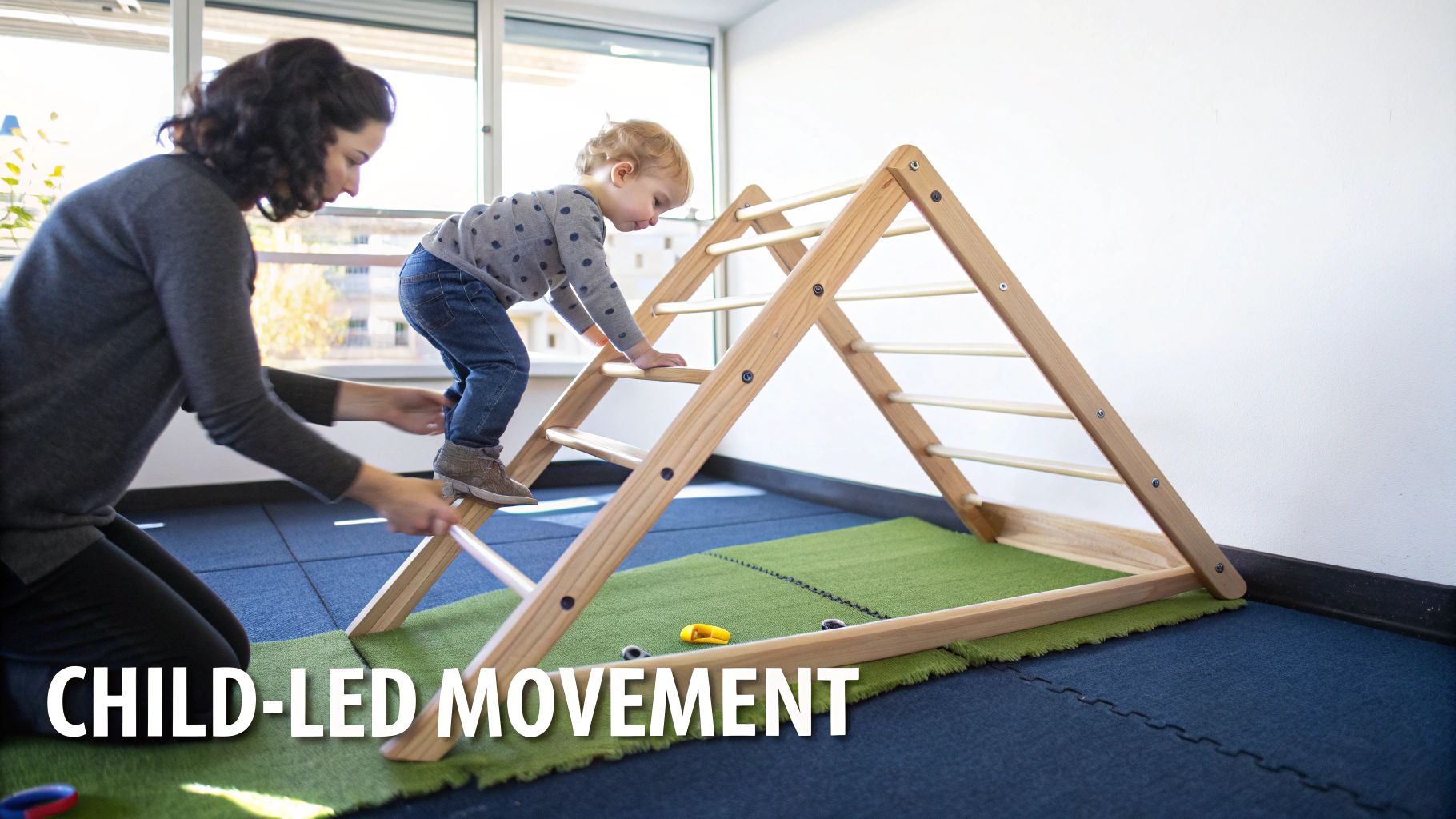
The real magic of the Pikler triangle Montessori connection isn't just in the shared philosophy—it's in the real-world skills it helps build. Think of it as a physical vocabulary builder. Each rung a child grasps and every step they take is a new word in their movement language.
This simple frame unlocks a whole cascade of benefits that lay the groundwork for lifelong confidence and learning.
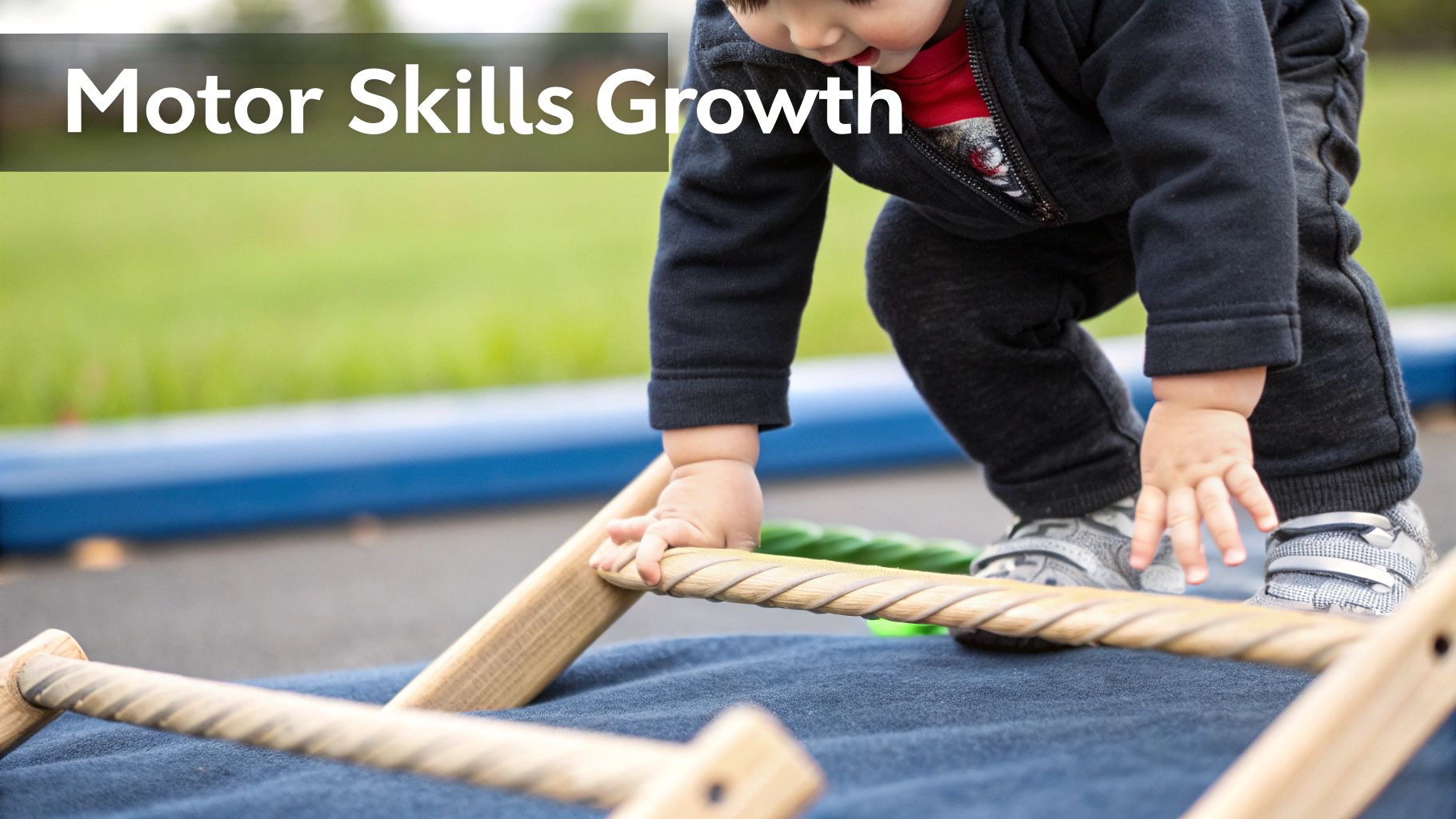
At its very core, the triangle is a powerhouse for developing gross motor skills. From the moment a baby grabs the rungs to pull themselves up, they’re strengthening their legs, core, and arms. As they get older, this naturally progresses to climbing, which sharpens their balance, coordination, and spatial awareness. These are the exact skills they’ll need to navigate a busy playground or just walk across the room without tripping.
Fostering Physical and Mental Strength
But the benefits don't stop with the big muscle groups. As a child grips the rungs, they're also developing their fine motor skills and hand strength. That purposeful grasping is a direct precursor to holding a crayon, using scissors, or buttoning up a coat. Every single climb is a full-body workout that pulls different muscle groups together seamlessly.
On top of that, the act of climbing is a huge cognitive exercise. A toddler sizing up the triangle has to problem-solve on the fly. They’re asking themselves:
- Can I reach that next rung?
- How do I need to shift my weight?
- What’s the safest way to get back down?
This process of risk assessment is absolutely crucial. It teaches children to understand their own limits and make smart decisions, building a kind of self-trust and resilience that will serve them far beyond the playroom. Understanding the whole picture of a baby's journey from tummy time to walking really helps put a tool like this into a broader context.
Building Confidence One Rung at a Time
Maybe the most profound benefit, though, is an emotional one. Each time a child reaches a new height or finally masters climbing over the top, they get a powerful surge of accomplishment. This isn't about praise from an adult; it's an internal, intrinsic feeling of success that builds rock-solid self-esteem.
This self-directed mastery is the essence of both Pikler and Montessori ideals. The child learns, "I can do it myself," which fosters independence and a can-do attitude toward future challenges, whether they are physical or intellectual.
This blend of physical and mental growth isn't just an observation; it’s well-documented. Research consistently shows how effective climbing structures are for improving both fine and gross motor skills. For instance, studies find that toddlers who use these kinds of structures show major improvements because they have to coordinate complex movements to get up, down, and around.
Ultimately, the Pikler triangle offers the perfect environment for a child to challenge themselves, learn from their experiences, and build a strong, capable body and mind.
Choosing the Right Pikler Triangle for Your Home
Picking out the right Pikler triangle Montessori families will love is about more than just aesthetics. It's a real investment in your child’s development and, most importantly, their safety. So, knowing what to look for is the key to making a smart choice.
The good news is that as these climbers have become more popular, the market has exploded with options. But with more choice comes more responsibility to sift through the noise.
Just look at the numbers. The global market for Montessori-inspired toys was valued at around $1.8 billion and is expected to more than double to $3.9 billion by 2032. Pikler triangles alone make up a $153 million market projected to hit over $340 million by 2033. You can dig into these market growth insights on HTF Market Insights. This boom means you have plenty of options, but you need to know how to spot quality.
Material Safety and Construction
First things first: safety. A top-notch Pikler triangle should be crafted from a strong, durable wood like Baltic birch or another solid hardwood. These materials are built to handle years of energetic play without splintering or warping.
Just as crucial are the finishes. Check that the product specifies non-toxic, child-safe paints and sealants. Any hardware—screws, bolts, you name it—needs to be sturdy and recessed so it won’t snag clothes or cause scratches.
Here's a quick checklist of what to look for:
- Smooth, Rounded Edges: Every surface, from the rungs to the corners, should be sanded perfectly smooth. No splinters allowed.
- Strong, Secure Joints: Give it a little shake. The triangle should feel stable and solid, with zero wobble. Strong joints are non-negotiable for safety.
- Certified Materials: Look for brands that use wood from sustainable sources and have safety certifications. This is your proof that they meet high standards.
A well-made Pikler triangle should feel more like a solid piece of furniture than a flimsy toy. The level of craftsmanship directly impacts how long it will last and, more importantly, how safe your child will be while exploring.
Design and Practicality
Beyond the build quality, you need to think about how the triangle will actually work in your home and for your family. The design can make a big difference in how much use it gets. For a side-by-side look, check out our guide on finding the best Pikler triangle set.
Consider these practical points:
- Size: Think about the triangle's footprint and height. You need enough space for it in your play area with plenty of clearance all around, but it also needs to be the right size to challenge your child.
- Foldability: If you're tight on space, a foldable design is a lifesaver. It makes it super easy to store away when it's not being used, freeing up your floor space.
- Adjustability: Some models have adjustable angles, which is a fantastic feature. You can start with a gentler slope and increase the difficulty as your little one gets stronger and more confident.
At the end of the day, the best Pikler triangle is the one that fits your family's space, budget, and values. By focusing on quality materials, solid construction, and a practical design, you'll choose a piece that will safely support your child's adventurous spirit for years to come.
Integrating the Pikler Triangle into Your Home
So, you've decided to bring a Pikler triangle into your home. This is more than just unboxing another toy; it’s about creating an invitation for your child to explore. The key is setting the stage thoughtfully so they can engage with it safely and, most importantly, on their own terms.
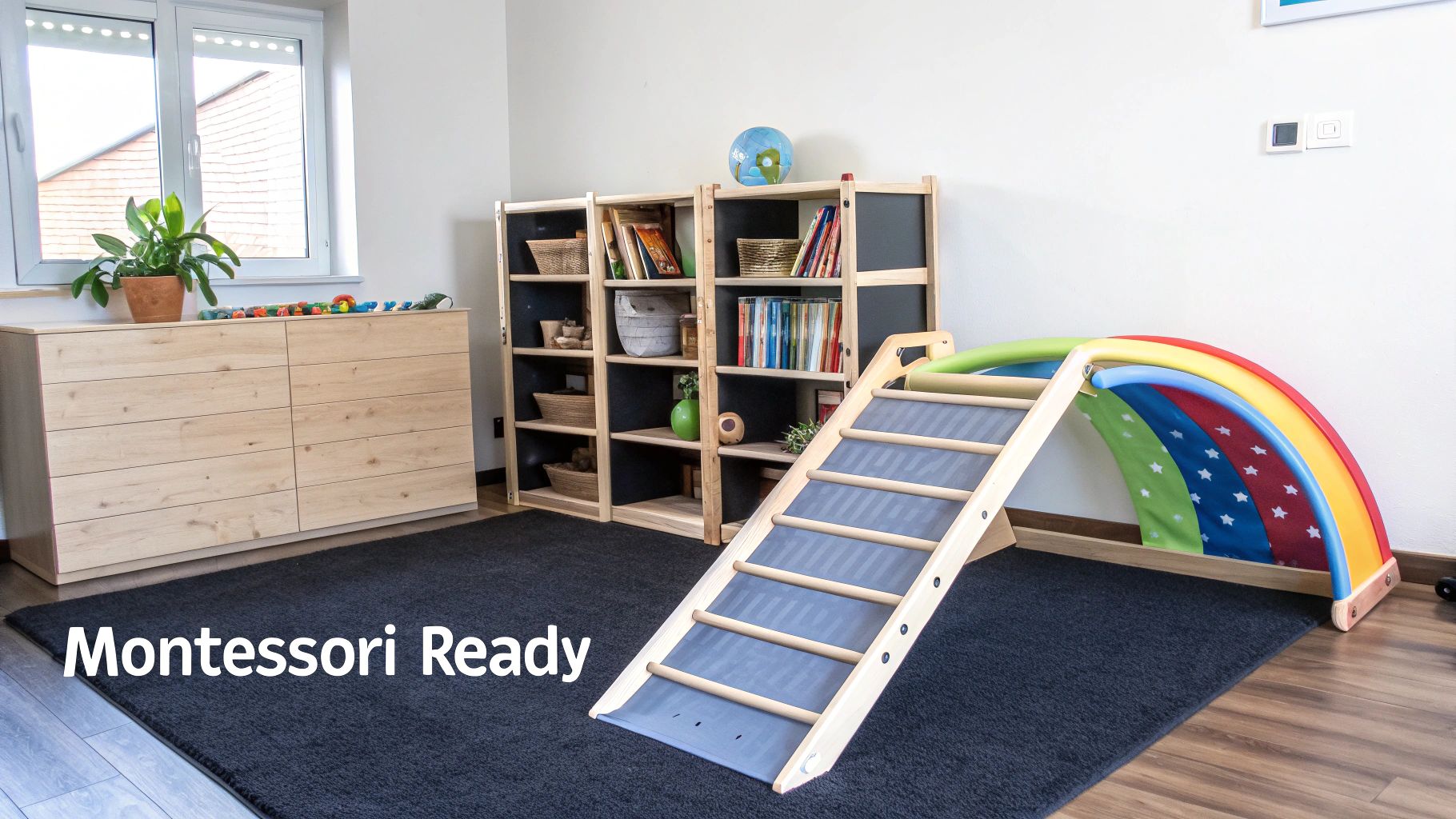
First thing's first: where to put it? You'll want to find a safe, open spot where your little one has plenty of room to move around without bumping into the coffee table. Always place it on a stable, flat surface with a soft landing zone underneath—a thick rug or a non-slip play mat works perfectly. This simple step provides security without taking away from the challenge.
Fostering Independent Exploration
Once the triangle is set up, the next step is both the most important and the easiest: do nothing. Seriously. Resist the urge to show your child how to climb or place them on the rungs. A core idea in both Pikler and Montessori is trusting the child's own ability to discover and learn at a pace that feels right for them.
Just present the triangle as another part of their environment. Let them approach it, touch it, and explore it when they are ready. This hands-off approach builds true, deep-seated confidence because every milestone—from that first pull-up to reaching the very top—is entirely their own achievement.
Your role is to be a calm, reassuring presence. Stay close enough to supervise but try not to hover. When you avoid phrases like "be careful!" you're sending a powerful message: "I trust you to know your own limits." That's a foundational life skill right there.
Evolving the Challenge with Accessories
One of the best things about a quality Pikler triangle is its ability to grow right alongside your child. Just as they start to master the basic frame, you can introduce new challenges by adding accessories. This keeps the experience fresh and continuously supports their developing skills.
Many Ocodile-compatible sets, for example, offer cool additions that expand the world of play:
- Ramps and Slides: A reversible ramp is a game-changer. It often has a smooth side for sliding and a cleated side for climbing, adding a whole new dimension. This encourages kids to problem-solve how to handle different inclines.
- Arches and Rockers: Connecting the triangle to a climbing arch creates a longer, more complex obstacle course that’s fantastic for balance and coordination. The arch can also be used on its own as a rocker or a tunnel.
- Imaginative Play: Never underestimate the power of a simple blanket. Draped over the top, it instantly transforms the climber into a cozy fort, a secret cave, or a mountain hideout. This is where gross motor play meets creative storytelling.
By thoughtfully introducing these elements, the Pikler triangle Montessori setup becomes a dynamic centerpiece for active, imaginative development for years to come.
A Guide to Safe and Age-Appropriate Play
When you bring a Pikler triangle into your home, safety is the foundation for all the amazing developmental play that follows. The real beauty of this simple climbing frame is how it meets your child right where they are, making it a perfect fit from the moment they can pull themselves up through their busy preschool years.
Knowing how kids typically interact with a climber at different stages is key. It helps you create a secure space for them to explore, and the journey starts much earlier than most parents think.
From Pulling Up to Confident Climbing
Babies as young as 6 to 7 months often use the lowest rungs to pull themselves into a standing position. This is their first real lesson in leverage and body awareness, turning the triangle into a sturdy support as they work on a huge gross motor milestone.
Once they hit the toddler years, their confidence and coordination really take off. You’ll see them start to experiment, placing their feet on the rungs for a slow, careful climb. This is such a critical time for them to build balance and problem-solving skills as they figure out how to shift their weight and plan their next move. For a deeper dive into this timeline, check out our guide on Pikler triangle age recommendations.
By the time they're preschoolers, many have mastered climbing all the way over the top and down the other side. It’s a massive accomplishment that gives their self-esteem a real boost. The triangle becomes a centerpiece for all sorts of imaginative games.
The Pikler triangle’s design is brilliant because it encourages self-assessed risk. Children will almost always climb only as high as they feel comfortable, which teaches them to listen to their bodies and understand their own limits.
To give you a clearer picture, here’s a quick breakdown of what you can expect at different ages.
Pikler Triangle Milestones by Age
| Age Range | Typical Interaction | Developmental Focus |
|---|---|---|
| 6-12 Months | Pulling to stand, holding onto rungs for support. | Gross motor skills, balance, body awareness. |
| 1-2 Years | Tentative climbing up a few rungs, exploring with feet. | Coordination, problem-solving, spatial awareness. |
| 2-3 Years | Climbing higher, attempting to go over the top. | Confidence, motor planning, strength building. |
| 3-5 Years | Confidently climbing over, using it for imaginative play (forts, etc.). | Agility, creative thinking, independent play. |
Remember, these are just general guidelines. Every child develops at their own pace, and the goal is to follow their lead.
Essential Safety Protocols
To give your child the freedom to explore safely, a few simple ground rules are all you need. These non-negotiables will give you the peace of mind to step back and let your little one lead the way.
- Constant Supervision: An adult should always be nearby and attentive. Think of yourself as a calm spotter, not a director. Your job is to offer a steady hand if needed, not to interfere with their process of discovery.
- Stable Placement: Always set the triangle up on a flat, even surface. This prevents any wobbling or tipping. A hardwood floor or a low-pile rug works perfectly.
- Soft Landing Zone: Place a non-slip mat or a thick, dense rug underneath the climber. This cushions any tumbles, which are a totally normal part of learning to move and climb.
- Clear the Area: Make sure the space around the triangle is free of other toys, furniture, or hard objects. This gives them plenty of room to move and a clear landing zone if they slip.
Following these simple steps helps you create the perfect Pikler triangle Montessori environment—one that encourages independence, respects your child’s pace, and puts safety first.
Frequently Asked Questions About the Pikler Triangle
Bringing a new developmental tool into your home naturally comes with a lot of questions. We’ve gathered the most common ones we hear from parents about the Pikler triangle and its connection to Montessori to help you feel confident in your choice.
When Should I Introduce a Pikler Triangle?
There’s no magic date on the calendar for this one—it’s all about following your child’s unique developmental timeline. Many families find the sweet spot is around 6 months, right when their baby starts trying to pull themselves up. At this stage, the rungs offer the perfect, sturdy support for this huge gross motor milestone.
As they grow into confident toddlers, you’ll see them start to explore climbing the rungs. Before you know it, your preschooler will be mastering the climb all the way over the top, turning it into the base for all kinds of imaginative games. The trick is to introduce it early and then step back, letting your child lead the way at their own pace.
Is a Pikler Triangle Really Worth the Money?
A well-made Pikler triangle is definitely an investment, but its real value goes way beyond what you’d expect from a typical toy. Unlike plastic gadgets that are outgrown in a season, the triangle is a long-term developmental tool. It serves your child for years, transforming from a simple pull-up bar for your infant to a cozy fort for your five-year-old.
When you factor in its durable build and the incredible range of skills it supports—everything from gross motor strength to risk assessment—the long-term value is undeniable. It easily replaces the need for several less versatile toys and supports core developmental skills that will stick with them for life.
How Is It Different from a Playground Climber?
While they both get kids climbing, their core purpose couldn't be more different. Think about a typical playground climber: it usually has a set path, like a specific ladder you're meant to go up and a slide you're meant to go down. The design tells the child how to play.
The Pikler triangle, on the other hand, is completely open-ended. It’s an invitation, not a set of instructions. This child-led approach empowers kids to solve problems, figure out their own physical limits, and discover new ways to move—a true hallmark of the Montessori philosophy.
Should I Try to Build My Own Pikler Triangle?
The DIY route can be tempting, but this is one of those times where safety really has to come first. Reputable brands that produce Pikler triangles use precision engineering to ensure the rung spacing is perfect, the locking mechanisms are secure, and all the surfaces are smooth and splinter-free.
They also use certified, non-toxic materials and put their designs through rigorous safety testing to make sure they are stable. Given how critical these safety features are, buying from a trusted manufacturer who lives and breathes child-safe construction is the most reliable way to protect your child’s well-being.
At Ocodile, we are dedicated to creating furniture that supports your child’s independence and safe exploration. Discover our full range of child-focused, Montessori-aligned products at https://ocodile.com.