



Platform Bed Full Size Mattress: A Parent's Guide
The moment usually comes fast. One week your child is still happily climbing into a crib, and the next they're swinging a leg over the rail, asking for a “big kid bed,” or waking up in a room that suddenly feels too babyish for who they're becoming.
That's when a lot of parents start searching for a platform bed full size mattress and realize the choices get confusing immediately. Size, height, slats, foam, off-gassing, guardrails, ventilation. None of those decisions are small when the person using the bed is still little, still learning body awareness, and still likely to roll, climb, bounce, and test every edge.
A full-size platform bed can be a smart long-term move for a child. It gives more room to grow, keeps the sleep surface accessible, and fits well with a Montessori-style room where independence matters. But the mattress choice has to support that goal. A mattress that's too tall, too soft, poorly ventilated, or poorly supported can undermine the safety benefits of the bed itself.
The Big Move to a Big Kid Bed
It often starts at bedtime. Your child climbs out without help, asks for a “real bed,” or wakes up upset after feeling boxed in by a crib that suddenly seems too small. That moment feels emotional, but the decision that follows is practical. The bed needs to support growing independence without creating a setup that is higher, softer, or less stable than a young child can handle safely.
A platform bed with a full-size mattress is a common long-term choice for that reason. It gives a child room to stretch, roll, and settle, and it gives parents enough space to sit for stories, fever nights, or the long phase of “stay with me for one more minute.” For Montessori-minded families, the lower profile also supports a room a child can use without constant lifting, boosting, or rescue.
What parents usually appreciate first is convenience. What matters more over time is risk reduction.
Why parents often choose platform beds
A platform setup tends to work well for young children because it keeps the sleep surface closer to the floor and removes the extra height of a box spring. That lower height can reduce the force of an overnight tumble, and it makes getting in and out easier for small bodies that are still developing coordination.
It also solves a problem I see often in kids' rooms. Parents buy a sturdy frame, then add a thick mattress and extra foundation until the whole bed sits much taller than they intended. A platform bed helps prevent that stack-up.
A few practical advantages stand out:
- Lower access: Many children can climb in and out on their own.
- Built-in support: The frame is designed to hold the mattress without a box spring.
- Less accidental height: Fewer layers usually mean a safer overall bed height.
- More years of use: A full size often lasts well past the toddler stage.
Independence is part of safety here, not separate from it. A child who can get into bed, get out, and move around the room without a big drop is working within their actual physical abilities.
A good big-kid bed should feel calm to the child and uneventful to the parent.
If you are still sorting through the timing of the switch, Woodstock Outlet's transition tips focus on the emotional side of the move. For parents building a child-height room from the start, Ocodile shares a useful guide on transitioning from crib to bed.
What usually goes wrong
The first mistake is choosing for softness before safety. Plush beds photograph well, but young children do better with a setup that is stable, breathable, and not overly tall. Too much sink can make it harder for a child to reposition, and too much bed height can cancel out one of the main safety benefits of a platform frame.
The second mistake is treating the bed frame as the only safety decision. In real use, the mattress changes the whole setup. It affects edge height, firmness, heat retention, and how securely your child moves on the surface.
Start with three questions. Can my child get in and out safely? Is the sleep surface low and stable? Are the materials appropriate for a child who will spend long hours with their face close to this bed?
That order saves a lot of regret.
Getting the Size Right for Safety and Comfort
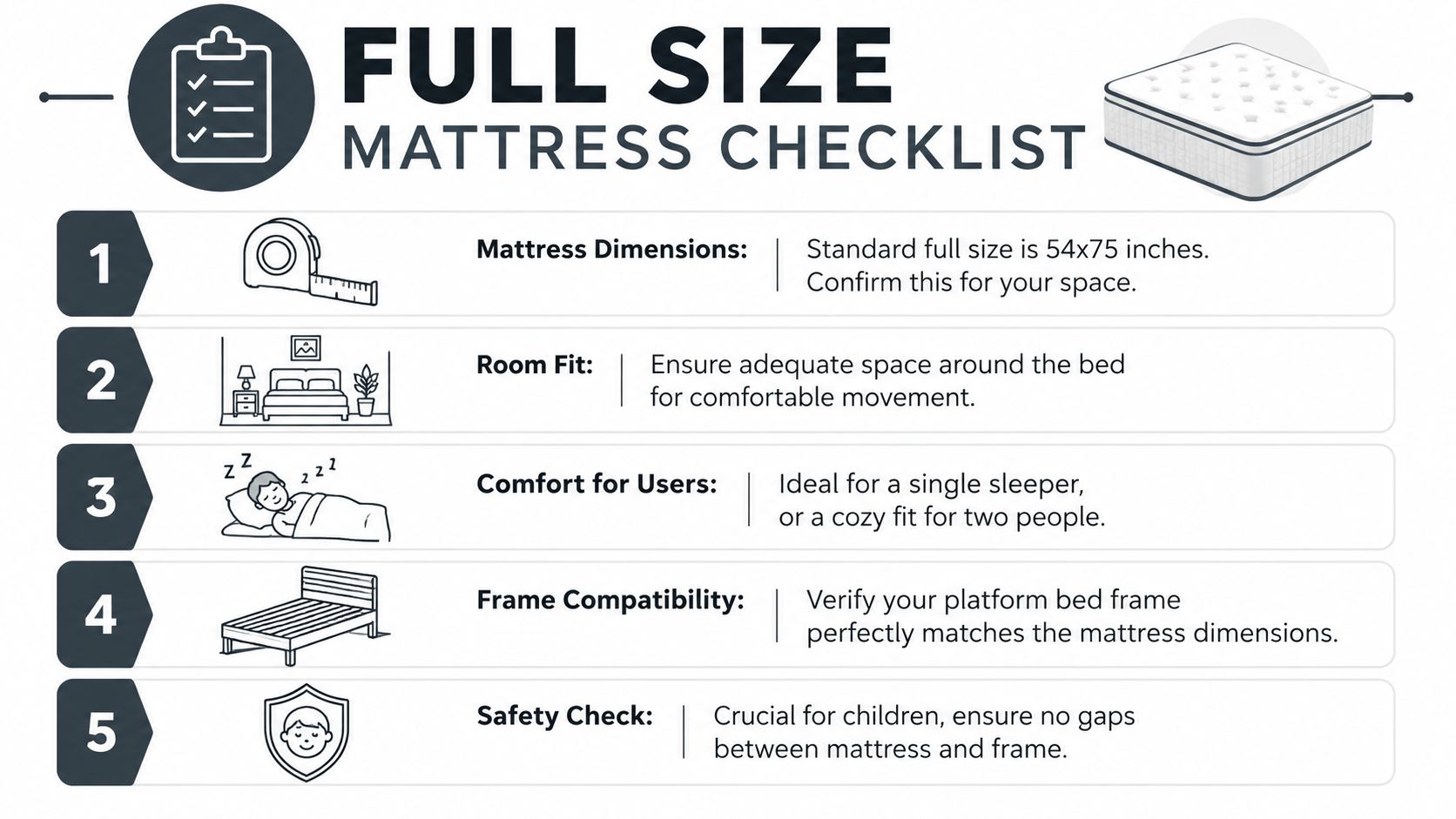
A full-size mattress isn't “big” in an abstract sense. It has a defined footprint, and getting that right matters. A standard full mattress measures 54 inches wide by 75 inches long, and the frame around it is usually slightly larger so the mattress stays in place rather than sliding side to side. Sierra Living Concepts also places Full in the standard size family alongside Twin (38" x 75"), Queen (60" x 80"), and King (76" x 80") in its platform bed frame guide.
For a child, full size is often the sweet spot. It offers more room than a twin for movement, parent snuggles, and growth, but it doesn't dominate a room the way larger sizes can.
The part many parents miss
Mattress thickness often matters more than mattress width.
The lower profile of a platform bed is one of its biggest safety benefits. The low height is tied to child-centered design because reducing the vertical distance from the floor to the mattress surface reduces fall severity, as noted in this overview of low-profile platform bed safety for children. If you place an overly thick mattress on that low frame, you raise the sleep surface and lose part of that advantage.
That issue becomes even more important if the bed uses side rails or partial guardrails. A mattress that sits too high can leave too little barrier above the mattress line, which makes the rail less useful when a child rolls.
What to check before you buy
Use this quick filter when evaluating a platform bed full size mattress setup:
- Measure the actual frame opening: A full mattress should sit securely inside the frame without large gaps.
- Look at the finished bed height: Think about where the top of the mattress will land, not just the height of the frame.
- Check rail relationship: If there are rails, make sure the mattress won't swallow them visually and functionally.
- Watch for bulky pillow tops: Thick comfort layers can make a bed feel plush but also raise the edge.
Practical rule: If your goal is a child-safe, low-profile bed, don't judge the mattress by softness first. Judge it by the final height it creates.
Full size is roomy, but the room still has to work
A full mattress gives flexibility, but parents should still walk the room mentally before ordering. Can your child get around the bed easily? Is there enough floor space for dressing, reading, and safe movement at night? A Montessori-style room works best when the child can move through it without squeezing past furniture.
A full bed should support freedom, not crowd it.
The Foundation of Good Sleep Slats and Support
A mattress only performs as well as the surface under it. Parents spend hours comparing foams and fabrics, then place the mattress on a weak frame with wide gaps. That's like buying good tires and putting them on a bent rim.
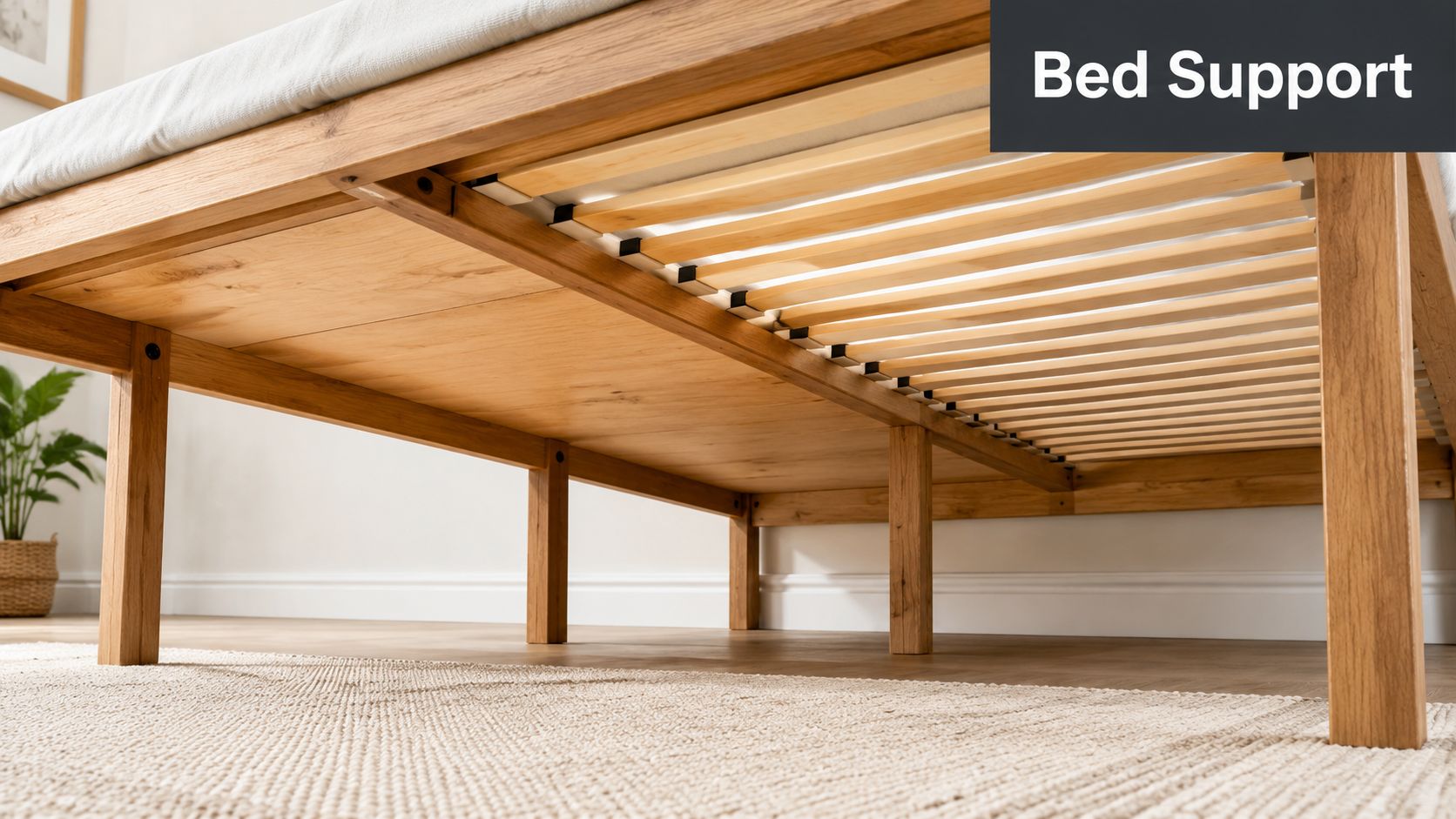
A platform bed works because it gives the mattress a continuous, stable base. That support usually comes in one of two forms: a solid deck or slats. Both can work. Both can also fail if the construction is poor.
Solid deck versus slats
A solid platform feels firm and stable. It can be a good match for families who want minimal movement under the mattress. The trade-off is airflow. If the design doesn't account for ventilation, the mattress can hold more heat and moisture.
A slatted platform usually gives better airflow. It also makes it easier to inspect the structure over time. But slats have one essential requirement. They need to be close enough together to support the mattress evenly.
A platform bed uses a rigid surface or closely spaced slats, typically less than 3 inches apart, to provide continuous support and remove the need for a box spring, according to this summary of platform bed slat spacing requirements.
The 3-inch rule matters
When slats are spaced too far apart, the mattress dips into the gaps. Children may not describe that as “poor support.” They'll just sleep on a surface that feels lumpy, unstable, or oddly soft in the middle.
To put it in the simplest terms:
- Close slats: The mattress stays level and supported.
- Wide slats: The mattress starts bridging gaps instead of resting on a base.
- Over time: Sagging, wear, and uneven feel show up much sooner.
A furniture engineering overview notes that platform beds often use slats spaced less than 3 inches apart and that the support system is built as a singular plane rather than a separate foundation. It also describes frame dimensions commonly running 56 to 59 inches wide and 77 to 80 inches long for a full mattress, with many frames benchmarked around a 500 lb load capacity.
No, you don't need a box spring
This is one of the most common points of confusion. Parents worry that placing a mattress directly on a platform bed means it won't be supported enough. In reality, the platform is designed to replace the box spring.
That matters for safety because one less layer keeps the bed lower and more stable. If you're comparing styles or considering custom builds for a child's room, these custom platform bed options can help you see how different support structures are integrated into the frame itself. If you're building instead of buying, Ocodile's full-size platform bed plans are useful for understanding how slat layout and frame construction affect mattress performance.
Here's a quick visual if you want to inspect the support system more confidently before buying.
Mattress Matchmaker Foam Innerspring or Latex for Kids
A mattress for a child's platform bed does two jobs at once. It has to support sleep, and it has to support safe, predictable movement during the parts of childhood that happen before sleep begins. Reading, rolling, climbing in, climbing out, and the occasional bounce all change how a mattress performs in a kid's room.
That is why I look at mattress type through a safety lens first, then comfort.
How the major mattress types behave
| Mattress Type | Best For | Potential Downsides | Firmness Feel |
|---|---|---|---|
| Memory foam | Children who like a quieter, cushioned feel and need even surface contact | Can sleep warmer for some kids and may feel slower to respond when they move | Contouring and steady |
| Innerspring | Kids who like a more traditional bed feel with some bounce | Extra bounce can encourage rough play, and lower-quality models can feel less even over time | Livelier and more buoyant |
| Latex | Families prioritizing resilience, a responsive feel, and lower chemical concern | Often feels firmer than expected and may not match children who want a deep sink-in feel | Springy and supportive |
| Hybrid | Families trying to balance cushioning with stronger edge and core support | Heavier and more complex, so frame support matters even more | Balanced, with some contour and some bounce |
What tends to work well for children
Memory foam usually gives the most stable surface on a platform bed. For younger children transitioning into a floor-level or low platform setup, that steady feel can help with body awareness and reduce the trampoline effect that turns bedtime into playtime. The trade-off is heat and slower response. Some kids love the cocooned feeling. Others fight it every time they roll over.
Innerspring mattresses are easy to test in a store because the feel is immediate. They can also make it easier for some children to get in and out of bed without sinking. The downside is practical. More bounce often means more jumping, and more jumping means more fall risk, especially in Montessori-style rooms where children have freer access to the bed.
Latex is the option I often point parents toward if they want a responsive surface and care a lot about material quality. It springs back quickly, sleeps cooler than many foam builds, and usually holds its shape well. But it can feel firmer than parents expect, especially for lighter children who do not weigh enough to compress the comfort layers much.
Hybrids sit in the middle. They can work well for school-age kids who want some cushioning without that stuck feeling. They also tend to be heavier, which matters if you rotate the mattress often or if the bed frame is lighter-duty.
For a child who is still learning safe movement, a mattress that is stable and easy to get off usually works better than one that feels extra plush or extra bouncy.
Match the mattress to the child, not the marketing
A toddler or preschooler in a low platform bed often does best with a medium-firm foam or latex mattress that keeps the sleep surface flat and predictable. That setup fits the Montessori goal of independence better because the child can climb in and out without fighting deep sink or unstable edges.
An older child who sleeps hot, changes positions constantly, or hates slow-moving foam may be happier on latex or a simpler hybrid. A child who seeks pressure relief and likes to feel tucked in may prefer foam, as long as the mattress does not trap too much heat.
Parents who are also sorting through indoor air quality concerns should review what GREENGUARD Gold certified mattresses are designed to address before choosing between foam, latex, or hybrid builds.
A parent-first way to decide
Skip brand slogans and watch your child.
- Hot sleeper: Favor breathable materials and a surface that does not hold too much body heat.
- Restless mover: Choose a mattress with quicker response so position changes feel easy.
- Sensitive to smells: Check certifications, ask about off-gassing, and let the mattress air out before first use.
- Climber and jumper: Reduce bounce and avoid overly tall, overly plush builds that make falls less predictable.
- Newly independent sleeper: Prioritize stable edges and a surface height that lets the child get down safely.
If you want another plain-language resource while narrowing options, Guynn Furniture's mattress selection tips are useful because they help parents think through comfort and support without turning the process into a science project.
Beyond Comfort Safe Materials and Healthy Certifications
A child spends long hours with their face pressed close to a mattress. That alone should make materials part of the buying decision, not an afterthought.
Parents often focus on firmness and price first, then glance at certifications at the very end. I'd reverse that. If a mattress smells harsh out of the box, uses vague language about “eco” materials, or refuses to say what standards it meets, that's a sign to slow down.
What the labels should tell you
The goal isn't to collect logos. The goal is to know what the mattress manufacturer is willing to verify.
Here's how I think about common certification language:
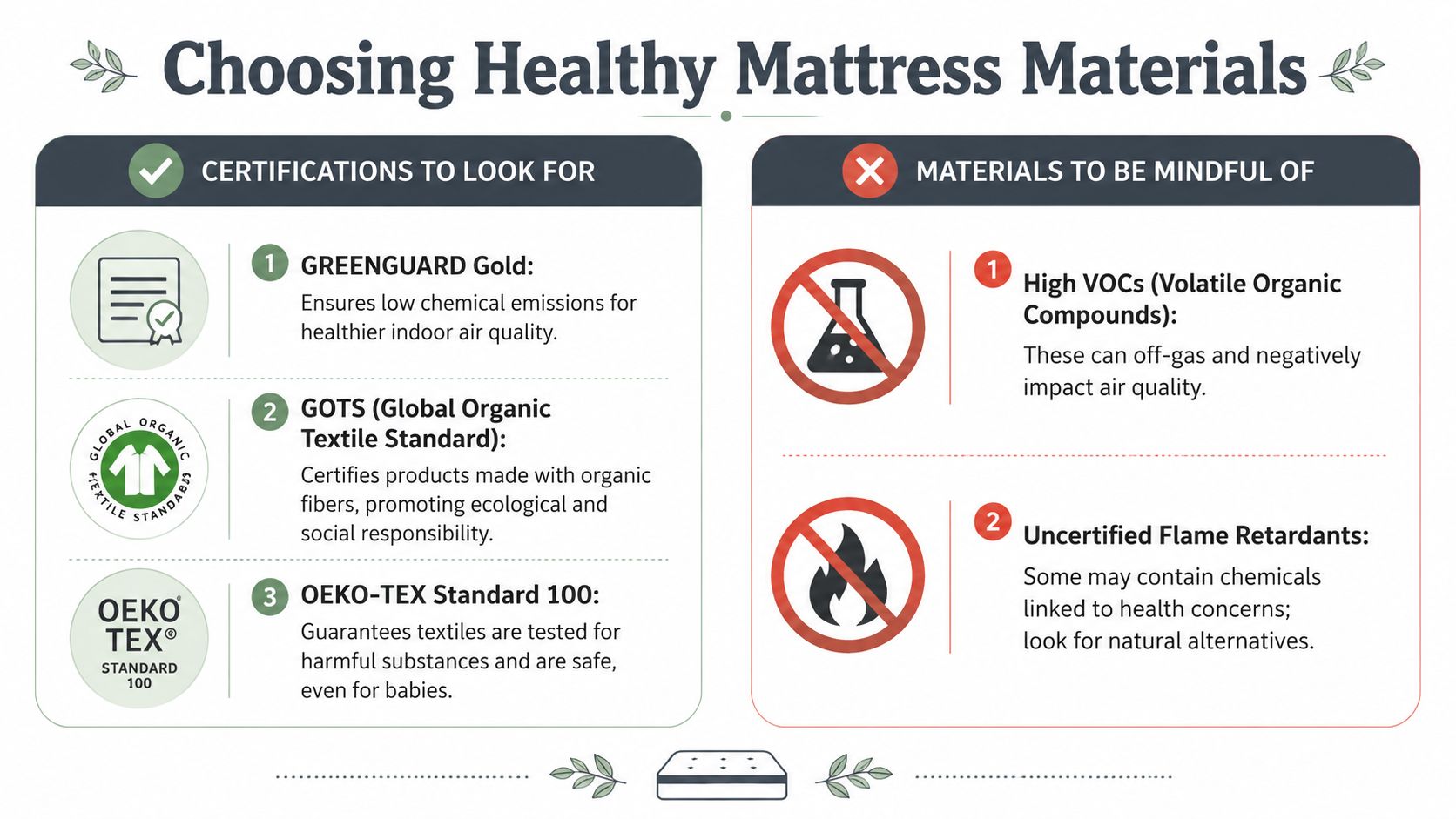
- GREENGUARD Gold: Useful when indoor air quality is a big concern, especially in smaller bedrooms.
- OEKO-TEX Standard 100: Helpful for textile components because it signals testing for harmful substances.
- GOTS: Relevant when organic textile content is part of your priority list.
- CertiPUR-US: Common on foam products and often one of the first things parents look for when they want more clarity about foam composition.
The exact mix will vary by mattress. What matters is that the brand gives you something specific and checkable, not vague reassurance.
Materials to approach carefully
Some mattresses feel plush and polished online but get fuzzy fast when you read the details. If you can't tell what's inside, assume you need more information.
Watch for:
- Unclear foam descriptions: If the foam type is hard to identify, it's harder to judge safety and longevity.
- Heavy odor after unpacking: Some off-gassing can happen, but strong lingering smell deserves attention.
- Missing certification details: If a brand names standards without showing clear product-specific information, keep digging.
- Vague fire barrier language: Parents should know what sits between their child and the mattress core.
Parent note: A mattress can feel comfortable and still be the wrong choice if the materials list raises more questions than it answers.
For families sorting through indoor air quality concerns, Ocodile's guide to GREENGUARD Gold certification gives a useful plain-English explanation of why low-emission standards matter in children's rooms.
Healthy materials won't make a mattress perfect. But they do remove one layer of uncertainty, and that matters when the room is supposed to be a place of rest, not a chemistry experiment.
Your Final Checklist for a Safe and Cozy Sleep Haven
The best setup is the one that stays safe after the excitement of delivery day wears off. A bed can look perfect in the room and still need a few practical checks before you call it done.
Start with the mattress and frame as a system, not as separate purchases. The bed should be low enough to support safe access, stable enough to prevent wobble, and breathable enough to avoid trapping heat and moisture.
The checklist I'd use in a store or on a product page
- Confirm the mattress is standard full size: That means 54 by 75 inches so it matches the frame correctly.
- Check the finished height: Think about the child climbing in, rolling near the edge, and waking at night.
- Inspect support underneath: Slats should be close and sturdy, or the platform should be solid and well built.
- Look for healthy material certifications: Don't rely on marketing words alone.
- Read the return policy carefully: Comfort is hard to judge until your child sleeps on it.
Ventilation deserves more attention
This is the maintenance issue many families miss, especially with storage beds or tightly packed rooms. A 2023 report highlighted that 29% of children's sleep environments experienced overheating issues linked to poor mattress ventilation, a problem that can be worse where under-bed storage restricts airflow, according to Get Laid Beds' discussion of low platform bed ventilation concerns.
That doesn't mean you need to fear storage. It means you should be thoughtful about it.
- Leave breathing room: Don't pack every inch beneath the bed with bins.
- Lift and inspect: Check under the mattress now and then for trapped moisture or musty smell.
- Rotate the mattress: Follow the maker's care guidance so wear stays more even.
- Recheck the frame: Slats can loosen, shift, or crack with time and use.
Beds for children should be easy to inspect. If a setup hides problems until they become obvious, it's harder to manage safely.
What works best over time
The setups that age well are rarely the fussiest ones. A low, sturdy platform bed with a properly fitted full-size mattress, breathable support, and clearly labeled materials tends to stay practical through growth spurts, bedtime reading phases, sleep regressions, and the years when kids start claiming their room as their own.
That's the ultimate goal. Not a showroom bed. A sleep space that supports rest, independence, and everyday safety without constant adjustment.
If you're building a child-first bedroom and want furniture designed around safety, independence, and practical family use, take a look at Ocodile. Their approach fits the kind of room many parents are trying to create: simple, accessible, and made for real daily life with young children.