


The 1-Minute Sand Timer: A Parent's Guide
Some days with a toddler can feel like one long negotiation. You ask for shoes, your little one runs away. You say it’s time to clean up, and suddenly the blocks become the most important thing in the world. We’ve all been there, trying to move the day along without turning every transition into a battle.
That’s where a 1-minute sand timer can help change the mood of the whole room. Not because it controls children, but because it gives them something they can readily understand. A minute is short, visible, and manageable. For a young child, that matters more than most of us realize.
Your Secret Weapon for Smoother Toddler Days
You’re at the park. Your little one is happy, muddy, and completely uninterested in leaving. You say, “One more minute,” but those words don’t land. To us, they sound clear. To a toddler, they can feel vague, sudden, or even unfair.
Now try a different scene. You kneel down, hold up a 1-minute sand timer, and say, “When the sand is all at the bottom, we’re putting on shoes.” Your child watches. The ending is no longer hidden inside your words. It’s right there in front of them.

I’ve used this approach in classrooms and at home, and the shift is often immediate. Not perfect. Not magical in the storybook sense. But calmer. More predictable. Less personal. The timer becomes the helper, so we don’t always have to be the “bad guy.”
Practical rule: Use the timer before resistance starts, not after the meltdown begins.
There’s something comforting about how old this tool is, too. The earliest sand timers date back to ancient Egypt in the 14th century BCE, and over time they evolved into tools for navigation and daily life before becoming the familiar household timers many families use today for children’s routines, as noted in this history of early sand timers.
What makes it work so well
A 1-minute sand timer helps because it is:
- Visible: Your little one can see time passing.
- Finite: A minute feels possible.
- Neutral: The timer ends the activity, not an adult’s sudden decision.
- Repeatable: Children learn the pattern quickly.
That’s why this small object often becomes one of the most useful tools in a family home.
Why a Minute Matters for Little Minds
Young children don’t experience time the way we do. Adults think in schedules, delays, and next steps. Toddlers mostly live in two categories: now and not now.
When we say “later” or “in five minutes,” we’re asking a child to work with an abstract idea. That’s hard when they’re still building basic concepts of sequence, waiting, and duration. A 1-minute sand timer helps by turning time into something concrete. Your little one can watch it, anticipate the ending, and begin to connect what they see with what happens next.
Why visual time feels safer
A visible timer can reduce the tension around transitions because it answers the question many children carry without saying out loud: “When will this end?” When they can see the sand moving, the waiting has shape.
Visible sand timers reduce anxiety around time limits and give young learners a clear way to understand a 60-second interval, which is one reason many Montessori-oriented families find them so helpful for independence and calm routines.
When a child can see time, they don’t have to guess what the adult means.
That’s also why some families use a 1-minute sand timer for children who benefit from extra structure. An emerging trend shows a 35% rise in queries for “1-minute sand timer accuracy for ADHD routines,” highlighting growing interest in reliable visual tools for focus and daily routines, according to this summary of timer interest and accuracy concerns. The same source notes that some budget timers can vary by 10-15 seconds, so consistency matters.
Where parents often get stuck
The confusion usually isn’t about whether a timer helps. It’s about how to use it without making everything feel rushed.
A one-minute timer is not for hurrying your child through the whole day. It’s for giving shape to short moments like these:
- Finishing a turn: “You may have one more minute with the truck.”
- Starting a task: “Let’s see if we can put socks on before the sand runs out.”
- Practicing waiting: “The timer is for waiting while I warm your lunch.”
- Creating a pause: “We’ll sit until the sand is done.”
A simple way to introduce it
Try this order:
- Name the task clearly: “When the sand is done, books go back on the shelf.”
- Show the timer at eye level: Let your little one see the top and bottom.
- Flip it once, then stay calm: Avoid adding lots of extra words.
- Follow through gently: The timer only builds trust if we use it consistently.
That trust matters more than speed. The timer isn’t there to pressure your child. It’s there to make the day feel understandable.
Everyday Magic with a 1-Minute Sand Timer
The beauty of a 1-minute sand timer is how easily it fits into real family life. It’s small enough to keep by the sink, on a low shelf, or beside a basket of books. Once your little one understands what it means, you can use it again and again in ways that feel playful instead of pushy.

Morning moments that start the day better
The toothbrush battle is the classic example for a reason. Instead of standing over your child repeating, “Keep brushing,” you can flip the timer and let them watch the sand fall while they brush. It gives the task a beginning, middle, and end. That feels much fairer to a child than a parent deciding when enough is enough.
Getting dressed can work the same way. If your little one feels overwhelmed by shirts, socks, and pants all at once, use the timer for just one part. “Let’s do socks while the sand runs.” A minute turns a large task into one manageable burst.
A short timer works best when the job is small and clear.
Midday uses that reduce friction
Clean-up time becomes easier when it feels like a game instead of a demand. We might say, “Let’s do a one-minute tidy-up and see how many blocks make it back to the basket.” The goal isn’t perfect organization. The goal is momentum.
Waiting is another overlooked use. If lunch isn’t ready, if a sibling is having a turn, or if you need to finish one quick task, the timer helps your child see that waiting has an endpoint. That can make a hard moment feel less endless.
Here are a few tried-and-true uses from everyday family life:
- Toy turn-taking: Flip the timer so each child gets a visible turn with a favorite item.
- Puzzle persistence: Encourage one more minute before giving up on a tricky piece.
- Snack table sitting: Use a calm minute to stay seated and finish eating.
- Hand washing: Pair the timer with scrubbing and rinsing so the routine has structure.
Evening routines that feel gentler
Evenings often unravel because everyone is tired. A 1-minute sand timer excels in these situations, creating a soft landing instead of another command.
A quiet minute with one book can help your little one shift from active play to rest. A one-minute clean-up before pajamas keeps the task from feeling huge. Even putting dirty clothes in the hamper can become “your one-minute helper job.”
A simple rhythm might look like this:
| Part of the evening | How the timer helps |
|---|---|
| Toy pick-up | Makes clean-up short and clear |
| Toothbrushing | Gives a visible end point |
| Book basket reset | Builds responsibility without pressure |
| Pre-bed pause | Signals that the house is slowing down |
What matters most is not using the timer for everything. Pick a few pressure points in the day and start there. When a tool is used thoughtfully, children don’t experience it as control. They experience it as clarity.
How Sand Timers Support Montessori Learning
A sand timer fits beautifully into a Montessori-style home because it turns an abstract idea into a concrete material your child can use independently. That’s a big deal. Young children learn best when they can touch, see, and repeat something for themselves.
Visible sand timers reduce anxiety around time limits and give children a concrete way to understand a minute, which aligns closely with Montessori principles of hands-on learning and independence, as described in this overview of visible timer benefits for young learners.
The child can do it, not just observe it
A timer is simple enough for a young child to manage. They can carry it, place it, flip it, and watch it without needing constant adult interpretation. That matters in a prepared environment where we want materials to support self-direction.
In Montessori practice, we often ask: does this tool help the child act with more independence? A 1-minute sand timer usually does.
- It supports self-initiation: A child can flip it before starting a task.
- It makes limits visible: The boundary is in the material, not only in adult language.
- It encourages repetition: Children can try the same routine again and again in a familiar way.
It respects the child’s need for order
Young children thrive on predictable patterns. A sand timer helps create order without making the environment feel rigid. “First we brush, then we watch the sand finish, then we rinse” is simple, calm, and easy to repeat.
That’s why timers pair so well with practical life routines like pouring, dressing, hand washing, and tidying. If you enjoy building those kinds of habits at home, these Montessori practical life activities for everyday independence offer a helpful next step.
The best Montessori tools don’t entertain the child. They orient the child.
A timer won’t replace patience, connection, or a thoughtfully prepared room. But it can support all three. In that sense, it’s much more than a parenting trick. It’s a quiet aid for self-regulation.
Choosing a Safe and Durable Timer for Your Child
Not every 1-minute sand timer is made with family use in mind. Some look charming on a shelf but don’t hold up to daily handling. Others may be inexpensive, yet inconsistent enough that your child loses trust in them. If we want a timer to become part of a routine, it needs to be safe, sturdy, and reliable.

Quality 1-minute timers achieve accuracy through precise sand grain calibration, with about 60 grams of sand moving through a 2-4mm aperture, and many classroom-ready models use shatterproof plastic construction with molded end caps to protect the inner glass, according to this product specification for a classroom sand timer.
What to look for first
For homes with toddlers and preschoolers, I’d pay attention to these features before color or style:
- Shatter-resistant outer casing: A plastic exterior helps protect the inner timer during drops.
- Molded end caps: These keep the structure more secure during repeated use.
- Easy visibility: Your child should be able to clearly see the sand moving.
- Comfortable size for little hands: It should be easy to grasp, carry, and flip.
If your family is also evaluating child-safe materials in the wider home environment, this guide to non-toxic kids furniture for family spaces is worth reading alongside your timer search.
Why consistency matters more than perfection
Children notice when tools behave unpredictably. If a timer sometimes feels much longer or shorter than expected, routines can become harder rather than easier. That doesn’t mean you need lab-grade precision. It does mean the timer should feel dependable from one use to the next.
This short video gives a helpful look at the kind of timer many families consider for repeated use.
If you’d like a broader look at timer styles beyond sand models, I also like David Pexa's guide to productivity timers because it helps parents think through visibility, simplicity, and everyday usability without overcomplicating the decision.
A quick checklist for buying
| Priority | What it means in real life |
|---|---|
| Safety | It can handle bumps, drops, and daily child use |
| Visibility | Your little one can easily track the sand |
| Durability | It stands up to repeated flipping |
| Consistency | It supports routines your child can trust |
When in doubt, choose the timer that looks boringly sturdy. That’s often the one that gets used every day.
Integrating Timers with Your Ocodile Furniture
A timer works best when it has a home. Instead of tucking it in a drawer and forgetting about it, place it where routines already happen. That small shift helps your little one connect the tool to the task without extra reminders.

In a child-led home, furniture and tools should work together. A timer near the sink supports hand washing. A timer by a low shelf supports clean-up. A timer beside a sleeping area supports a predictable wind-down.
Create simple timer stations
Think of the timer as part of the environment, not an extra parenting gadget. A few thoughtful placements can make routines smoother:
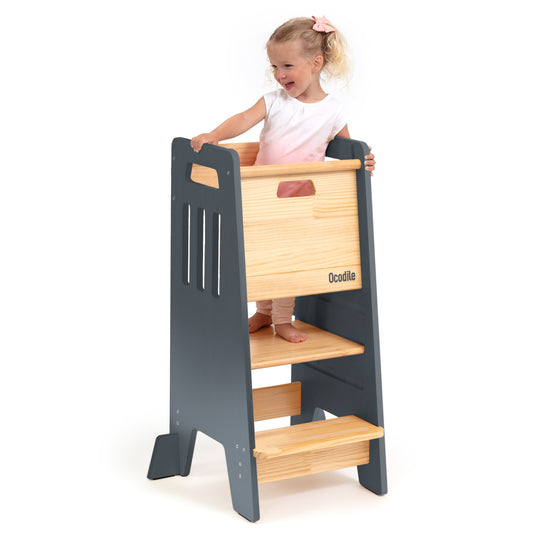
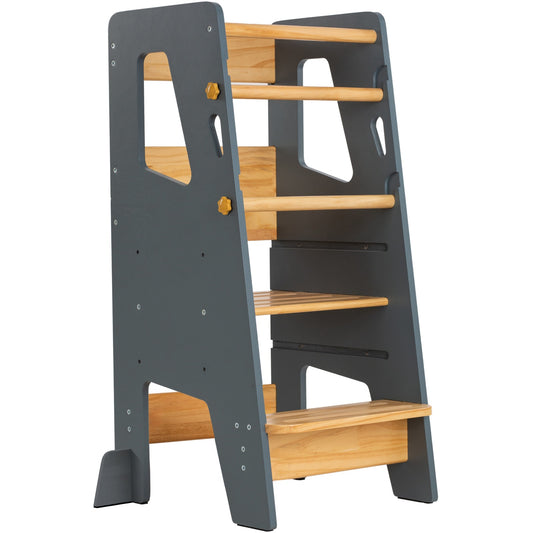
- At the kitchen helper area: Use it for taking turns stirring, pouring, or waiting while a parent finishes one step. Families who use a helper tower often find that this setup supports calmer kitchen participation. This guide to the learning tower kitchen helper in daily family routines shows how that kind of space can encourage independence.
- Near the floor bed or book nook: A quiet one-minute pause with a book can signal that rest time is getting closer.
- Beside a step stool at the bathroom sink: Pair the timer with brushing teeth, washing hands, or a quick face wipe.
- On a low toy shelf: Flip it for tidy-up bursts or turn-taking with a favorite toy.
Keep the setup calm and repeatable
The timer should be easy to reach, easy to see, and used in the same way most days. That repetition is what helps a child trust the routine. If the timer shows up only when adults are frustrated, it starts to feel like a warning. If it lives in the environment and appears during ordinary transitions, it feels supportive.
Keep the timer where the action happens. Young children respond better to tools they can reach than rules they have to remember.
This is the power of a 1-minute sand timer in a modern home. It brings old-fashioned simplicity into the exact spots where family life gets messy, busy, and wonderfully real.
If you’d like to create a home that supports this kind of calm independence every day, explore Ocodile. Their child-friendly furniture is designed to help your little one participate safely in routines, play, and practical life right alongside you.