



Childrens Pull Out Beds: Best Children's Pull Out Beds
The need for an extra bed usually shows up at the least convenient moment. A sibling suddenly wants to share a room. A cousin is staying over. Your child had a rough night and you ended up wishing there were a second sleep spot already built into the room instead of an air mattress wedged between toys and a bookshelf.
That's why so many parents start looking at childrens pull out beds. They solve a real problem without asking you to give up the whole floor plan of the room. You get a bed for daily use, another sleeping space tucked underneath, and in some cases extra flexibility for guests, siblings, or bedtime support.
They're also part of a much bigger shift toward practical family furniture. The global kids' beds market reached $18.4 billion USD in 2025 and is projected to keep growing, which reflects steady demand for safe and practical sleep solutions, including pull-out and floor beds, according to Wise Guy Reports on the kids' beds market.
Your Guide to Space-Saving Sleep Solutions
One of the most common room-design mistakes is treating a child's bed like a single-purpose object. In real homes, it rarely is. It becomes the reading spot, the parent-comfort station, the sleepover setup, the sibling backup bed, and sometimes the only open floor area left in the room.
That's where pull-out beds earn their place. During the day, the room still works like a child's room. At night, you can create a second sleep surface in seconds instead of dragging out folding bedding from a closet.

Why families choose them
Parents usually come to this option for one of a few reasons:
- Shared rooms: Two children need separate sleep spaces, but the bedroom won't comfortably hold two full frames.
- Sleepovers and visitors: You want a guest bed that doesn't dominate the room every day.
- Nighttime support: A parent may need to stay nearby during illness, transitions, or sleep regressions.
- Flexible growth: The room needs to adapt as your child changes, not force a full redesign every year.
A good pull-out bed should disappear when you don't need it and work smoothly when you do.
The best choices balance three things at once. They save space, support safe sleep, and fit the way your child uses the room. That last part matters more than most product roundups admit. A bed can look beautiful online and still be awkward to pull, too high for a younger child, or frustrating to use with standard bedding.
What works in everyday use
In practice, the strongest options are usually the simplest ones. A low-profile daybed with a smooth trundle often works better than a complicated setup with decorative panels, hard-to-reach pulls, or bulky side parts that catch bedding and fingers.
A smart purchase also looks beyond the frame. The pull-out mechanism, mattress thickness, room clearance, edge finish, and your child's ability to use it safely all matter. Those details are what make a bed either helpful or annoying after the first week.
Understanding Pull Out Bed Types and Mechanisms
Not every pull-out bed works the same way. “Trundle bed” is the term many stores use, but the mechanism underneath can be very different from one model to the next. That difference affects comfort, safety, room flow, and how easy the bed is for an adult or child to use.
The three common styles
A standard rolling trundle is the simplest version. It is a low bed on wheels that slides under the main frame. You pull it out when needed and push it back in when you're done. This style works well for occasional guests, siblings in small rooms, and homes that want the easiest setup.
A pop-up trundle starts low like a standard trundle, but the lower bed can rise up after it's pulled out. That can create two side-by-side sleep surfaces at a similar height. Some families like this because it feels less like one child is sleeping “on the floor” and more like a flexible guest arrangement.
A drawer-style trundle blends storage and sleep. These often look cleaner from the outside, but the mechanism can be more restrictive. In some designs, the mattress space shares room with drawers, which can reduce flexibility for bedding or make the pull-out section feel tighter.
Pull-Out Bed Mechanism Comparison
| Mechanism Type | Best For | Consideration |
|---|---|---|
| Standard rolling trundle | Sleepovers, guest use, simple daily operation | Needs clear floor space in front of the bed |
| Pop-up trundle | Siblings, flexible two-bed layout, guest comfort | Lifting mechanism should feel stable and easy to lock |
| Drawer-style trundle | Rooms that need storage and occasional extra sleep space | Can be heavier to operate and less forgiving with mattress fit |
What parents often miss
The mechanism matters as much as the look. If the trundle catches on rugs, drags on the floor, or requires a strong pull every time, people stop using it. Then the “space-saving” feature becomes dead storage under the bed.
If you're comparing styles and want to explore convertible options at Gates, it's useful to look at how different designs handle multi-use sleeping without making the room feel crowded. Even if you don't choose a convertible format, it helps sharpen your eye for how motion, clearance, and access affect daily use.
Practical rule: Pull the lower bed out fully before buying if you can. If the movement feels awkward in a showroom, it won't feel better at home.
Which type usually works best
For most families, the standard rolling trundle is the easiest place to start. It has fewer moving parts and fewer surprises. Pop-up styles can be excellent, especially for older children or guest use, but only when the lift mechanism feels secure and not wobbly. Drawer-style models make sense when storage is the top priority, but they require closer attention to interior dimensions and mattress compatibility.
Matching the Bed to Your Child's Developmental Stage
The right bed isn't only about age. It's about what your child can do safely and confidently without constant adult correction. Some children are ready for a pull-out setup earlier because they move carefully, understand simple room rules, and can climb in and out without drama. Others need more time, even if they're older.
Readiness matters more than a birthday
A child is usually a better match for this kind of bed when they can:
- Get in and out smoothly: No jumping, sliding headfirst, or needing repeated rescue.
- Follow a simple boundary: They understand that the pull-out section isn't a toy to open and close all day.
- Use bedding with basic cooperation: They can help straighten blankets or step aside while an adult sets up the lower bed.
- Handle nighttime movement: They can orient themselves if they wake in the dark and need to get up safely.
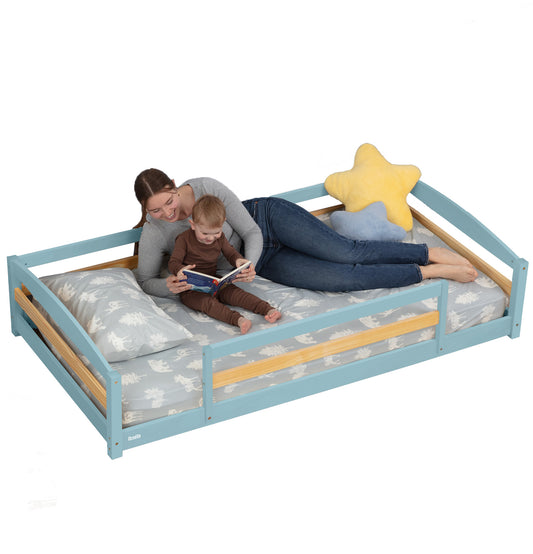
That's why a low frame often works better than a tall one, especially in a Montessori-style room. It supports independence because the child can access the sleep space with less climbing and less risk.
Size and use should grow with the child
A bed can fit a room and still be wrong for the stage your child is in. If the lower trundle is intended for a sibling who'll use it often, daily access becomes a bigger issue than if it's just for occasional guests. A younger child may do best on the main bed with the lower trundle reserved for a parent or visitor. In other homes, the opposite makes more sense because the lower surface feels more approachable.
Here's the trade-off many families face:
- A very low setup supports self-access but may feel less substantial for older kids.
- A heavier, taller frame may last longer visually and structurally but can be less child-friendly in the early years.
- A multi-use daybed shape can work for reading and rest, but it needs enough side openness to avoid feeling boxed in.
A few developmental cues that help
If a child still treats furniture as gym equipment, a pull-out mechanism needs extra caution. If they're in the stage of wanting to “do it myself,” a smooth-glide low bed can support independence beautifully.
This is also where manufacturer guidance matters. Weight limits, mattress depth limits, and intended use for the trundle section are not decorative fine print. They tell you what the bed was built to do. Parents should check those details before assuming the lower bed can handle frequent use, adult use, or rough handling from active children.
The best bed for development is the one your child can use predictably, not the one with the most features.
Navigating Critical Safety Standards and Features
Small bed details change the safety profile fast. A frame can look sturdy, modern, and expensive and still have risky gaps, poor rail geometry, or moving parts that aren't suitable for children. For pull-out beds, safety starts with the same principle that applies to every child sleep setup. The simpler and more controlled the design, the better.
The non-negotiable measurements
For raised beds, guardrails must be at least 5 inches above the mattress surface, and all structural gaps must be under 3.5 inches to prevent a child's torso from passing through, according to the CPSC-related bunk bed safety requirements summary. That standard is most relevant when a child bed has a raised sleep surface, and it becomes especially important when a manufacturer combines pull-out features with lofted or raised elements.
Mattress thickness affects this directly. A bed can leave the factory with acceptable guardrail clearance, and then lose that safety margin when a thicker mattress is added. Parents often focus on comfort first and unintentionally reduce the protective height the rail was meant to provide.

Why lower beds still need real safety thinking
Some parents assume the lower a bed is, the less they need to worry. That's not how injuries work in real homes. A nationwide study found that 76% of bed-related fall injuries in children originated from conventional beds, while bunk bed falls were generally more severe, according to the PubMed study on pediatric bed injuries. In other words, ordinary beds deserve ordinary vigilance.
That should change how you inspect a pull-out model. Don't reserve careful checking only for bunks and lofts. Standard beds also need thoughtful design, especially if a child uses them independently.
What to inspect before buying
Use this checklist when you see a bed in person or evaluate one online:
- Check moving parts: The trundle should open without sudden release, twisting, or exposed pinch points near hands.
- Inspect the edge finish: Corners, side rails, and pull handles should feel smooth, not sharp or rough.
- Look at wheel behavior: Casters should track straight and not skid unpredictably when the bed is pulled.
- Confirm mattress fit: The mattress shouldn't leave side gaps that could trap limbs or bunch bedding.
- Assess frame stability: The main bed shouldn't shift when weight is added to the top or when the lower bed is pulled.
- Review material and fire-safety information: It helps to understand how children's furniture materials are regulated, especially when finishes and textiles are involved. Ocodile's overview of furniture flammability standards is a useful starting point for that part of the decision.
Features that tend to work better
Beds with fewer decorative cutouts usually perform better from a safety perspective because there are fewer openings to evaluate. Recessed handles tend to be gentler than protruding pulls. Solid side panels can reduce awkward hand placement, though they need to be balanced with airflow and easy bedding access.
If a mechanism needs force, a child will either struggle with it or misuse it. Neither outcome is ideal.
The strongest safety mindset is simple. Treat the bed like a moving piece of equipment, not just a static frame. If it slides, lifts, folds, or locks, test each action with your child's real habits in mind.
A Parent's Guide to Materials Mattresses and Maintenance
Material choices affect more than appearance. They shape how the bed ages, how easy it is to clean, how much it rattles after months of use, and whether the whole setup still feels reliable once a child starts climbing, leaning, and pulling on it every day.
Materials that age well
Solid wood and high-quality plywood usually hold up better than low-grade composite builds in childrens pull out beds. They tend to feel steadier, tolerate repeated movement more gracefully, and are easier to inspect when something loosens over time. Thin panels and weak fastener points often show problems first around the pull-out section, where friction and daily motion put stress on the structure.
Parents should also pay attention to finish quality. A bed used by children gets touched constantly, often with damp hands, rough toys, and the occasional cup that should never have been near the bed in the first place. A finish that chips easily won't stay attractive or easy to maintain.
Mattress fit is not a small detail
Mattress choice changes function fast. The trundle mattress has to fit the designed height allowance. If it's too thick, the lower bed may not close properly, bedding may bunch, and any intended clearance or support can be compromised.
If you want a broader overview of feel, support, and mattress shopping basics, this Ruidoso mattress guide is a useful companion resource. For younger sleepers specifically, Ocodile's guide to the best mattress for toddler bed helps narrow the comfort and fit questions that come up when a child is transitioning.
A practical reminder belongs here. A nationwide study found that 76% of bed-related fall injuries in children originate from conventional beds, according to the earlier-cited pediatric injury research. That's one more reason to avoid sloppy mattress fit or unstable bedding arrangements even on low beds.
Keep the bed safe after assembly
A well-built bed still needs upkeep. The moving part underneath is what usually changes first with use.
- Tighten hardware regularly: Bolts and connectors can loosen from repeated pull-out motion.
- Clean the track or wheel path: Dust, toy pieces, and rug fibers can make the trundle drag or tilt.
- Watch for frame twist: If the lower unit starts closing unevenly, don't force it. Find the source.
- Recheck the mattress profile: New toppers, pads, or folded blankets can interfere with fit.
Most bed problems show up gradually. A squeak, a drag, or a wheel that veers is usually an early warning, not a harmless quirk.
Designing a Montessori-Friendly Space with a Pull Out Bed
The usual advice about pull-out beds focuses on floor space. That's useful, but it misses the more important question in a child's room. Does the bed help the child use the room independently, or does it create one more adult-controlled object they can't manage safely?
There's still a real guidance gap here. The available discussion around children's sleep environments often centers on bed access and need, not on how convertible or pull-out beds fit into child-led room design. The PolicyLab project at Children's Hospital of Philadelphia highlights the importance of pediatric sleep, and it also points to how little practical guidance exists around convertible bed design in spaces meant to support autonomy.

When a pull-out bed fits Montessori values
A Montessori-aligned room supports access, order, and freedom within safe limits. A pull-out bed can fit that approach if the design is low, easy to understand, and not mechanically fussy. The child should be able to approach the bed calmly, get in and out without climbing, and understand how the room changes when the lower bed is open.
That means the bed should not dominate the room. It should serve the child's routines.
A few setup choices make a big difference:
- Keep the frame low: The child can enter and exit more naturally.
- Leave clear walking paths: The room should still function when the trundle is open.
- Use reachable storage: Low bookshelves and simple baskets reinforce independence around bedtime.
- Avoid overcomplicated bedding: If the child can help reset the bed, the setup is more likely to support ownership.
For more ideas on room layout and child-height access, Ocodile's article on the Montessori bedroom for toddler offers a helpful design lens.
What doesn't work well
A tall, heavy, highly decorative trundle often fights the Montessori goal even if it saves space. If the lower bed requires adult strength, catches on the floor, or introduces visual clutter, the child can't engage with it meaningfully. In that case, the room may still be stylish, but it's not especially child-centered.
Another common mistake is assuming that “independence” means full unsupervised use of every moving part. It doesn't. Independence works best when the environment gives the child safe choices, not unlimited control over furniture mechanics.
This short visual gives a helpful example of a child-centered room approach in practice:
A better way to think about the bed
In a Montessori room, the bed is part of the child's daily rhythm. They rest there, read there, sometimes calm down there, and learn how to care for their own space around it. The best pull-out bed subtly supports those habits. It doesn't need to be flashy. It needs to be understandable.
A child-friendly room isn't only small-scale. It's legible. The child can tell what belongs where and how the room is meant to work.
Your Final Buying Checklist and Pull Out Bed FAQ
A good buying decision usually comes down to restraint. The best childrens pull out beds are rarely the ones with the longest feature list. They're the ones that fit the room, match the child, and stay easy to use after the novelty wears off.

Buying checklist
- Measure the full footprint: Check the bed closed, open, and with bedding in place.
- Test the pull action: It should glide smoothly without jerking, scraping, or twisting.
- Match the height to the child: Lower is often easier for independence and safer for everyday use.
- Confirm the mattress allowance: Don't guess. The trundle needs the right profile to function properly.
- Inspect the materials: Favor sturdy construction and finishes that can handle real family life.
- Check for entrapment and pinch concerns: Look closely at gaps, handles, and all moving parts.
- Think about who will sleep where: Guest use, sibling use, and parent-support use all call for different priorities.
- Review a second opinion before buying: If you want another perspective focused specifically on styles and shopping criteria, this trundle bed buying guide is worth a look.
FAQ
Are pull-out beds safe for children who sleep independently
This question is still poorly answered in most mainstream content. The national bedlessness discussion from SHP shows how often children's sleep conversations focus on access to beds rather than the safety of specific convertible designs. In practice, a pull-out bed can be safe for independent sleep when the frame is stable, the mechanism is smooth, the mattress fits correctly, and the child is developmentally ready for the setup.
Is the trundle best for the younger child or the older child
It depends on height, ease of access, and who uses the bed most often. Many families place the younger child on the lower surface because it feels more approachable. Others keep the younger child on the main bed if they want the trundle reserved for guests or parent support.
Are pop-up trundles better than standard trundles
Not automatically. Pop-up styles can be more versatile, but they add mechanism complexity. A standard rolling trundle is often easier to maintain and easier to trust over time.
Can a pull-out bed work in a Montessori room
Yes, if it stays low, simple, and easy to access. The bed should support the child's routines, not make the room harder to understand or use.
If you're looking for child-focused furniture that puts safety, independence, and calm design first, Ocodile is worth exploring. Their approach is built around practical family life, with products designed to help children participate more confidently in everyday routines while giving parents peace of mind.