



Childrens Pull Out Beds: Find Your Ideal Children's Pull
You might be reading this while standing in your child's room, trying to solve three problems at once. You need a bed that fits. You want something safe. And you'd love it if that bed also helped your child feel a little more capable and settled in their own space.
That's where children's pull out beds can make a lot of sense.
Parents often shop for them as a space-saving fix, but that's only part of the story. A well-designed pull-out bed can also support independence. It can give a young child easier access than a tall bed, offer a sibling sleep setup without crowding the room all day, and create a more flexible rhythm for families who need one room to do many jobs.
The tricky part is that these beds come in several forms, and the differences matter. Some are great for occasional sleepovers. Some work better for siblings. Some feel much closer to a Montessori-style low bed. Some look neat online but create safety or layout problems in real homes.
A good choice starts with understanding how the bed works, how your child moves, and how the room will function on an ordinary Tuesday night, not just in a styled product photo.
Understanding Childrens Pull Out Beds Types and Mechanisms
A children's pull-out bed is any bed with a second sleeping surface that stores underneath or folds out from the main piece. The category sounds simple, but the mechanisms behave very differently.
Some glide like a drawer. Some roll on casters. Some rise up to match the main mattress height. That one difference changes how easy the bed is to use, how independent a child can be with it, and whether it makes sense for everyday sleeping or occasional guests.
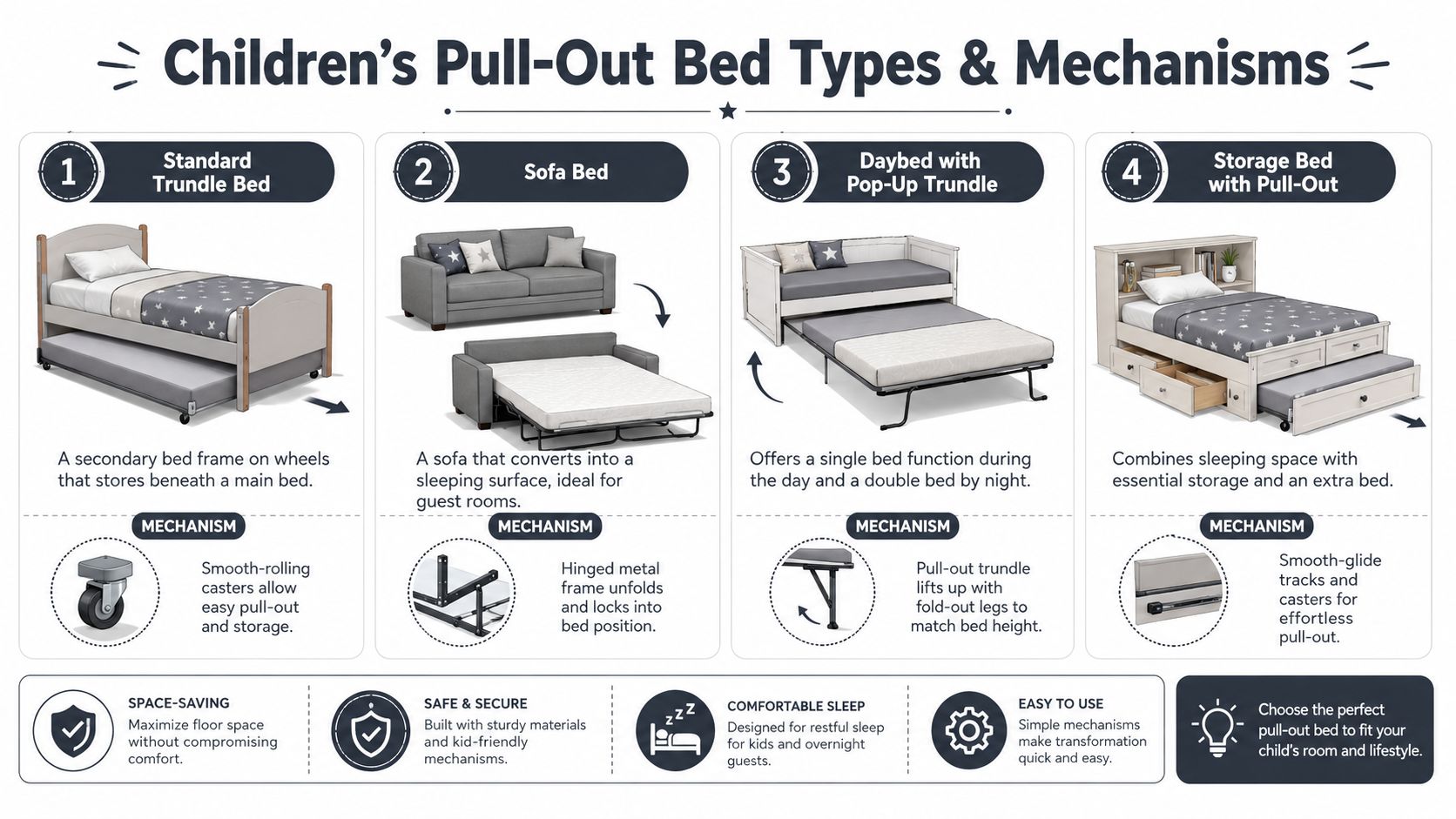
The main types parents usually see
Here's the simplest way to picture the common options:
| Type | How it works | Best for | Watch out for |
|---|---|---|---|
| Drawer bed | Slides out like a deep drawer under the main bed | Younger children, low-profile rooms, Montessori-inspired access | Mattress height is often limited |
| Traditional trundle | A separate lower frame rolls out, often on wheels | Sleepovers, siblings, guest flexibility | Wheels and tracking need to move smoothly |
| Pop-up trundle | Pulls out, then lifts upward to near main-bed height | Creating a larger sleep surface or guest-ready setup | Lift hardware adds complexity |
| Convertible daybed or sofa bed | Main furniture changes shape or reveals a second sleep surface | Multi-use rooms | Everyday setup can take more effort |
A drawer bed is the closest cousin to a floor-bed mindset. It stays low, looks calm in a child's room, and is often easiest for a child to understand. Pull, stop, lie down. That simplicity matters.
A traditional trundle is similar, but it usually feels more like a separate bed hiding under another bed. It may roll farther and more freely, which is useful, but it can also mean you need better floor clearance and more parent involvement.
Why the mechanism changes the experience
The mechanism affects more than convenience.
A low drawer-style setup often supports self-access better. A pop-up trundle supports flexibility better. A rolling trundle may be perfect for weekend cousins but annoying for nightly use if the floor is uneven or the frame shifts.
Practical rule: If your child will use the lower bed often, choose the simplest motion with the fewest steps.
Parents also get confused by language. One retailer may call a bed a trundle, another may call it a pull-out, and a third may market the same idea as a guest bed. Focus less on the label and more on three questions:
- How does it move: Does it slide, roll, fold, or lift?
- Who can use it alone: Can your child open it safely without pinched fingers or heavy lifting?
- How often will it be used: Every night, some nights, or only when friends stay over?
Those answers usually point you to the right category faster than any product filter does.
The Ultimate Safety Checklist for Pull Out Beds
It is 10 p.m., your child is tired, and a bed that felt simple in the showroom now has wheels, gaps, corners, and moving parts to manage in dim light. That is the true safety test. A good children's pull out bed should support sleep, yes, but it should also support growing independence without asking a child to handle risks they cannot yet judge.
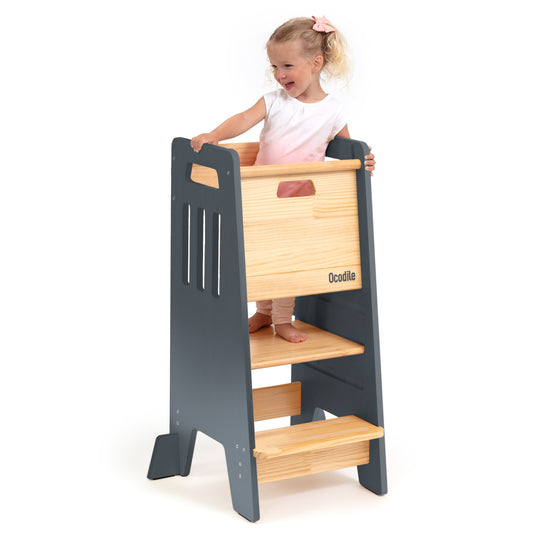
A children's bed should be assessed as a whole system. Look at the frame, the height, the pull-out motion, and the space around it. The goal is not only to prevent accidents. It is to create a setup a child can use with confidence, the way a well-designed step stool helps a child wash hands safely instead of waiting for help every time.
The two measurements that matter most
Start with openings and height.
For children's pull-out beds that fall under trundle-bed or convertible-bunk style safety rules, the upper structure should avoid openings large enough to create an entrapment hazard. Guidance used for bunk-style beds also treats bed height as a key threshold, because a higher sleep surface may require continuous guardrails. You can review those bunk-style safety requirements in this guide to bunk bed safety requirements.
Those measurements are easy to overlook because they do not feel as visible as color, storage, or style. Yet they often matter more. A bed can look calm and child-friendly while still creating a risky gap or a fall hazard.
A parent's required checklist
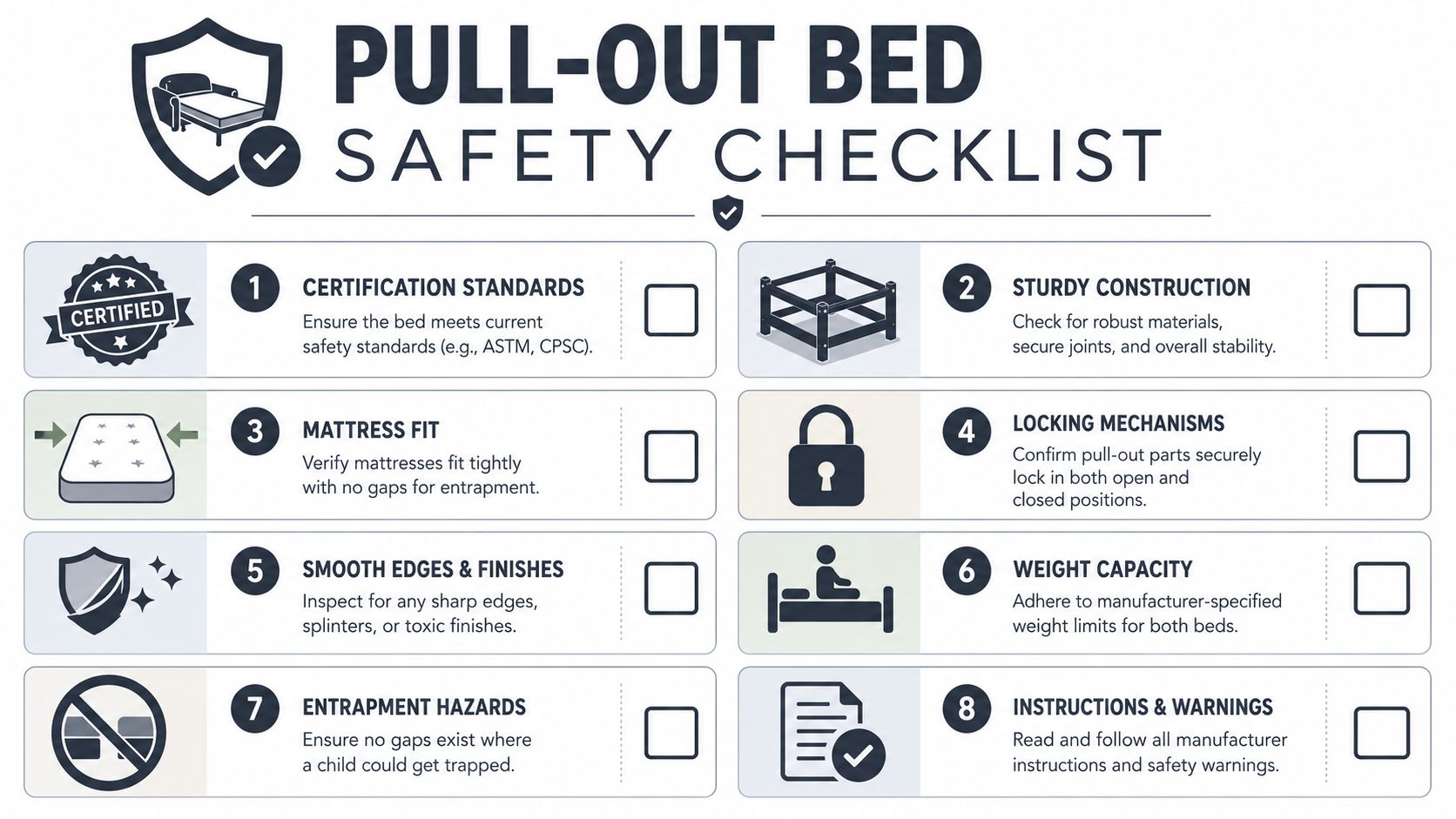
Use this list before you buy, after delivery, and again once the bed is fully assembled.
- Check every opening: Look at headboards, side panels, and decorative cutouts. Wide gaps can turn a pretty design into a trapping risk.
- Inspect rail coverage: If the sleep surface is high enough to need guardrails, the rails should run continuously where protection is needed, not stop short for looks.
- Test the pull-out path: Open and close the lower bed several times. It should move in a controlled way, without jerking, sticking, or racing forward.
- Check for pinch points: Watch where little fingers could land near tracks, hinges, handles, or lift points.
- Look at wheel behavior: If the lower section rolls, it should stay put during climbing and not drift across the floor.
- Confirm mattress fit: The mattress should sit snugly inside the frame, without large side gaps.
- Run your hand over edges and hardware: Feel for rough wood, sharp corners, exposed screws, and anything that catches a sleeve or scratches skin.
- Notice the finish and smell: A strong chemical odor means it is wise to ask about coatings, curing time, and whether the bed is ready for indoor use.
- Recheck fasteners after assembly: Loose bolts and reversed parts are common causes of wobble, dragging, and frame strain.
One more practical check helps a lot. Ask your child to show you how they would get in and out while you watch. You are not testing obedience. You are seeing whether the design matches their current coordination and judgment.
Safety in the room matters too
Even a well-built bed can become unsafe if the surrounding area is poorly set up. Cords, blind pulls, unstable shelves, hard nightstands, and crowded pathways all increase risk, especially when a child wakes in the dark or pulls the lower bed out half-asleep. This guide to childproofing your home is useful for checking the whole sleep zone, not just the bed itself.
If you remember only the core idea, remember this. A safe pull-out bed should be stable, predictable, and easy for a child to use correctly. That is what turns a flexible piece of furniture into a tool for both safety and independence.
Age Appropriateness When to Introduce a Pull Out Bed
Parents often ask for a perfect age, but readiness matters more than a birthday. A child can be physically tall enough for a new bed and still not be ready to manage the climbing, boundaries, or moving parts.
A pull-out bed works best when the child can get in and out calmly, follow simple sleep rules, and leave the mechanism alone during play. If the bed invites constant opening, closing, jumping, or hiding games, it's probably arriving too early or in the wrong form.
Signs your child is ready for the main bed
Many children transition well once they can:
- Climb in and out steadily: No panic, no awkward belly-flops, no need for a full rescue every night.
- Understand sleep boundaries: They know the bed is for resting, not for standing on the frame or launching off the side.
- Follow a short safety rule: For example, “Feet first when you get down.”
- Sleep with less containment: They no longer rely on crib sides to stay settled.
A lower bed frame usually makes this transition easier. It reduces the climb, supports confidence, and gives you fewer fall worries.
Readiness for the pull-out portion
The lower bed asks for a different skill set. A child using it should understand that the pull-out mechanism isn't a toy. They also need enough body awareness to avoid fingers near tracks, wheels, or lifting hardware.
That's why the lower section often works better for:
- occasional sleepovers
- an older sibling
- a child who already handles daily routines with less physical help
- homes where an adult will open and close the bed each day
If you have to repeat “don't play with that part” many times a day, choose a simpler bed.
A useful middle ground is a low-profile frame where the main sleep surface is easy for the child to access, but the pull-out section is still managed by the adult. That setup gives the child independence without giving the mechanism too much power in the room.
Children don't all mature at the same pace, so the best question isn't “Is my child old enough?” It's “Can my child use this bed calmly, safely, and with growing confidence?”
Choosing the Right Mattress and Sizing
A beautiful pull-out frame can become frustrating fast if the mattress is wrong. This is one of the most common mistakes parents make. They focus on the outer bed dimensions and forget that the lower section has to clear the frame, move smoothly, and still feel comfortable enough for real sleep.
Start with the pull-out clearance
The lower mattress usually has the stricter limit.
If it's too tall, the trundle may scrape the slats, bunch the bedding, or refuse to close fully. If it's too thin, the bed may technically function but feel unsupportive. That's why you should always check the manufacturer's stated mattress height allowance before buying any mattress at all.
Then compare that number to the actual mattress height, not the marketing label. Quilted covers and pillow-top styling can add bulk that matters inside a tight under-bed cavity.
Match size and sleep habits
Think in pairs:
- Main bed size: What does your child need for nightly comfort and growth?
- Pull-out bed size: Will it be for a sibling, a guest, or occasional use?
Most families do best when both mattresses are easy to dress with simple bedding and easy to remove for cleaning. If your child has allergies, night sweats, or frequent accidents, practical care matters as much as comfort. In these situations, protection for children, adults, and care homes can be a helpful resource, especially if you're deciding whether to add a waterproof layer without making the bed noisy or overly warm.
What to prioritize in the mattress itself
A child's mattress should feel supportive, breathable, and uncomplicated.
Look for:
- A compatible height: This comes first for the lower section.
- A snug frame fit: Gaps reduce safety and make the bed feel unfinished.
- Breathable materials: Children tend to sleep warm, and lower pull-out sections can trap air more than open bed frames.
- Easy-clean covers or protectors: Especially useful in shared rooms and frequent guest setups.
- Stable edges: Helpful when a child sits on the side to climb in.
If you're still deciding what mattress qualities matter most for a younger child, this guide to the best mattress for toddler bed is a practical starting point.
The best mattress choice is usually the simplest one that fits correctly, supports the body well, and doesn't fight the mechanism every time you open the bed.
Designing the Room Layout and Storage Solutions
A pull-out bed saves space only when the room lets it open fully. That's the part many parents discover too late. They measure the wall, buy the bed, assemble it, and then realize the trundle collides with a rug edge, toy basket, or door swing.
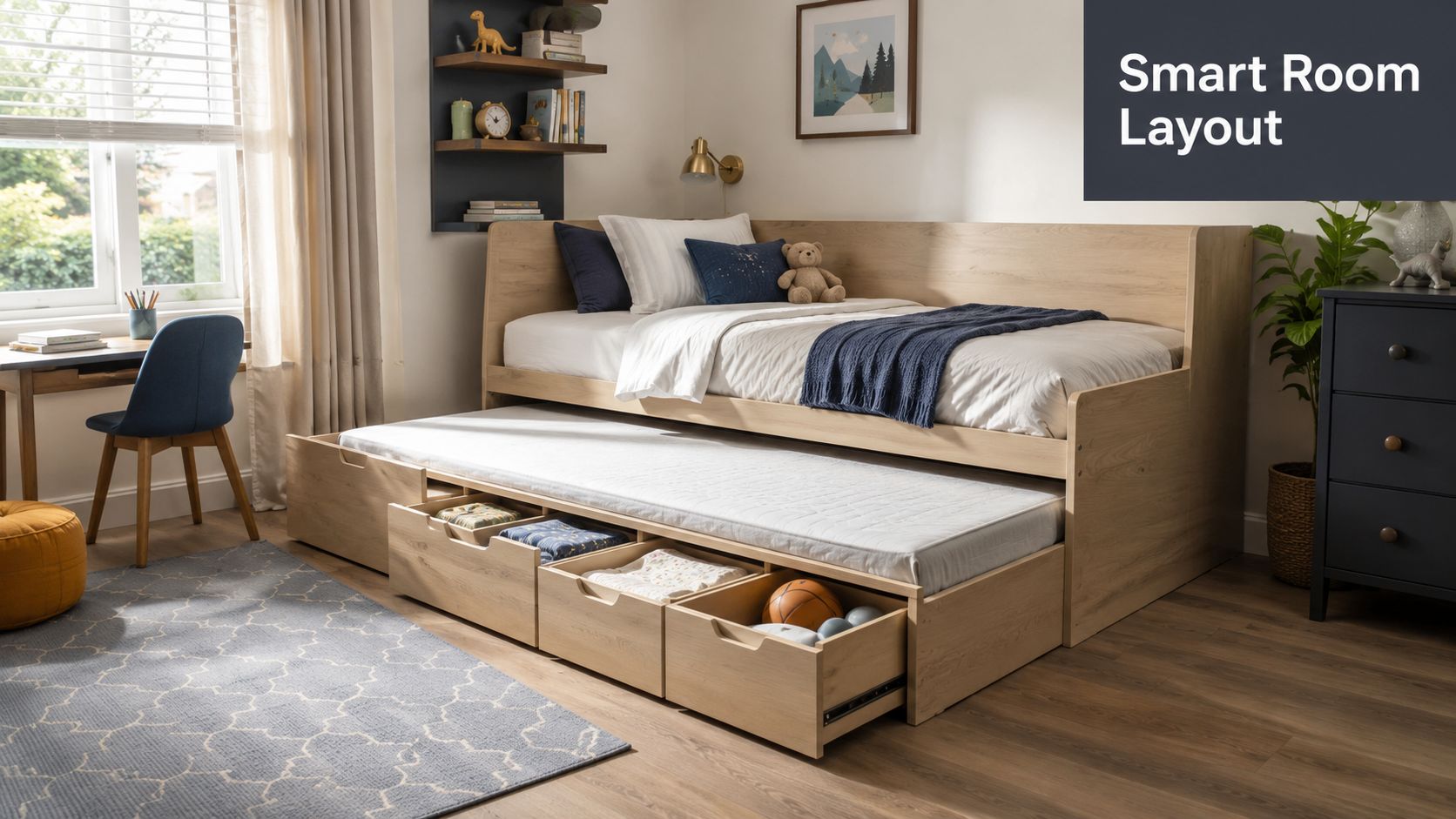
Measure the room the way the bed will actually work
Measure in layers, not just once.
First, measure the wall where the bed will sit. Then measure the open-floor path needed for the pull-out to extend. After that, check what else needs to function at the same time. Can the bedroom door still open? Can your child still walk to the window? Can you kneel beside the lower bed for bedtime?
A quick planning list helps:
- Bed footprint: The space the main frame occupies when closed
- Pull-out clearance: The full distance needed when the lower bed is open
- Walkway space: Room for feet, bedtime routines, and nighttime bathroom trips
- Furniture conflicts: Dressers, shelves, radiators, and door arcs
- Rug thickness: A thick rug can stop wheels or drag on the lower frame
Use the bed as part of a storage plan
The best room layouts treat the pull-out bed as one piece of a larger system.
If the bed includes drawers, assign them a clear purpose. Pajamas in one. Spare bedding in another. Books in a bin nearby rather than underfoot. If it doesn't include storage, pair it with narrow wall shelving, low toy baskets, or a dresser that doesn't block the extension path.
A child's room feels calmer when every object has a home and the bed area stays visually open. That matters for sleep, and it matters for independence. A child can only manage their space if they can reach and understand it.
Low storage often works better than tall storage in shared or compact rooms because children can use it without asking for help.
A moving example can help you visualize how much floor behavior matters in a compact setup:
A simple layout formula
Try this order when arranging the room:
- Put the bed on the longest uninterrupted wall.
- Keep the pull-out side free of heavy furniture.
- Place storage on the walls, not in the extension zone.
- Reserve a soft open area for dressing, reading, or play.
- Test the room at night with low light, because that's when the layout really proves itself.
A good layout doesn't just fit the bed. It supports bedtime, cleanup, and morning routines without friction.
Pull Out Beds vs Alternatives Trundles Floor Beds and Bunks
A pull-out bed is rarely the universal best choice. It's the best choice for some families, in some rooms, for some stages. Comparing it thoroughly against other options makes the decision much easier.
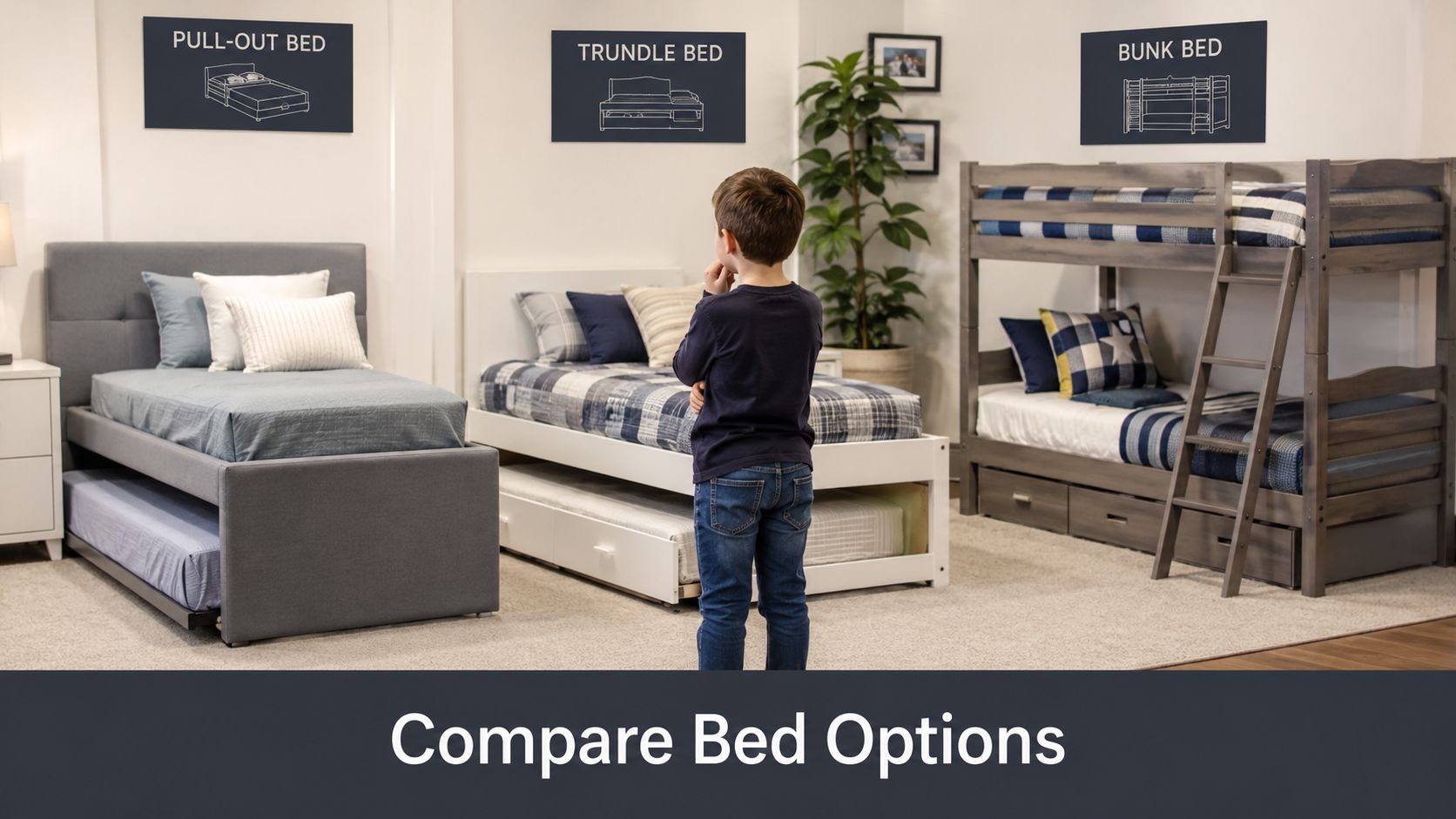
A side-by-side look
| Bed type | Best strength | Main tradeoff | Independence feel | Space strategy |
|---|---|---|---|---|
| Pull-out bed | Flexible sleeping without permanent second-bed bulk | Needs floor clearance in front | Often good if low | Uses horizontal space only when opened |
| Standalone trundle setup | Similar flexibility with simple guest use | Lower bed may feel secondary | Moderate | Efficient for occasional use |
| Floor bed | Easiest access for a young child | No built-in second sleep space | Highest | Uses permanent floor space |
| Bunk bed | Strong for shared rooms with limited footprint | Higher climb and more safety demands | Lower for younger children | Saves floor space vertically |
The reason many families land on a pull-out model is balance. It can feel more accessible than a bunk and more versatile than a floor bed. During the day, the room stays open. At night, the second sleep surface appears when needed.
Where pull-out beds solve a real family problem
Most furniture guides frame these beds as a convenience item. That misses a bigger issue.
Research highlighted by the Beds for Kids project at CHOP PolicyLab notes that over 733 children in one Chattanooga community lack individual beds, often sleeping on floors or sofas. That context matters because it shifts the conversation. A pull-out bed can sometimes function as a practical transition tool in crowded homes, not just as a stylish extra for sleepovers.
That doesn't mean every family should buy one. It means the category deserves more respect than it usually gets. In a compact room, a pull-out bed may help siblings share sleep space more comfortably. In a family navigating housing instability or frequent room changes, it may offer flexibility without committing to a bulky two-bed layout.
Which option fits which household
Consider the match this way:
- Choose a floor bed if your main goal is child-led access and the room can dedicate floor space full time.
- Choose a bunk if two children need permanent beds and the room's vertical height and safety setup support it.
- Choose a pull-out bed if your family needs one room to shift between solo sleeping, sibling sharing, and guest use.
- Choose a classic trundle if the second bed is only occasional and you want the simplest guest-ready option.
If you're also weighing early-childhood sleep setups, this comparison of floor bed vs crib can help clarify how independence changes across stages.
Some families don't need the “best” bed category. They need the bed that solves tonight's sleeping arrangement safely and calmly.
That's often where pull-out beds shine.
FAQs Montessori Use Maintenance and Longevity
A pull-out bed often gets tested in real family moments. Your child wakes early and climbs out on their own. A cousin stays over. A toy rolls under the frame. A year later, the room has to work for a different routine. Those everyday details tell you more about the bed's value than a showroom photo ever will.
Can a pull-out bed be Montessori-friendly
Yes, if the bed supports safe independence instead of adding obstacles.
Montessori-friendly furniture helps a child understand how to use their space with confidence. A low pull-out bed can do that well because it gives a child a clear path in and out of bed, much like a floor-level sleep setup. The key difference is that the adult still manages the part that folds, rolls, or slides if the mechanism is too heavy or complicated for the child.
That balance matters. Independence for a young child should feel like reaching a low shelf, not operating a piece of machinery.
A pull-out bed tends to fit this approach best when:
- the main mattress sits low enough for the child to get in and out alone
- the sleep surface feels stable underfoot, without high edges or climbing
- the room has enough open floor space for calm, safe movement
- the lower section stays an adult-managed feature until the child is older
Drawer-style designs often work better here than taller frames with bulky trundles. They are easier to read visually, and children usually do better with furniture that has an obvious purpose.
What maintenance matters most
Pull-out beds are simple to live with when you treat them like a stroller or a sliding drawer. The sleeping surface may look fine for years, but the moving parts need quiet, regular care.
Start with the parts that do the work. Wheels, runners, and glides should move evenly and without scraping. If the frame begins to wobble, tighten the hardware before that small shift turns into a larger alignment problem. Dust, crumbs, and small toys often collect where parents cannot see them, and those bits are usually what make a bed start sticking or pulling unevenly.
A simple rhythm is enough:
- Weekly: Check the under-bed path and remove toys, socks, or books
- Monthly: Tighten visible screws or bolts and inspect slats for strain or cracks
- Seasonally: Pull the lower bed out fully, vacuum the track area, wipe hidden surfaces, and rotate mattresses if the manufacturer allows it
Spills deserve quick attention. Moisture trapped under a mattress or along a seam can shorten the life of both the bed and the mattress.
The first part to age is usually the mechanism, not the mattress platform.
Will it last as your child grows
It can, if the design solves real family needs instead of a short-lived stage.
The best long-term pull-out beds work like a good children's coat with room to layer underneath. At first, the bed may support a child who is learning to get in and out independently. Later, the same frame may handle sibling room-sharing, sleepovers, or a reading nook by day and guest bed by night. That kind of flexibility is useful because children's rooms rarely stay fixed for long.
Look for features that age well:
- Simple styling: The frame should still look right when your child outgrows toddler decor
- Straightforward hardware: Standard wheels, runners, and fittings are easier to inspect and replace
- Multiple uses: The bed should make sense for daily sleep, occasional sharing, or guest use
- Good proportions: A frame that is low and sturdy usually adapts better across stages than one built around novelty
A well-chosen pull-out bed does more than save floor space. It can give a child safe access to their own sleep area, support growing independence, and help the room change with family life instead of fighting it.
If you're looking for child-focused furniture that supports safe exploration and growing independence at home, Ocodile offers thoughtfully designed pieces made for real family life.