



Flame Retardant Furniture: A Parent's Guide to Safety
You're standing in a nursery store, or scrolling late at night with one eye on a sleeping toddler, trying to choose a chair, a glider, or a little sofa for the playroom. The product page says it meets fire standards. Another says it has “clean materials.” A third mentions foam, fabric, barriers, and labels you've never heard of.
Most parents read those words and feel two things at once. Relief, because safety is being mentioned. Unease, because it's hard to tell what kind of safety the brand means.
That confusion is reasonable. Furniture safety often gets framed as a simple choice between “fire safe” and “not fire safe.” Real life is more complicated. With flame retardant furniture, the better question is whether a piece is designed to handle fire risk in a smart way, without filling your home with chemicals your child ends up breathing, touching, and swallowing in dust.
The Hidden Choice in Your Child's Room
A lot of us start with good intentions and very little clarity.
You want the reading chair in your child's room to be soft. You want the play couch to handle spills, jumping, and daily chaos. You want the nursing chair to feel comfortable during long nights. Then you notice a label about flammability, and suddenly the decision gets heavier. If a product doesn't use chemical flame retardants, is it less safe? If it does use them, what exactly is sitting in your home for years?
That's the hidden choice many families don't realize they're making.
Why this feels so confusing
Furniture companies often compress a complicated topic into one reassuring sentence. “Meets safety standards” can sound like the whole story. It usually isn't. A piece can meet a fire rule through material design, or it can meet it by relying on added chemical treatments. Those aren't the same thing.
For parents, the problem is practical. Your child doesn't interact with furniture in an abstract way. They nap on it, press their face into it, chew corners, crawl under cushions, and play on the floor nearby where dust settles. So the details matter.
Safety isn't only about what happens in a rare emergency. It's also about what your child is exposed to every ordinary day.
The real question to ask
The best question isn't “Is this furniture fire safe?”
It's this:
- How does this furniture meet fire requirements
- Does it rely on added flame retardant chemicals
- Can it meet the same standard through better fabrics, barriers, and construction
That shift changes everything. It moves you away from fear-based shopping and toward informed shopping.
Parents often assume stricter chemical treatment must mean stronger protection. Modern furniture design shows that isn't always true. In many cases, manufacturers can build for fire resistance with smarter layers and better textiles rather than putting chemical additives into foam.
That's good news, because it means you may not have to choose between fire safety and a lower-toxin home. You can look for both.
The Unseen Tradeoff Health vs Fire Safety
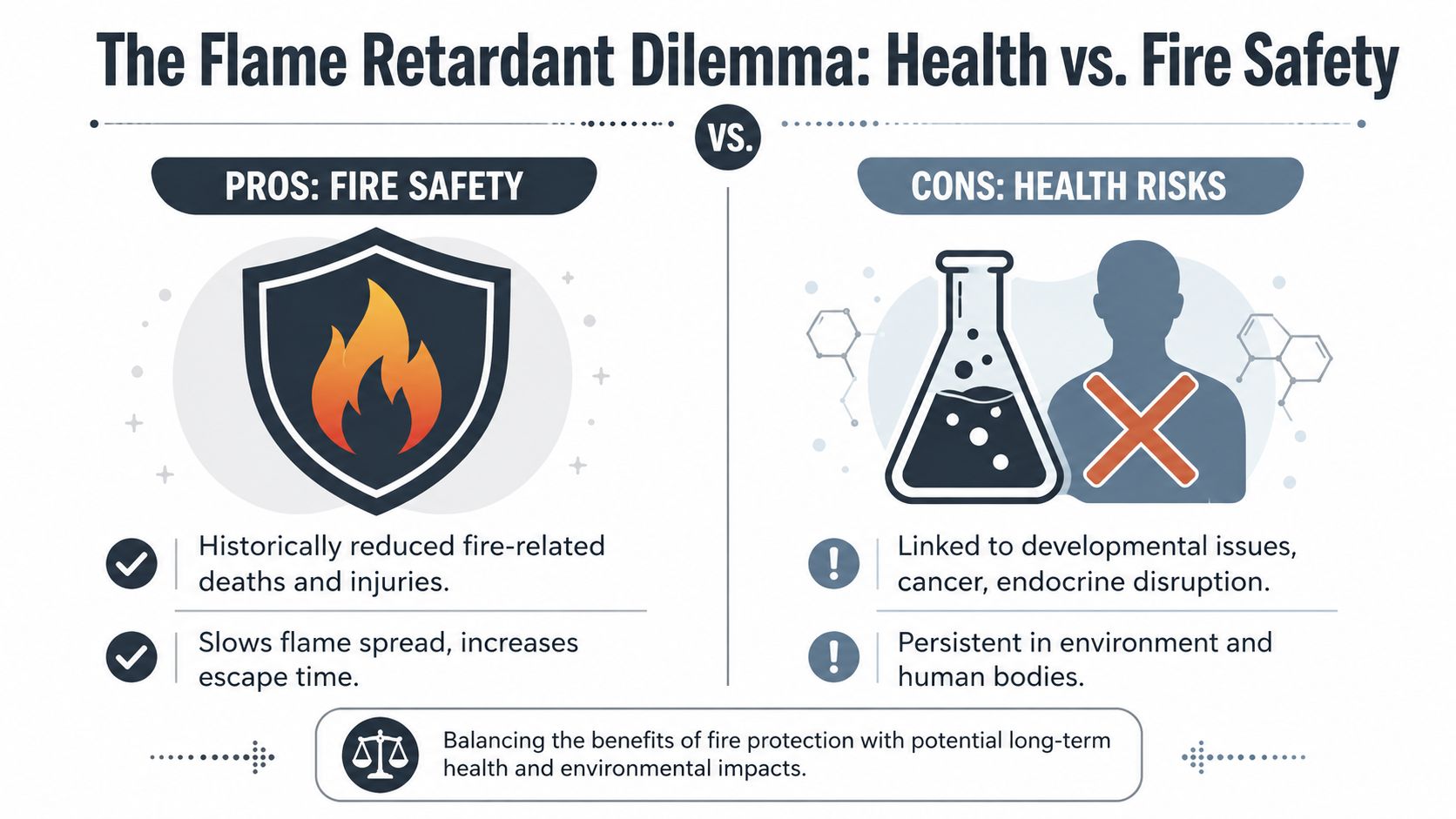
Flame retardants were introduced with a goal most parents would support immediately. Slow fires down. Give people more time to escape. Reduce injuries and deaths.
The problem is that actual results haven't matched that simple promise.
What the fire data actually tells us
Between 2003 and 2016, furniture fires accounted for only 2.2% of U.S. house fires, and a Silent Spring Institute analysis found that adding flame retardants to furniture did not significantly reduce the risk of fatal fires, especially in common smoldering-cigarette scenarios, according to Silent Spring Institute's summary of the research.
That matters because many families have been led to believe chemical treatment in furniture is a major life-saving tool. The evidence described above points to a much narrower benefit than is commonly assumed.
The leaky shield problem
Parents often picture flame retardants as a protective layer locked inside the product, like a shield that stays put. That isn't how many of these chemicals behave.
A better image is a leaky shield. The furniture may contain chemicals, but over time they can migrate out and end up in household dust. Children are especially exposed because they spend time on floors, touch surfaces constantly, and put their hands in their mouths more often than adults.
Small-room and bench-scale tests discussed in this review of upholstered furniture and flame retardants found that chairs with common flame retardant-treated foam often showed similar visible flaming behavior and peak heat release to chairs without added flame retardants. The same review also describes evidence that certain brominated and organophosphate flame retardants used in older furniture can migrate into dust and are associated with endocrine disruption, neurodevelopmental effects, and increased cancer risk, with children facing particular concern because of their higher hand-to-mouth contact.
Why parents should care about dust
This isn't only a furniture issue. It becomes a home environment issue.
If you're worried about what may already be circulating in your space, especially in rooms with older upholstered pieces, resources on indoor air quality testing in Toronto can help families understand how to think about dust, indoor pollutants, and when testing may be useful.
Practical rule: If a safety feature adds a long-term chemical burden to your home, it's fair to ask whether the benefit is strong enough to justify that tradeoff.
For many families, that tradeoff doesn't look acceptable once they understand it clearly. The better path is usually to look for furniture that handles fire risk through design choices, not just chemical additives hidden inside foam.
How to Read Furniture Labels and Regulations
Labels can feel cryptic until you know the handful of words that matter.
The most helpful shift in U.S. furniture rules is that manufacturers don't have to depend on added flame retardant chemicals to meet the law. That means a parent in a showroom or reading a product page can look for signs of how the product complies, not just whether it complies.
Start with TB 117-2013
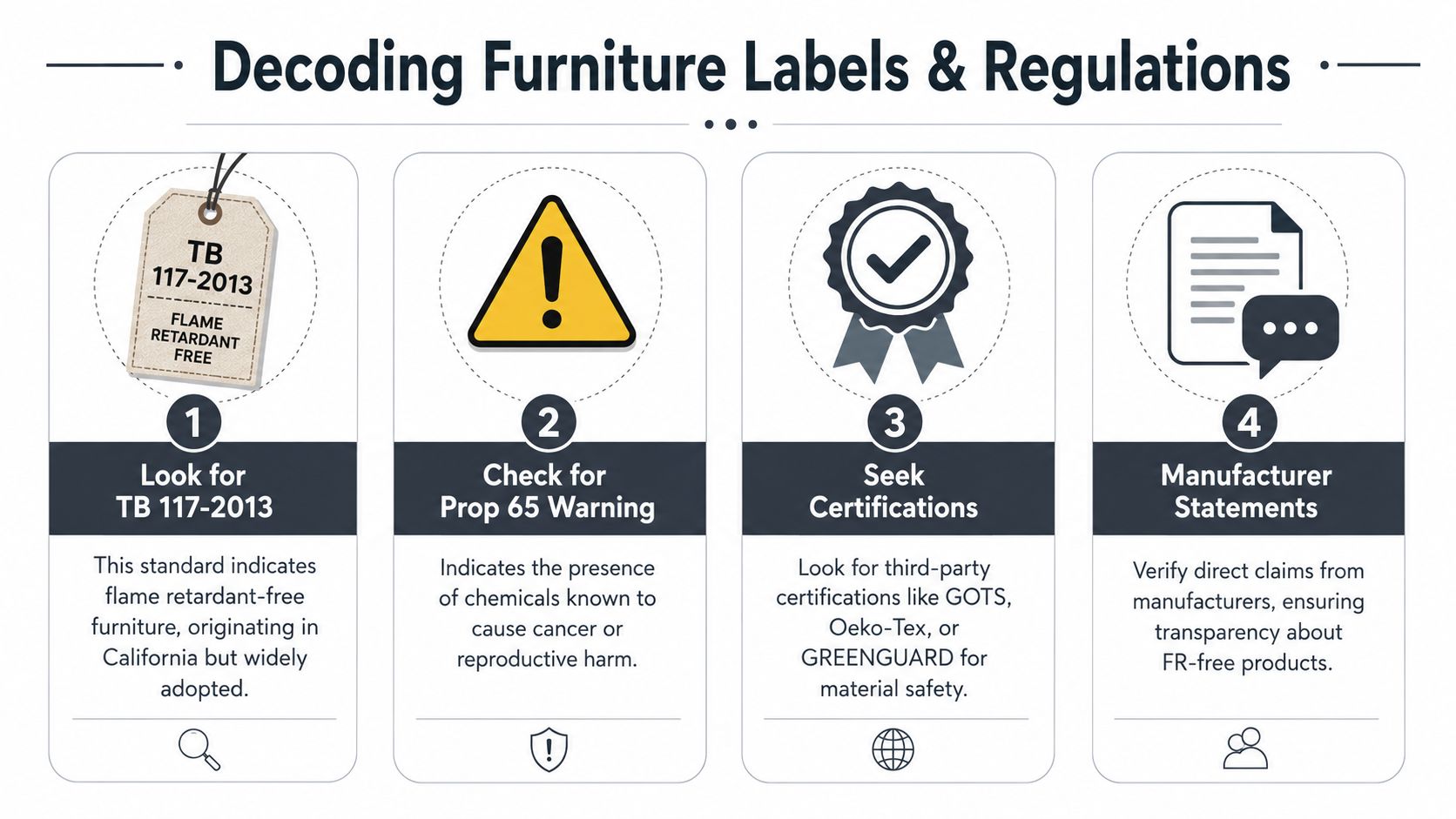
In the United States, 16 CFR Part 1640 incorporates California TB 117-2013, and that standard focuses on smolder resistance to cigarettes. It allows manufacturers to meet safety requirements with smolder-resistant fabrics and barrier materials instead of adding chemical flame retardants to foam, as explained in this overview of U.S. furniture flammability standards.
That's the label framework many parents need to know.
When you see a tag referring to TB 117-2013, it does not automatically mean the furniture contains flame retardants. In fact, the updated approach was important because it created room for safer design strategies.
What to look for on the tag
A useful shopping routine is to check for these things in order:
-
A TB 117-2013 reference
This tells you the item is meeting the current smolder-focused standard, not an older open-flame approach many parents still associate with chemical-heavy furniture. -
A clear “no added flame retardants” statement
If the brand states this directly, that's much more helpful than broad words like “natural” or “clean.” -
Any warning language
If you see a Proposition 65 warning, pause and read more closely. It doesn't answer every question, but it does signal that more investigation is worth your time. -
A material breakdown
Cover fabric, barrier layer, foam type, and finishes all matter.
If a label sounds polished but doesn't say whether the product contains added flame retardants, treat that silence as missing information, not reassurance.
Why global context gets messy
Parents in Europe or childcare operators buying across markets often run into a second layer of confusion. Rules on fire safety and chemicals don't line up neatly from one region to another. If you need a broader primer to understand EU chemical compliance, it helps to separate chemical law from furniture fire-performance rules, because brands sometimes blend those topics together in marketing.
In the UK, upholstered furniture rules have been strict since 1988, and those regulations have historically pushed manufacturers toward chemical treatments in foams and fabrics. If you want a fuller explanation of how furniture flammability standards evolved and why today's labels can be confusing, this guide on furniture flammability standards offers a useful consumer-level overview.
Safer Furniture Alternatives and How to Find Them
Once you stop assuming chemicals are the only route to fire safety, the search gets easier.
The strongest alternatives usually come from material choice and construction choice. That includes solid wood where possible, simpler finishes, thoughtfully selected upholstery, and designs that use barriers or textiles that are resistant rather than relying on treated foam.
Materials worth prioritizing
Not every family is shopping for the same room, so it helps to think in categories instead of absolutes.
- Solid wood pieces work well for beds, shelves, step stools, and tables because they reduce the need for foam-filled components entirely.
- Upholstered items with barrier systems can offer a more balanced option when you do want softness.
- Natural fiber covers, including wool-based approaches where available, can support lower-chemical design depending on the specific product construction.
One of the most useful findings from fire testing is that a woven fiberglass barrier placed between fabric and foam can significantly delay fire spread to the foam and keep heat release and asphyxiant gases lower than comparable chairs without that barrier, even when the foam itself has no added flame retardants. That finding appears in the earlier cited review of upholstered furniture fire testing and points toward a better engineering approach than loading foam with chemicals.
What this looks like in real shopping
A safer product description often sounds less dramatic than a chemical-heavy one. It may mention:
- cover fabric chosen for smolder resistance
- a barrier layer between fabric and foam
- no added flame retardants in the foam
- simple, transparent material disclosure
That's what you want. Clear construction details beat vague “advanced protection” language every time.
A note for childcare providers
Childcare centers and schools face a harder version of the same problem because they also have to think about inspectors, insurance, and local code interpretations.
A 2025 survey of European early-years facilities found that over 60% of decision-makers were considering flame-retardant-free or low-chemical furniture, while 78% reported confusion about whether local building codes or insurance rules required chemical flame retardants or allowed barrier-based designs, according to the Green Science Policy Institute case study.
That confusion is familiar to many parents, just at a larger scale. If you're buying for a classroom, nursery, or shared play space, ask for written documentation of compliance and ask exactly how the product meets the relevant fire standard. Don't accept “commercial grade” as a complete answer.
For parents building a lower-toxin room at home, guides to non-toxic kids furniture can help you compare materials and construction styles before you commit.
Evaluating Manufacturer Claims and Certifications
By the time you've read a few product pages, you'll notice how often brands use soft language. “Eco-conscious.” “Mindfully made.” “Healthy home friendly.” None of those phrases tell you whether the furniture contains added flame retardants.
You need proof, not mood.

What counts as a stronger claim
Some certifications and disclosures are more useful than others because they narrow the wiggle room.
Here's a quick way to sort them:
| What you see | How useful it is | Why |
|---|---|---|
| “Non-toxic” | Low on its own | Too broad unless the brand explains materials |
| “No added flame retardants” | Strong | Directly answers the main question |
| Low-emission certification | Helpful | Speaks to chemical emissions, not necessarily all materials |
| Foam-specific certification | Helpful with limits | Useful for foam chemistry, but not the whole product |
| Full material list | Strong | Lets you verify fabrics, barriers, foam, and finishes |
Questions worth asking directly
If a brand doesn't answer these on the product page, email customer support.
- Does this product contain any added flame retardant chemicals
- Is the foam free from organophosphate and halogenated flame retardants
- How does the product meet flammability requirements
- Is there a barrier fabric between the cover and the foam
- Can you share the exact certification names for the finished product and for the foam
A trustworthy company should be able to answer in plain language.
Ask for the sentence you wish the label already had: “This product contains no added flame retardant chemicals.”
Why older furniture deserves extra caution
The concern is sharper with older upholstered pieces. Studies summarized in the previously cited review found that certain brominated and organophosphate flame retardants used in pre-2015 furniture can migrate into household dust and are associated with endocrine disruption and neurodevelopmental effects in children, who have greater hand-to-mouth exposure.
That doesn't mean every older chair must leave your home today. It does mean torn cushions, crumbling foam, and mystery secondhand upholstery deserve a closer look.
If you're comparing broader low-emission labels and trying to understand what they do and don't cover, this primer on GREENGUARD Gold certified furniture can help you ask better questions.
Simple Steps to Maintain a Low-Toxin Home
Even if you make great choices going forward, many families already have older furniture in the house. That's normal. You don't need to panic or replace everything at once.
What helps most is reducing the dust pathway.
Cleaning habits that lower exposure
In the UK, where strict upholstered furniture flammability rules have been in place since 1988, studies show flame retardants can leach into indoor dust and accumulate in human tissues, while reviews have found little evidence that those chemical-based standards reduce fire deaths and some testing suggests they can increase smoke toxicity, as described by FIDRA's overview of UK furniture regulations and flame retardants.
That's a strong reminder that everyday exposure often happens through ordinary dust, not through obvious contact with a label or a cushion.
A practical routine helps:
- Vacuum with a HEPA filter if you have one, especially around upholstered furniture and along floor edges where dust collects.
- Wet-mop hard floors instead of only dry sweeping, which can move dust around.
- Use a damp cloth for dusting shelves, baseboards, and window ledges.
- Wash children's hands before meals and after floor play.
- Inspect old foam for tears, crumbling, or escaping particles.
Small changes matter
You don't need a perfect home to lower exposure.
Open windows when weather allows. Rotate play areas away from aging upholstered pieces if one chair is shedding foam. If you're reupholstering an older item, ask in advance about barrier materials and whether any added flame retardants will be used.
The goal isn't perfection. It's reducing the amount of dust and uncertainty your child lives with every day.
Your Action Plan for a Safer Home
The clearest takeaway is also the most reassuring one. Flame retardant furniture is not the only way to think about fire safety, and it often isn't the best way to think about family safety either.
Parents usually get stuck because they're offered a false choice. Either accept hidden chemicals or accept more danger. Modern standards and better material design make that choice less rigid than it used to be.
Keep your checklist short
When you shop, focus on three actions:
-
Check how the furniture meets fire rules
Look for current-compliance language and direct statements about no added flame retardants. -
Prefer smarter construction
Solid wood, transparent upholstery materials, and barrier-based designs are often the most sensible route. -
Verify claims yourself
Ask the manufacturer direct questions. Look for specific certifications and exact material disclosures, not just calming language.
Use the same standard every time
Whether you're buying a nursery glider, a classroom reading chair, or a playroom couch, use one simple filter:
- Is the product compliant
- Is the company transparent
- Is the design minimizing unnecessary chemical exposure
If the answer to any one of those is unclear, keep looking.
You don't need to become a chemist to make a better decision. You just need to stop treating “meets safety standards” as the end of the conversation. For children's furniture, the safest choice is often the product that balances fire performance with the least avoidable chemical burden inside your home.
That's a thoughtful standard. It's practical. And it's one parents can use with confidence.
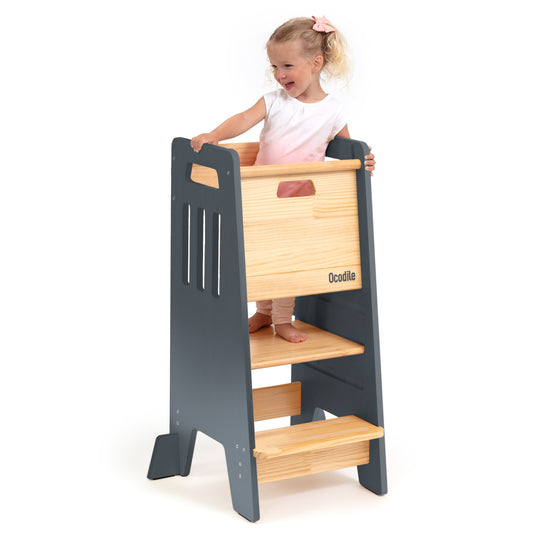
If you're looking for children's furniture designed with daily family life in mind, Ocodile offers child-focused pieces that emphasize safe exploration, practical design, and materials chosen for real homes. It's a good place to start if you want furniture that supports independence without losing sight of safety.