



Half Circle Tables: Safe & Creative Kids' Spaces
Your dining table is busy. The kitchen counter is crowded. The coffee table is too low for coloring and too easy to bump into during a race to the hallway. If you're trying to carve out a calm little work zone for your child inside a very real family home, furniture can feel like a compromise from the start.
That's why so many parents end up looking at half circle tables. They fit into corners, soften the room visually, and create a child-sized place to draw, sort, build, or snack without taking over the whole house. The confusing part is that the same shape often shows up under different names, and those names can make shopping harder than it should be.
The Search for a Perfect Kids Corner
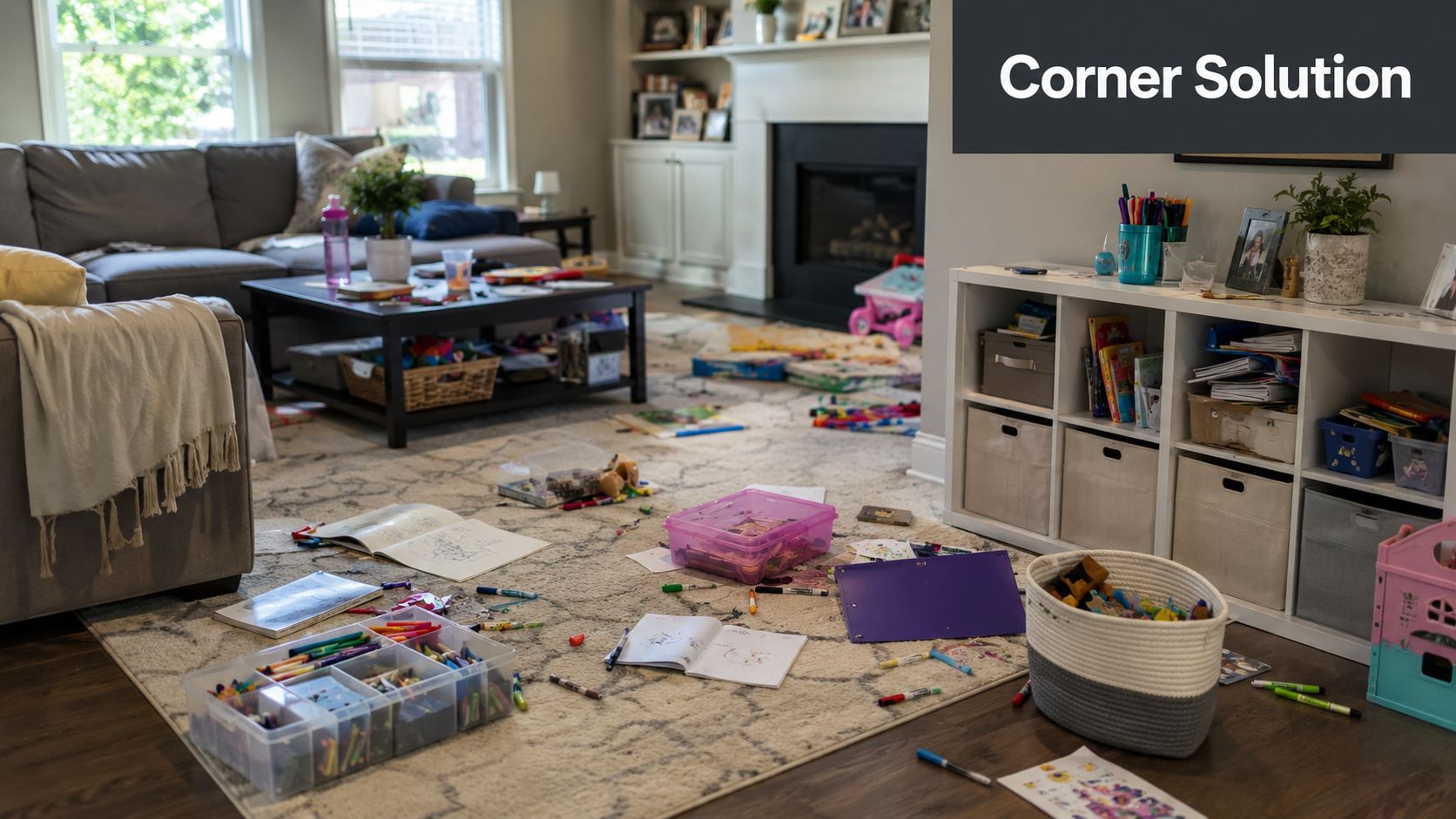
Parents usually start with a simple goal. You want one spot where crayons, puzzles, stickers, and small hands can settle for a while. But the room you're working with might also need to stay walkable for adults, safe for toddlers, and presentable enough that it still feels like home.
The terminology is complex. In classroom catalogs, you'll often see half circle table or half-round activity table. In residential design, the historical term is often demilune. That gap in language creates real confusion for families. A 2025 industry report found that 68% of parents searching for child-safe half circle tables in major markets expressed uncertainty about safety certifications because of this naming inconsistency, as noted in this demilune definition and naming discussion from 1stDibs.
What the name tells you and what it doesn't
The name helps you find the shape. It doesn't tell you whether the table is stable, whether the finish is child-safe, or whether the height works for a preschooler and an adult sharing the same surface.
A decorative demilune for an entryway and a classroom activity table can look related in photos but behave very differently in daily life. One may be designed to hold a vase against a wall. The other may be built for glue sticks, block towers, and repeated wiping.
Practical rule: Shop by function first, shape second, and label last.
If you're comparing options for a family home, it also helps to think beyond style and ask the same practical questions you'd use when choosing kid and pet friendly furniture. Can the surface handle daily cleanup? Are edges forgiving? Will the piece still work when your child's interests shift from stacking cups to early writing?
Why parents keep coming back to this shape
A half circle table solves a problem many homes have. You need a defined activity zone, but you don't want sharp corners sticking into walkways or a full round table floating awkwardly in the room.
That's the appeal. The table gives your child a clear place of their own, while the flat side keeps the footprint disciplined. It feels gentler in a shared space, and for many families, that makes the idea worth a closer look.
The Smart Design of a Semicircle
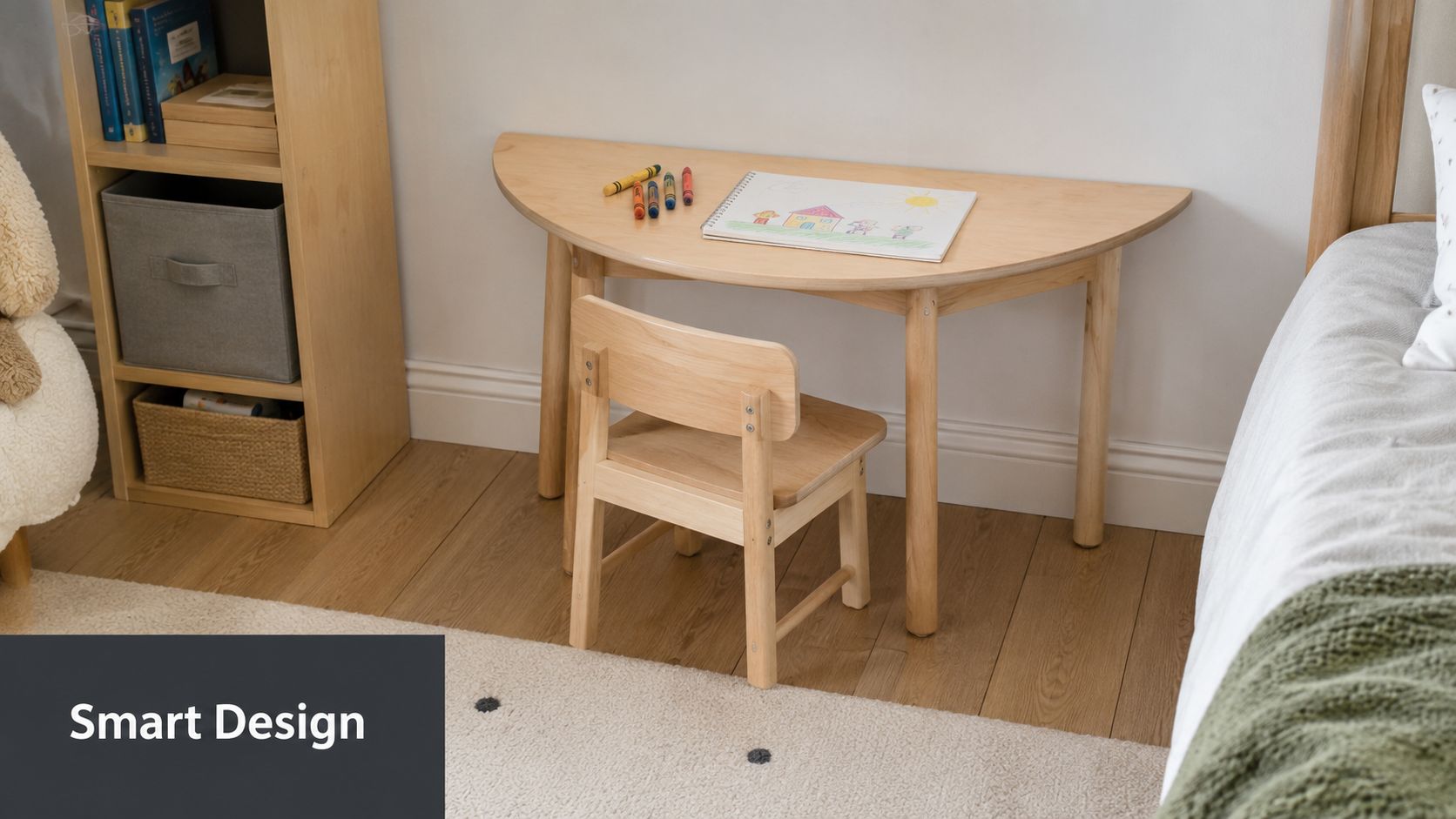
The best way to think about a semicircular table is not as half of something missing. It works more like a bridge between your child's activity zone and the rest of the room. One side stays quiet and orderly against a wall. The curved side opens outward and welcomes use.
That balance is old. The term demilune comes from the French for “half-moon” and became popular in the 1700s. These tables were designed to “hug the wall,” removing the protruding corners of rectangular tables in narrow hallways, a space-saving idea described in this history of antique table styles.
Why the flat back matters
The flat edge does more than save inches. It sets a boundary. In a busy room, that matters because children often do better when furniture gives them a clear sense of where an activity begins.
Placed against a wall, a half circle table can create:
- A drawing station with supplies within reach
- A puzzle zone that doesn't spill into a main walkway
- A reading corner where the curve softens the feel of the room
That same flat edge also makes placement easier for adults. You don't have to guess how to float it in the room. You can anchor it neatly, then build around it with a chair, rug, shelf, or floor cushion.
Why the curve changes how children use it
Corners tell children where not to stand. Curves invite movement. A curved front lets a child shift from one side to another without bumping into a hard point, and it makes shared use feel more natural because no single seat feels like the “head” of the table.
A good children's table shouldn't just fit the room. It should guide calmer movement inside it.
This is one reason the shape feels collaborative. Two siblings can spread out along the arc. One child can work in the center while an adult slides in nearby. Even when only one child uses it, the curve creates a feeling of openness that square furniture sometimes lacks.
A shape that plays well with other furniture
Parents sometimes worry that a half circle table will be harder to coordinate with the rest of the home. In practice, it often blends better than a chunky rectangle because the silhouette is softer. If you're comparing shapes across family dining and activity spaces, guides that help you choose your oval dining table can also sharpen your eye for flow, circulation, and how curved edges change the feel of a room.
The semicircle works because it solves two design jobs at once. It respects wall space, and it creates a friendlier front edge for children.
Finding the Perfect Fit Sizing and Layouts
A half circle table often looks smaller than it really feels in daily use. Then a parent brings one home, places it in the corner, pulls up a chair, and realizes the tabletop is either too high for relaxed shoulders or too deep for easy reaching. Good sizing prevents that kind of friction.
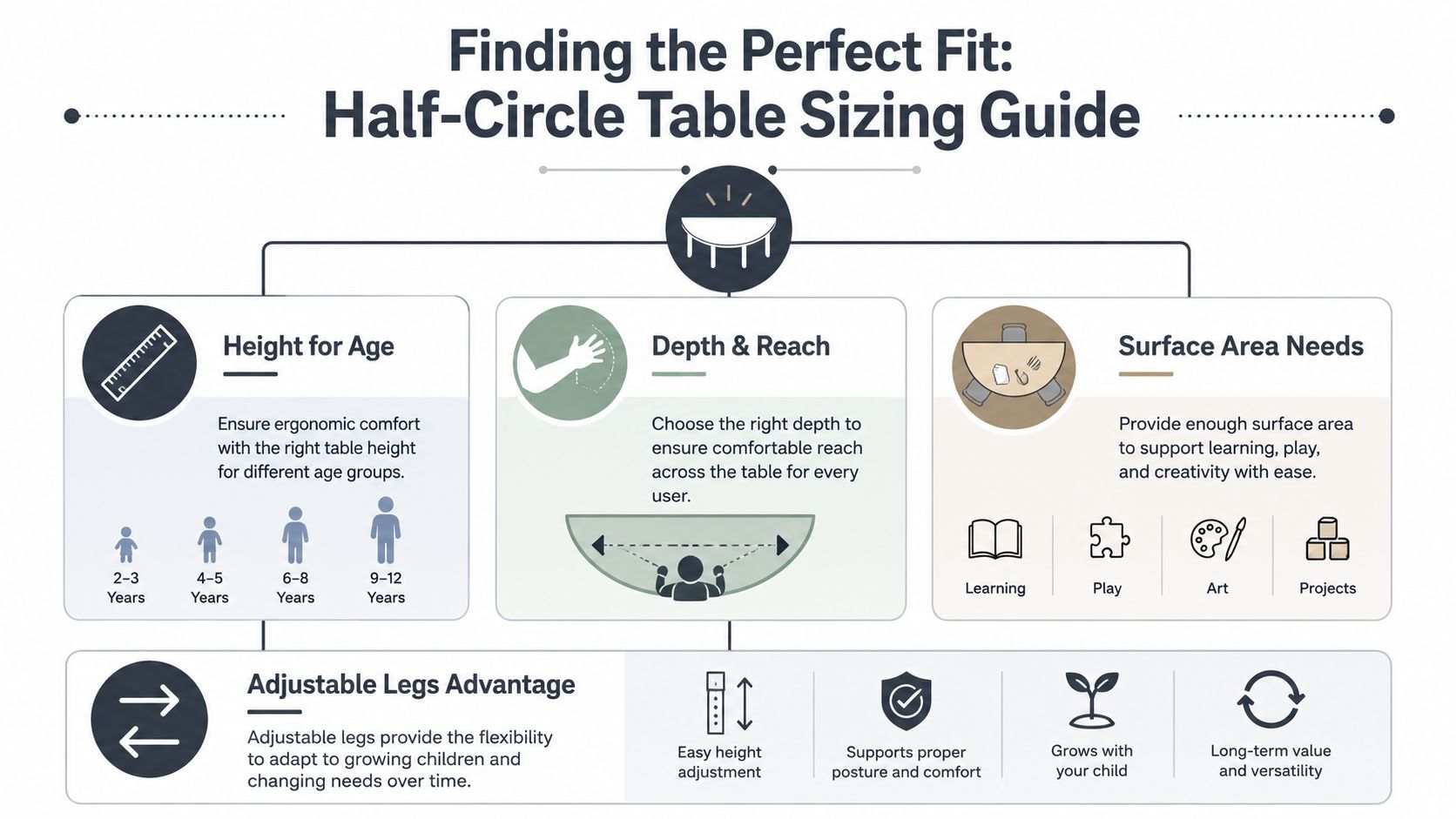
This matters even more with a demilune, or half circle table, because the shape invites shared work. In a Montessori-inspired setup, a child may use the curved front independently one moment, then sit beside a parent for pouring, drawing, or puzzle work the next. The table has to fit both the room and the bodies using it.
Start with height, not diameter
Parents are often tempted to begin with the tabletop width because that is the number they see first on a product page. Height usually matters more.
A simple check works well:
- Seat your child in the chair first. Use the actual chair, not a rough guess.
- Look at the elbows. Forearms should rest naturally on the surface without raised shoulders.
- Check the feet. They should reach the floor or a steady footrest so the child is not dangling.
- Notice the reach. Your child should be able to get crayons, paper, or a tray without leaning across the table.
If a child has to shrug to color, the table is too high. If they fold over their work like a pocketknife, it is too low.
Adjustable legs can be useful in family homes because children grow quickly and shared activity spaces change over time. Fixed-height tables can still work well, but only if the match between chair, child, and tabletop is already right.
Depth affects independence
The curved front can make a table feel welcoming, but the full depth still determines whether a child can use it well. A surface that is too deep often turns simple tasks into climbing, stretching, and constant requests for help.
That is especially important for parent-child use. If you plan to sit nearby for practical life work or art, keep the materials in the child's easy reach zone and leave the far edge for items an adult can manage. Families choosing between sizes and matching seating often get useful ideas from this guide to the best toddler table and chairs.
Three layouts that work in real homes
The semicircle shape gives you a few smart options without asking for a dedicated playroom.
| Layout | Best for | What to check before buying |
|---|---|---|
| Flat side against the wall | Independent work, small bedrooms, tidy art corners | Leave enough space behind the chair for easy in and out |
| Curved side facing the room | Sibling projects, open play areas, shared supplies | Make sure each child can reach their own materials |
| Parent-child pairing | Montessori-style lessons, crafts, reading, snack prep | Test whether the adult seat and child seat create a comfortable working height |
Two half circle tables can also face each other to form a full circle. That setup works well for siblings or small group activities, but it needs more clearance than many parents expect.
Before ordering, map the footprint with painter's tape on the floor. It is one of the easiest ways to see whether the curve helps traffic flow or steals too much walking space. If you want a clear measuring process, this guide can help you ensure a perfect furniture fit.
The best size is the one that lets your child sit well, reach easily, and share the table comfortably with you when the activity calls for it.
A Guide to Safe Materials and Sturdy Construction
A half circle table often looks simple at first glance. In real family use, it works more like a small tool bench. It has to handle watercolor jars, snack spills, elbows, climbing attempts, and the steady pressure of a parent and child working side by side.
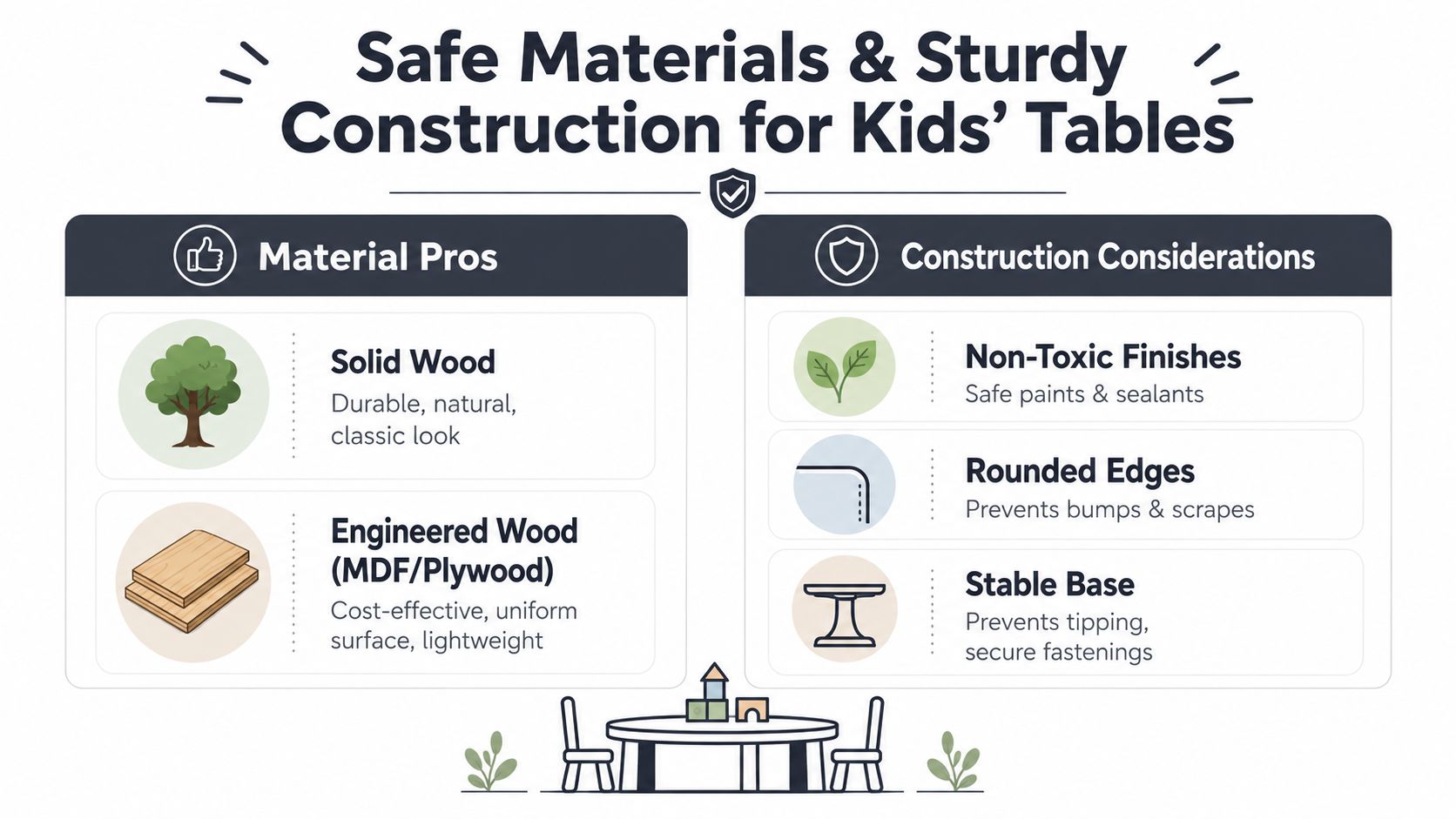
That matters even more with demilune tables sold for decor. Some are beautiful accent pieces, but a family activity table needs a different kind of strength. If you want the demilune look and the function of a true half circle table, start by checking what sits under the pretty top.
How to think about common materials
Parents often ask whether solid wood is automatically the safest and best choice. It can be excellent, but material names alone do not tell the full story. The finish, edge treatment, thickness, and joinery affect daily safety just as much.
Here is a practical way to compare the common options:
| Material | Strengths | Watch-outs |
|---|---|---|
| Solid wood | Long-lasting, repairable, warm feel | Heavier, can dent, quality depends on wood species and joinery |
| Plywood | Stable, strong for its weight, less likely to warp than some solid boards | Exposed edges need good finishing, lower grades can chip or splinter |
| MDF | Very smooth, often budget-friendly, good base for painted finishes | Heavy, can swell if moisture gets in, depends heavily on good sealing |
For a shared parent-child table, I usually suggest focusing on the surface first. The top should stay flat, wipe clean without fuss, and resist staining from the ordinary messes of home life. High-pressure laminate can be a smart choice for this reason. It works like a raincoat over the tabletop core. The coating does not make a weak table strong, but it can make cleanup easier and help the surface hold up better to markers, snack crumbs, and regular wiping.
The safety details parents should inspect
Small details tell you a lot. A safe table usually feels calm and predictable the moment you touch it.
Check these points closely:
- Rounded edges: Run your hand along the full curve and the flat side. Both should feel smooth, not sharp or thin.
- Stable leg design: Press gently on the front and sides. The table should stay planted instead of rocking.
- Secure hardware: Screws and brackets should feel tight after assembly and stay tight with normal use.
- Easy-clean finish: The top should wipe down cleanly without turning tacky, cloudy, or rough.
- Clear finish information: Look for specific product details about paints, stains, sealers, or coatings.
The underside matters too. Parents often focus on the top because that is what they see in product photos, but the base tells you how the table will behave during real use. Wide-set legs, corner blocks, and solid attachment points usually signal better stability than thin legs fastened with minimal hardware.
What “sturdy” looks like in everyday use
A sturdy half circle table stays steady during ordinary movement. Your child leans in to thread beads. The top does not sway. You sit down for a Montessori-style pouring activity. The table does not skid or creak. A sibling bumps the side while passing by. The legs keep the top level.
That kind of predictability helps children concentrate. It also helps parents relax. Shared activities work better when the furniture does not need constant correcting.
For a deeper primer on finishes and safer material choices, this guide to non-toxic kids furniture is useful when a product listing gives you polished photos but very little material detail.
Red flags worth taking seriously
Some warning signs show up before you ever bring the table home.
- Visible flex in the tabletop suggests weak support underneath.
- Very narrow leg placement can make a semicircle table feel tippy when weight shifts toward the curve.
- Chipped finish or rough seams tend to get worse with cleaning and daily friction.
- Strong chemical odor can be a sign that finishes have not cured well or that product information is too vague.
- Fussy cleaning instructions do not suit an activity table meant for family life.
A good half circle table should feel ready for work, not delicate. If it is going to support reading, drawing, sorting, snack prep, and those close parent-child moments that Montessori homes value, safety and construction need to carry as much weight as shape and style.
Creative Uses From Art Stations to Shared Activities
A half circle table earns its place when it works for more than one moment of the day. In the morning, it might hold crayons and paper. By late afternoon, it becomes snack-and-story space. After dinner, it can turn into a parent-child work surface for puzzles, sorting games, or tracing letters.
That flexibility matters because many families aren't looking for furniture that serves children alone. They want a piece that supports connection. According to 2025 data cited by Allied USA's half-round activity table page, 54% of families prioritize shared activity furniture for children under 6, yet 72% struggle to find tables that balance adult-child height compatibility.
A shape that helps adults join in
Half circle tables make unusual sense at home. The shape naturally creates two working zones. The child can spread materials along the curve, while the adult uses the straighter side or sits close enough to guide without hovering.
That changes the tone of shared activities. The adult isn't looming over the child's only workspace. Both people have room to participate.
Some of the best family furniture doesn't separate adult space from child space. It creates a respectful overlap.
Think about a simple watercolor setup. The child sits at the center of the arc with paper, brush, and cup. The adult sits alongside with extra supplies, helping refill water or model a technique. The table becomes a place of partnership instead of supervision.
Real home uses that suit the shape
Here are a few ways families tend to use this kind of table well:
- Art station: Keep paper in the middle, caddies at the ends of the curve, and a wall-mounted display above the flat back.
- Reading and storytelling corner: Place the table near a shelf and use it for drawing scenes from books, letter matching, or quiet narration.
- Sensory setup: The curve keeps tools close to the child, while an adult can sit opposite with towels and backup materials nearby.
- Homework transition zone: For older siblings, it works as a softer-looking study surface than a standard desk.
One of my favorite uses is collaborative making. Parent and child can roll clay, string beads, build with magnetic tiles, or work through practical life activities without fighting for tabletop territory. That's hard to achieve on a tiny square table.
Making Montessori-style use feel natural
Families drawn to Montessori-inspired homes often want furniture that supports independence without isolating the child. A half circle table does that nicely because it offers clear access, a defined work area, and easy adult participation when needed.
Try a few simple habits:
- Keep only a small number of materials out so the table doesn't become visual clutter.
- Use trays or baskets to define each activity.
- Return supplies to the same place so the child learns the rhythm of setup and cleanup.
- Leave one edge open for an adult to join when guidance helps.
If you're planning a more creative setup, this article on an arts and crafts table with storage offers useful ideas for containing supplies without making the space feel crowded.
The emotional value of a shared table
The practical benefits are easy to see. The less obvious benefit is emotional. A child-sized zone that still welcomes a parent can make everyday routines feel calmer. You're not dragging chairs around the house or improvising on the floor every time your child wants to do something with you.
That's why this shape is so appealing. It supports independence, but it doesn't force separation. For young children, that balance is often where the best learning happens.
Your Half Circle Table Purchase Checklist
A good purchase decision usually comes down to a handful of grounded questions. Not trends. Not styling photos. Just clear signs that the table fits your home and your child.
Commercial design offers a useful lesson here. Modular half-round tables such as Herman Miller's Everywhere Table are built for reconfiguration, and benchmark data cited by Dimensions indicates these systems can reduce table-moving labor by up to 40%. Parents don't need office furniture at home, but the principle matters. Adaptable furniture stays useful longer.
The checklist I'd use before buying
- Does the height fit your child now? Check seated posture, shoulder position, and reach.
- Can it adapt? Adjustable legs or a versatile layout matter more than a trendy finish.
- Does the shape suit the room? The flat back should let the table sit neatly where you need it.
- Are the edges and finish child-friendly? Run your hand along the perimeter and inspect the surface closely.
- Does it feel stable under pressure? Push lightly from different angles.
- Will it support shared use? Make sure an adult can comfortably sit nearby when needed.
- Can you clean it without stress? If the care routine feels fussy, it may not suit family life.
- Will it still make sense in a year or two? The best table grows with the way your household functions.
The smartest choice is usually the calmest one
Parents often feel pressure to choose furniture that does everything. A better goal is choosing one piece that does its main job well. For half circle tables, that job is simple. They should create a safe, welcoming, compact place for children to work and for adults to join when connection matters.
If a table helps your child settle in, keeps the room easier to move through, and supports the kind of family life you want more of, it's probably the right one.
If you're building a home that supports independence, safety, and everyday togetherness, Ocodile is worth a look. Their child-focused furniture is designed to help families create spaces where kids can explore confidently and join in with daily life in a practical, beautiful way.