


How to Make Child Independent: Build Self-Reliance
You're probably living some version of this already, the morning starts with a missing shoe, a child who wants to “help” but slows everything down, and a voice in the back of your mind asking whether you should just do it yourself so you can get out the door. That tension is where child independence begins. It doesn't begin with a grand speech about responsibility, it begins with a kitchen stool, a clear routine, and a child getting one more chance to try.
How to make child independent is really the question of how to build skill without taking over. The answer is not to wait for a magic age, then expect a child to suddenly act capable. Independence grows through small, repeated moments, and the home environment either supports that growth or blocks it.
Why Independence Is Built in Small Daily Moments
The fastest way to understand independence is to watch a rushed morning unfold. A parent reaches for the child's jacket, zips the backpack, and grabs the spoon because there's no time to wait. The child learns something in that moment, just not the lesson adults usually want. They learn that help arrives before effort finishes.

Independence grows through repetition
A child doesn't become self-reliant because a parent announces, “You're old enough now.” They get there through structured repetition, reduced help, and gradually more responsibility. ParentData describes this as a stepwise process, adults first do a task for the child, then with the child, then step back while watching, and finally allow the child to do it independently. It also notes backward chaining, where the child completes the last step first so they can experience success sooner. ParentData's explanation of scaffolding and backward chaining matches what many families see at home, a child gains confidence when the task is broken into pieces they can finish.
That's why waiting for “readiness” can backfire. Readiness often appears after a child has had enough guided practice to make the task feel familiar. Harvard Health's guidance to start a chore chart by age 2 reflects the same early-start mindset, and its suggestion to pick around three behaviors per day keeps the expectation manageable (Harvard Health on fostering independence in children).
Practical rule: If a task keeps getting rescued, it's probably too big, too fast, or too hidden in the environment.
Small routines build the bigger skill
A toddler who puts socks in the hamper, a preschooler who carries their cup to the sink, and an early school-age child who puts books in the backpack are all practicing the same underlying ability. They're learning to notice a cue, act on it, and finish a sequence. That's the foundation of independence.
Parents often ask whether small jobs matter if the child can't do the whole task yet. They do matter, because each tiny routine creates the next one. A child who learns to put clothes in a laundry basket can later sort them, then fold simple pieces, then manage parts of dressing.
The Scaffolding Method and Prompt Fading Explained
The most reliable way to teach a child a new routine is to make the support visible, then reduce it on purpose. That's the heart of scaffolding and prompt fading. In plain terms, you start with more help than the child needs, then remove that help in a controlled way so the child can carry the skill alone.

Four stages that make sense to children
The stepwise progression described by ParentData works because it respects how children learn. First, the adult does the task for the child. Then they do it with the child. Next, the adult watches while the child does it. Finally, the child does it alone, and that is the moment parents have been aiming for all along. ParentData's scaffolding model pairs naturally with backward chaining, where the adult handles the earlier steps and the child completes the final step first. That might mean a parent starts a zipper and the child pulls the tab, or the adult puts toothpaste on the brush and the child finishes brushing.
A helpful way to think about it is this.
- I do it first. The child watches the whole routine.
- We do it together. The child joins at one or two clear points.
- You do it with support. The child leads while the adult stays quiet and ready.
- You do it alone. The routine becomes familiar and repeatable.
The University of Central Florida family-support guide recommends breaking tasks into small sequential steps, using visual supports, and intentionally reducing help over time. It also recommends wait time, which gives the child a chance to process the instruction and act before an adult jumps in. That matters because many parents accidentally train a child to wait for the adult's voice instead of noticing the routine itself. UCF's adaptive in-home family guide lays out that same logic in practical terms.
Practical rule: Say less, wait longer, and let the child meet the cue before you repeat it.
What prompt fading looks like at home
Take handwashing. You can start by standing beside the sink and modeling each step, wet hands, soap, rub, rinse, dry. Then use a visual cue, maybe a picture near the sink or a simple gesture toward the soap. After that, give one short prompt, like “soap first,” and then pause. If the child still struggles, step back to the earlier level of help instead of adding a long explanation.
The same approach works for putting away utensils, dressing, or setting the table. The trick is to keep the success criterion narrow and observable. NAEYC's guidance on toddler autonomy aligns with that, children do better when they get time to try simple tasks, have routines, and aren't pulled into daily power struggles. Learn more about scaffolding in child development if you want a simple mental model for choosing the right level of support.
Age-Appropriate Self-Care Skills and Chore Progressions
Parents usually don't need more theory, they need to know what their child can do this week. The easiest way to decide is to match the task to the child's current skill, then lower the barrier just enough that success is still possible. Harvard Health's recommendation to start a chore chart by age 2 and keep expectations to around three behaviors per day is useful because it keeps responsibility visible without overwhelming the child (Harvard Health).
A practical age-banded view
For toddlers, independence usually starts with movement and simple carry tasks. A two-year-old might put clothes in a laundry basket, carry napkins to the table, or place a snack container back in a designated bin. The motor demand is simple, and the win is clear. The adult still prepares the environment, but the child owns the final action.
Preschoolers can often handle more sequence and choice. Setting the table, putting shoes in one spot, or helping gather ingredients for a simple meal gives them a job with an obvious beginning and end. If you want a broader feeding example, Hiccapop's comprehensive guide is a useful reference for families thinking about self-feeding routines and early mealtime independence.
Early school-age children can usually manage more self-care and cleanup. That might include dressing with less help, bringing dishes to the sink, or checking a simple visual list before leaving the house. The skill underneath isn't just “doing chores,” it's planning, remembering, and completing a sequence without a parent narrating every step.
| Age Band | Self-Care Tasks | Household Chores | Key Skill Developed |
|---|---|---|---|
| Toddler | Put shoes in place, place clothes in laundry basket, wash hands with prompts | Carry napkins, put toys in bins, help match socks | Following a simple routine |
| Preschooler | Dress with partial support, feed self with utensils, brush with supervision | Set the table, put utensils away, water plants | Completing a short sequence |
| Early school-age | Dress more independently, manage toileting steps, prepare simple snacks | Clear the table, sort laundry, pack a bag with a checklist | Responsibility and self-monitoring |
Choices should narrow, not multiply
A child gets stuck when the decision is too big. “What do you want to wear?” can become a half-hour negotiation. “Red shirt or blue shirt?” is a real choice, and it still keeps the child moving.
The same applies to chores. Ask for one visible outcome, not a vague effort. “Put the spoons in the drawer” is easier to finish than “clean up the kitchen.” If a task keeps collapsing, break it down again until the child can do one piece without guessing.
For families who want more ideas on toddler-level routines, this toddler independence guide fits well with the same slow-build approach.
Designing a Child-Friendly Environment for Independence
A child can't act independently in a room that assumes adult-sized bodies and adult-only habits. The environment either invites action or creates dependence. That's why Montessori-trained educators pay so much attention to furniture height, access, and layout before they worry about motivation.

Remove the barrier before you repeat the instruction
If a child can't reach the sink, the problem isn't attitude. If they can't open the drawer, the problem isn't laziness. If the shoes live on a high shelf, the child will keep needing an adult to begin the routine.
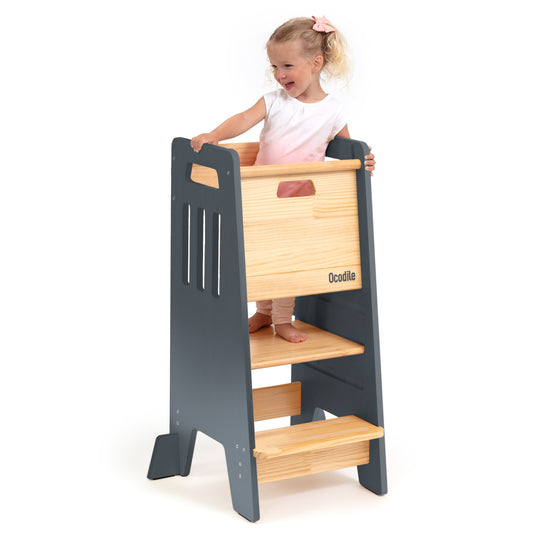
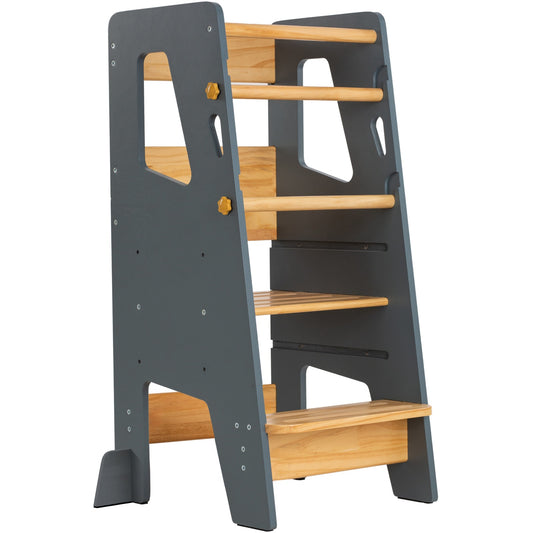
That's where tools like a standing tower matter. Ocodile's foldable kitchen tower and OC2 toddler standing tower are examples of furniture that bring a child safely up to counter height, which helps them participate in supervised kitchen work without being physically excluded from the task. In the same category, a step stool can solve the bathroom reach problem, and a floor bed can give a child more control over getting in and out of sleep space.
The idea behind these choices lines up with the concept of nurturing early learning environments described by Kids Club Early Learning Centre, where the space itself helps children act, not just watch (Kids Club Early Learning Centre). That's the part many parenting guides skip. A good setup reduces the need for constant adult correction because the child can see, touch, and access what they need.
Compare tools by the problem they solve
A standing tower helps with reach and participation. A low shelf helps with visibility and selection. A basket by the door helps with packing and exit routines. A floor bed supports independent getting in and out of bed, while a high adult bed says, “wait for me.”
This Montessori learning environment resource is helpful if you want to think in zones rather than single products. The point isn't to buy more furniture. It's to remove the exact barrier that keeps a child from doing the next step on their own.
Practical rule: If the child needs an adult to reach, open, or see the item, the environment is still doing too much work for the parent.
Balancing Autonomy with Emotional Readiness
Parents often hear that independence is good and then feel pressure to push faster. That's where trouble starts. A child who is anxious, highly sensitive, or recovering from change may need more time, more predictability, and smaller steps than a child of the same age who is already comfortable with new routines.
Readiness is emotional, not just chronological
Mainstream advice often focuses on chores, choices, and responsibility, but it can miss the bigger question, whether the child is ready to tolerate the feeling of trying and not getting it right immediately. Children's Hospital guidance on raising an independent child emphasizes a measured pace and matching expectations to emotional readiness, not just age (Children's Health on raising an independent child). That matters because a child under stress may resist, shut down, or cling harder when the demand feels too large.
Parents sometimes confuse support with dependence. A child who needs a slower ramp-up is not failing to develop independence. They're telling you the task needs to be smaller, clearer, or more predictable. The goal is not to “make up” independence quickly. The goal is to build enough trust in the process that the child can try again tomorrow.
For families who care about character-building alongside skill-building, Villarreal Houston Academy's guide for parents on youth character offers a broader lens on patience, effort, and consistency. Independence grows best when children feel safe enough to practice those traits.
Watch for the signs that say slow down
A child may need less pressure if they repeatedly freeze, melt down at the start of a routine, or refuse tasks they previously accepted with ease. That doesn't automatically mean you should stop teaching the skill. It usually means you should shrink the task, return to modeling, or reduce the number of steps expected at once.
A child's refusal often means the step is too large for the current moment, not that the child can't ever learn it.
A measured pace protects both autonomy and connection. You stay steady, the child stays safer, and the skill still moves forward. That balance matters more than forcing a milestone on your timetable.
Your Weekly Rollout Plan and Common Setback Fixes
The cleanest way to start is with one routine, one environment change, and one week of consistent practice. If you try to change everything at once, you'll lose the pattern before the child can own it. The goal is a stable cue sequence, not a perfect performance.

A simple week to teach one routine
- Monday: Choose one routine and prepare the space so the child can reach, see, and access what they need.
- Tuesday: Model the whole task slowly, with no rush to hand it over.
- Wednesday: Fade to one clear prompt, then wait.
- Thursday: Praise the attempt, not just the finish.
- Friday: Fix one setback, such as a missing visual cue or a drawer that's too hard to open.
- Weekend: Repeat the routine in a calmer moment so the child can feel the success again.
The most common setback is overprompting. Adults talk too much, repeat themselves, or rescue before the child has time to think. The fix is to shorten your language and keep the cue sequence consistent. Another common issue is regression after a child does well once. That usually means the skill wasn't stable yet, so the answer is more repetition, not a bigger lecture.
If power struggles appear, the task is probably too public, too long, or too emotionally loaded. Move the practice to a calmer time and shrink the task until the child can finish without friction. If well-meaning relatives keep stepping in, make the routine visible to everyone so the child gets the same cue from each adult.
The quiet truth is that independence doesn't arrive in a burst. It settles in through repetition, environment design, and support that fades at the right pace. Keep the task small, keep your cues steady, and let the child experience doing more for themselves.
If you're ready to create a home where your child can practice independence, explore Ocodile for child-sized furniture that supports safe participation in everyday routines. Their standing towers, floor beds, and step stools are designed to turn ordinary moments into real practice, which is what young children need.