


Montessori Learning Environment: Foster Independence
You're probably not trying to build a showroom. You're trying to get through breakfast without lifting your child onto the counter for the fifth time, stop the toy mess from taking over the living room, and help your child do more on their own without setting up a whole classroom at home.
That's where the idea of a Montessori learning environment often gets misunderstood. People see neat shelves, wooden toys, and neutral colors, then assume Montessori is mostly about aesthetics. It isn't. A Montessori environment is a practical way of saying, “This space respects my child's size, pace, and growing ability.”
When the environment fits the child, small things start to shift. A child can reach their cup, put shoes away, choose one activity, return it, wash hands with less help, and join daily family life instead of waiting for an adult to manage every step. That's the point. Independence isn't taught only through instructions. It's built into the room.
There's also a bigger reason this matters. Montessori education has documented benefits, yet access is uneven. Research discussed in this review of Montessori access and equity notes that high-fidelity Montessori remains concentrated in more affluent areas, even though children in those settings show stronger gains in areas like reading, math, and executive function. For many families, home becomes the most realistic place to bring in these principles.
If you're also trying to create a calmer emotional tone, especially with siblings or in group settings, Soul Shoppe's classroom resources offer useful ideas for mindfulness and regulation that fit well alongside Montessori-style independence.
Beyond a Tidy Playroom An Introduction
A tidy shelf can help. A tidy shelf alone won't create independence.
The useful question is different: Can your child act meaningfully in this space without waiting for you? If the answer is mostly no, then the room may be organized for adults, not prepared for children.
What parents usually notice first
Most families arrive at Montessori through frustration, not theory. They notice one or more of these patterns:
- Too many choices: Toys are everywhere, but the child still says they're bored.
- Too much adult lifting: Snacks, books, clothes, and tools all live out of reach.
- Too many interruptions: The child starts something, gets distracted, and moves on without finishing.
- Too little ownership: Cleanup becomes a battle because the room doesn't make order obvious.
Those problems aren't signs that your child “can't focus.” Often, the environment is doing too much, offering too much, or hiding the tools a child needs to succeed.
A child who depends on adults for every small step doesn't need more lectures. They usually need a room that makes success easier.
Montessori at home looks different from a classroom
That's good news. You don't need to recreate a school.
A home-based Montessori learning environment can be simple: a low shelf with a few well-chosen activities, a hook for a jacket, a step stool in the bathroom, a child-height place for dishes, and a sleeping space a child can enter and leave safely. The home still needs to function as a home. It just works better when children can participate in it.
Real homes also come with real constraints. Apartments are small. Kitchens are shared. Living rooms do double duty. Budgets are uneven. Montessori only becomes useful when it can meet families where they are.
The shift that matters
Instead of asking, “How do I make my home look Montessori?” ask:
| Better question | Why it helps |
|---|---|
| Can my child reach what they need? | Accessibility supports independent action |
| Is there a clear place for each item? | Order reduces overwhelm |
| Are there only a few meaningful choices? | Limited options improve focus |
| Can my child help with daily life? | Participation builds confidence |
That's the foundation. Not perfection. Not matching furniture. Not a photogenic playroom.
The Core Principles of a Montessori Environment
Montessori works best when you understand the logic behind it. Otherwise, it can turn into random rules like “only use beige toys” or “always buy wooden shelves,” which misses the point.

Respect for the child
Respect in Montessori doesn't mean letting a child do whatever they want. It means treating the child as a capable person with real developmental work to do.
That changes how adults speak, set up the room, and respond to mistakes. Instead of rushing in, you pause. Instead of assuming “too hard,” you ask whether the task is sized correctly and introduced clearly.
A lot of parents find this easier when they also let go of comparison. Children don't all move at the same pace, and Baby's individual development pace is a useful reminder of that principle in everyday parenting.
The prepared environment
A prepared environment is a space designed so the child can act with increasing independence. Consider a cook's workspace. The tools are visible, reachable, and arranged for use.
In a child's space, that might mean:
- Low access: shelves, hooks, and baskets the child can reach
- Clear sequence: materials arranged from left to right or simple to complex
- Order with purpose: each activity has complete parts and a defined home
If you want a broader overview of the philosophy behind these choices, Ocodile's guide on what the Montessori method of teaching is gives a helpful parent-friendly summary.
Auto-education through self-correcting work
Montessori materials are often described as autodidactic, meaning the material helps the child notice and correct errors independently. The child doesn't always need an adult to say, “That's wrong.”
Constant adult correction can create dependence. Self-correction builds persistence. A puzzle piece won't fit. A pouring task spills. A sequence looks incomplete. The environment gives feedback, and the child adjusts.
Practical rule: Don't rush to fix a child's mistake if the task itself can teach the lesson.
Freedom within limits
Freedom in Montessori is structured. The child may choose from available work, move with purpose, repeat an activity, and participate in care of self and care of the home. The limit is that the choice must be safe, respectful, and connected to the environment.
That's why “freedom” doesn't mean every toy on the floor at once. Too much access creates noise, not independence.
The uninterrupted work cycle
One of the clearest technical features of Montessori is the uninterrupted work cycle. The American Montessori Society describes Early Childhood programs as requiring a minimum 2-hour uninterrupted work period daily, with 3 hours considered optimal, because that sustained span supports the deep concentration needed for cognitive development in children (AMS core components).
At home, you won't replicate a school work cycle exactly. You can still protect stretches of focused time by reducing transitions, leaving a child engaged instead of interrupting for unnecessary errands, and allowing repetition.
A child who chooses, works, repeats, tidies, and returns materials is doing far more than “playing nicely.” That child is building coordination, concentration, and internal order.
The Developmental Benefits of Montessori Learning
When people ask whether a Montessori learning environment is “worth it,” they're usually asking a practical question: does this setup change anything meaningful for the child?
The answer is yes, and the benefits show up across academic, cognitive, and social-emotional development.

Cognitive growth
The strongest pattern in Montessori is not just content learning. It's how children learn.
A major review of Montessori research summarized in Psychology Today's discussion of the evidence reports that Montessori students achieve significantly better academic outcomes than traditional peers and are on average a full school year ahead by sixth grade, with especially strong gains in language and math. The same analysis also notes stronger executive function, including self-control and working memory, plus a more positive school experience overall.
That lines up with what many parents see at home. When the space is calm, accessible, and limited in the right way, children often stay with tasks longer and solve more problems without asking for immediate help.
Social and emotional development
Independence is often discussed as a practical skill, but it's also emotional.
A child who can pour water, wipe a spill, choose work, and return materials starts to trust their own ability. That doesn't make them less connected to adults. It often makes them more secure because they aren't waiting for constant rescue.
The same research summary above points to stronger social-emotional outcomes in Montessori settings, especially for younger children. That matters because confidence in early childhood is built through repeated, meaningful action.
Children build self-esteem from competence, not praise alone.
What this looks like in daily life
Here's where the benefits tend to become visible at home:
| Area | What parents often notice |
|---|---|
| Focus | Longer engagement with one task |
| Problem-solving | More trial and error, less instant frustration |
| Self-control | Better ability to wait, repeat, and complete |
| Confidence | More “I can do it” moments |
| Community | More willingness to help with real household tasks |
The home advantage
A home Montessori setup won't mirror a formal classroom, and it doesn't need to. Its strength is that it gives children daily practice in real life. They aren't only sorting objects or matching cards. They're getting dressed, carrying dishes, watering plants, and helping prepare food.
That link between environment and capability is what makes Montessori so durable. It doesn't depend on a script. It depends on adults preparing spaces where children can participate with purpose.
Designing the Prepared Environment at Home
Most homes don't have a dedicated Montessori room. They have a kitchen, a hallway, a bedroom, maybe one shared living area, and a lot of objects that adults need too. That's normal.
The prepared environment works at home when you stop thinking room by room and start thinking function by function. Where does your child eat, dress, wash, read, build, rest, and help? Those are the zones that matter.
Research and parent interest both reflect the same practical tension. As noted by Montessori Academy's prepared environment overview, families increasingly look for solutions for “home Montessori for small spaces,” because real homes often don't match the spacious examples shown online.
Accessibility first
If a child can't reach it, it isn't really theirs.
That doesn't mean every item in the house belongs at child height. It means the items you expect the child to use independently should be accessible. Start with essentials.
- In the entryway: low hook for a coat, basket for shoes
- In the bathroom: step stool, reachable towel, simple grooming tools
- In the kitchen: accessible cup, small plate, snack station if appropriate
- In the bedroom: low clothing choices, reachable books, safe bed access
One helpful starting point is to review examples of Montessori materials for home, then choose only what supports tasks your child is already trying to do.
Order beats abundance
Children tend to use a space better when they can read it quickly. One shelf with four complete activities often works better than bins full of mixed items.
Try this pattern:
- Put out a limited number of choices.
- Make each choice complete.
- Give every item a fixed home.
- Rotate based on interest and readiness, not on a rigid schedule.
The trade-off is real. Fewer visible materials can feel too sparse to adults at first. But for many children, less visual noise means better concentration and easier cleanup.
The goal isn't to own less for the sake of minimalism. The goal is to show less so the child can use more.
Beauty matters, but function matters more
Montessori spaces often use natural materials, calm colors, and open shelving because these features support clarity and care. Still, beauty shouldn't become a burden.
A beautiful room that your child can't use independently isn't well prepared. A small apartment corner with a reachable shelf, a child-sized table, and a plant the child can water is often more Montessori than a styled playroom adults constantly manage.
Here's a useful way to judge a space:
| If a feature does this | Keep it |
|---|---|
| Helps the child act alone | Yes |
| Makes cleanup obvious | Yes |
| Encourages careful handling | Yes |
| Exists mainly for adult aesthetics | Reconsider |
Safety is part of independence
Independence only works when the setup is safe enough to trust.
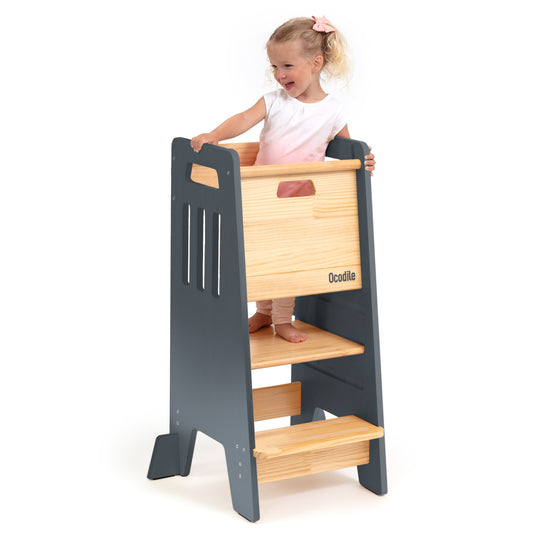
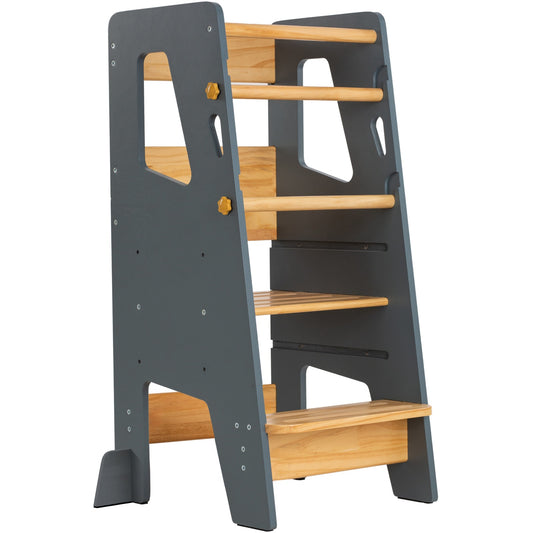
Furniture matters. A standing tower in the kitchen, a stable step stool in the bathroom, and a low bed a child can enter without climbing all support freedom with fewer unnecessary adult lifts. Ocodile makes child-focused furniture such as standing towers, floor beds, and step stools designed to help children participate safely in everyday routines at home.
The useful standard is simple. If a product gives access, stability, and clear use, it supports the prepared environment. If it creates new hazards or only looks the part, skip it.
Montessori Room Layouts and Activities by Age
A Montessori learning environment changes as the child changes. The same principle stays steady. The room should match the child's current developmental work, not the adult's wish for a finished setup.

For more visual examples of simple setups, these Montessori playroom ideas can help you translate the principles into an actual room.
Infant space 0 to 1 year
An infant doesn't need a crowded nursery. The room should support movement, observation, rest, and calm connection.
Keep the layout open. Floor space matters more than decorative furniture. A low mirror at floor level, a movement mat, and a small area for a few simple objects are often enough. If books are included, display only a few with covers visible.
Activities at this age are simple and sensory:
- Visual focus: mobiles or high-contrast objects
- Grasping practice: lightweight rattles or natural-texture items
- Movement: time on a firm mat for rolling and reaching
The common mistake is overloading the room. Infants benefit from clarity. Too much stimulation can make the space harder to use, not richer.
Toddler room 1 to 3 years
Toddlers need access to real life. This is the age when the environment starts doing serious work.
A useful toddler room usually includes a low bed, a low shelf with a small number of activity options, accessible clothing, and a place to sit for books or snacks. In shared spaces, one defined toddler zone is often enough. It doesn't need to be large.
Good toddler activities usually involve action with a clear end:
| Activity type | Example |
|---|---|
| Practical life | carrying, wiping, pouring, dressing frames |
| Language | object naming, simple books, songs |
| Motor work | posting, stacking, transferring |
| Care of environment | watering plants, putting laundry in a basket |
This is also when furniture earns its keep. Stable child-height tools reduce the amount of “wait for me” built into the day.
If your toddler is constantly climbing furniture to join you, that's information. They're asking for a safer way to participate.
Preschooler corner 3 to 6 years
Preschoolers can handle more complexity, but they still need order. This age benefits from defined work areas rather than one catch-all play zone.
A strong setup often includes a small table and chair, open shelving for selected activities, a reading area, and practical tools for self-care. Materials can expand to include early language, counting, matching, art, and more detailed practical life work.
Useful activities here often involve sequence, precision, and repetition:
- Practical life: food prep, cleaning, folding, buttoning
- Sensorial work: sorting by size, shape, sound, or texture
- Language: sound games, letter exploration, vocabulary objects
- Math readiness: counting objects, ordering quantities, simple number association
The main trade-off at this age is between variety and depth. Adults often add too much too soon. Preschoolers usually do better when a smaller set of meaningful choices stays available long enough for repetition and mastery.
Your Montessori at Home Checklist and Safety Tips
A good Montessori setup doesn't need a full reset. Most families get further by changing a few pressure points first. Pick the moments in your day where your child wants to participate but can't yet do so safely or independently.

A quick visual walk-through can help before you buy or rearrange anything.
Home checklist
Use this as a practical audit:
- Child access: Is there at least one place where your child can independently reach clothes, books, and a few activities?
- Clear order: Does each item have an obvious place to return to?
- Limited choices: Are only a manageable number of toys or materials visible at once?
- Real participation: Can your child help with one daily task such as snack prep, hand washing, wiping, or dressing?
- Calm layout: Does the room feel usable, or does it compete for attention?
- Rotation: Are you removing what isn't being used instead of constantly adding more?
Safety tips that matter
Montessori doesn't mean unsupervised freedom. It means carefully prepared freedom.
Focus on these basics:
- Anchor heavy furniture: Shelves and storage units should be secured.
- Check stability: Step stools, towers, tables, and chairs should sit firmly without wobble.
- Choose child-safe materials: Avoid finishes or components you can't confidently use around young children.
- Control true hazards: Medicines, sharp tools, cords, and cleaning products stay inaccessible.
- Match the setup to the child: A useful environment for one age may be unsafe for another.
This short video is a helpful companion if you want to see the ideas in motion.
What works and what usually doesn't
The most effective Montessori homes are rarely the fanciest. They're the ones where the child can do something real.
What tends to work:
- Simple zones instead of one giant toy area
- Reachable tools instead of adult-controlled storage
- A few repeatable activities instead of endless novelty
- Daily life involvement instead of entertainment-only setups
What usually doesn't:
- Overdecorated rooms that the child finds difficult to move around in
- Too many materials on display
- Unsafe access disguised as independence
- Frequent adult interruption just when concentration begins
Start with one corner, one shelf, one routine. A Montessori home grows by use, not by instant transformation.
A calmer, more independent home usually starts with a few well-chosen tools. Ocodile makes child-focused furniture such as standing towers, floor beds, and step stools that can help turn everyday routines like cooking, washing, and getting dressed into safer opportunities for participation.