



Montessori Climbing Furniture: Benefits & Safety
Your child keeps trying to climb the couch, the coffee table, the low bookshelf, and somehow your lap at the same time. Most parents don't see a “bad” behavior here. They see a child whose body is asking for challenge, movement, and practice.
That's where Montessori climbing furniture often enters the conversation. But this category can be confusing fast. Parents hear “Montessori,” sellers say “Pikler,” and product pages focus on pretty nursery photos instead of the details that are important for safe use.
What helps most is to strip it back to basics. A good climbing set should support movement, independence, and confidence. It should also be made well, tested properly, and designed with real safety details in mind, not just a trendy look.
What Is Montessori Climbing Furniture
A toddler who climbs everything in sight usually isn't trying to cause chaos. They're practicing. Pulling up, stepping over, shifting weight, and testing limits are part of early development. Many families end up looking for a safer place for that urge to go.
Montessori climbing furniture is the name many parents use for low indoor climbing equipment made for young children. You'll usually see pieces such as a triangle climber, an arch, or a ramp. These are meant to give children a way to move freely and build skill through play.
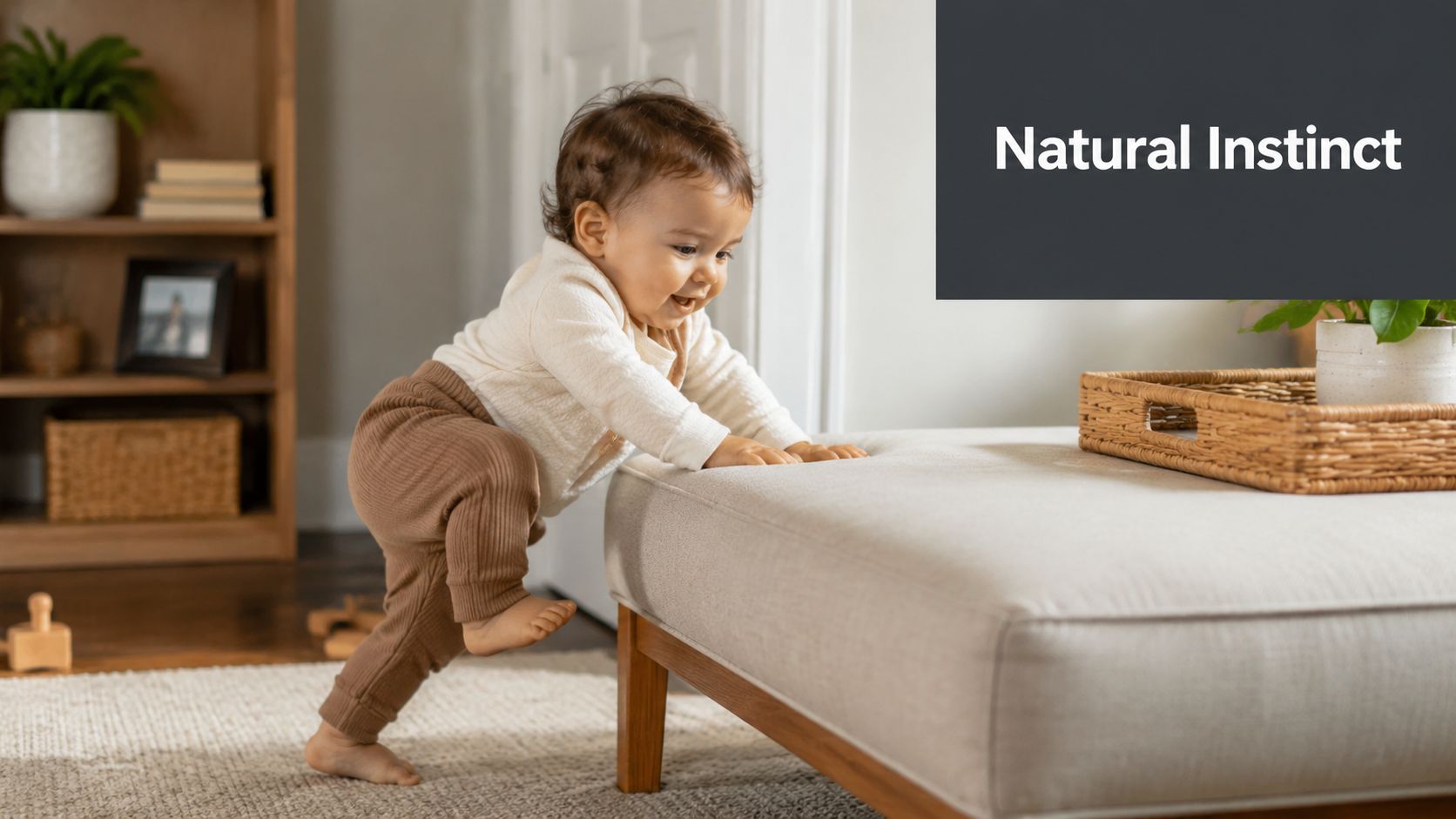
Many parents first meet this idea while shopping for a Montessori climbing triangle. The appeal is easy to understand. Instead of constantly saying “get down,” you're giving your child a structure that was made for climbing.
More than a toy
The biggest mindset shift is this. A climbing frame isn't just entertainment.
It's a tool that lets a child repeat meaningful movements at their own pace. A cautious child may spend days only holding the rungs and stepping onto the first bar. A more adventurous child may climb, turn, and climb down again and again. Both are learning.
Practical rule: If your child seeks movement all day, a climbing set can turn that need into safer, more purposeful play.
What parents usually mean by the term
This category often includes:
- Triangle climbers for climbing up, over, and down
- Climbing arches that can also be used for rocking or imaginative play
- Ramps or slides that connect pieces and change the challenge
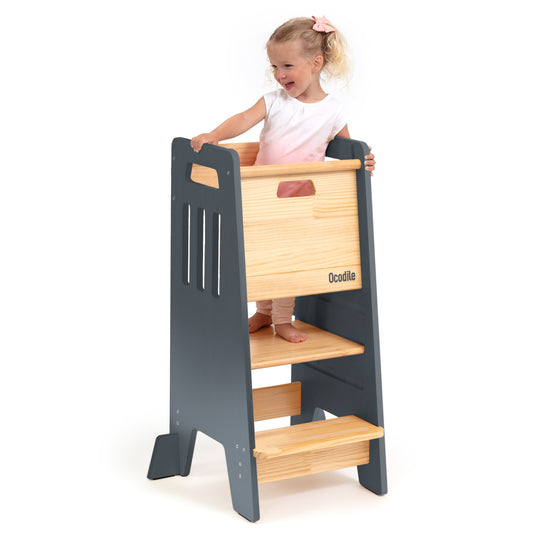
- Related independence furniture such as standing towers for everyday participation in the home
The word “Montessori” gets used broadly because the furniture supports independence and child-led activity. But as you'll see, one of the most important things for parents to understand is that not every piece marketed this way comes from the same design tradition.
How Climbing Furniture Boosts Child Development
A climbing frame looks simple, but a child experiences it as a full-body learning space. Every reach, shift, and step asks the brain and body to work together.
The piece often pictured first is the Pikler triangle. It was designed by Hungarian pediatrician Emmi Pikler in the 1930s, and it's often marketed today as Montessori climbing furniture. Its purpose is to help children develop balance, body control, coordination, and self-confidence through independent exploration, while also supporting heart health, bone strength, and brain activity, as described in this overview of the Pikler triangle.
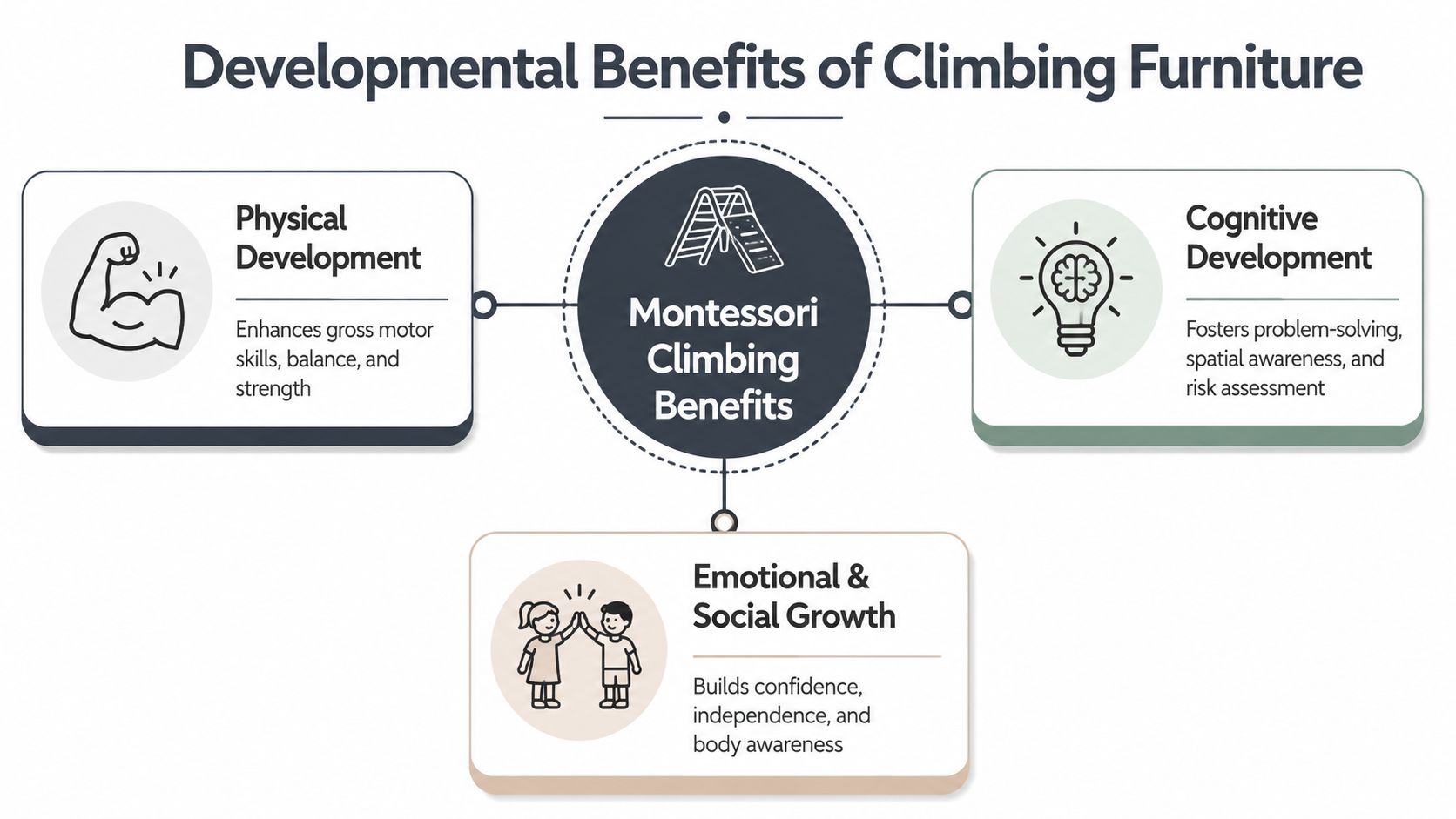
Physical growth through repeated movement
When children climb, they aren't just “burning energy.” They're practicing key movement patterns.
- Balance: A child learns how to steady the body while shifting from one rung to another.
- Coordination: Hands, feet, eyes, and trunk all have to work together.
- Strength: Climbing asks for pushing, pulling, gripping, and controlled lowering.
- Body awareness: Children begin to judge where their bodies are in space and how much effort a movement needs.
This is why a basic climber can support the same goals parents look for in many toddler gross motor activities. The difference is that the challenge stays available all day, and the child can return to it when they're ready.
Cognitive skills develop at the same time
A good climbing frame acts like a physical puzzle. The child has to answer small questions with their body.
Should I place my foot here or there?
Can I reach that rung from this position?
Do I go up, turn around, or back down?
Those decisions build early problem-solving and spatial reasoning. They also introduce gentle risk assessment. A child learns what feels stable, what feels too high, and when to slow down.
A child who pauses before the next step is still learning. Caution is part of skill building, not a sign that the equipment is too hard.
Confidence grows from doing it alone
One of the quiet benefits of climbing furniture is emotional. Children feel proud when they master something their bodies once found difficult.
You can often see the sequence happen in real time:
- Observation: They circle the structure and watch.
- Testing: One foot goes up, then back down.
- Practice: They repeat the same route many times.
- Mastery: Suddenly the child moves with confidence.
That process teaches resilience. It also supports independence, because the adult doesn't need to direct every move. The child becomes the one solving the challenge.
Exploring Types of Montessori Climbing Furniture
Not all climbing pieces do the same job. Some are best for simple up-and-down movement. Others invite rocking, sliding, crawling underneath, or pretend play. When parents understand the function of each piece, shopping gets much easier.
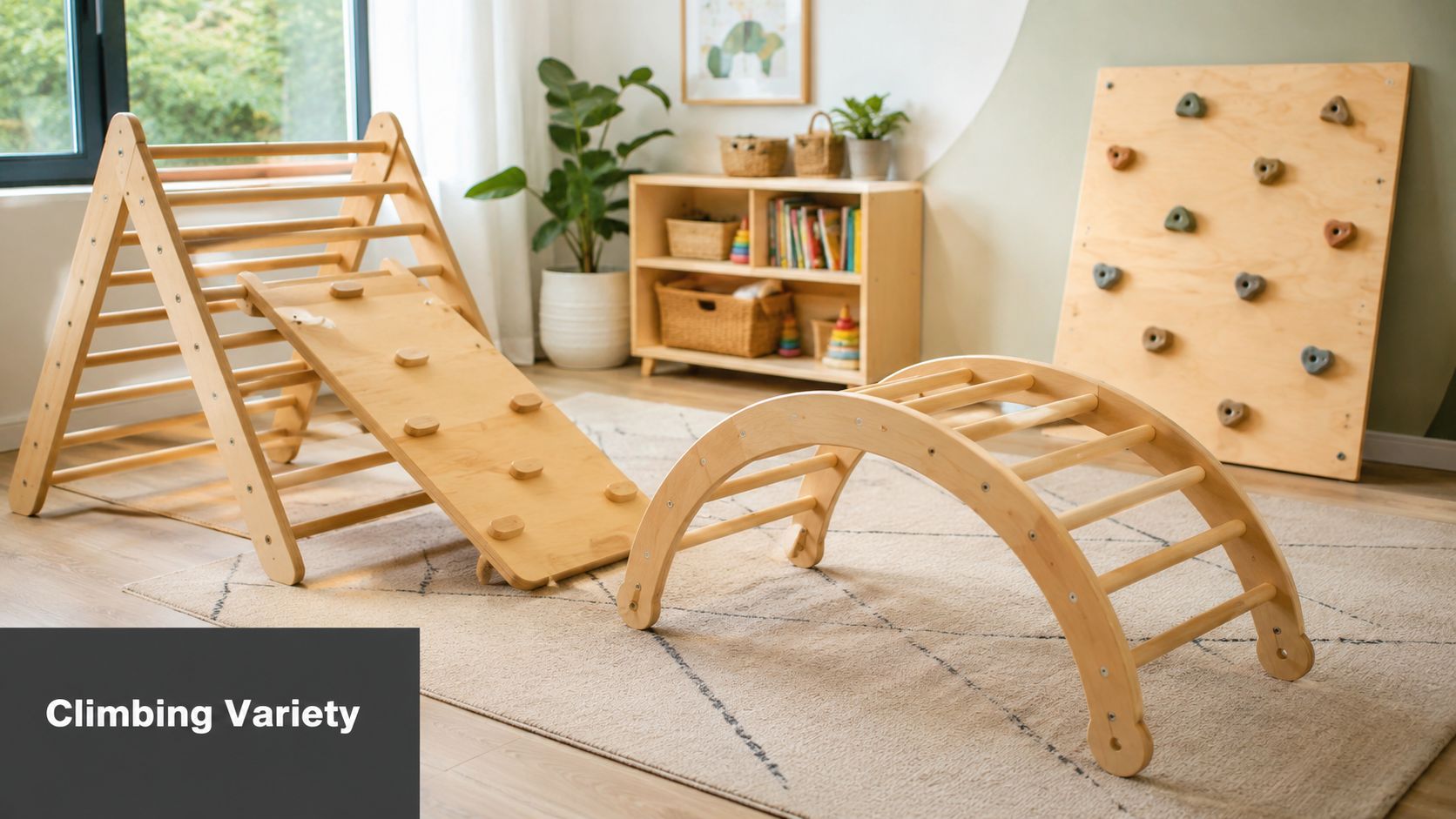
The triangle climber
This is the piece commonly associated with Montessori climbing furniture. It has an A-frame shape with rungs running up both sides. Children can pull to stand on it, climb upward, swing a leg across the top, and practice climbing down.
Its strength is repetition. A young toddler may only use the lower rungs. An older child may climb across more smoothly and combine it with other pieces. That range is one reason many families start here when browsing children's climbing sets.
The climbing arch or rocker
The arch has a different feel. Turned one way, it can be climbed like a curved ladder. Turned the other way, it can work as a rocker.
That gives it a broader play life in many homes. Some children use it for movement. Others turn it into a bridge, a tunnel, a store counter, or a spot to drape a blanket.
Here's a closer look at how these pieces often work together in real play:
Ramps and slides
A ramp changes the challenge more than parents expect. One side may be smooth for sliding. The other may include small grips for climbing.
Once attached to a triangle or arch, the child gets new movement choices. They can climb up the ramp, cross the frame, and climb down the other side. That makes the whole setup feel fresh without requiring a completely new toy.
Related independence furniture
Some families also group standing towers into the same general philosophy, even though they aren't climbing toys in the usual sense. They support safe participation in daily routines such as washing produce, mixing batter, or watching a caregiver cook.
That connection matters. The broader goal isn't only play. It's helping children move, participate, and do more for themselves in a prepared environment.
| Piece | Main use | What children practice |
|---|---|---|
| Triangle climber | Up-and-over climbing | Balance, coordination, planning |
| Arch rocker | Climbing and rocking | Core control, imaginative play |
| Ramp or slide | Connecting and changing routes | Risk judgment, strength, movement variety |
| Standing tower | Daily participation at counter height | Independence, stability, routine skills |
How to Choose Safe and Durable Climbing Furniture
You find a climbing triangle online that looks beautiful in the nursery photo. The wood appears smooth, the price seems reasonable, and the reviews sound positive. Then you start reading more closely and realize the listing says very little about bar spacing, finish, testing, or how the frame locks open. That is the moment many parents notice they are not really choosing decor. They are choosing a piece of movement equipment their child will trust with their whole body.
That is also where the Montessori and Pikler confusion can cause trouble. Many sellers use “Montessori” as a general style label, even when parents are looking for Pikler-style climbing equipment. The difference matters because Pikler-inspired designs are usually discussed in terms of movement freedom and body awareness, but for parents, the practical question is simpler. Is this climber built in a way that supports safe development? According to this video discussion of ASTM and CPSIA concerns, many products sold under the Montessori label raise concerns about stability, safety details, and standards compliance.
What to check before you buy
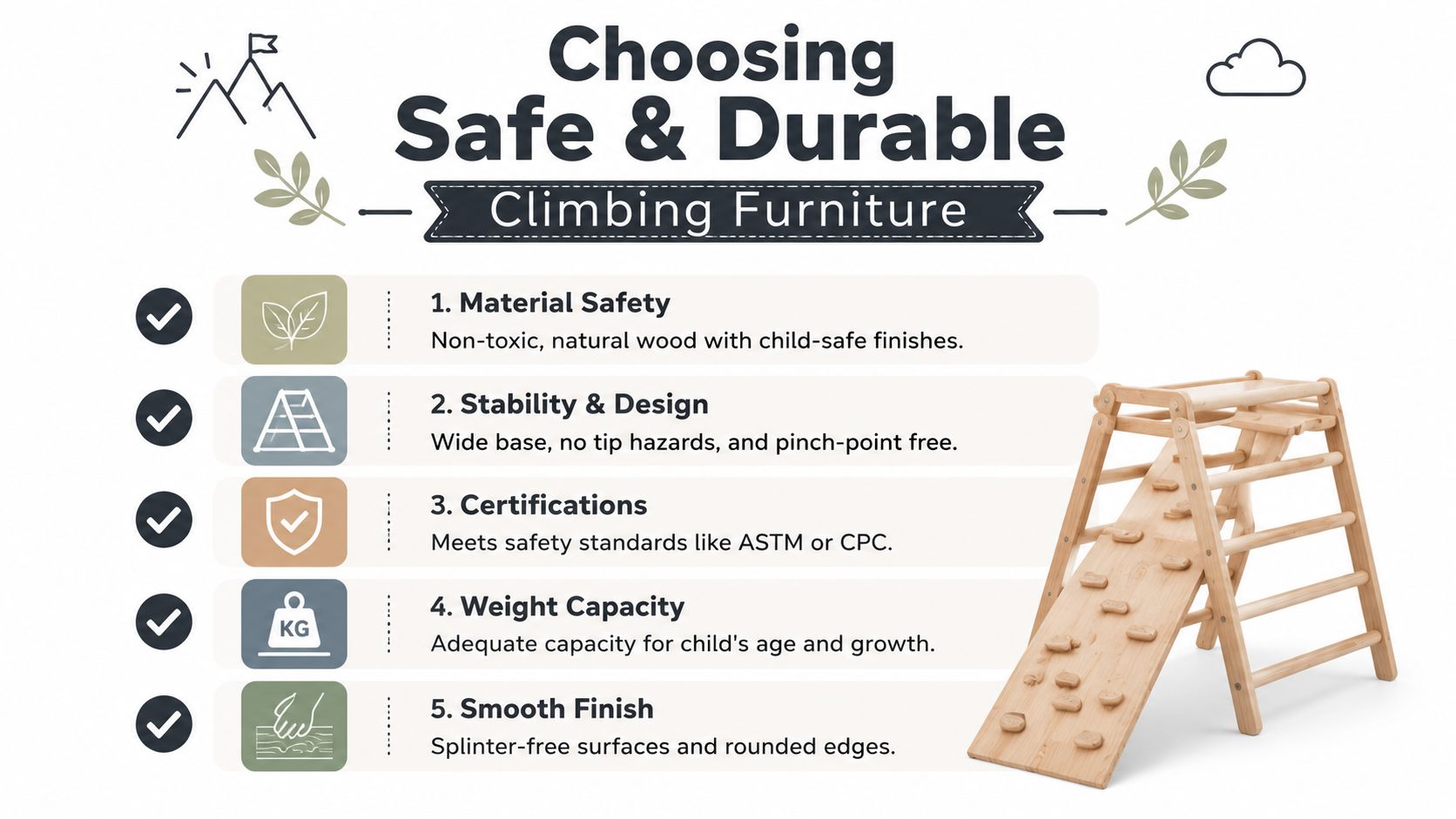
I usually tell parents to read a climber listing the same way they would read a car seat listing. Start with the parts that affect safety and daily use. Leave color and room styling for last.
- Material quality: Look for solid wood or well-finished birch plywood with clear information about what the frame is made from. Vague wording often signals vague quality.
- Surface finish: Check for rounded edges, smooth sanding, and finishes made for children's furniture. Rough corners and visible splinters are immediate warning signs.
- Bar spacing: This is one of the most important design details. Spacing should be intentional and consistent so a child's body moves through the frame without avoidable entrapment risk.
- Stability: Foldable climbers should open firmly and lock securely. A frame should look steady under use, not flexible in a way that suggests wobbling.
- Safety testing: Look for specific standards, certifications, or testing information. General phrases like “kid-safe” do not tell you much.
Safety lens: If a product page focuses heavily on appearance but barely explains construction, slow down and keep comparing.
Certifications and load limits
Parents often ask whether certifications really matter for a simple wooden climber. They do, because they show the maker has at least addressed the product as equipment, not just as a pretty object for a playroom.
Look for named standards such as ASTM F963, EN71, CPC, or CE where those labels are relevant to your region and product type. Then read the details carefully. A load limit should be clearly stated, and the recommended use should match the child's age and stage. A frame may hold more weight in testing than in everyday child use, but the seller should explain that plainly.
A short buying checklist helps keep the process clear:
- Read the full materials list. Clear descriptions are a good sign.
- Check for named standards or testing. Specific information is more useful than marketing language.
- Look for anti-entrapment design details. Bar spacing should never feel accidental.
- Review age guidance and supervision notes. Good brands make this easy to find.
- Study the locking mechanism on foldable models. You want obvious, secure positioning.
Think like a long-term furniture buyer
Climbing furniture gets used more like a stool, ladder, and play structure combined than like a typical toy. It takes repeated weight shifts, pulling, gripping, and occasional bumps. That is why it helps to shop with the same mindset you would use for a hardworking chair or table. These tips for durable home furniture are useful for that reason. The habits are similar: check joinery, surface quality, materials, and how the piece will hold up over time.
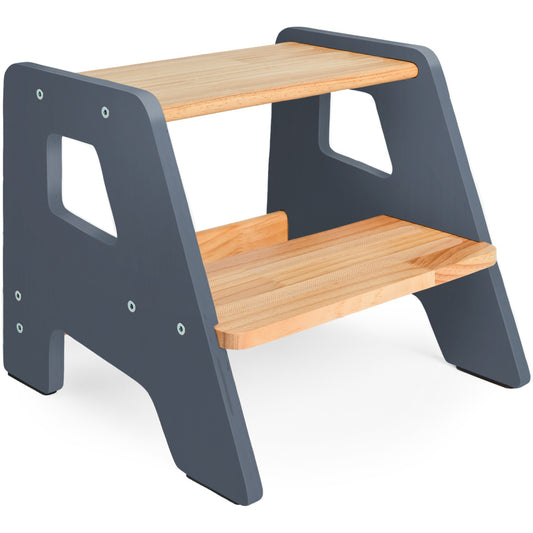
If you're comparing brands, Ocodile is one example of a company focused on child furniture that supports independence and safe exploration, alongside products such as standing towers and step stools. That broader product range can help parents judge whether a brand is thinking carefully about child use, material consistency, and everyday function across the home.
Home Setup and Placement for Safe Play
A well-made climber can still become a poor setup if it's placed badly. Most accidents happen around the furniture, not just on it. Placement changes how a child approaches the climber, how they fall, and how easily an adult can supervise.
Where to place it
Choose a level surface with enough open space around the structure. Keep it away from sharp-edged furniture, hard walls that are too close, and busy walkways where siblings or adults may brush past.
The best spot is usually a room where family life already happens. Children tend to use climbing furniture more naturally when it's part of the living space, not tucked away in a room they rarely enter.
A simple placement checklist helps:
- Open clearance: Give the child space to climb down in all directions.
- Good sight lines: Put it where you can supervise while doing normal household tasks.
- Steady flooring: Avoid unstable surfaces that shift under the frame.
- Low distraction nearby: Don't place it right beside a sofa arm, table edge, or tempting jump-off point.
What to put underneath
This is the part many parents ask about, and product listings often gloss over it. Thick gym mats may sound safer, but they can change the stability of foldable climbing equipment.
According to 2025 childcare safety reports discussed here, foam mats exceeding 1.5 inches under a foldable Pikler model can increase the risk of tripping or frame tipping by 32%. That doesn't mean you need a bare floor. It means you should be cautious about overly soft or thick surfaces.
A thin mat or low-pile rug often makes more sense than a thick foam gym mat under a foldable climber.
Supervised doesn't mean directed
Children can play independently on a climbing structure, but they still need adult supervision. That doesn't mean constant instructions. It means you stay present, available, and close enough to respond if needed.
Good supervision often sounds like this:
- “You're finding your footing.”
- “You can climb down when you're ready.”
- “I'm right here.”
That kind of presence supports confidence without rushing the child.
Don't ignore the room around it
Soft furnishings, window treatments, and the general environment also affect safety. If your climbing area is near windows or large fabric panels, it's worth reviewing broader home safety topics such as understanding fire resistant drapes, especially if you're creating a dedicated play corner.
For maintenance, keep it simple. Check hardware from time to time, wipe the wood according to maker guidance, and stop use if anything feels loose or unstable.
Practical Activities for Your Climbing Furniture
It often starts like this. Your child climbs two rungs, climbs back down, then spends ten minutes turning the same frame into a cave for a stuffed rabbit. To an adult, that can look like they are "not really using it." In early childhood development, that is meaningful practice. The furniture is giving the child a safe place to test balance, plan movement, and invent play on their own terms.
This is also where many parents get tangled in the Montessori vs. Pikler question. Montessori home environments support independence and purposeful activity. Pikler-based movement work focuses more directly on free motor development and natural climbing. In daily family life, the label matters less than the setup. What matters is that the structure is stable, made from child-safe materials, and used in ways that match your child's stage.
A well-made climbing piece can serve more than one purpose because the child keeps bringing new skills to it. First it is a ladder. Then it becomes a tunnel, a house, or a place to practice getting up and down with control.
Simple ways to keep play fresh
You do not need complicated plans. Small changes are enough.
- Blanket fort: Drape a light blanket over part of the frame and place a cushion or a few books inside for quiet time.
- Obstacle path: Set floor cushions, taped lines, or a tunnel nearby so your child climbs, steps, crawls, and turns in sequence.
- Toy rescue game: Place soft toys on one side and invite your child to climb up, pick one up, and bring it down carefully.
- Ramp play: If your set includes a ramp, let your child roll balls or cars down it and watch how angle and surface change the speed.
Each activity supports a slightly different skill. Climbing builds body awareness and grip strength. Crawling under and around the frame helps with spatial understanding. Carrying a toy while climbing down adds planning and control.
Repetition is real learning
Many parents worry when a child repeats the same route again and again. Repetition is how young children build reliable movement patterns. It works like practicing the same step on a staircase until the body no longer has to guess.
A child who climbs one rung, pauses, and returns to the floor is still learning. They are judging height, testing balance, and deciding whether they feel ready for more. That kind of self-paced practice fits both Montessori respect for independence and Pikler's emphasis on unhurried motor development.
Quiet uses matter too
Climbing furniture does not need to be active every day. An arch on its side can become a reading nook. A triangle partly covered with a scarf can become a pretend house, animal shelter, or shop counter.
That longer life is one sign of a thoughtful purchase. Good material quality and a stable design support movement play, but they also support open-ended use as your child grows. Parents often get more value from a piece that can shift between gross motor play and calm pretend play than from one that does only one job.
If you're exploring child-sized furniture that supports independence at home, Ocodile offers products such as standing towers, floor beds, step stools, and Pikler-style options designed around safe exploration and everyday family use.