




 - Monica
 - Lindsay

Adjustable Height Step Stool: A Parent's Safety Guide
Your child is tugging at your leg while you cook. They want to rinse strawberries, stir pancake batter, or just see what you're doing. The counter is too high, a dining chair is too unstable, and a basic fixed stool never seems to be the right height in every room.
That's where many parents get stuck. We want to say yes to helping, but we also know that a bad setup turns a good moment into a fall risk fast. A toddler doesn't use a stool the way an adult does. They lean, twist, climb down backward, get distracted, and test limits.
Most product pages still talk about step stools as if the main buyer is an adult or a senior. That leaves parents with the question they need answered. Is this stool safe enough for a young child to use with increasing independence, and under what conditions?
Beyond Their Reach The Need for a Better Boost
A toddler in a kitchen usually wants closeness before they want competence. They want to stand where you stand. They want to wash the cucumber you're slicing or watch the dough come together. The problem is that most household “boosts” weren't designed for that kind of use.
A kitchen chair invites climbing from the side. A low plastic stool may slide on tile. A fixed stool might work at the bathroom sink but leave your child reaching too far at the kitchen counter. Parents often patch together a solution, then spend the whole activity with one hand on the child and one hand on the task.

The reason this feels harder than it should is simple. Most guidance around step stools still centers on adult or senior use. One of the biggest gaps in current coverage is real safety guidance for young children. Retail listings often highlight load capacity and non-slip surfaces, but they don't answer the question parents keep asking: when is an adjustable stool safe enough for a 2- to 5-year-old to use independently? That gap is called out directly in this retail overview discussing the lack of toddler-specific safety guidance.
Why generic advice falls short
What works for an adult can fail for a toddler because the risk pattern is different.
- Tipping risk: A young child shifts weight suddenly and often steps near the edge.
- Overreaching: If the stool is too low, the child stretches forward instead of staying centered.
- Climbing down: Going up is usually easier than coming down safely.
- Surface mismatch: Bathroom tile and kitchen flooring don't forgive wobble.
Parents usually don't need a stronger stool first. They need a better-matched stool.
An adjustable height step stool can solve a real problem here, but only if you evaluate it from a child-development point of view. Height range matters, but so do footprint, grip, climb pattern, and whether your child can use it without turning every task into a balance test.
Understanding the Core Design That Grows with Your Child
An adjustable height step stool is different from both a fixed stool and a learning tower. A fixed stool gives one boost and asks your child to adapt. A learning tower offers more enclosure but takes up more room and serves a narrower set of use cases. An adjustable stool sits between those two. It changes with the task and, ideally, with the child.
In formal safety language, a step stool is defined as a self-supporting, foldable, portable ladder that is non-adjustable in length, 32 inches or less in overall size, and built with flat steps for single-person use. The American Ladder Institute also warns that step stools shouldn't be left set up and unattended, which matters even more in homes with young children who see any raised surface as an invitation to climb. That guidance appears in the American Ladder Institute's step stool safety definition.

What adjustability actually changes
The core idea is simple. The standing platform can be set higher or lower so the stool fits the moment better.
That matters in family life because your child's tasks change fast:
- washing hands at one sink
- brushing teeth at another height
- helping at a kitchen counter
- reaching a shelf in a playroom
- growing taller between one season and the next
Why this can be better than a fixed stool
A fixed stool is easiest to understand and easiest to outgrow. If it's too low, your child leans. If it's too high, climbing becomes awkward. An adjustable model gives you room to respond instead of replacing the stool as soon as routines change.
Here's the parent-friendly version of the design logic:
| Type | Best use | Limitation |
|---|---|---|
| Fixed stool | One stable, repeat task | Height may stop fitting quickly |
| Adjustable height step stool | Multiple rooms and growing kids | Requires careful setup and supervision |
| Learning tower | Longer kitchen activities with more enclosure | Bulkier and less portable |
A stool that “grows with your child” isn't magic. It just lets you keep the platform where your child can stand upright, stay centered, and climb with control.
That's the core value. Not more features for their own sake, but a better fit over time.
Building Confidence from the Ground Up With Safe Materials
The safest stool for a toddler isn't merely the one with the biggest weight rating. Parents get drawn to that spec because it sounds reassuring, but it can distract from what matters more in daily use. How the stool behaves when a child steps up, wiggles, pivots, or climbs down tells you more than the headline number.
A useful technical example comes from heavy-duty adjustable stools. A bariatric commercial version lists a 750 lb weight capacity, uses all-steel construction, and includes non-slip platform and leg surfaces. The important takeaway isn't that a toddler needs that capacity. It's that load capacity alone doesn't guarantee stability. The frame material and the contact surfaces are what help the stool stay steady when weight shifts, as shown in this commercial adjustable stool specification.

What to inspect first
Start with the base. If the footprint is narrow, a toddler can make it feel unstable quickly just by stepping near the edge or turning to talk to you.
Then look at the contact points.
- Feet on the floor: Non-slip footings help the stool hold position on smooth surfaces.
- Feet on the platform: A textured or grippy top reduces slipping when socks, damp feet, or splashed water enter the picture.
- Edges and corners: Rounded edges reduce the damage from inevitable bumps.
- Rigidity: A stool should feel solid under movement, not springy or twisty.
Material matters, but not in the way many listings suggest
Parents often compare wood and plastic as if one category is always safer. That's too simplistic. A well-made wooden stool can feel grounded and rigid. A poor one can wobble if joints loosen. A solid molded stool can be practical in bathrooms. A flimsy one can skate across tile.
What you're really judging is the material system. That means the combination of frame strength, joinery, surface grip, and how the stool meets the floor.
For families who are also thinking about durability across the whole home, this guide on how to select pet-friendly furnishings is useful because it frames safety around real wear, traction, and daily mess, not just appearance. The same thinking applies to children's stools. Surfaces have to hold up under repeated movement and frequent cleaning.
Why I prefer a boring stool over a clever one
The stools that worry me most are the ones trying too hard to look sleek. They often shave down the base, reduce grip, or make the platform smaller to save visual space. That may look tidy in a product photo, but toddlers don't use products carefully enough for that trade-off to make sense.
A stool for young children should feel uneventful. Stable. Predictable. Easy to wipe down. Hard to tip.
If you want a closer look at why many parents still prefer natural materials for this category, Ocodile has a useful piece on a natural wood step stool that reflects the broader appeal of wood in child furniture. The bigger point remains the same, though. Choose the design that stays steady under real child movement, not the one with the flashiest specs.
Practical rule: If a stool seems stable only when the child stands perfectly still, it isn't stable enough for a toddler.
How to Choose the Right Adjustable Height Step Stool
Parents often shop by category first. Bathroom stool. Kitchen stool. Potty stool. That's understandable, but it leads to the wrong question. The better question is this: what height and posture does my child need for this task without leaning, stretching, or climbing awkwardly?
That's where adjustability earns its place. Small height differences can change performance more than people expect. In a controlled study, using a step stool during CPR on a bed improved chest compression depth by an average of 4 mm, from 46 ± 13 mm to 50 ± 11 mm, and the effect was strongest for rescuers 167 cm tall or shorter. The same study also found 18% more incomplete recoil, which is a reminder that height changes can help one part of a task while affecting another. The lesson for parents is not about CPR itself. It's that a small change in elevation can materially alter how well someone performs a height-dependent task. See the details in this controlled study on step stool use and CPR performance.

For a practical visual example, this video shows the kind of child-height access many families are trying to create.
The checklist I'd use in a real home
Don't start with weight capacity. Start with fit.
-
Match the task height
A stool that works at the bathroom sink may be wrong for kitchen prep. Watch where your child's hands need to land. They should be able to reach the working surface without lifting their shoulders or leaning their chest forward.
-
Look at platform space
Your child needs enough room to place both feet securely and adjust stance without stepping to the edge.
-
Check the climbing pattern
Some stools are easy to step onto but awkward to descend. Practice both directions before you trust independent use.
-
Choose supervision level realistically
Some children can follow “hands on the counter, feet in the middle.” Others can't yet. Buy for the child you have, not the one you hope shows up next month.
Signs a stool is the wrong fit
| If you notice this | It usually means |
|---|---|
| Child reaches with straight elbows and leans chest forward | Platform is too low |
| Child climbs up but hesitates coming down | Step geometry feels insecure |
| Child stands on tiptoes | Height still isn't enough |
| Child keeps stepping to one side | Platform may be too small or task setup is off |
Parents comparing stool styles for kitchen use may also find this guide to a kids step stool for kitchen routines helpful. The strongest choices are the ones that support upright posture, controlled climbing, and the lowest effective standing height for the task.
Don't buy the tallest option your child can manage. Buy the lowest option that lets them participate well.
Unlocking Independence in Every Room
The best part of a well-matched stool is that it turns ordinary routines into practice. Not performance, not pressure. Practice. Your child gets repeated chances to do small things with growing skill.
In the bathroom, independence often starts with handwashing. A child climbs up, turns toward the sink, braces both feet, and reaches the faucet without asking to be lifted. Then comes soap, rinsing, drying, and climbing down. These moments look small from the outside, but they build sequencing, balance, and confidence.
In the kitchen
Kitchen participation is where many families first see the difference between “cute helping” and real capability. A child who can stand at the right height can rinse produce, tear lettuce, transfer cut fruit into a bowl, or stir batter with less fatigue and less constant rescue from a parent.
The key is choosing tasks that match attention span and body control. Short, repetitive jobs usually work best at first. Washing mushrooms. Passing carrot peels to a compost bowl. Pressing cookie cutters.
In the bathroom and beyond
Bathroom use asks for a different kind of success. The floor may be smoother, the pace is usually rushed, and the child is often using the stool while sleepy or distracted. That means the setup has to be forgiving.
I also see stools become useful in bedrooms and entryways. Reaching a low shelf, climbing into bed, or helping put away a backpack can all be opportunities for self-sufficiency, as long as the stool remains task-specific and isn't left around as an open invitation for unsafe climbing.
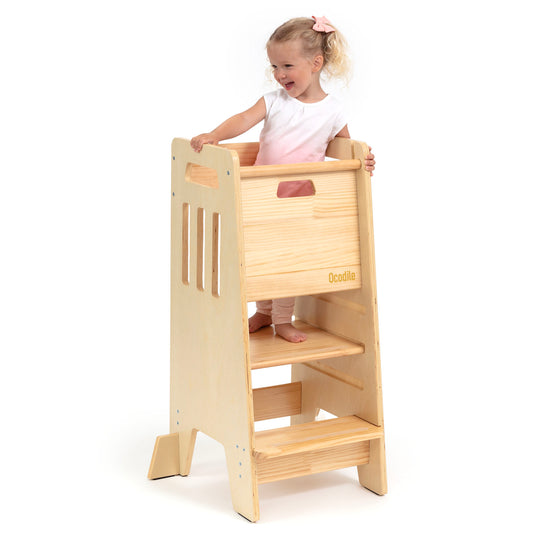
For families leaning toward a Montessori-style home, the bigger idea will feel familiar. Independence grows when the environment fits the child. A stool is one small part of that. If you're weighing whether a more enclosed helper is better for your routines, this overview of a Montessori learning tower can help clarify when each setup makes sense.
The goal isn't to make children independent from us. It's to make them capable beside us.
That's why the right stool matters. It doesn't just raise a child to counter height. It gives them a stable place in family life.
Your Guide to Adjusting and Maintaining Your Stool
An adjustable stool only helps if you keep adjusting it to the child and the task. Many commercial models use 1-inch increments, such as 8.5, 9.5, and 10.5 inches, to fine-tune elevation. That kind of spacing is useful because the safest setup is the lowest height that still gets the job done, which keeps the center of mass lower and improves stability, as described in this commercial product overview of adjustable stool height settings.
How to adjust it safely
Always adjust the platform with the child off the stool and out of the way. Set the stool on a flat surface, make the height change fully, and check that every locking point or support point is seated before the next use.
A simple routine helps:
- Place first: Put the stool where it will be used.
- Adjust second: Choose the lowest setting that allows comfortable reach.
- Test third: Press down and shift it lightly side to side before your child climbs up.
- Observe once: Watch the first use after every adjustment.
How to know it's time to lower or change the setup
Watch posture more than age. If your child starts leaning less than before, standing too tall over the task, or bending awkwardly at the hips, the platform may now be too high or the task has changed.
Maintenance doesn't need to be complicated.
- Wipe spills promptly: Water and soap residue can reduce grip.
- Check hardware regularly: Tighten anything that loosens with use.
- Inspect the feet: Worn grip at the bottom changes how the stool behaves on hard flooring.
- Retire it from risky jobs: If your child starts carrying heavy or bulky items while standing on it, redirect that routine.
A stool stays safe when it stays boring. Solid. Clean. Predictable.
Frequently Asked Questions From Parents
When is a child ready to use an adjustable height step stool?
Readiness is more about behavior than birthday. A child should be able to climb up with control, stand with both feet planted, follow a simple safety rule, and climb down without panic. If one of those pieces is missing, the stool can still be used, but not independently.
Is a step stool better than a learning tower?
They solve different problems. A step stool is compact, portable, and useful across more rooms. A learning tower gives more enclosure for counter tasks but takes more space and is less convenient to move. If your child needs more boundary support during longer kitchen activities, a tower may fit better. If you want flexibility and a smaller footprint, a stool may be the more practical tool.
How do I teach safe climbing?
Keep the lesson short and physical. Show your child where to place each foot, where to put their hands, and how to climb down slowly. Practice when you are not rushed. Many children need far more coaching on climbing down than climbing up.
Should I leave the stool out all day?
Not usually. Safety guidance for step stools warns against leaving them set up and unattended. In a home with toddlers, that matters because a stool quickly becomes climbing equipment for unrelated adventures. Bring it out for the task, then put it away when the activity is done.
What matters more, adjustability or stability?
If forced to choose, stability wins every time. But the best answer is proper adjustability within a stable design. A stool that changes height but feels twitchy is a poor trade. A stool that stays planted and lets you keep your child at the lowest effective height is the safer long-term choice.
If you're looking for child-focused furniture that supports everyday independence with a safety-first mindset, Ocodile makes products designed for real family routines, including step stools and helper furniture built around practical use at home.