


Baby Gates Best Guide: How to Choose for Any Space
The moment usually sneaks up on you. One day your baby is happily staying where you set them down, and the next day they’re heading for the stairs, the dog bowl, the laundry room, and that one hallway you somehow never noticed was so full of hazards.
That’s when shopping for baby gates stops feeling optional.
Most parents start by searching for the “best” gate and quickly run into a problem. Many guides assume your home has neat, straight openings and perfect walls. Real homes don’t always cooperate. You might have a staircase with chunky baseboards, a wide opening between the kitchen and living room, or walls that meet at an awkward angle. That doesn’t mean your home is impossible to childproof. It just means you need the right kind of gate for the right spot.
Your Guide to a Safer Home for Your Little Explorer
You set your baby down with a toy, turn for a moment, and suddenly they are halfway to the hallway, locked in on the stairs like a tiny heat-seeking missile. That is the point when home starts to look different. Openings you ignored before now feel like decisions waiting to happen.

That shift in perspective is a good sign. It means you are seeing your home the way a mobile child does, room by room, gap by gap, climbable object by climbable object.
Baby gates help, but only when the gate matches the spot. A gate that works beautifully across a simple bathroom doorway can be the wrong choice for the top of the stairs, an extra-wide opening, or a space with uneven trim and ornate baseboards. That is where many guides fall short. They show the easy setup. Real families often need answers for the awkward spaces.
The goal is not to turn your home into a fortress. The goal is to create reliable boundaries so you can cook, carry laundry, answer the door, or use the bathroom without that constant mental math of, "Can my child reach the stairs before I get back?" A well-chosen gate gives you a safer pause. It also creates more chances to say yes, because part of the house is set up for success.
One safety study found that U.S. emergency departments treated an estimated 37,673 children younger than 7 years for baby gate related injuries from 1990 through 2010, averaging 1,884 children per year. The takeaway is simple. Gates are safety tools, not decorations. They need the right design, the right placement, and the right installation.
Practical rule: The best baby gate is the one that fits your exact opening, stays secure over time, and suits that specific location.
Start by looking at your home's trouble spots the way water finds weak points. Staircases, angled walls, oversized pass-throughs, and doorways with thick molding all change what will fit safely. If you are working through your full safety plan, this guide on how to childproof your home pairs well with gate planning. And if you want cleaner crawling surfaces without harsh residue, these eco-friendly floor cleaning methods are worth a look.
Understanding Pressure-Mounted vs Hardware-Mounted Gates
This is the first decision that matters. Before you compare brands, colors, or latch styles, you need to know which type of gate belongs in which place.
Most baby gates best lists mix these together too casually. They shouldn’t. These two categories work in very different ways.

Pressure-mounted gates
A pressure-mounted gate works a lot like a tension shower rod. It stays in place by pressing outward against two sides of an opening.
That makes it appealing for everyday use between rooms. You usually don’t need to drill holes, and many models are fairly quick to move if your needs change. If you want to block a hallway, a pantry entrance, or a doorway between the playroom and kitchen, this style can make sense.
Pressure-mounted gates often work well when you need:
- A temporary barrier for a doorway you use only part of the day
- A renter-friendly option because you’d rather avoid screws
- A portable solution you may want to reposition later
But the convenience comes with limits. They rely on tension. Tension can loosen. And most pressure-mounted gates have a bottom bar, which adults step over all day. In a calm doorway, that may be manageable. Near stairs or when you’re carrying a baby, it’s a bad trade.
Hardware-mounted gates
A hardware-mounted gate works more like a door. It’s attached with screws to solid mounting points, so the gate becomes part of the structure around it.
This is the gate type you use when failure is not acceptable.
According to Consumer Reports’ baby gate buying guide, hardware-mounted gates are bolted directly to wall framing and must withstand a 30-pound push-out force test per ASTM F1004 standards. Consumer Reports also notes that these gates held up in crash tests that simulated a toddler ramming them at full speed, while pressure-mounted gates can fail under similar loads. That’s why hardware-mounted is the only safe choice for the top of a staircase.
If a gate is guarding a drop, don’t choose tension. Choose screws.
A side-by-side comparison
| Feature | Pressure-mounted | Hardware-mounted |
|---|---|---|
| How it stays in place | Tension against walls or frame | Screwed into mounting surface |
| Best locations | Doorways, hallways, room-to-room openings | Top of stairs, bottom of stairs, high-risk areas |
| Wall impact | Usually less drilling | Requires drilling |
| Ease of moving | Easier to relocate | More fixed |
| Trip risk | Often has a bottom bar | Usually swings clear |
Where parents get tripped up
The confusion usually comes from the word “sturdy.” A pressure-mounted gate can feel sturdy when you first install it. That doesn’t mean it belongs everywhere.
A parent might lean on it in a doorway and think, “This seems solid.” But at the top of the stairs, a child doesn’t need much force in the wrong direction for a tension gate to become unsafe. That’s why the rule is simple.
Use pressure-mounted gates for same-level separation. Use hardware-mounted gates for stairs and other high-risk zones.
What about retractable gates
Some families consider retractable gates because they disappear when open and look less bulky. They can be useful in some layouts, especially tight walkways, but they’re still a specialty choice. The key is the same as with any gate. Match the design to the location, and never let looks outrank safety.
When you’re choosing among baby gates best options, start with this question: What am I protecting, and what happens if this gate fails? That answer points you to the right category fast.
Decoding Key Safety Features and Certifications
You find a gate that looks perfect online. The color matches your trim, the reviews sound reassuring, and the price feels reasonable. Then you read the product page and hit a wall of terms like ASTM, JPMA, walk-through latch, directional stop, and extension kit. For many parents, this is the moment baby gate shopping stops feeling simple.
What helps is knowing which details protect your child and which ones are just sales copy.
A good gate should pass two tests. It should meet recognized safety requirements, and it should still work well in real life, in a home with crooked walls, thick baseboards, wide openings, or stair posts that are anything but standard.
Safety details that deserve your attention
Start with the parts that prevent the most common problems.
A gate should be tall enough that your child cannot easily pitch forward over it as they grow. The openings should be narrow enough to reduce the risk of a head, arm, or leg slipping through. The bottom gap matters too, especially on uneven floors or over decorative trim, because a gate that sits too high can leave space for a small child to scoot under or get caught.
Those details sound small until you picture daily use. A half-inch here or there can be the difference between a gate that acts like a firm barrier and one that leaves a weak spot at floor level.
For stair locations, look closely at swing direction and stops. A stair gate should open away from the drop or have a stop that prevents it from swinging out over the stairs. That feature is easy to overlook on a product page, but it matters in the split second when you are carrying laundry, holding a toddler, or stepping down with tired feet.
A practical checklist for comparing gates
Before buying, I would check these points in this order:
- The gate matches the location. Start with the opening you need to secure, especially if it is angled, extra wide, or framed by heavy molding.
- The spacing is child-safe. Gaps in the gate and near the sides should stay narrow.
- The latch works one-handed. If you need two hands and a burst of patience every time, use tends to slip.
- The close is easy to confirm. You should be able to hear, feel, or clearly see that it locked.
- The stair model has a directional stop. That keeps the door from opening over the edge.
- The instructions address real-world mounting surfaces. This matters a lot in older homes and in decorative stair areas where the left and right sides may not sit on the same flat plane.
One sentence I always come back to is simple: a safety product has to be safe for a tired adult to use correctly.
What certifications actually mean
Certification language can sound technical, but the idea is straightforward. A manufacturer is showing that the gate was tested against known hazards rather than designed around appearance alone.
You may see references to ASTM standards or JPMA certification. You do not need to memorize the code names. What matters is that the product points to recognized child safety requirements and gives clear use instructions, age guidance, and installation limits. If a listing only says “extra secure” or “premium safety” without saying what standard it follows, I would keep looking.
This is also a good moment to think about materials, especially if your child chews rails or spends a lot of time close to the gate. If you are trying to reduce chemical exposure across the room, this guide to non-toxic kids furniture is a helpful companion to gate shopping.
The gate matters, but so does the structure holding it
Parents often focus on the gate panel and forget the surface it mounts to. That is where many tricky layouts become tricky for real.
If you are attaching a gate near stair balusters, newel posts, carved trim, or ornate baseboards, the surrounding structure has to support the gate properly and leave safe spacing around it. A strong latch cannot make up for a poor mounting surface. For families comparing barrier spacing and guardrail principles around stairs, British Standard 6180 for balustrades offers useful background on why barrier design and infill spacing matter.
That is especially relevant in homes that do not have neat, flat doorway frames. A gate can be well made and still be the wrong choice for an opening with angled walls or decorative stair details unless the mounting method suits that layout.
Features that are useful, and features that are just preferences
Some extras prove helpful. Others depend on how your household moves through the space.
| Feature | Helpful when | Less important when |
|---|---|---|
| Auto-close | You pass through often and want backup if someone forgets to shut it | You prefer to stop and check the latch manually each time |
| Stay-open mode | Adults need repeated access during cooking, cleaning, or naps | The area should stay closed almost all the time |
| Dual-lock latch | You have an older toddler who studies how things work | The gate separates a lower-risk room on the same level |
| Low-profile threshold | You walk through frequently and want fewer toe stubs | The gate swings clear and does not leave a floor bar in the path |
The best gate is the one your household can use correctly, every time, in the actual space you have. That matters even more in the homes many guides ignore. The ones with wide pass-throughs, uneven trim, angled walls, and staircases that look beautiful but make standard gate advice fall apart.
How to Measure Your Space for a Perfect Fit
Measuring sounds simple until the gate arrives and doesn’t fit around the baseboard, leaves a gap near the wall, or needs an extension you didn’t know to order. A tape measure saves a lot of frustration here.
Start with the actual opening, not your best guess.

Measure more than once
Take three width measurements:
- Bottom of the opening
- Middle of the opening
- Top of the opening
Use the narrowest one when comparing against the gate’s fit range. Older homes, plaster walls, and heavily trimmed openings are often less square than they look.
Check the trim and baseboards
Baseboards are where many parents get caught off guard. A gate can fit the width of the opening and still fail because the lower contact points hit thick trim before the upper points sit correctly.
Look closely at:
- Baseboard depth
- Baseboard height
- Casing that sticks out
- Any decorative shoe molding near the floor
If you’re dealing with a hardware-mounted gate on heavy trim, you may need spacers or mounting kits approved by the manufacturer so both sides sit on the same plane.
Wide openings and open-plan spaces
For a wide pass-through between rooms, check whether the gate is designed to span the space on its own or whether it requires extensions. Don’t assume every add-on works with every model. Many don’t.
If the opening is especially wide, a multi-panel gate or configurable gate may fit better than a standard swing gate.
A visual walkthrough can help if you want to see measuring basics in action:
Angled walls need one extra check
If your walls don’t face each other squarely, measure the width and also look at the angle where the hardware would sit. Some gates only install straight across. Others can handle angled mounting.
Bring your tape measure, a notepad, and your phone camera. A quick photo of the opening, trim, and wall shape makes comparing gate specs much easier later.
This is one of those jobs where slow is fast. Ten extra minutes measuring beats dealing with a gate that never closes right.
Choosing the Best Baby Gate for Every Location
Location decides almost everything. The safest gate for one spot may be the wrong gate for another, even in the same house.
That’s why a real baby gates best guide has to talk about rooms and layouts, not just product categories.

Top of the stairs
This is essential. Use a hardware-mounted gate.
For this spot, I’d prioritize:
- A directional stop so the gate can’t swing out over the stairs
- A strong latch that closes consistently
- Solid mounting into secure points
- No bottom bar to trip over
If your staircase has a wall on one side and a banister or post on the other, don’t improvise with a gate that only sort of fits. Look for stair-specific hardware or a model designed for offset mounting.
Bottom of the stairs
The bottom of the stairs gives you a little more flexibility, but not complete freedom. Parents often think, “It’s lower risk, so I can use whatever is easiest.” Sometimes that works. Sometimes it creates a daily tripping problem in a high-traffic area.
A hardware-mounted gate often feels better here if the stairs are busy and the opening is narrow. A pressure-mounted gate may work if the area is flat, clear, and away from foot traffic patterns that make a threshold bar annoying or risky.
Doorways and hallways
Pressure-mounted gates typically earn their keep. They’re useful for:
- keeping a crawler out of the kitchen during dinner prep
- separating a play area from a home office
- blocking access to pet food or litter
- creating boundaries in a long hallway
For these spots, ease matters. If the gate is frustrating to open, adults start propping it open or stepping over it in sloppy ways. That’s when good intentions slip.
Wide openings between rooms
Open-plan homes often need gates in places that weren’t designed to hold one. A wide opening between a family room and kitchen is a classic example.
Here, a standard narrow gate may not be your best bet. You may need:
| Space type | Best gate style |
|---|---|
| Very wide opening | Configurable or multi-panel gate |
| Wide but straight opening | Hardware-mounted gate with approved extensions |
| Need clear walkway when open | Swing gate with proper span and swing room |
Check swing clearance before you buy. A large gate can fit the opening but still be awkward if it blocks cabinetry, bumps furniture, or opens into a traffic path.
Angled walls and non-standard layouts
Many parents feel abandoned by typical reviews. They see plenty of advice for simple doorframes and almost none for strange stair landings or slanted walls.
That gap is real. A significant gap in most reviews is the lack of solutions for angled walls, a common challenge in up to 30-40% of U.S. homes, according to BabyGearLab. That’s exactly why specialized angle-mount gates matter.
If your walls meet at an odd angle, or your staircase has one wall and one offset post, look for a gate that specifically allows angle mounting. Don’t assume every hardware-mounted gate does.
Homes with ornate baseboards or awkward trim
This one comes up more than people expect, especially in older homes and apartments with decorative woodwork.
If the trim pushes the lower mounting point farther out than the upper one, the gate may sit twisted unless you use a compatible spacer or mounting kit. The fix is often straightforward, but it needs to be planned. Never force a gate into alignment by overtightening one side.
Odd layouts don’t require unsafe compromises. They require a gate that was designed for odd layouts.
A simple location-based decision guide
- Top of stairs: hardware-mounted only
- Bottom of stairs: usually hardware-mounted, sometimes pressure-mounted if the area is low-risk and flat
- Doorways between rooms: pressure-mounted can work well
- Wide pass-throughs: multi-panel or extension-compatible models
- Angled or offset openings: angle-mount hardware gates
- Decorative trim and baseboards: models that allow spacers or specialized mounting solutions
When parents ask me what’s “best,” I always come back to this. The best gate is the one that respects the physics of the spot where you’re putting it.
Installation and Maintenance for Long-Term Safety
A good gate can become a bad gate if it’s installed carelessly or left unchecked for months. The safest setup is the one you maintain like part of the home, not like a one-time purchase you forget about.
Installing hardware-mounted gates well
For hardware-mounted gates, the most important job is getting a secure anchor. Follow the manufacturer’s instructions closely and use the paper template if one is included. It saves guesswork and helps keep the latch aligned.
A few habits make a big difference:
- Find solid mounting points. If the instructions call for studs or structural wood, don’t substitute drywall alone.
- Check level before tightening fully. A slightly crooked gate often becomes a latch problem later.
- Test the swing path. Open and close it several times before calling the job done.
- Confirm the stop direction. At stairs, make sure the gate can’t open toward the drop.
If you’re securing other furniture in the same area, this guide on how to secure furniture to wall is worth doing at the same time.
Installing pressure-mounted gates without shortcuts
Pressure-mounted gates need even tension. Parents sometimes crank one side tighter to fix a gap or make the latch catch. That usually creates a new problem somewhere else.
Do this instead:
- Set the gate in place and center it.
- Tighten gradually, alternating sides.
- Watch the frame shape as you go.
- Check whether the latch closes smoothly without forcing it.
- Recheck after a bit of normal use.
If the model includes wall cups, use them when the manufacturer recommends them. They help stabilize the contact points and can reduce slipping.
The monthly check that keeps gates trustworthy
Gates live hard lives. Adults bump them with laundry baskets. Toddlers shake them. Older siblings lean on them. Hinges loosen.
A quick routine helps:
- Tighten screws and fittings
- Inspect the latch for wear
- Look for new gaps near the floor or wall
- Check that the gate still self-aligns
- Replace damaged parts with manufacturer-approved parts only
If a gate starts feeling annoying to use, inspect it. Small alignment problems often show up as everyday frustration before they become a safety issue.
Know when the gate’s job is over
Eventually your child changes the equation. A gate that worked beautifully for a crawler may become a climbing challenge for a determined toddler.
Once a child can climb the gate, lean dangerously over it, or manipulate the latch, reassess. Safety gear has seasons. Keeping a gate past its useful phase can turn it from barrier to hazard.
Building Your Confident Child-Safe Home
The simplest way to choose well is this.
Start with the location. That tells you the type of gate you need. Then check the features and fit so the gate works safely in your real home, not an idealized one.
If you remember only three things, make them these:
- Stairs call for hardware-mounted gates
- Accurate measurements prevent bad fits and dangerous gaps
- Safety standards and practical design matter more than style
That’s enough to make smart decisions, even in a home with wide openings, angled walls, or old-fashioned trim.
A child-safe home doesn’t have to feel closed off. The right gate creates freedom inside safe boundaries. Your child gets room to explore. You get fewer panic sprints across the house. And daily life starts feeling more manageable again.
That’s what’s valuable here. Not a perfect product. A home that works better for the stage you’re in.
Frequently Asked Questions About Baby Gates
Can I use a pressure-mounted gate at the top of stairs if it feels very tight
No. If it’s at the top of the stairs, use a hardware-mounted gate. A pressure-mounted gate may seem solid at first, but that’s not the same as being properly secured for a fall-risk location.
Are baby gates safe for older toddlers
They can be, until the child starts climbing them or figuring out the latch. The moment a gate becomes a climbing target, it needs to be reevaluated. At that point, your strategy may need to shift from containment to closer supervision and different room setup.
What’s the best gate for renters
Usually a pressure-mounted gate for doorways and hallways, because it often avoids drilling. But renters still need hardware-mounted gates for stair tops. If that applies to your home, it’s worth asking the landlord about patchable screw holes rather than choosing the wrong gate for the spot.
How do I handle a banister on one side and a wall on the other
Look for a gate that supports stair-specific mounting accessories or angle mounting. This is a very common awkward setup. The safest solution is usually a hardware-mounted stair gate paired with the proper attachment kit for the banister or post, following the manufacturer’s instructions closely.
Are extra-wide and multi-panel gates as safe as standard gates
They can be, if they’re designed for that opening and installed as directed. Wide spaces often need a different style of gate altogether. What matters most is that the gate suits the span, the traffic flow, and the mounting surfaces.
Should I choose wood, metal, or mesh
Material matters less than location, construction, and correct installation. Metal gates often feel more rigid in busy areas. Mesh or retractable styles can be useful where a swing gate gets in the way. Wood can blend nicely with interiors, but don’t let appearance outweigh secure mounting and reliable operation.
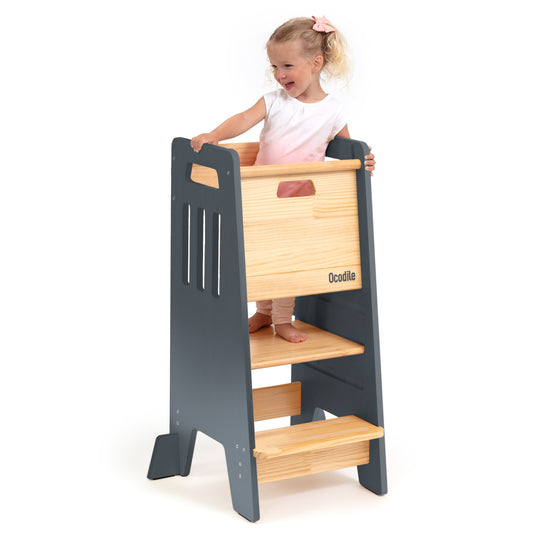
If you’re building a home that supports safe, independent exploration, Ocodile is worth a look. Their child-focused furniture is designed to help families create practical spaces where little ones can participate, learn, and move with confidence.