



Best Toddler Tower: A Parent's Guide to Safety in 2026
Your toddler is tugging on your leg while you chop vegetables. They want to see. They want to help. They want to do exactly what you're doing, right now, at counter height.
That's the moment most parents start searching for the best toddler tower.
I get it. A tower can turn dinner prep from a struggle into a shared routine. It can give a child a safe place to wash berries, stir batter, or watch you cook without being held on one hip. But once you start shopping, the choices blur together fast. Some look sturdy. Some look stylish. Some fold. Some convert. Almost all say they're safe.
That's where things get tricky. A toddler tower isn't just a stool with rails. It's a piece of furniture that lifts a very active child up to the same level as knives, glassware, and hot pans. The best choice comes down to safety design, not marketing language.
| Tower factor | Safer sign | Caution sign | Why it matters |
|---|---|---|---|
| Stability | Wide, heavy base | Narrow footprint, lightweight frame | A wider base resists tipping when a toddler leans |
| Containment | Enclosed sides on at least three sides | Open-back or easy-climb side rails | Better enclosure helps reduce falls and climb-outs |
| Platform surface | Non-slip texture or grip strips | Smooth, slick standing surface | Toddlers shift, bounce, and pivot without warning |
| Guard rail height | Top rail sits above the child's navel | Rail hits too low on the torso | Low rails make backward falls more likely |
| Adjustability | Platform can be set to fit the child well | One fixed height that becomes too low or too high | Fit changes as your child grows |
| Materials and finish | Sturdy construction, non-toxic finish | Weak-feeling joints, unclear finish details | Safety is both structural and chemical |
Why Every Parent Starts Searching for a Toddler Tower
Most families don't begin with a product search. They begin with a daily problem.
Your toddler doesn't want to stay on the floor while you cook. They want to stand close enough to see the bubbles in the pancake batter, rinse grapes in the sink, or hand you the wooden spoon. That urge isn't misbehavior. It's development. Young children learn by watching, copying, and participating.
A good tower can support that beautifully. It brings a child into family life instead of leaving them on the sidelines. It also frees your arms. You're not balancing a child on your hip while opening the oven or slicing fruit.
What parents are really looking for
Most parents say they want “the best toddler tower,” but what they usually mean is something more specific:
- A safer way to include their child in kitchen routines
- A setup that supports independence without creating constant worry
- A product that fits real life, including small kitchens, shared spaces, and fast cleanups
That mix of goals is why shopping feels confusing. One tower may look sleek but feel wobbly. Another may fold neatly but leave too much space around the child. A third may seem enclosed but use side cutouts that invite climbing.
Practical rule: If a tower makes your child more reachable to the counter but less contained in the process, it isn't solving the full problem.
Why the kitchen changes everything
At floor level, toddlers face ordinary household risks. At counter height, those risks change.
A child who can now reach the edge of the counter can also reach things that were out of reach a moment ago. The tower doesn't create curiosity. Your toddler already has that. It creates access.
That's why this decision deserves more than a list of trendy features. The best toddler tower is the one that respects how toddlers move, lean, climb, and test limits.
Understanding the Alarming Truth About Tower Safety
You turn to rinse berries for ten seconds. Your toddler, thrilled to be at counter height, twists to watch the dog, plants one foot on the side rail, and leans farther than you expected. That is the moment tower safety becomes real. The risk is not only falling. It is how quickly a stable-looking product can become unstable once a toddler uses it like a toddler.
If Consumer Reports were to test toddler towers in September 2026, one might expect to find what many parents already suspect from real use: appearance and safety do not always match. Their reporting on toddler tower hazards shows that stability and entrapment are serious concerns in this category, based on Consumer Reports' toddler tower safety testing.

Why does this happen so often? Start with basic physics.
A tower stays upright only while the child's center of mass remains over the base. The moment a toddler leans hard to one side, climbs a rail, or bounces with both knees bent, that center shifts. If the base is too narrow, the tower is too light, or the platform sits high relative to the footprint, tipping becomes much easier. Ocodile's explanation of toddler tower stability testing methods is useful here because it shows how side loading exposes the same weak points parents see in everyday kitchen use.
Toddler behavior makes that physics problem worse. Adults tend to stand, reach, and stop. Toddlers sway, pivot, and test boundaries. They do not treat a tower like a step stool. They treat it like a small climbing structure placed next to interesting objects, sounds, and people.
That is why many failures are predictable.
Entrapment is the second major issue, and it often surprises parents more than tipping. A gap that looks decorative to an adult can catch a shoulder, leg, or torso during a slip or climb attempt. In child safety, openings are not just design details. They are pathways, and toddlers explore pathways with their whole bodies.
The standards question adds another layer of confusion. Many parents assume a product sold for toddlers must meet a specific legal rule before it reaches the market. In practice, some products are tested to voluntary standards, some are only partially evaluated, and some rely on marketing language that sounds more reassuring than informative. Third-party testing matters because it puts a product in front of an independent evaluator instead of asking parents to trust a product page. This guide for conscious buyers explains what that process does and does not tell you.
The practical takeaway is simple. A tower can look polished, photograph well, and still fail at the exact moment your child leans, twists, or tries to climb out. Parents do not need to memorize engineering terms, but they do need to judge towers by real-world forces and real toddler behavior, not by appearance alone.
Core Features That Define a Truly Safe Tower
A safe tower has one job. It should keep helping your child stay in position even when your child stops behaving predictably.

Start with containment
Containment is what keeps a standing surface from turning into a fall hazard. Many parents focus on whether a child can get in and out easily. Safety starts with what happens after the child is inside.
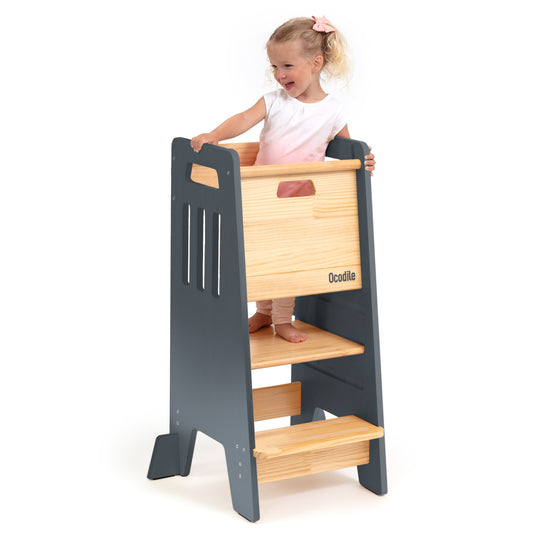
Look at the upper rail first. It should reach high enough on the torso to help block a backward tip during a lean or sudden twist. If the rail sits too low, it acts less like a barrier and more like a low fence a toddler can fold over. Side panels matter for the same reason. They reduce the easy escape paths toddlers notice right away, especially when something interesting is happening on the counter.
The standing platform matters too. Shoes, bare feet, and spilled water all change friction. A platform with grip helps the child correct a wobble before it turns into a slide.
If you're new to the category, this overview of what a learning tower is helps make these parts easier to picture in everyday use.
Read the base the way a safety tester would
The upper rails get attention because they are near the child. The base usually reveals more.
A stable base works like a wide stance. The farther the support points spread under the child's weight, the harder it is for a sideways reach to shift the center of gravity past the edge. That is the basic physics behind tipping. Toddlers create force in bursts, not neat straight lines. They bounce once, pivot quickly, then reach with one arm while their feet stay planted badly.
Check the tower from floor level. Are the feet spread wide enough to resist side-to-side movement? Does the frame feel planted near the bottom, or does most of the weight sit higher up? Can you nudge it with one hand and make it scoot?
A safe tower should feel dull in the best possible way.
Materials affect stability, wear, and what touches your child
Materials are not just a style choice. They shape how much the tower flexes, how well the joints hold over time, and whether the finish adds another concern.
Rigid, well-assembled wood often feels steadier than very light frames because it resists the small shifts that start a wobble. What matters most is not the label alone, but the whole build. Thick panels, secure fasteners, smooth edges, and a finish that does not chip easily all support safer daily use. If paint or sealant flakes, a toddler will find it with fingers or teeth long before an adult notices.
Claims about safety testing also need careful reading. Some brands use reassuring phrases without explaining who tested the product, what was tested, or whether the testing covered chemical safety, structural safety, or both. This guide for conscious buyers gives a clear explanation of what third-party testing can and cannot confirm.
Adjustability changes safety over time
A tower can fit well in March and poorly by July.
As children grow, the same platform height can leave the rail sitting lower on the body than it should. That changes containment even though nothing looks broken. An adjustable platform helps keep the child at a working height where the counter is reachable without standing on tiptoe, hunching the shoulders, or leaning the torso too far over the rail.
That matters because toddlers are problem-solvers. If the setup feels awkward, they compensate. They climb the rail, brace a foot in the wrong spot, or lean farther than you expect.
One option in this category is Ocodile's foldable kitchen tower, which is a standing tower designed for family use at counter height. Whether you consider that model or another, use the same checks every time: torso-height containment, grip underfoot, a wide planted base, durable finishes, and a platform height that still fits your child now.
Comparing Common Toddler Tower Designs
Choosing the best toddler tower often comes down to your home, your child, and the trade-offs you can live with day after day.

A family with a compact apartment may prioritize folding storage. A family with a climber may need stronger enclosure even if the tower takes up more visual space. A childcare setting may prefer a simpler, dedicated design over something that converts.
Enclosed versus open-sided
This is the biggest design fork.
An enclosed tower usually gives a younger or more impulsive toddler clearer boundaries. The child has less room to step sideways out of position, and fewer easy paths to climb onto the counter. This style tends to work better for children who get excited, pivot quickly, or test every opening.
An open-sided tower can feel less restrictive and may appeal to parents who want easier in-and-out access. But more openness often means less containment. That can be fine for an older child with better body control, yet it usually asks more of supervision.
Here's a simple way to understand it:
| Design choice | Better fit for | Main trade-off |
|---|---|---|
| Enclosed sides | Younger toddlers, climbers, high-energy users | Bulkier look, sometimes more footprint |
| Open sides | Older toddlers with stronger balance | Less passive protection |
Foldable versus fixed
This choice is less about safety labels and more about how the tower lives in your home.
A foldable tower can be practical in a small kitchen, shared dining area, or grandparent home where the tower won't stay out all day. If you'll fold and store it, that convenience matters.
A fixed tower often feels more straightforward. Fewer moving parts can mean less fuss in everyday use, and some parents prefer the solid feel of a non-folding frame.
The question to ask isn't “Which is better?” It's “Which one will we use correctly?”
If a foldable design is so cumbersome that you stop using it, it isn't helping. If a fixed tower blocks your kitchen path and gets shoved around constantly, that also creates problems.
Multifunction towers versus dedicated towers
Some towers convert into desks, chalkboard stations, or small tables. These can be appealing, especially if you want fewer kid items in the house.
But multifunction design always deserves a second look. Every extra hinge, panel, or transformation adds complexity. That doesn't automatically make a product unsafe, but it does mean you should inspect how securely it locks into tower mode and whether the conversion features create openings or weak points.
A dedicated tower is easier to judge because it has one job. A convertible tower can save space and money over time if the tower mode remains stable and well-contained.
For parents comparing these styles in action, this short video gives a helpful visual reference:
Match the design to the child, not just the kitchen
Some toddlers stand carefully and imitate exactly what you do. Others treat every household object like climbing equipment.
That difference matters. An adventurous child often needs stronger enclosure and fewer decorative footholds. A cautious child may do well in a slightly more open design, as long as the fundamentals are still solid.
The right tower is the one that fits your child's behavior on their busiest day, not their calmest one.
If you're torn between two models, picture your real routine. Morning rush. Pasta water boiling. Sibling running through the room. That thought experiment usually tells you more than a polished product photo.
Beyond the Tower Itself Safe Setup and Supervision
A safe tower can still be used unsafely. That's why setup matters almost as much as the product itself.

Build the habit before you build the snack
Start with assembly. Follow the manufacturer's instructions carefully, tighten hardware fully, and recheck screws from time to time. Furniture used by toddlers absorbs a lot of movement. A tower that started solid can loosen with daily use.
Placement comes next. Put the tower on a flat, non-slip surface where it won't rock. Keep it away from open flames, hot pans, knife blocks, appliance cords, and anything breakable within reach.
For related childproofing around the home, this guide on how to secure furniture to the wall is a useful companion read.
What supervision really means
“Supervised” doesn't mean listening from across the room while unloading the dishwasher.
It means staying close enough to intervene quickly if your child starts climbing, leaning out, reaching toward a hazard, or trying to step down unsafely. The available safety guidance is clear that supervision within arm's reach is mandatory because even a safer tower can't eliminate the risk of leaning or climbing out.
A few house rules help a lot:
- One child at a time: Crowding changes balance and invites pushing.
- Feet stay on the platform: No sitting on rails or climbing the sides.
- Kitchen tasks stay simple: Washing produce, stirring cool ingredients, or observing are better than handling sharp or hot tools.
- Shoes or bare feet are usually better than slippery socks: Better traction reduces slips.
Cleaning and maintenance count too
Parents often wipe down the tray or rails and move on. That's fine, but look deeper once in a while.
Check for rough spots, peeling finish, loosened joints, or worn grip surfaces. If you want to rethink what you use around children's furniture, BacteriaFAQ has a practical guide on healthier home cleaning that can help you choose products more carefully.
A tower works best when it stays predictable. Stable in the same spot. Clean enough for daily use. Watched every time.
The Ocodile Framework for Choosing Your Tower
A good checklist changes the decision from guesswork to observation.
Parents often get stuck because many towers look similar in photos. The key differences become apparent when you ask two questions at the same time: What happens to the tower when a toddler shifts their weight fast, and what does the design invite a toddler to try next? That is the heart of this framework. Stability is physics. Climbing, bouncing, and leaning are toddler behavior.
Use the table below as a scoring sheet, not a marketing filter. A safe-looking tower can still fail in daily use if the platform sits too high, the rails sit too low, or the side openings invite climbing.
Toddler Tower Evaluation Framework
| Feature Category | What to Look For (The Ideal Standard) | Why It Matters |
|---|---|---|
| Safety standard compliance | Clear testing language, specific compliance details, and no vague “safe for kids” claims | Clear information lets you judge the product instead of relying on reassurance |
| Stability design | Wide footprint, low center of gravity feel, and resistance to rocking when pushed lightly from the side | Toddlers rarely stand still. They pivot, bounce, and lean suddenly, which shifts force outward |
| Enclosure type | Containment on at least three sides, with no easy footholds or large gaps | Openings do two things. They increase fall space and they tempt climbing |
| Guard rail fit | Top rail sits above your child's navel when standing on the platform | A rail that is too low stops looking protective the moment a child leans backward or sideways |
| Platform surface | Non-slip texture or grip strips | Fast turns and excited foot movements are common. Slippery surfaces remove the margin for error |
| Adjustability range | Platform can be repositioned as your child grows | Proper rail height depends on where your child's center of mass sits, not just on age labels |
| Material quality | Thick, sturdy parts, tight joints, and finishes suitable for children's furniture | Strength matters at the joints first. That is where wobble usually begins |
| Chemical safety | Recognized low-emission or child-suitable finish certifications, plus clear information about paints and sealants | Toddlers touch rails constantly and often bring hands to mouth |
| Weight capacity | A stated maximum load that leaves room above your child's current weight | Standing still and dropping weight during a bounce are different stresses |
| Daily usability | Easy to clean, easy to place safely, and realistic for your kitchen size | Families use products correctly when the setup fits real life |
How to use the framework in real life
Start with the product photos, but read them like a safety reviewer. Look at the base first. A narrow base under a tall frame works like a top-heavy stool. It may seem fine with a still child, then wobble when your toddler turns to show you a spoon.
Next, check the openings. Many towers fail here. A side cutout that helps an adult lift the product can also work like a foothold to a child who wants to climb out. Toddlers are natural problem-solvers. If a shape suggests a step, many children will test it.
Then check fit. Picture your child standing on the platform with both hands busy at the counter. Where would the top rail hit their body? If it lands too low, the tower may contain less than you expect. If the platform adjusts, ask whether it adjusts enough to keep that rail useful as your child grows.
One more point matters. Missing information is information.
If a listing is beautiful but vague about materials, testing, or finish, move on. If it folds but the hinges and locking points are hard to understand from the photos, ask more questions before buying. If the standing surface looks slick, count that as a real safety drawback, not a small cosmetic issue.
Good toddler gear earns trust through design, not adjectives.
The best toddler tower for your home is the one that stays stable under real toddler movement, contains the body where falls usually start, and fits your space well enough that you will use it correctly every day.
If you want to apply this framework to a real product line, Ocodile offers children's furniture designed around safe participation in everyday family routines, including standing towers. Use the checklist above with any model you consider so you can choose with confidence, not guesswork.