




 - Monica
 - Lindsay

Child Vanity Table: A Parent's Complete Buying Guide
Most parents don’t start out shopping for a child vanity table because they think their child needs a tiny beauty station. It usually starts in the bathroom or bedroom, with a little one standing on tiptoes, watching closely while you brush your hair, fasten a clip, wash your face, or sort through a drawer. Then comes the copying. They reach for the brush. They want their own mirror. They line up hair ties like treasures.
That impulse is worth paying attention to.
A young child isn’t only pretending to “play grown-up.” They’re practicing observation, coordination, routine, and independence. They want a place that makes sense at their size, where they can participate safely instead of being told, again and again, “not there” or “don’t touch that.” A well-chosen child vanity table can become that place.
The problem is that most of what’s sold under this label looks more like themed toy furniture than a useful part of a child’s daily environment. A lot of parents feel that disconnect right away. They aren’t looking for glittery clutter or a princess prop. They want something steady, simple, safe, and helpful.
That’s the lens I’m using here. Not “Is it cute?” first, but “Will this support my child well?” If you’re choosing between play value, safety, and real-life usefulness, you don’t have to pick only one. You just need to know what matters most.
From Mimic to Mini Me An Introduction
A toddler watches everything. You smooth lotion onto your hands, and suddenly they need some too. You pull a brush through your hair, and they’re at your side, asking for “my turn.” You check yourself in the mirror before leaving the house, and they copy the same serious little face back at their reflection.
That’s why a child vanity table makes sense for so many families. It answers a very ordinary, very healthy desire. A child wants to join in.

A lot of people assume the vanity is a modern, decorative extra. It isn’t. The vanity table, historically known as a dressing table, originated in Europe during the late 17th century, and by the 18th century it was part of the “toilette,” a social grooming ritual used by both men and women according to Vermont Public’s history of the dressing table. In other words, this furniture has always been tied to preparation, self-care, and the way people move into the day.
Children notice those routines because routines are meaningful.
Why children are drawn to this space
A vanity setup can support simple tasks that matter to a child:
- Hair brushing: A child can see what they’re doing instead of relying on guesswork.
- Face washing prep: A washcloth, a small brush, or a comb becomes easier to access.
- Belonging management: Clips, headbands, or a favorite lotion tin have a home.
- Transitions: Getting ready for school, church, or bedtime feels more predictable.
A child often asks for “my own” version of adult furniture because they want competence, not just novelty.
That same thinking is why child-sized tables and chairs work so well in other parts of the home. If you’ve already seen how much easier daily routines become with properly scaled furniture, you’ll probably enjoy this guide to the best toddler table and chairs.
It’s not about vanity in the shallow sense
The word can throw people off. Parents sometimes worry that a child vanity table encourages appearance-focused habits too early. In practice, the opposite can be true when the piece is used well. A simple setup says, “Here is your space to care for yourself.” That’s very different from, “Here is your stage to perform.”
Used thoughtfully, it becomes a quiet corner for daily life. Brush hair. Put away clips. Wipe hands. Look in the mirror. Try again.
That’s a powerful shift for a small child.
More Than Just a Pretty Playset
The market has trained us to expect one version of a child vanity table. It’s usually bright, themed, heavily decorated, and aimed at pretend play alone. Mirrors, stools, toy makeup, and lots of visual noise. Often, it’s also clearly marketed to girls in a narrow way.
Many parents are looking for something else entirely.
A 2025 Montessori research report found that 68% of parents seek child-led furniture that promotes real-life skills, while many retailers still offer stereotypically gendered designs that prioritize aesthetics over function and safety, as noted in this Teamson market-gap summary. That gap explains why so many caregivers feel underwhelmed when they start shopping.
Toy vanity versus developmental furniture
The easiest way to cut through the confusion is to ask a simple question. What is this furniture helping my child do?
Here’s a practical comparison:
| Type | Main purpose | What it usually includes | What a child learns |
|---|---|---|---|
| Toy vanity | Pretend play and themed role play | Decorative mirror, toy accessories, flashy styling | Imaginative play |
| Developmental vanity | Daily self-care and independence | Stable surface, accessible storage, child-sized seat, usable mirror | Routine, coordination, order, self-help skills |
Neither category is “bad.” Pretend play is valuable. But if your child vanity table is going to take up room in your home, it helps to choose one that can do more than look adorable for a few months.
What useful design looks like
A developmental setup often looks quieter than retail listings suggest. It may have neutral wood, open storage, a simple mirror, and enough surface area for a hairbrush, a soft cloth, and a small basket. That doesn’t make it boring. It makes it usable.
Look for signs that a vanity supports real participation:
- A reachable surface: Your child shouldn’t need to climb onto it to use it.
- Storage that makes sense: Drawers and trays should help, not frustrate.
- A seat that matches the table height: Good posture matters, even for short routines.
- A mirror placed for the child, not for the product photo: If they can’t comfortably see themselves, they won’t use it well.
Parent check: If you can picture your child brushing their own hair, putting clips away, and wiping the surface afterward, you’re looking at furniture. If you can only picture staged dress-up photos, you’re probably looking at a toy.
This distinction matters because children don’t separate “play” and “learning” the way adults do. A child might sit down to “pretend” and then end up practicing real sequencing, grip control, and tidy-up habits. The best child vanity table leaves room for both. It doesn’t trap the child inside one script.
That’s why many families now prefer simpler pieces. A neutral design can work for siblings, fit into more rooms, and age better as interests change. One month it’s a hair station. Later it’s where a child organizes accessories, wipes glasses, or gets ready for a visit to grandparents.
Useful furniture grows with how children live.
Your Non-Negotiable Safety Checklist
Parents need more than nice product photos. A child vanity table sits low to the ground, often includes a mirror, may come with a stool, and sometimes has drawers. That combination brings real safety questions.
Start with this: if a vanity has drawers and is tall enough to fall under furniture stability rules, it isn’t “just a kids’ item.” It needs to be evaluated like any other serious piece of furniture.

Under the STURDY Act, clothing storage units over 27 inches tall, which can include some child vanities with drawers, must pass ASTM F2057 stability tests to prevent tip-overs. The accompanying stool must also comply with ASTM F2613, according to Compliance Gate’s overview of children’s furniture regulations in the United States.
The first thing to check
If you remember one rule, make it this one. Anchor the furniture if there’s any chance a child could pull, climb, or lean on it. Even a child who never climbs at home may try it once when reaching for a brush, a headband, or a toy stored on top.
For a clear step-by-step walkthrough, this guide on how to secure furniture to the wall is worth bookmarking before setup day.
Secure first, style second. A beautiful vanity that can tip is a hazard, not a helper.
Your shopping checklist
Use this list whether you’re buying online, in a store, or secondhand.
- Check the overall stability: Press lightly on the corners. It should feel planted, not wobbly.
- Inspect the stool: The seat needs to sit flat and feel steady under shifting weight, not only under perfect stillness.
- Look at all edges and corners: Rounded or softened edges are kinder in a room where children move quickly.
- Ask about finishes: Choose child-safe, non-toxic finishes and avoid vague wording.
- Assess the mirror carefully: Acrylic or shatter-resistant options are safer for young children than fragile glass.
- Open and close every drawer: They should glide cleanly without jerking, pinching, or inviting a hard pull.
- Notice hardware and small parts: Loose knobs, decorative gems, or tiny pieces can become a problem fast.
If you’re furnishing a whole room and want a broader lens on safe materials and practical finishes, this article on kid-friendly furniture gives a useful whole-home perspective.
Questions retailers should answer, but often don’t
Many listings focus on style words. “Princess.” “Dreamy.” “Cute.” Those words tell you almost nothing about safety. Ask better questions.
| Ask this | Why it matters |
|---|---|
| Is the vanity designed to be anchored? | Some units include hardware or clear instructions, some don’t. |
| What is the mirror made of? | You want clarity here, not vague reassurance. |
| What material is the stool made from? | Lightweight can be fine, flimsy is not. |
| How are drawers prevented from pulling out or overextending? | Drawer behavior affects both pinching and tipping risk. |
| What finish is used on the surface? | Kids touch everything, then touch their faces. |
The room matters too
Parents sometimes buy a safe item and place it in an unsafe setup. The furniture is only half the picture.
Place the vanity where you can supervise easily. Keep cords, plug-in lights, hot styling tools, and adult cosmetics elsewhere. If you want the space to feel inviting, use child-safe tools instead: a soft brush, fabric hair ties, a washcloth, a wooden tray, maybe a small basket.
If an item would worry you on a low shelf, it doesn’t belong on the vanity top either.
A safe child vanity table should reduce friction in daily routines. It shouldn’t create a new list of things you have to guard every minute.
Finding the Perfect Fit Size and Materials
Once safety is covered, the next question is fit. A child vanity table can be perfectly safe and still be awkward to use. If the seat is too low, the child hunches. If the tabletop is too high, their shoulders lift. If the mirror sits wrong, they stop using it.
That’s why size should be judged by your child’s body, not by the age label on the box.

What a good fit looks like
A useful setup lets a child sit with feet supported and arms resting naturally on the tabletop. They should be able to look into the mirror without stretching up or slumping down. You’re aiming for ease.
A quick at-home test helps:
- Sit test: Does your child sit centered without sliding forward?
- Elbow test: Can they bring hands to the surface comfortably?
- Mirror test: Can they see their full face while sitting normally?
- Reach test: Can they get their own brush or clips without standing on the seat?
If the answer is “almost,” the vanity may still work with an adjusted stool or a different mirror angle. If everything requires compensating, skip it.
Comparing common materials
Material choice shapes how a vanity feels over time. It affects stability, cleaning, repairability, and how well the piece survives daily use.
| Material | Strengths | Tradeoffs | Best for |
|---|---|---|---|
| Solid wood | Durable, repairable, steady feel | Heavier, often pricier | Long-term home use |
| Plywood | Stable, often stronger than it looks, practical | Quality varies by manufacturer | Families wanting durability without bulk |
| MDF | Smooth finish, often inexpensive | Can chip, swell, or wear faster | Light use if build quality is good |
| Plastic | Easy to wipe, lightweight | Can feel flimsy, may slide or age poorly | Temporary or very casual use |
In many homes, wood or quality plywood gives the best balance. It tends to feel calmer in the room and more like real furniture than a novelty item. That matters because children often treat sturdy, well-made pieces with more care.
A short visual can help you think through child-scale furniture in a practical way:
Small details that change daily use
Parents often focus on the frame and forget the touch points. Those details decide whether the vanity becomes part of the routine or turns into clutter.
Watch for these:
- Drawer pulls: Easy for small hands to grip, but not sharp or loose.
- Surface finish: Smooth enough to wipe clean after lotion drips or wet hands.
- Seat design: Wide enough for stable sitting, simple enough to reposition.
- Weight balance: Heavy enough to feel secure, not so heavy that placement becomes difficult.
A child-sized piece should feel inviting, not fragile. Children know the difference.
If you’re buying for a toddler, simplicity often wins. A flat top, one mirror, one seat, one basket. If you’re buying for an older preschooler, a little more storage may make sense. Either way, choose a shape and material that still works when the novelty fades and the daily habits remain.
Creating a Montessori-Friendly Vanity Space
A Montessori-friendly vanity doesn’t start with a style label. It starts with respect for the child. The point is to create a space the child can use independently, safely, and purposefully.
That idea goes back to Maria Montessori herself. In The Discovery of the Child, she described child-sized furniture as “tables in different shapes that did not rock” and chairs that were “miniature adult replicas,” a foundation for furniture that supports independence in ordinary life, as discussed in ArchDaily’s history of children’s scale furniture.

What makes the space Montessori-friendly
It’s less about owning a special kind of vanity and more about preparing the environment well. A child should be able to understand the space at a glance.
That usually means:
- Order: Only a few items are available, and each has a place.
- Accessibility: The child can reach what they need without adult lifting.
- Reality-based tools: A real brush, a real cloth, a real container, chosen safely.
- Calm design: Fewer distractions help the child focus on the task.
If you like the broader philosophy behind child-sized furniture, this introduction to a Montessori table and chair pairs well with the same ideas.
What to put on the vanity
You don’t need much. In fact, too much works against the goal.
A simple setup might include a soft hairbrush, a small tray for clips or hair ties, a folded washcloth, and a child-safe mirror. Some families also add a tiny basket for daily items. If your child is very young, keep it even simpler.
Fewer objects often lead to better concentration and more independent use.
A gentle routine works better than a script
Children use spaces best when adults model first, then step back. You might sit beside your child a few mornings in a row and show the sequence. Brush goes back in the tray. Hair ties go in the basket. Washcloth gets folded. Seat gets pushed in.
That’s enough. You don’t need a lesson plan.
A Montessori-friendly vanity space often supports these small habits:
| Routine | Skill underneath |
|---|---|
| Brushing hair | Coordination and body awareness |
| Putting away clips | Order and categorization |
| Wiping the surface | Responsibility and care for environment |
| Checking appearance before leaving | Self-awareness and confidence |
Keep it grounded in daily life
This kind of setup works best when it belongs to the rhythm of the home. Before bed. Before going out. After bath time. Before visitors arrive. Children don’t need constant novelty. They need meaningful repetition.
If your child uses the vanity only as a stage set, simplify the tools. If they ignore it, check whether it’s too crowded, too high, or too ornamental to feel useful. When the environment is right, children often move toward independence naturally.
Success isn’t that the vanity looks beautiful in the room. It’s that your child begins to say, “I can do it.”
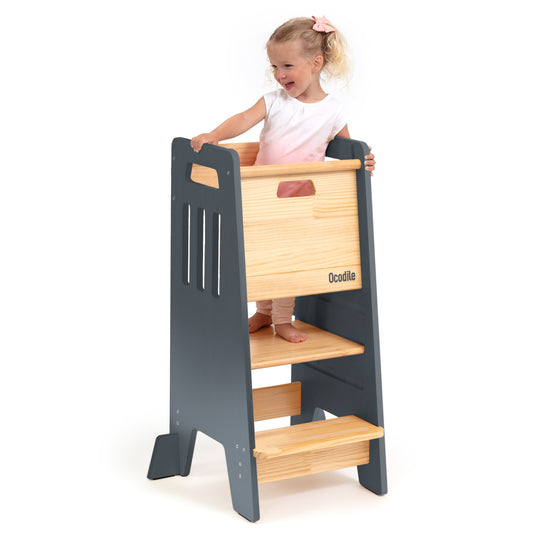
The Ocodile Approach to Child-Centered Design
By the time most parents finish researching a child vanity table, they’re not just comparing colors or drawer styles. They’re asking bigger questions. Is this safe in real life, not just in photos? Will it help my child do something meaningful? Will it still make sense in our home after the first rush of excitement passes?
Those are the right questions.
A child-centered approach to furniture starts from the child’s daily experience. Can they reach it? Can they use it comfortably? Can they succeed without constant correction? Good design for children isn’t only scaled down. It’s thought through.
That same mindset matters across the home. Families often discover that once they stop buying around trends and start buying around function, the room becomes calmer and easier to use. The vanity area, bedroom, reading nook, and even a nursery benefit from the same principle. If you’re thinking about the overall feel of a child’s room, this guide on how to decorate a nursery offers helpful ideas for creating a space that feels warm without becoming overloaded.
What thoughtful design tends to include
A strong child-focused furniture philosophy usually leads to the same priorities:
- Safety that’s built in: Stable construction, sensible proportions, and materials chosen for children’s spaces.
- Usefulness over gimmicks: Furniture should support real routines, not only staged moments.
- Simple aesthetics: Clean lines and natural materials often age better than heavy themes.
- Respect for family life: The piece should work for the child and still fit beautifully into a shared home.
The best children’s furniture doesn’t ask a child to become careful enough for the furniture. It asks the furniture to be ready for the child.
That’s the standard more parents are looking for now. Not louder, flashier, or more decorated. Just wiser. Furniture that supports independence, feels good to use, and helps everyday family moments go more smoothly.
Conclusion Fostering Independence One Brush Stroke at a Time
A child vanity table can be a toy, but it doesn’t have to stop there. Chosen carefully, it can become a small station for real life. A place to brush hair, put away clips, wash up, get ready, and feel capable.
That’s why the best buying decision usually has very little to do with themes or trends.
What matters most is whether the piece is safe, stable, well-sized, and simple enough for your child to use with confidence. If it supports independence, fits your routines, and doesn’t create new hazards, it’s doing its job. If it also looks beautiful in your home, that’s a bonus.
The bigger idea is reassuring. You don’t need to create a perfect childhood room. You just need to prepare spaces that let your child participate in daily life. A mirror at the right height. A stool that feels steady. A brush they can reach. A place where they can try.
Those small choices add up.
They tell your child, “You belong here. You can learn this. I trust you to practice.” And that message reaches far beyond grooming. It shows up in confidence, in routine, in responsibility, and in the quiet pride children carry when they can do something for themselves.
A good child vanity table won’t raise a confident child on its own. But it can support the kind of everyday moments that do.
If you’re looking for children’s furniture that puts safety, independence, and thoughtful design first, explore Ocodile. Their approach to child-centered furniture is built around the same principles that matter most at home: practical use, family connection, and spaces that help children grow with confidence.