



Children's Play Furniture: a Guide to Safe & Fun Options
Your toddler is dragging a chair across the kitchen floor again. They want to “help” rinse strawberries, stir pancake batter, or watch you chop vegetables. You want to say yes, because that curiosity is wonderful. You also want everyone to stay safe, and you’d prefer not to spend the whole morning saying, “No, not there. Careful. Get down.”
That’s where children's play furniture starts to matter. Not as extra stuff to fill a playroom, but as a practical way to bring children into family life with more safety, more independence, and less stress. A sturdy tower by the counter, a child-sized table near the living room, or a low shelf that lets a child choose and put away their own materials can change the rhythm of an ordinary day.
Families are paying more attention to this for good reason. The global playroom furniture market was valued at USD 3.55 billion in 2023 and is projected to grow at a 6.8% CAGR from 2024 to 2030, linked to rising parental awareness of furniture’s role in children’s overall development, according to Grand View Research’s playroom furniture market analysis.
The interest makes sense. Good play furniture helps a child do real things. Reach the sink. Sit with proper support. Climb safely. Build, draw, read, pretend, and rest in spaces that fit their body and their stage of development.
Welcome to Your Child's World of Play
Children don’t separate life into neat categories the way adults do. To them, helping you bake is play. Washing toy dishes beside you is play. Carrying blocks from the rug to a basket is play. Sitting at a little table while you answer email nearby is also play.
That’s why the most useful children's play furniture doesn’t just entertain. It supports participation.
A standing tower in the kitchen can turn a clingy morning into a shared routine. A low stool near the bathroom sink can make handwashing feel manageable. A child-sized table in the living area can hold crayons in the morning, a snack in the afternoon, and puzzle pieces before dinner. These aren’t isolated products. They’re tools that help your child feel included in daily family life.
Why parents start looking for it
Most parents don’t begin with a design vision. They begin with a problem.
- Your child wants to be close: They follow you from room to room and get frustrated when they can’t join in.
- Your furniture doesn’t fit them: Adult chairs, counters, and shelves are too high, too slippery, or too unstable for independent use.
- You need safer routines: You want fewer risky workarounds, like toddlers climbing dining chairs or balancing on upside-down bins.
Good play furniture should reduce friction in daily life. If a piece makes your child safer, calmer, and more capable, it’s doing its job.
The best part is that these pieces often support both fun and function at the same time. A simple stool may help with pretend play one hour and tooth brushing the next. A small table may host finger painting, snack time, and quiet reading in a single day.
That’s the lens worth using as you shop. Don’t ask only, “Will my child like this?” Ask, “Will this help my child belong, participate, and practice independence in our real home?”
Understanding the Purpose of Play Furniture
Think of children's play furniture as a developmental toolkit. A toy may entertain. Furniture shapes how a child moves, reaches, focuses, rests, and joins family activities. That difference matters.
When parents hear “play furniture,” they sometimes picture one category: a climber, a play couch, or a miniature table. In practice, it covers several kinds of support. Each one helps a child practice a different set of skills.

Furniture for active play
Some pieces exist mainly to support movement. Climbers, arches, balance elements, rockers, and sturdy indoor gross-motor pieces let children test their body in space.
These pieces help children practice:
- Balance and coordination: Climbing up, stepping down, shifting weight, and planning movement
- Body awareness: Learning where arms, feet, knees, and torso are in relation to edges and surfaces
- Risk assessment: Figuring out what feels steady, what feels high, and when to slow down
Active play furniture works best when it gives a child a clear challenge without adding hidden hazards. That means stable bases, usable grip points, and enough room around the piece for movement.
Furniture for creative and quiet play
Not all play is loud. Some of the most valuable children’s play furniture supports focus.
A child-sized table and chair set, a reading nook, low display shelving, or a simple art station can help children settle into longer stretches of concentration. When materials are at their height and easy to access, children don’t need an adult to start every activity.
This category often supports:
| Function | What it looks like at home | Why it matters |
|---|---|---|
| Creative work | Art table, easel, accessible craft shelf | Encourages self-expression and repeated practice |
| Quiet focus | Reading corner, floor cushion, low book display | Supports attention and calmer transitions |
| Choice-making | Open shelf with a limited set of activities | Helps children choose, use, and return items |
What looks simple to an adult can build confidence in a child. A low table says, “This space is for you.” A reachable shelf says, “You can begin on your own.”
Furniture for practical life
Play furniture often forms part of family connection.
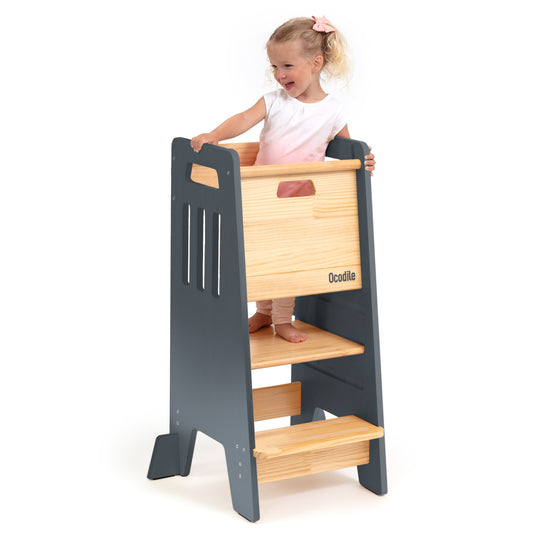
A learning tower near the kitchen counter, a small stool in the bathroom, a weaning table, or a child-height bench by the entryway all support practical life tasks. These are everyday routines that children want to join, even when adults assume they’re “too little.”
Practical rule: If your child keeps inventing unsafe ways to reach, climb, or participate, they probably need a better setup, not less interest.
Practical life furniture helps children:
- Take part in real routines like food prep, washing hands, tidying, dressing, or pouring water.
- Build confidence through repetition because daily tasks happen again and again.
- Feel useful instead of constantly redirected away from family activity.
That’s why the most effective children’s play furniture often doesn’t stay in a dedicated playroom. It lives where your family lives. Near the counter. By the bookshelf. At the end of the hallway. Beside the coffee table.
When you see it as a toolkit, buying decisions get easier. You’re not collecting “kid stuff.” You’re choosing supports for movement, focus, creativity, and participation.
Matching Furniture to Your Child's Milestones
Age labels on product listings can be helpful, but they don’t tell the whole story. A child’s size, coordination, confidence, and habits matter just as much. That’s especially true with children's play furniture, where a piece has to fit both the child’s body and the child’s current abilities.
Research discussed in the EDRA41 paper on children’s furniture ergonomics and safety notes that ill-fitting play furniture can increase fall risks by up to 40% for children ages 2 to 5, and that gaps larger than 3.5 inches can create head entrapment hazards. That’s the part many parents miss. Size is not just a comfort issue. It’s a safety issue.

Infants from birth to 12 months
At this stage, the goal isn’t “furniture” in the adult sense. It’s support for safe floor-based exploration.
Infants benefit from low, stable, simple setups:
- A firm floor play area: A predictable surface supports rolling, pivoting, crawling, and reaching.
- Low visual access: Mirrors fixed safely at floor level or low shelves with a few objects can invite movement and curiosity.
- Supportive seating used sparingly: If you use infant seating, it shouldn’t replace floor time.
For babies, the best environment usually has fewer pieces, not more. Clear floor space matters. So does avoiding bulky items that block movement or invite awkward climbing before a child is ready.
Toddlers from 1 to 3 years
This is the stage where many families first start shopping for children's play furniture in earnest. Toddlers want to do things themselves, but their judgment and coordination are still catching up.
Useful pieces often include:
- Learning towers or kitchen helpers for supervised counter-height participation
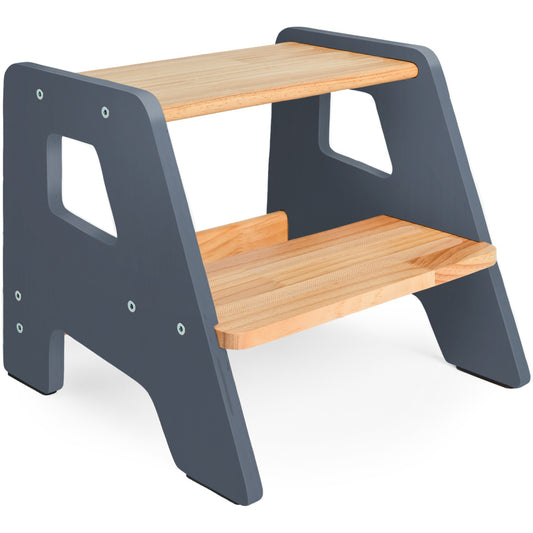
- Step stools for sinks, beds, and simple access needs
- Low tables and chairs for snacks, drawing, and puzzles
- Open shelves that let toddlers choose and return a small number of items
- Simple gross-motor pieces with stable shapes and clear climbing paths
What matters most here is proportion. A stool that’s too narrow or a tower that’s too small can feel tippy under a fast-moving toddler. A chair that leaves feet dangling can make sitting harder than it needs to be. A shelf that’s too tall encourages unsafe reaching.
Preschoolers from 3 to 5 years
Preschoolers use furniture differently. They’re not only practicing movement. They’re also rehearsing ideas.
A preschooler may use the same table for painting, snack prep, loose parts play, and “writing a menu” for an imaginary restaurant. Furniture at this age has to support longer attention, stronger bodies, and more elaborate pretend play.
Look for pieces that allow:
| Stage | Helpful furniture | What it supports |
|---|---|---|
| Young preschooler | Small table set, art easel, book display | Concentration, hand use, independence |
| Older preschooler | More robust climbing or practical life furniture | Coordination, confidence, role-play |
| Mixed routines | Storage that keeps materials visible and reachable | Ownership of space and easier cleanup |
Preschoolers also test boundaries with more force and speed. That means even attractive furniture should be judged by how it behaves under real use. Can a child climb onto it from the side? Does it wobble on hard floors? Are there cutouts or gaps that could catch a head, arm, or foot?
A piece can be beautiful and still be wrong for your child right now. Fit always comes before style.
A simple way to check fit at home
Before buying, try to picture the actual action your child will take.
Ask yourself:
- Can my child get on and off this piece with control?
- Will their feet rest well if it’s seating?
- Are there side openings, slats, or gaps that look questionable?
- Will this piece invite climbing in a way it wasn’t designed for?
- Can I place it where my child will really use it, not where it only looks good?
That last question matters more than people think. A child-sized table hidden in a spare room gets less use than one near the family’s daily activity. A sturdy tower parked where food prep happens becomes part of life.
The right match isn’t just about age. It’s about readiness, body fit, and the routines your child keeps trying to join.
A Parent's Guide to Safe Materials and Design
Safety starts long before a child climbs, sits, or stands on a piece of furniture. It starts with what the piece is made from and how it’s built. Parents don’t need an engineering degree to judge this well, but they do need a few clear filters.

Material safety in plain language
Many families prefer wood because it feels sturdy, repairs well, and tends to age gracefully. In broader market data, wood remains the dominant material choice for children’s furniture because parents often associate it with safety and durability. Even so, “wood” on a product page doesn’t tell you enough.
Here’s the practical difference:
- Solid wood: Often durable and easier to inspect for cracks, rough edges, or weak joints.
- Plywood: Can be a good option when it’s well-finished and edges are smooth and sealed.
- Plastic: Can work well for some lightweight uses, especially where easy cleaning matters, but stability and durability vary a lot by design.
- Engineered boards with unclear finishes: These deserve extra caution if the product information is vague.
Parents should also pay attention to finishes. If you want a deeper breakdown, Ocodile’s guide to non-toxic kids furniture gives a useful overview of what to watch for in coatings and materials.
A good surface should feel smooth, sealed, and easy to wipe. It shouldn’t flake, smell strongly, or leave you guessing what was used on it.
Structural safety you can actually check
Material matters, but design matters more in everyday use. A beautiful piece can still fail if it tips, pinches, or traps.
The key benchmark many parents should know is the ASTM F2057-17 stability standard. According to the safety summary from Ace Office Systems on U.S. children’s furniture regulations, this standard requires children’s furniture to withstand a 50-pound force without tipping. That’s useful because tip-overs are a major source of furniture-related injuries in young children.
You can translate that into a home check:
- Push lightly from different angles. A piece shouldn’t feel eager to rock.
- Notice where the weight sits. Bottom-heavy designs usually feel steadier.
- Check the footprint. Narrow bases and taller profiles need extra scrutiny.
- Look at joinery and hardware. Loose screws, thin fasteners, and flexing joints are warning signs.
Safety check: If a child can lean, pull, or climb on it in ordinary use, assume they eventually will.
Small design details with big consequences
Parents often focus on the big hazards and miss the subtle ones. These smaller details deserve attention:
| Design detail | Safer choice | Why it matters |
|---|---|---|
| Edges | Rounded or eased edges | Reduces injury risk during bumps and falls |
| Openings and gaps | No hazardous spaces where head or limbs can catch | Helps prevent entrapment |
| Surface grip | Steps and standing zones with traction | Supports safer climbing and standing |
| Finish quality | Smooth, sealed, easy to clean | Reduces splinters and wear problems |
If you’re buying second-hand, inspect even more carefully. Hardware loosens over time. Finishes wear down. Previous repairs may not be obvious at first glance.
The simplest rule is the one that saves the most trouble. Choose children's play furniture that is stable, clearly made, and easy to understand at a glance. If you need to “make it work,” it probably isn’t the right piece.
Embracing Independence with Montessori Principles
Montessori at home often gets reduced to a look. Light wood, low shelves, neutral colors. The deeper idea is much more useful. A child should be able to participate in daily life with as much independence as their development allows.
That principle fits children's play furniture beautifully, especially when the furniture lives in shared spaces instead of being pushed off into a separate room. A practical home setup says, “You belong here, and this environment helps you act on that.”
The prepared environment at home
A prepared environment doesn’t mean a perfect house. It means a space arranged so a child can do more for themselves.
That might include:
- A low shelf in the living room so books and a few activity choices are visible
- A child-sized table for drawing, snack prep, or puzzles
- A safe height aid in the kitchen or bathroom so your child doesn’t need unsafe climbing solutions
- A simple sleep setup that allows more autonomy around rest and getting in and out of bed
The point isn’t to force independence too early. The point is to stop making everything harder than it needs to be.
Why these pieces support real confidence
Children build confidence through repeated success. When furniture fits their body and the task makes sense, they don’t need constant lifting, repositioning, and correction from adults.
A learning tower is one of the clearest examples. It lets a child stand securely at counter height for supervised practical life activities like washing produce, stirring batter, or observing how a meal comes together. Families who want a closer look at this kind of setup can see examples in Ocodile’s article on the Montessori learning tower.
A floor bed does something similar in a different routine. It can support freedom of movement around sleep and rest. A child-sized table gives the same message in work and play. “You can begin here. You can use this space.”
Independence doesn’t mean doing everything alone. It means the environment helps the child do what they’re ready to do.
Why wood remains a common choice
In the broader market, playroom furniture makes up about 10% of the kids’ furniture market, and wooden variants are seeing 1.4X growth, tied to eco-conscious parents who value well-rounded development and social skills through dedicated play spaces, according to Fortune Business Insights on the kids furniture market.
That preference lines up with Montessori-minded homes for practical reasons. Wood often feels calmer visually, tends to be sturdy, and works across more rooms without looking out of place. It also blends more naturally into shared family spaces, which matters if you’re placing children’s play furniture in the kitchen, hallway, or main living room.
One example is the Ocodile standing tower, which is designed to help young children participate more safely in everyday counter-height routines. It’s not a playroom-only item. Its main use is practical life participation.
That’s the shift worth holding onto. Montessori-inspired furniture isn’t about creating a special corner that adults admire. It’s about helping children join family life with more competence and less unnecessary dependence.
How to Design a Thriving Play Space at Home
A thriving play space doesn’t have to be a separate playroom with custom built-ins and perfect storage. Most families need something more realistic. They need children’s play furniture to work in the kitchen, living room, hallway, or a bedroom corner without taking over the house.
That’s good news, because children often do better when play and family life stay connected.

Put furniture where life already happens
Start with your family’s real traffic pattern. Where does your child already try to join in? That’s usually where furniture belongs.
A few examples work well in everyday homes:
- Kitchen: A supervised standing tower, a stool, or a low snack-prep station
- Living room: A small table, a book display, or a basket-and-shelf setup for open-ended materials
- Entryway: A bench or low spot for shoes and bags
- Bedroom: A reading chair, floor-level book storage, or a simple getting-dressed zone
If the child always migrates back to where you are, don’t fight that. Design around it.
Keep the layout simple enough to maintain
Parents often get overwhelmed by the visual clutter that comes with children’s spaces. The fix usually isn’t more furniture. It’s fewer pieces doing clearer jobs.
Try this approach:
| Area | One furniture job | One storage job |
|---|---|---|
| Living area | Small table or open floor play surface | Low shelf with limited choices |
| Kitchen edge | Safe standing or sitting support | Tray or basket for one practical activity |
| Reading corner | Comfortable child seat or rug | Front-facing book display |
A room feels calmer when each zone has an obvious purpose. Children also tend to use spaces better when they can tell what belongs there.
For parents who want visual inspiration without drifting into unrealistic setups, Ocodile’s playroom furniture ideas can help you think through layouts that fit daily use.
Make room for mixed ages and different needs
Families rarely have one child, one age, one temperament, and one perfect routine. You may have a toddler who climbs everything and an older sibling who wants quiet drawing space. You may also be supporting a neurodiverse child who needs clearer boundaries, more predictable access, or calmer sensory input.
An emerging trend for 2026 is the addition of customizable adult seating in play areas, along with growing parent interest in furniture that works for mixed-age siblings or neurodiverse children. Some parent forums report 40% of queries on this topic going unanswered, as noted in Soft Play’s discussion of seating for play areas.
That trend reflects a real home need. Adults need a place to sit close by. Children need furniture that doesn’t force one style of play.
Consider these adjustments:
- For mixed ages: Use a combination of floor play, one child-height work surface, and one higher-interest area that requires supervision.
- For sensory-sensitive children: Choose calmer colors, simpler layouts, and materials that don’t overstimulate visually.
- For shared play: Add an adult seat nearby so connection is easy and supervision feels natural.
This is a useful point to borrow ideas from other room-design approaches too. If you’re trying to make a shared space feel warm and grounded, these tips for a child's nature-themed space offer practical ideas you can adapt without turning your home into a themed set.
A quick visual example can help when you’re planning zones and flow:
The best home play spaces don’t separate children from the family. They give children a workable role inside family life.
Your Practical Play Furniture Buying Checklist
By the time you’re ready to buy, it helps to stop thinking in categories like “Montessori,” “modern,” or “popular.” Those labels can be useful, but they don’t make decisions for you. A solid purchase usually comes down to fit, safety, and whether the piece supports your real routines.
Use this checklist when comparing children's play furniture online or in person.
The quick evaluation list
- Check stability first: If it wobbles, rocks, or seems easy to tip, move on.
- Read material details carefully: Look for clear information about wood type, finish, and surface quality.
- Match it to your child now: Don’t buy only for the ideal future version of your child. Buy for current body size and current ability.
- Measure the footprint: Make sure the piece can live where your child will use it.
- Think about cleaning: Sticky art tables, kitchen helpers, and stools need wipeable surfaces and accessible corners.
- Inspect openings and edges: Watch for pinch points, rough edges, and hazardous gaps.
- Ask what habit it supports: Participation, reading, climbing, drawing, dressing, cleanup. If you can’t answer that clearly, you may not need it.
Play Furniture Feature Comparison
| Feature | What to Look For | Why It Matters |
|---|---|---|
| Stability | Wide base, solid feel, no wobble | Reduces tip risk during normal child use |
| Material quality | Clear material description, smooth finish, durable surfaces | Helps with longevity and safer daily contact |
| Age appropriateness | Size and height suited to your child’s current stage | Supports safer and more comfortable use |
| Adjustability or longevity | Flexible use across routines or growth stages | Makes the piece more useful over time |
| Home fit | Works in the kitchen, living room, or bedroom without crowding | Increases daily use and reduces clutter |
| Ease of cleaning | Wipeable finish, accessible corners, washable components if relevant | Keeps maintenance realistic for busy families |
A final filter that helps
Ask one more question before you click buy. Will this piece make daily life smoother, or will it create another area you have to manage?
That question saves a lot of money.
If you’re updating a shared family room and want the child-friendly setup to blend better with adult seating, textiles, and everyday messes, practical resources like this guide to an affordable living room refresh can help you think about the whole space, not just the kids’ corner.
Children’s play furniture works best when it serves the family as a whole. Safe. useful. easy to live with.
Frequently Asked Questions About Play Furniture
Can I use play furniture outdoors
Only if the product is specifically designed for outdoor use. Many indoor pieces can warp, weaken, or become harder to clean if they sit in damp or sunny conditions. If you occasionally move a piece outside, inspect it afterward for roughness, loosening hardware, or finish wear.
How do I introduce a new piece like a learning tower to a hesitant toddler
Keep the first use short and familiar. Invite your child to join you for something simple, like washing fruit or stirring dry ingredients. Stay close, model how to climb in and out, and don’t force a long session. Familiar routines usually help children warm up faster than formal “trying it out.”
Is second-hand children’s play furniture safe to buy
It can be, but inspect it carefully. Check for wobbling, cracks, missing hardware, rough edges, unstable repairs, peeling finish, and unsafe gaps. If you can’t tell how sturdy it is, skip it.
Do I need a dedicated playroom
No. Many families get better results by placing children’s play furniture in the rooms where life already happens. A small, well-chosen setup in a shared space often gets used more than a separate room full of seldom-used items.
If you’re looking for children’s play furniture that supports independence in everyday family routines, Ocodile focuses on practical pieces like standing towers, floor beds, and step stools designed to help children participate more safely at home.