



Unlock Perfect Children's Table Height
One child is perched too high, shoulders creeping up while they color. Another is folded over a table that looked cute online but leaves them rounding their back five minutes into a puzzle. In a home with more than one child, this happens all the time. One surface ends up doing everything: snack station, art table, sticker lab, homework corner, play dough zone.
That’s why children's table height matters more than most parents expect.
A table isn’t just a flat surface. It shapes how a child sits, how long they stay engaged, and whether the space feels inviting or frustrating. When the height is right, children settle in more easily and use the space with less help. When it’s wrong, they fidget, lean, kneel, or abandon the activity.
The hard part is that most guides assume you’re buying for one child at one age. Real homes don’t work like that. Siblings share. Furniture gets repurposed. One child grows fast while another still needs a much lower setup. The useful question isn’t just “What size table does a child need?” It’s “What works safely and comfortably in the life my family has?”
Why Your Child's Table Height Matters More Than You Think
A child can look busy at a table and still be uncomfortable.
You’ll often see the clues fast. A preschooler wraps one leg around the chair because their feet don’t reach the floor. An older sibling leans far forward because the tabletop sits too low for drawing or writing. A toddler keeps standing up because sitting there never feels stable.

What poor fit looks like at home
Most parents don’t need a formal assessment to spot a mismatch. They just need to know what to look for.
- Raised shoulders: The table is usually too high.
- Collapsed chest and rounded back: The surface may be too low, or the chair may be too high for the child.
- Feet swinging or tucked under the chair: The seat doesn’t support stable sitting.
- Constant kneeling or standing: The setup may be asking the child to work around discomfort.
These aren’t small details. Children do a lot of focused work at tables: coloring, cutting, building, tracing, threading, snacking, reading, and later, writing. If the surface fights their body, the activity itself becomes harder.
Why this affects more than posture
A good setup supports more than neat sitting. It supports willingness.
When a child can climb into their own chair, rest their arms comfortably, and stay steady without help, the space starts to feel like it belongs to them. That’s a big part of a prepared environment. The furniture matches the child, so the child can act independently in it.
A well-sized table often gets used more because the child doesn’t have to work around the furniture before they can start the activity.
This matters even more in shared rooms and family spaces. If one table has to serve siblings with different needs, height becomes the difference between a useful station and a daily compromise that frustrates everyone.
Finding the Goldilocks Zone Recommended Table Heights
Two siblings can sit at the same table and have opposite problems. The older child hunches because the surface is too low. The younger one lifts their shoulders because it is too high. That is why generic “kids table” labels fall short in real homes.
A workable table height gives the child a place to rest their forearms without reaching up or collapsing down. Age helps you narrow the range. Actual fit decides it.

A practical height chart
Use this as a starting point, especially if you are buying before you can test the table in person.
| Child stage | Recommended table height |
|---|---|
| Infants 6 to 12 months | 12 to 13 inches (30 to 33 cm) |
| Toddlers 1 to 2 years | 13 to 14 inches (33 to 35 cm) |
| Preschoolers 3 to 5 years | 18 inches (46 cm) |
| School-age 6 to 8 years | 20 inches (50 cm) |
Autonomous summarizes these stage-based ranges in its children’s table height size chart and notes that children often outgrow furniture within a few years.
Charts are useful. They are not enough on their own.
In families with one child, a fixed table that fits well right now can work beautifully. In families with siblings close in age, those same charts often leave parents stuck between two imperfect choices. Buy for the younger child and the older one perches awkwardly. Buy for the older child and the younger one loses stable arm support.
That trade-off shows up most often in the preschool years, when a two-year age gap can mean a big difference in seated height. For shared spaces, the better question is not “What table fits a four-year-old?” It is “Who will use this table most, and who can be safely adapted with a cushion or foot support?”
How to use the chart without getting fooled by it
A quick age match is fine for shortlisting. The final decision should still be based on how the child sits at the table.
Here is the practical order I use:
- Start with the age range to rule out obviously wrong sizes.
- Check the main user first if one child will spend more time there drawing, writing, or doing school tasks.
- Plan the workaround for the second child before you buy, especially in a shared bedroom or playroom.
- Leave room for growth only if the setup can still work comfortably now.
If you are shopping for younger children, this guide to toddler table and chairs options is useful for comparing shapes, seat pairings, and small-space layouts.
One more real-world point matters here. A table that is slightly too high often creates more visible strain than one that is slightly too low, because children start lifting their shoulders and poking their head forward to work. That same pattern can carry into screen time and homework habits later on. Parents trying to correct forward head posture usually end up addressing furniture fit along with movement habits.
The buying rule that saves the most regret
Buy for current fit if the table is fixed.
Buy for the usable range if the table is adjustable or if siblings will share it daily.
That sounds simple, but it prevents a common mistake. Parents often choose the table their child will “grow into,” then spend the next year watching them kneel, lean, or avoid the space altogether. A table that fits now gets used now. In a shared setup, the best choice is often the one that fits one child well and can be adapted safely for the other, rather than a middle height that fits neither especially well.
How to Measure for a Perfect Ergonomic Fit
If you want the best answer for your child, measure the child, not just the room.
The two most useful ideas are sitting popliteal height and clearance between the seat and the table underside. Jonti-Craft’s guidelines identify sitting popliteal height as the distance from the floor to the back of the knee while seated with feet flat and knees at a right angle, and they note 8 inches from seat top to table underside as a typical clearance in children’s ergonomic setups (Jonti-Craft chair and table guidelines).

The three checkpoints that matter
You don’t need specialist equipment. A tape measure and a minute or two are enough.
- Feet flat on the floor Seat the child so their feet rest fully on the floor or on a firm foot support. If their feet dangle, the chair is too tall or they need a footrest.
- Knees bent comfortably The knees should sit around a right angle. If the knees are pushed too high or the legs stretch downward, the setup is off.
- Elbows resting naturally on the tabletop Ask the child to place their forearms on the surface. You’re looking for elbows at about a right angle, without lifted shoulders.
Properly fitted furniture that keeps feet flat and elbows at 90 degrees has been shown in classroom ergonomic studies to increase children’s attention spans by up to 20% by improving comfort and reducing postural strain, according to the same Jonti-Craft guidance.
How to take a quick home measurement
Use this sequence:
- Start with the chair: Measure from the floor to the top of the seat.
- Seat the child and check the legs: Feet should be supported, and the back of the knees shouldn’t be pressed hard by the seat edge.
- Measure table relation: Look at how the forearms meet the tabletop, not just the table’s listed height.
- Watch the shoulders: If they creep upward while drawing or eating, the table is too high.
A good fit often looks almost boring. That’s the point. The child isn’t compensating.
Don’t ignore head and neck position
Table height and screen or book position work together.
If a child is always dropping their chin or pushing the head forward, the issue may be more than the table alone. Parents who want a simple overview of correct forward head posture may find it useful when checking reading and desk habits at home.
For chair pairing, this guide to the height of a chair seat can help you line up the seat and table instead of guessing one without the other.
If the chair fits but the table doesn’t, the child still compensates. The two pieces have to work as a pair.
Beyond Height Safety and Design Considerations
A table that measures "right" can still be a poor fit for real family life.
In homes with two or more children sharing one setup, I pay close attention to what happens between measurements. One child kneels on the chair. Another leans hard on the tabletop while coloring. Someone scoots in sideways, and someone else uses the table standing for five minutes. Good dimensions help, but day-to-day safety comes from how the table behaves under ordinary kid use.

Features worth checking before you buy
Start with stability.
If a child can rock the table by pressing on one corner, the height almost stops mattering. Shared tables get more side pressure, more climbing, and more chair-bumping than single-child setups. A broad, steady base usually ages better than a light table with a narrow footprint.
Then look at the parts children hit and handle:
- Rounded edges: They reduce the force of everyday bumps during play, meals, and quick getaways from the seat.
- Smooth, child-safe finishes: Easier cleaning matters, especially when one child is painting while another is eating crackers.
- Leg placement that leaves usable knee space: A table can have the right top height and still feel awkward if the legs block chairs or force siblings to sit too far apart.
- No pinch points or fiddly hardware within reach: This matters more on furniture that gets moved, folded, or adjusted regularly.
Durability matters too. Children's tables take glue, markers, dropped cups, and repeated wiping. A delicate finish or wobbly joinery usually turns into more maintenance for the adult and less freedom for the child.
Standards still help, even at home
As noted earlier, school furniture standards treat sizing and posture as health issues, not styling choices. That is a useful frame for parents.
At home, the goal is simpler. Choose a table that supports comfortable sitting, stays put when a child leans on it, and pairs well with the chair you use. If you need more flexibility across ages, an adjustable children's chair can solve part of the mismatch without replacing the whole table.
Design choices that work for more than one child
Many generic guides fall short here. They assume one child, one chair, one perfect fit.
Family spaces rarely work that way. One table may need to handle a preschooler doing puzzles and an older sibling writing or crafting later the same day. In that situation, clean lines and a stable shape usually beat novelty designs. A simple wooden table with enough surface area, good leg clearance, and a finish that can handle heavy use tends to stay useful longer.
The best choice is often the one that creates the fewest workarounds. Less wobble. Fewer collisions. Easier cleaning. More room for siblings to sit, switch places, and use the space safely.
Adjustable vs Fixed Tables Which Is Right for You
This decision usually comes down to one question. Are you buying for one stage, or for several years and possibly several children?
Both fixed and adjustable tables can work well. They just solve different problems.
Fixed tables work best when
A fixed table makes sense if you want simplicity.
It’s often the easier option for a child who is solidly in one stage and uses the table mostly for play, snacks, or short creative sessions. There’s no mechanism to reset, and many parents like the straightforward look and feel.
A fixed table is often a good fit for:
- Dedicated toddler spaces: The child uses one chair, one room, one main activity zone.
- Short-term stage buying: You know the child may move to a different setup later.
- Homes that value simplicity: Fewer moving parts can mean less fuss.
The downside is obvious. Children grow. Schools In notes that height-adjustable tables outperform fixed ones because children can grow 4 to 6 inches annually, and mismatched heights from fixed tables can lead to a 30 to 40% higher incidence of back and neck pain in children who sit for prolonged periods (classroom table leg heights guide).
Adjustable tables work best when
Adjustable tables shine in homes that change often.
If siblings are sharing, or if you’re trying to avoid replacing furniture as quickly, adjustability solves a real problem. It gives you a way to keep the table useful as the child’s body changes and as activities shift from blocks to drawing to early writing.
They’re especially practical for:
- Multi-child households: One surface can be reset for different users.
- Longer time horizons: You’re trying to reduce outgrowing and replacement.
- Mixed-use spaces: The same table may host art one day and early schoolwork the next.
If you’re comparing seating with that kind of flexibility in mind, this guide to an adjustable children's chair is a helpful companion to table selection.
The trade-off most families feel
Fixed tables usually feel calmer. Adjustable tables usually feel smarter for the long haul.
That doesn’t mean every family needs an adjustable model. If your children rarely sit for long, or if one child is the main user, a fixed table may be completely reasonable. But if your home has siblings close enough in routine to share a workspace, fixed height often becomes the limitation first.
Solving the Sibling Challenge Shared Spaces and Mixed Ages
Most size charts stop being useful here.
They tell you what one child needs. They don’t tell you what to do when a toddler and an older sibling both want the same table, often at the same time. That’s a common family problem, and guides rarely address it directly. My Duckling notes that while many resources give age-specific charts, few deal with shared tables for siblings, even though multi-child households often need a solution that avoids buying multiple furniture sets (shared study space discussion).
Set the table for the older child, then support the younger one
This is often the least frustrating option.
If the age gap is modest, choose a table height that works for the taller child, then bring the younger child up safely with the right chair and reliable foot support. The key is support from below, not making the child reach from above.
That means:
- Use a stable chair with foot support for the younger child.
- Avoid cushions that slide and create a perched, unstable sitting position.
- Watch elbow position, not just whether the child can physically reach the surface.
When one surface still isn’t enough
Sometimes sharing one exact height doesn’t work.
In that case, it’s often better to create two nearby working heights than force one bad compromise. A low floor table for the youngest child and a standard child table beside it can keep siblings together without forcing the same posture.
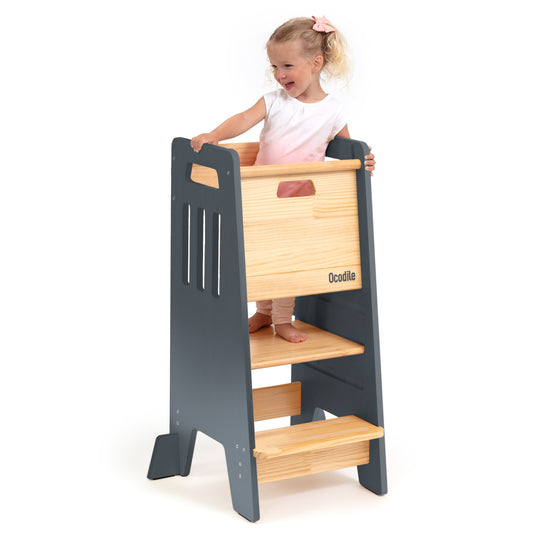
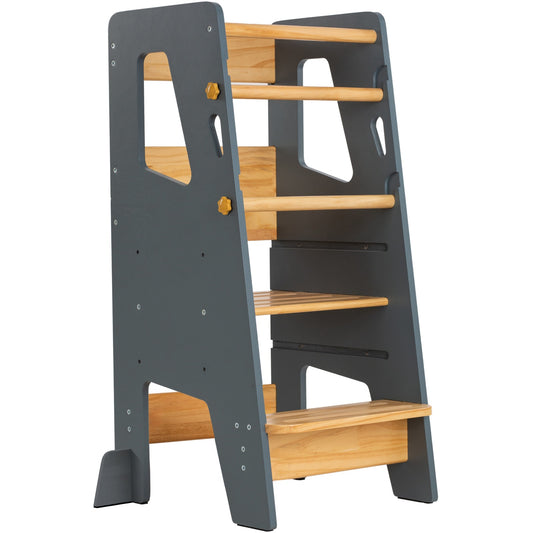
One practical option in a mixed-age home is furniture that adapts beyond a single use. For example, some Ocodile toddler towers can transform into a table and chair, which can help families add a second child-scale work surface without dedicating space to another full table.
Mixed-age setups work best when they protect each child’s position, not when they insist both children use the room in the exact same way.
What doesn’t work well
Three things usually fail fast in sibling spaces: one oversized chair passed down to everyone, a too-tall table with no foot support, and makeshift boosters that shift every time the child moves.
Shared doesn’t have to mean identical. It just has to be intentional.
Creating Your Child's Ideal Workspace
The most useful children’s workspace isn’t the one with the trendiest look. It’s the one your child can use comfortably, safely, and often.
That starts with fit. Feet need support. Arms need a natural resting place. The surface has to match the child who is using it, not the age printed on the box. In shared homes, it also means accepting that one perfect number usually won’t solve everything.
A strong setup usually has these qualities
- It matches the child’s body, not just their age
- It uses stable, safe furniture with sensible edges and materials
- It accounts for growth instead of pretending children stay the same size
- It respects sibling differences without turning every activity into a compromise
That’s what makes a workspace feel calm. The child can sit down and begin.
Keep the goal bigger than the furniture
A table is really a tool for independence.
It gives a child a place to draw without hunching, pour without strain, build without wobbling, and focus without constantly adjusting their body. For some families, that means a simple fixed table. For others, it means an adjustable setup, a second lower station, or a carefully paired chair and footrest.
If you’re exploring alternative seating ideas for children who need more specific support, the Salli Slim Tilt Ergonomic Chair For Kids is one example of how some parents think beyond standard chairs when posture is a bigger concern.
The right space doesn’t have to be elaborate. It just needs to respect how children move, grow, and share a home. When that happens, the table becomes more than furniture. It becomes a place where family life runs more smoothly, and where children can do more on their own.
If you’re building a safer, more child-centered home, Ocodile offers practical furniture designed to support independence, everyday family routines, and comfortable spaces for young children to explore and learn.