



Childs Dressing Tables: Best Child's Dressing Tables
Your child has probably already told you they want one, even if they never used the words.
They stand beside you while you brush your hair. They reach for the comb. They study the mirror. They line up clips, scrunchies, or a washcloth with surprising seriousness. What looks like imitation is often something much more important. Your child is practicing how daily life works.
That's why childs dressing tables can be so useful when we choose them thoughtfully. Done well, they give a young child a safe, scaled place to care for themselves. Done poorly, they become one more cute object that frustrates, wobbles, or takes up space without helping.
Most shopping guides stop at style. Parents get shown themed mirrors, bright colors, and adorable stools. But the real question is simpler. Can your child use this furniture safely and independently? If the answer is yes, the table becomes part of a routine. If the answer is no, it stays decorative.
We can look at this the same way we would any Montessori-inspired setup. The furniture should fit the child, reduce adult correction, and invite useful action. A brush within reach. A mirror at the right level. A seat that feels steady. A drawer that opens smoothly instead of turning into a climbing temptation.
If you're weighing whether a dressing table is worth it, or trying to choose between several options, it's important to slow down and look past the product photos.
The Perfect Little Corner for Your Mini Me
A parent gets ready for the day. Their child watches every move.
Not casually, either. They notice the hairbrush, the cream jar, the careful way a clip gets fastened. A minute later, they want to try it too. They aren't asking for luxury. They're asking for participation.
That's the part many adults miss. A child who wants their own mirror and brush isn't only playing pretend. They're trying to join the rhythm of family life. They want a place where they can copy what they see, with tools that make sense for their body and abilities.
A childs dressing table can turn those moments into something calmer and more useful. Instead of balancing on tiptoes near your sink or reaching into an adult drawer, your child gets a clear place of their own. That changes the tone of the interaction. You stop saying “not there” and start saying “let me show you how.”
Why children are drawn to this kind of space
Young children learn by observing and repeating. Grooming routines are full of small actions they can practice:
- Brushing hair helps them coordinate both hands and track what they see in the mirror.
- Placing clips in a tray builds simple organizing habits.
- Washing face with a cloth supports self-care and body awareness.
- Sitting down to get ready creates a predictable transition before school, bedtime, or going out.
A child's interest in daily rituals is often a request for competence, not attention.
That's why the right setup feels so different from a toy vanity. It gives your child a practical role. They're not performing. They're practicing.
And for you, that little corner can become one of the most peaceful places in the room.
More Than Just a Table with a Mirror
A child's dressing table is easy to dismiss as a smaller version of adult furniture. But from a developmental point of view, it can be much more useful than that.
At its best, it works as a self-care station. It gives your child one clear place to brush hair, check their face, store small belongings, and manage a simple getting-ready routine. Those tasks look tiny to us. To a child, they're rich with learning.
What the furniture is really teaching
When a child uses a dressing table regularly, they're often practicing several skills at once:
| Daily action | Underlying skill |
|---|---|
| Looking into a mirror while brushing | Coordination and visual feedback |
| Opening a small drawer | Fine motor control |
| Returning items to one place | Order and sequencing |
| Sitting for a short routine | Attention and self-regulation |
This is why Montessori families often care so much about the phrase prepared environment. The point isn't to buy special-looking furniture. The point is to prepare a space where your child can succeed without needing constant rescue.
A brush on a high shelf doesn't teach independence. A brush placed where your child can reach it does.
A modern object with an older history
The dressing table has a long history, but the meaning around it has changed. The modern dressing table as a distinct furniture piece developed in Europe at the beginning of the 17th century, and the concept became distinctly feminine during the Art Deco period, according to this history of the dressing table. The same source notes that the word “vanity” comes from the Latin “vanus,” meaning idle or futile, and only picked up its later connotations in the 14th century.
That history matters for one reason. It reminds us not to get stuck on the word vanity.
For children, this furniture doesn't need to be about appearance in a shallow sense. It can be about care, routine, and confidence.
The difference between cute and useful
A useful child setup usually has these qualities:
- Reachable tools your child can access without climbing
- A mirror they can use while seated or standing properly
- Simple storage for brushes, clips, or a soft cloth
- A stable seat that supports a short routine comfortably
Practical rule: If you can picture your child using the table for one real task each day, you're likely looking at helpful furniture, not just themed décor.
That's the standard worth using when you shop for childs dressing tables.
The Uncompromisable Guide to Safety Standards
Style matters. Safety matters more.
A child's dressing table sits at the crossroads of several risks. It may include drawers, a mirror, a stool, hard corners, paint finishes, and tempting surfaces to pull on or climb. That means we can't treat it like harmless playroom décor. We need to assess it like real furniture.
Stability comes first
Child dressing tables must meet mandatory stability standards under ASTM F2057-23 to prevent tip-overs. The standard requires units to withstand a 50-pound (22.7 kg) force without tipping, simulating a child climbing or pulling on the furniture, as explained by the Consumer Federation of America summary of the new tip-over safety standards.
That's the technical language. In daily life, it means this: if a child opens a drawer and leans, the furniture should stay put.
Still, even a compliant unit should be anchored when appropriate. If you want a clear step-by-step overview, this guide on how to secure furniture to the wall is worth reading before installation.
What strong construction actually looks like
A table can look sturdy in photos and still fail in the joints.
When you inspect a piece in person, or ask questions online, pay attention to how the frame is assembled. Tight joinery matters because repeated drawer use, scooting, and child movement all stress the same connection points. If you want to understand the difference between stronger and weaker joinery styles, Vinson Fine Furniture's wood joint guide gives a useful visual explanation.
Here's what to check:
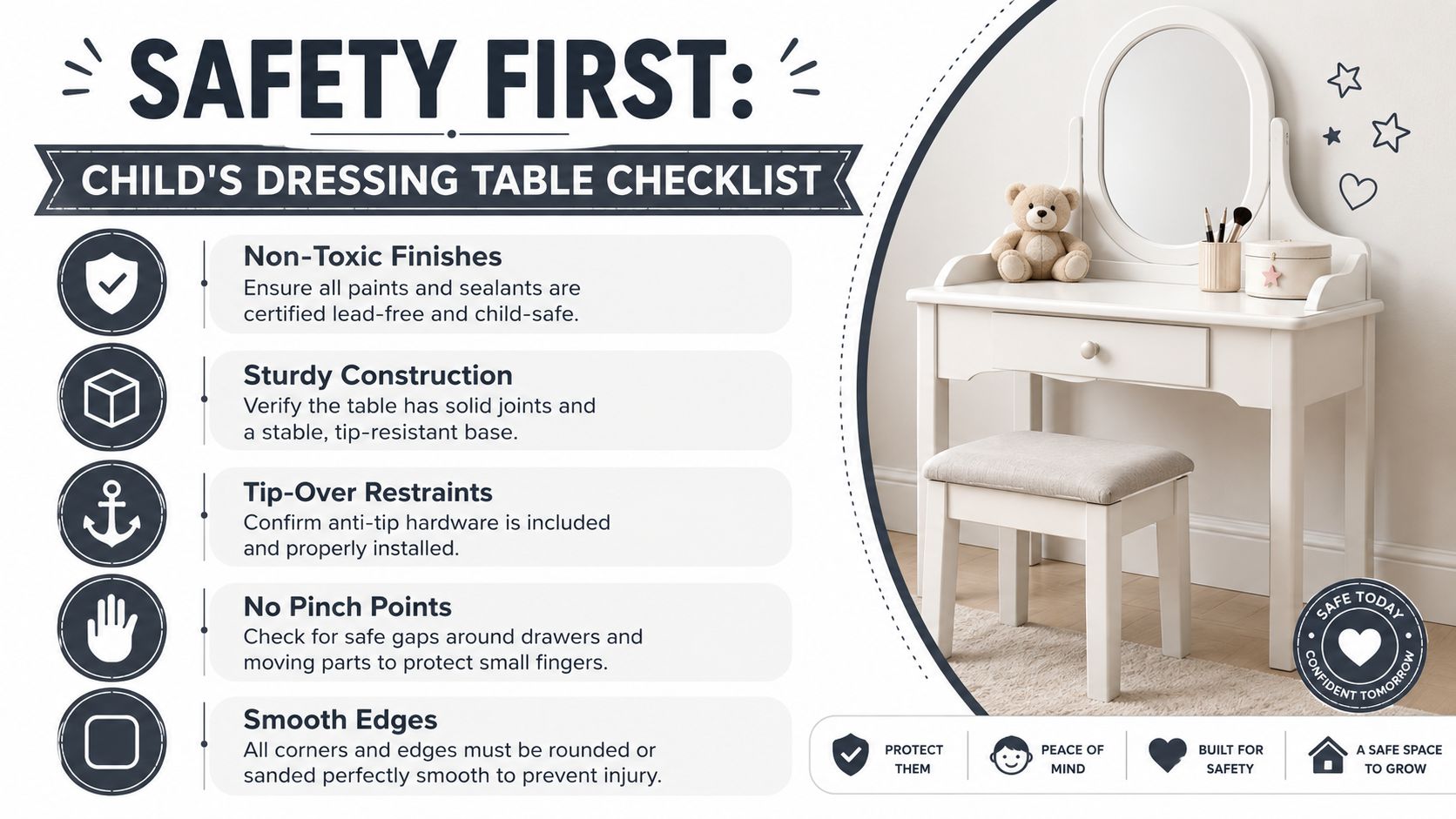
- Base stability matters more than decorative trim. Press lightly at the corners and notice if the piece rocks.
- Drawer behavior tells you a lot. Drawers should open smoothly without lurching outward.
- Hardware quality matters. Knobs, screws, and mirror fixings should feel secure, not loose or ornamental.
Material safety isn't optional
Structural safety is only one side of the picture. Materials matter too.
Child dressing tables must also meet ASTM F2388-18 for structural integrity. That standard prohibits the use of wood screws on key structural elements to reduce the risk of loosening and exposed sharp points. In addition, 40 CFR Part 770 limits formaldehyde in composite wood parts to ≤ 0.05 ppm, as noted in the CPSC rule documentation for child product safety standards.
For parents, that translates into a few plain-language questions:
- What is the finish made of? You want child-safe, non-toxic coatings.
- What is the board material? Composite materials need low-emission compliance.
- Are edges smooth and rounded? A child's face and hands will be close to every surface.
If a retailer gives vague answers about coatings, materials, or testing, treat that as useful information.
A short safety screen before you buy
Use this when comparing childs dressing tables online or in a shop:
- Ask about anti-tip hardware and whether it's included in the box.
- Check the mirror material and how firmly it's fixed in place.
- Look for rounded edges on the tabletop, stool, and drawer fronts.
- Test moving parts so fingers won't get trapped easily.
- Read assembly details because poor setup can undermine good design.
The safest table is the one that still feels safe after months of real use, not only on delivery day.
Finding the Just Right Fit for Your Child
A dressing table can be safe and still be wrong for your child.
Many parents often find themselves frustrated. The listing says “child-sized,” but the child still has to stretch up to the mirror, perch awkwardly on the stool, or shuffle into a space that's too tight to use comfortably. That mismatch doesn't just make the table less useful. It can create new safety problems.
The gap between age labels and real readiness
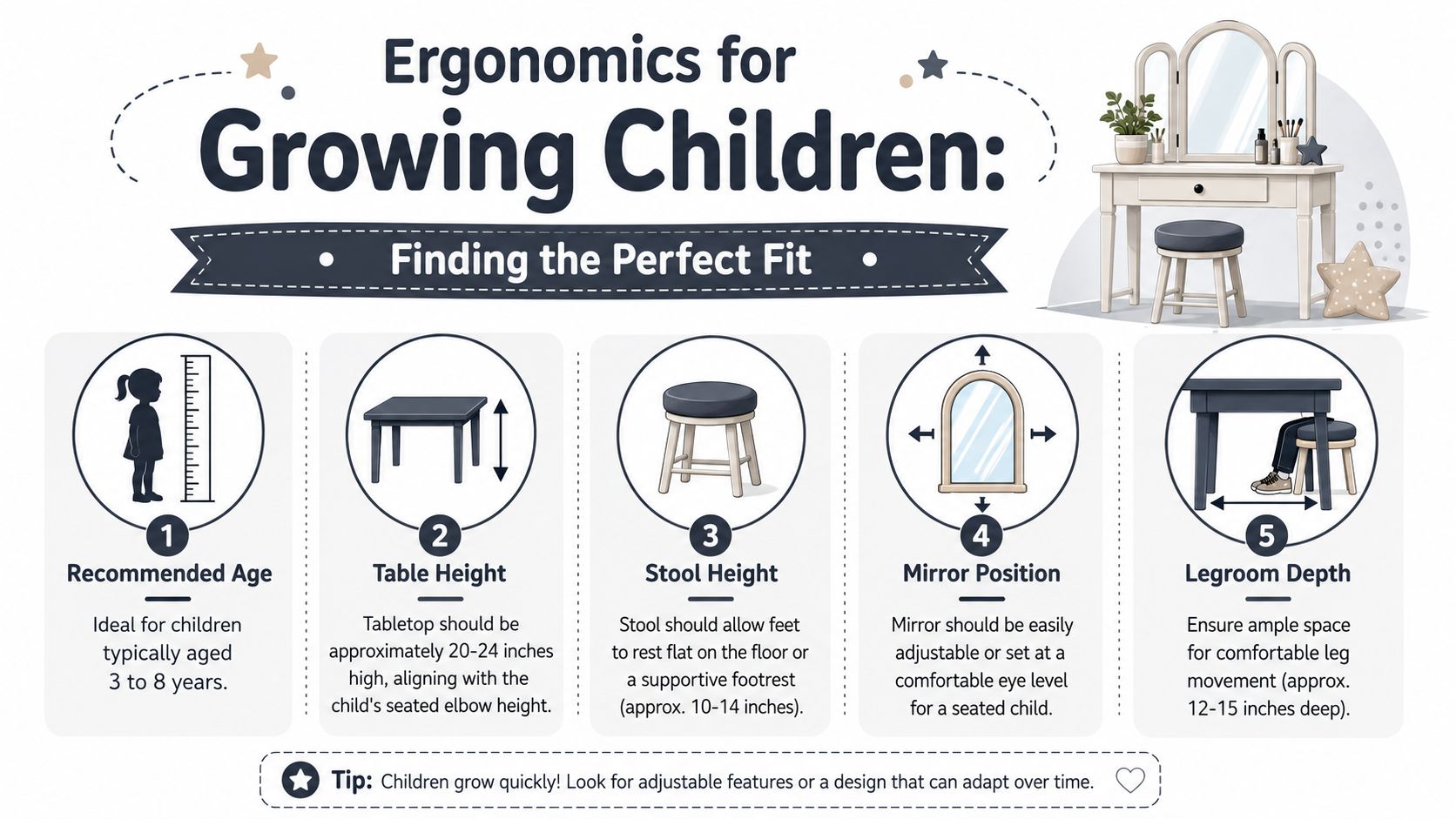
Some guidance suggests introducing this kind of setup around ages 3 to 4, but functional independence depends on fit, not just age. A child often needs a mirror height of 80 to 100 cm and a countertop of 50 to 60 cm to use the station comfortably, according to this parent guide to a child's dressing table. The same source notes that 60 to 70 cm of front clearance is needed for chair access.
Those numbers explain a problem many families recognize immediately. The child can technically sit there, but they can't use it with ease.
What good fit looks like in everyday use
You don't need complicated measuring tools. You need to watch your child.
A well-fitted setup usually allows your child to:
- See their face without tiptoeing or lifting their chin uncomfortably
- Rest their arms naturally on the tabletop
- Get in and out of the seat easily without knocking into nearby furniture
- Reach basic items like a brush or hair tie while staying seated
If your child has to kneel on the stool, scoot to the front edge, or stand to use the mirror, the table isn't really supporting independence.
A Montessori way to test the fit
Try this simple observation at home before buying.
| Check | What you want to see |
|---|---|
| Mirror check | Your child sees themselves while sitting normally |
| Arm check | Shoulders stay relaxed, not raised |
| Seat check | Feet feel supported or stable |
| Access check | Stool moves in and out without crowding |
Montessori thinking is practical, not abstract. When the environment fits the child, the adult gives fewer reminders. The task becomes smoother. Your child feels more capable.
A dressing table should remove friction from a routine, not add a new layer of coaching.
That's why fit deserves as much attention as color, theme, or storage.
Choosing Materials That Last Through Playtime
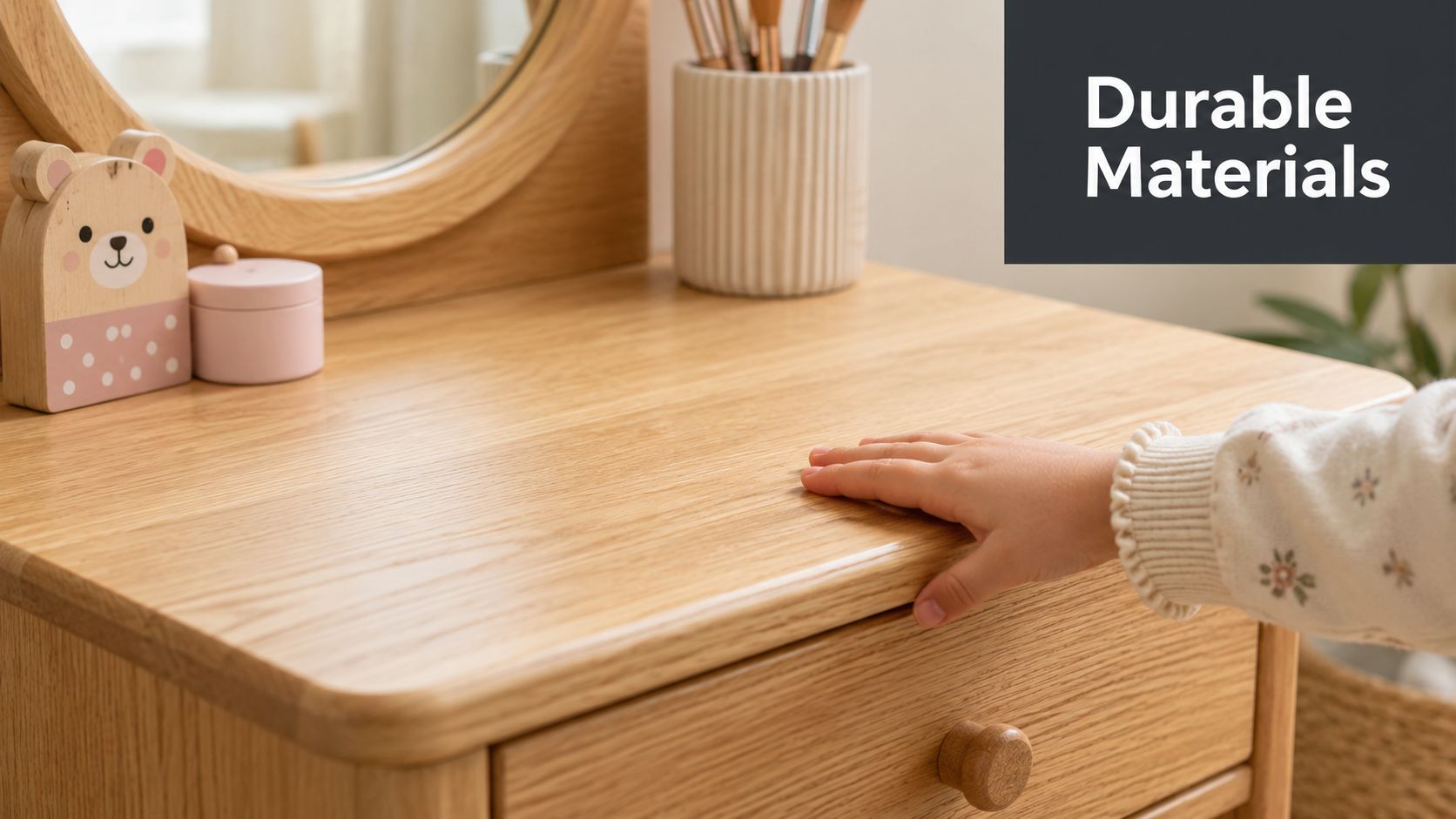
When parents compare childs dressing tables, materials often get reduced to appearance. Wood looks warm. plastic looks easy. MDF looks smooth in photos. But the material affects far more than style. It changes how the table feels, how long it lasts, how it wears at the edges, and how confident you feel when your child uses it every day.
Comparing the common options
Here's a practical side-by-side view:
| Material | What parents often like | What to watch for |
|---|---|---|
| Solid wood | Durability, repairability, weight | Heavier to move |
| Plywood | Good balance of strength and practicality | Quality varies by manufacturer |
| MDF or similar engineered board | Smooth finish and lower cost in many cases | Edge wear and moisture sensitivity can become issues |
| Plastic | Easy wiping and light weight | Can feel temporary or less stable |
For many families, solid wood or good-quality plywood feels more dependable over time. They tend to handle everyday bumps, wiping, and repeated use better than cheaper alternatives.
Finishes matter as much as the frame
The top surface, stool, and drawer pulls will all be touched constantly. Young children also have a habit of touching furniture and then touching their mouth or face. That's why it helps to prioritize child-safe finishes and to read material details carefully.
If you're comparing broader options for healthier materials in kids' spaces, Ocodile's guide to non-toxic children's furniture is a useful companion read.
A few things are worth asking directly:
- Is the finish water-based or otherwise child-safe?
- Are the edges sealed well enough for frequent wiping?
- Will the surface chip easily around handles or corners?
Think in years, not in the first week
A dressing table gets used hard in small ways. Brushes get dropped. Drawers get tugged. Wet cloths get left behind for a moment. Dress-up jewelry gets scraped across the top.
That's why “cute now” isn't enough. You want a material that still feels calm and usable after the novelty fades.
If you're considering a secondhand piece or want to refresh an older one rather than buy new, this guide on how to transform old furniture with vinyl can help you think through surface updates. For a child's piece, though, any makeover still needs to keep safety and finish quality at the center.
The best material choice is usually the one that lets you stop worrying about the furniture and focus on the routine.
Smart Designs with Storage and Style
Once safety, fit, and materials are sorted, design becomes more interesting. Not because style is the main event, but because the right design can extend the table's useful life by years.
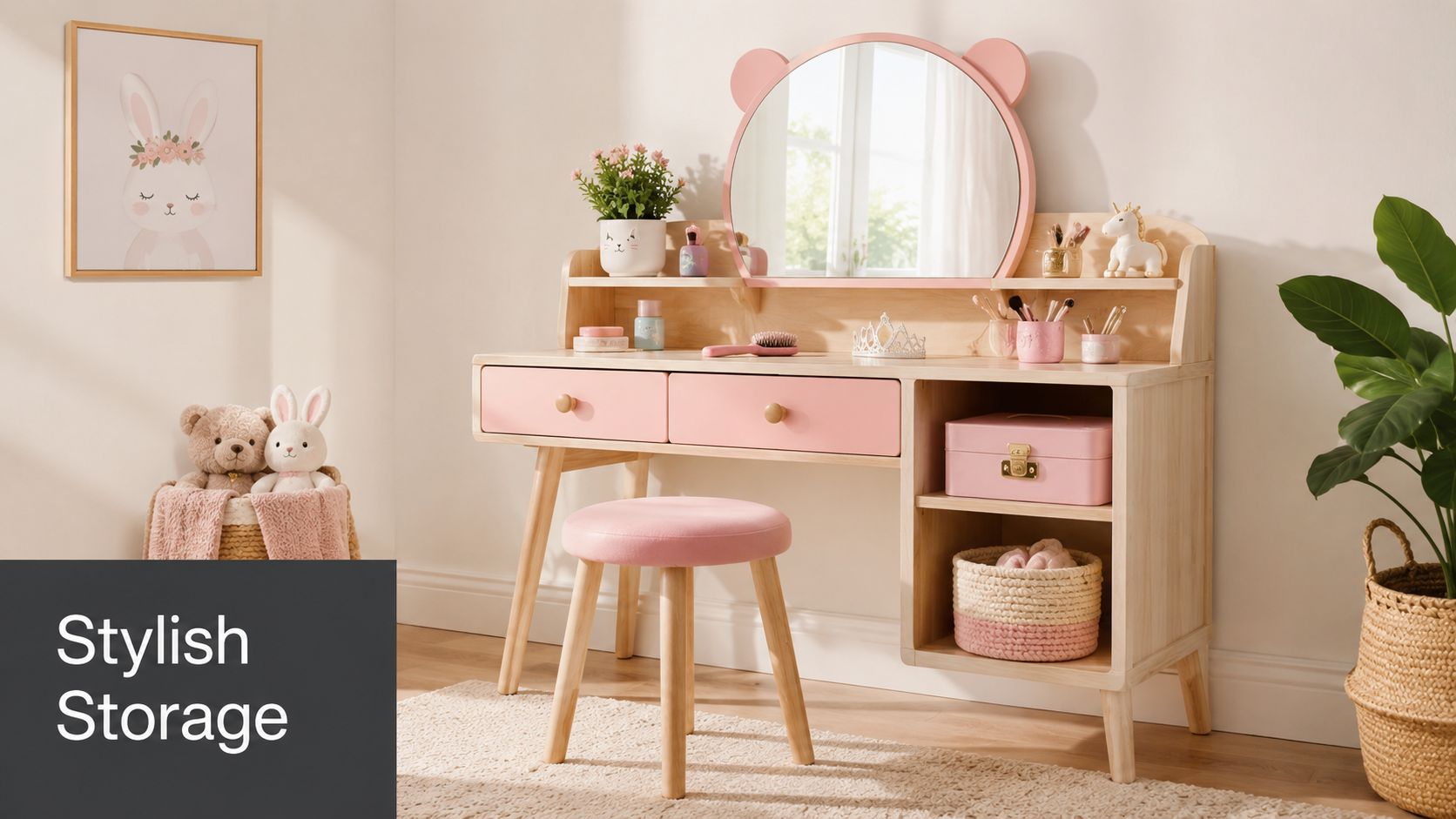
A smart design isn't only pretty. It helps a child know where things go, what the table is for, and how to use it without creating clutter. That can mean drawers, trays, cubbies, removable mirrors, or a tabletop shape that leaves enough room for one practical activity at a time.
Storage should match the routine
Parents often overbuy storage and underthink access.
If your child uses the table for simple grooming, they may only need a small brush, a cloth, and a place for clips or hair ties. Deep drawers make more sense when the table doubles as a dress-up station or accessory organizer. Open compartments can be easier for younger children because they don't need to master drawer control first.
Useful features often include:
- Small divided storage for clips, bands, or jewelry
- One easy-open drawer rather than several stiff or shallow ones
- Open shelf space for a basket or tray
- A removable or simple mirror that doesn't dominate the whole piece
Multi-use design usually ages better
The most flexible childs dressing tables often stop being “vanities” after a while. They become writing tables, art stations, or catch-all getting-ready corners.
That's especially helpful in small homes. For smaller urban spaces, modular and wall-mounted vanities are an emerging trend. Bulky standalone units in the 70 to 90 cm range often require 60 to 70 cm of front clearance, while newer wall-mounted options can save floor space and may include features like slow-closing drawers, according to this guide for choosing a kids dressing table in small homes.
If your child's room needs furniture to do more than one job, this guide to choosing the best art and craft table with storage for kids can help you think in the same multi-use way.
A short visual can help when you're comparing compact setups and practical features:
How to choose a style that still works later
You don't need to avoid playful design. But it helps to ask whether the style supports or limits the furniture.
A bear-shaped mirror can be charming. A pastel stool can feel lovely in a nursery or preschool room. The question is whether the design leaves enough visual calm and practical use for the piece to stay relevant as your child grows.
Sometimes the most “special” furniture is the piece your child can keep using in a new way next year.
That's often a better investment than a highly themed table that only works for one phase.
Your Parent Checklist for the Perfect Purchase
When you're looking at several options, details start to blur. A checklist helps you come back to what matters.
Use this as your final filter before you buy.
Safety must-haves
- Confirm anti-tip protection. If the table includes drawers or height that could invite climbing, make sure anchoring hardware is included or compatible.
- Inspect edge and corner shape. Smooth, rounded edges are kinder in fast-moving bedrooms and play spaces.
- Check moving parts carefully. Drawers and mirrors shouldn't create obvious pinch points or wobble.
- Ask specific material questions. You want clear answers on finishes, composite wood, and compliance, not reassuring marketing language.
Fit and independence checks
- Measure your child, not just the room. The table should support comfortable arm position and natural mirror use.
- Look at front clearance. If the stool can't move in and out cleanly, the setup won't feel inviting.
- Picture one real routine. Can your child sit, brush hair, put an item away, and stand up without help?
Material and durability questions
- Decide what kind of wear you expect. A daily-use table needs stronger materials than an occasional dress-up prop.
- Touch the surfaces if possible. Rough edges, thin coatings, and flimsy drawer fronts tend to reveal themselves quickly.
- Think about cleanability. A useful child surface should handle a damp cloth and ordinary messes well.
Design and storage decisions
- Match the storage to the task. More compartments aren't always better.
- Consider whether it can serve a second purpose later. A mirror that removes, or a shape that can work as a desk, gives you more flexibility.
- Choose calm over crowded. Furniture that helps a child focus often looks simpler than furniture designed mainly for photos.
If a table passes those checks, it has a good chance of becoming part of your child's daily life rather than another object you manage for them.
If you're looking for child-centered furniture that supports independence in real family routines, Ocodile is one place to explore. Their approach focuses on safe, practical designs for children, with an emphasis on helping little ones participate more confidently in everyday life.