



How to Choose a Foldable Kitchen Helper for a Small Kitchen
You’re trying to rinse strawberries while your toddler asks to see, and there isn’t room to keep another bulky piece of furniture beside the counter. A foldable kitchen helper can give your child a place to stand during supervised kitchen tasks, then tuck away afterward. But folding flat is only useful if it fits your kitchen when open, stays securely in its working position and has somewhere practical to go when you’re finished.
Choose by checking those three things first: open footprint, folding mechanism and actual storage space. Then compare platform height, guardrails and the manufacturer’s age and weight guidance. Here’s how to make that decision without guessing from product photos.
Measure the working space before the storage space
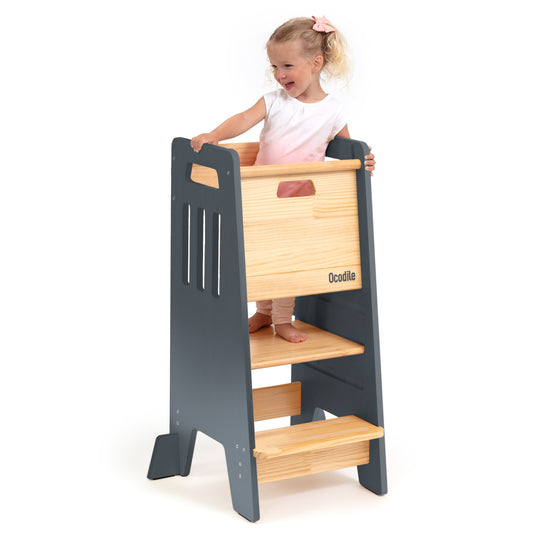
A kitchen helper, also called a learning tower, is a raised standing platform with surrounding barriers that lets a child reach a work surface. A folding version reduces its size for storage, but it still needs adequate room whenever your child uses it.
Start by choosing a counter section away from the stove, hot appliances, knives and dangling cords. That location matters more than finding an empty corner that happens to fit the furniture.
Check the full open footprint
Measure the available floor space at your chosen counter, including any feet or supports that extend beyond the platform. Compare it with the fully assembled, fully open dimensions, not just the width shown in a product photo.
A foldable kitchen helper should fit without blocking the route you use to supervise your child or reach the sink. In a galley kitchen, check whether another adult can pass without bumping the tower or asking your toddler to move.
Painter’s tape can help you mark the footprint on the floor. Treat that outline as occupied space and walk through your usual routine. Open the dishwasher, refrigerator and nearby drawers. If an appliance door overlaps the outline, plan to move the empty helper before opening it, or choose a different working spot.
There is no single clearance measurement that suits every kitchen. Your layout and the product instructions determine what works.
Measure the folded shape, including protruding parts
Next, measure the exact storage location. A narrow gap beside a cabinet may look ideal until a hinge, handle or support sticks out farther than expected.
Check folded width, depth and height separately. Also check whether the manufacturer allows upright storage. Foldable does not automatically mean self-standing when folded. A unit leaning unsecured against a wall can create a new problem if your child pulls on it.
The right foldable kitchen helper needs a storage spot you can use without blocking a doorway, vent or appliance. Think about access, too: if putting it away requires moving three other things, it may spend most of its life open.
For broader layout changes, Ocodile’s guide to small-space kitchen solutions can help you consider storage and family work zones together.
Inspect how it opens, locks and folds
Folding convenience should never depend on leaving a support partly extended. Before ordering, look for assembly instructions or a demonstration that clearly shows the unit opening into its intended working position.
Understand what holds it open
Different designs use different mechanisms, such as latches, pins or folding braces. Identify what keeps the model open and how you confirm that it is properly engaged. If the listing doesn’t explain this, ask the seller for the manual.
You should be able to check the mechanism before each use without guessing. The manufacturer’s instructions should also explain any adjustments and whether hardware needs periodic tightening.
When comparing a foldable kitchen helper, treat a clear locking procedure as more useful than a vague claim that it is “extra safe.” The practical question is whether you can reliably set it up as intended every time.
Guardrails are another layer of protection, not a replacement for supervision. Check the entry opening and surrounding barriers, and make sure your child cannot reach a release mechanism during normal use. Never improvise a missing latch or use a damaged folding joint.
Consider pinch points and who does the folding
Moving hinges and closing frames can pinch fingers. Folding and unfolding should be an adult task, with your child away from the moving parts.
Picture doing it after breakfast, with a wet counter and a toddler waiting nearby. Can you move the empty unit comfortably? Does the folding process require several separate steps? Where will your child wait while you do it?
Easy to fold and easy to carry are different qualities. A carry handle may help, but the unit’s weight, shape and your storage route still matter. Don’t assume “foldable” means lightweight, and never move or fold it with a child inside.
Match the platform to your child and counter
A compact tower still needs to fit the child using it. Follow the manufacturer’s age, weight and readiness requirements rather than choosing by age alone.
Your child should be able to use the standing area as intended without needing to climb onto the guardrails to reach the counter. A platform that puts the work surface too high may leave them stretching; one that raises them too far can make the surrounding barriers less useful.
An adjustable platform can help a foldable kitchen helper remain useful as your child grows, but only within the product’s stated limits. Check how adjustments are made and whether tools are required. Any adjustable parts should be secured according to the instructions before use.
Also consider what your child actually does when excited. A toddler who repeatedly leans far outward, climbs the sides or tries to jump off may not be ready for that activity, even if they meet the listed age guidance.
For a closer look at barriers, stability and supervision, Ocodile’s kitchen helper safety and buying guide covers the broader checks that apply beyond folding designs.

Compare folding towers, fixed towers and step stools
The smallest item isn’t necessarily the most practical choice. Compare how each option works during the activity, not just how little space it takes up afterward.
| Option | Useful when | Main trade-off to check |
|---|---|---|
| Folding learning tower | You need to reclaim floor space between supervised activities | Folding steps, locking procedure and safe storage |
| Fixed learning tower | You have a suitable permanent working spot | Its footprint remains in the kitchen |
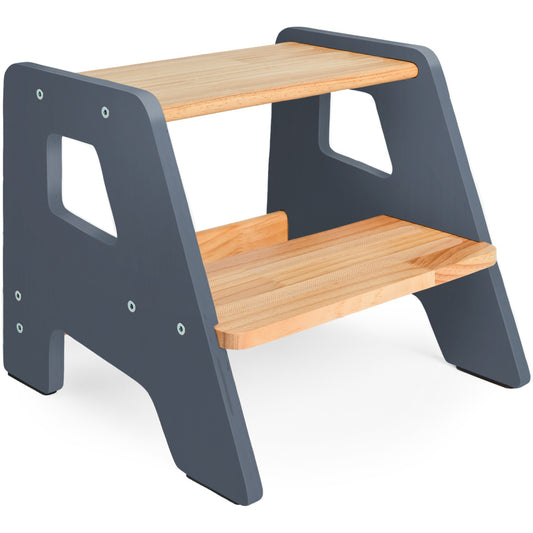
| Step stool | Your child can use that model as directed for a short reaching task | Many models lack surrounding barriers and provide less standing space |
A foldable kitchen helper makes the most sense when putting it away solves a real layout problem. If your kitchen has a dedicated, unobstructed spot and you use the tower repeatedly throughout the day, a fixed model may be simpler.
Don’t treat a step stool as an equivalent substitute for every tower activity. Follow its own intended use and supervision guidance. A dining chair is not a purpose-built kitchen helper, and an improvised setup can introduce sliding, climbing and fall risks.
Test it against an ordinary weekday routine
Imagine using the helper for one specific task rather than every possible kitchen activity. Washing produce, stirring a cool mixture or transferring ingredients into a bowl can give your child a manageable role while you stay beside them.
Make setup short enough that you’ll actually use it
A folding design has value when you can retrieve it, open it correctly and put it away without reorganizing the kitchen. Consider how often you expect to do that. Once a day for food preparation feels different from unfolding it repeatedly between meals.
Your foldable kitchen helper should work with the routine you already have. If the storage spot is down a hallway or behind heavy furniture, a slightly different layout may help more than choosing the thinnest model.
Keep the activity supplies ready before your child climbs up. A bowl, towel and a few ingredients within your reach reduce the temptation to step away while they’re elevated.
Choose tasks that don’t crowd the counter
Small kitchens work better when the child’s task is contained. Give them one bowl of cooled ingredients to mix, rather than spreading several containers across the counter. Keep hot cookware and sharp tools outside their reach throughout the activity.
If deciding what to cook is part of the bottleneck, this comparison of FitChef and similar meal-planning tools offers options for organizing recipes and grocery lists. Choose the meal first, then identify a simple, supervised part your child can help with.
The goal is participation alongside you, not unsupervised access to the kitchen. Once the task ends, help your child down and put the helper away as instructed.
Check these details before ordering
A foldable kitchen helper is worth considering only when you can verify both its everyday fit and its setup requirements. Save the measurements and instructions so you can compare models on the same basis.
Before purchasing, confirm:
- Open and folded dimensions: Include projecting supports, hinges and handles, not just platform size.
- Working-position mechanism: Understand how the unit opens fully and how any locks or braces engage.
- Child fit: Check platform settings, entry arrangement and the stated age and weight limits.
- Storage and ownership details: Confirm permitted storage position, assembly requirements, cleaning guidance and return terms.
Look beyond material labels, too. Wood versus plastic alone doesn’t establish stability or suitability. Construction, condition, support geometry and correct use all matter. Check for smooth accessible surfaces and follow the manufacturer’s maintenance instructions.
If key information is missing, ask before buying. A clear answer about dimensions or folding instructions is more helpful than another lifestyle photo.
Frequently asked questions
Is a folding kitchen helper less stable than a fixed tower? Folding alone does not determine stability. The design, fully engaged supports, condition of the hardware, floor surface and correct use all matter. Follow the model’s instructions and stop using it if a joint or locking mechanism is damaged.
Can I keep a foldable kitchen helper partly folded to save space while my child uses it? No. Use it only in the manufacturer’s specified working position. Partly folding it or leaving supports undeployed can compromise its intended structure.
What age is right for a kitchen helper? Use the manufacturer’s age and weight guidance, then consider your child’s ability to stand and participate as directed. Meeting an age recommendation does not remove the need for close adult supervision.
Can I store it behind a door? Only if the manufacturer permits that storage position and the unit does not interfere with the door, access or an exit route. Make sure your child cannot pull the stored unit onto themselves.
Compare a foldable kitchen helper with your measurements
Once you have a suitable working area and storage spot, compare the products that meet those requirements. Ocodile’s Adjustable Foldable Kitchen Tower is one option to review for a folding design with platform adjustment.
Check its current specifications and request any instructions you need before ordering. The right choice is the one that fits fully open, stores as directed and is straightforward for you to set up correctly during an ordinary day.