


Small Space Kitchen Solutions: 2026 Family Design Guide
Dinner starts with good intentions. Then the toddler drags a chair toward the counter, the cutting board is balanced over the sink because there's no prep space left, and you're opening the fridge sideways so you don't bump into a drawer. In a small kitchen, ordinary family life can feel like a traffic jam.
That frustration is common, not personal. Small kitchens are showing up in more homes, and not just in city studios. A 2022 NKBA survey found that 52% of new kitchen remodels in the US were for spaces under 100 square feet, up from 38% in 2015 (compact kitchen remodel trends). Families are trying to cook, store, clean, snack, supervise, and sometimes work in footprints that were never designed for all of that at once.
Most advice about small space kitchen solutions stops at shelves, bins, and cabinet organizers. Those help. But they don't solve the bigger family problem. Parents don't just need more storage. They need a kitchen that still works when a young child wants to participate.
That changes the design brief.
A functional family kitchen has to do three jobs at the same time. It has to support fast adult workflow, keep hazards under control, and create one safe place where a child can help without becoming an obstacle. When those three things line up, a small kitchen stops feeling cramped and starts feeling intentional.
From Chaos to Calm A New Vision for Your Small Kitchen
Small kitchens have always demanded discipline, but family life adds motion, noise, spills, and unpredictability. A narrow galley can work beautifully for one cook. Add a preschooler who wants to rinse berries or stir batter, and the same layout can feel impossible by 5:30 p.m.
The fix isn't to turn your child into a spectator. It's to design the room so participation has boundaries.
Stop treating the kitchen like a storage problem only
Parents usually start with the obvious moves. They clear counters. They buy stackable containers. They add hooks under a shelf and maybe a cart by the wall. Those are useful changes, but they don't address where a child stands, what they can safely reach, or how you move around them without breaking rhythm.
That's why many small kitchens stay stressful even after an organizing reset. The room may be tidier, but the workflow is still fragile.
A calm kitchen doesn't mean a silent one. It means everyone knows where they belong.
There's also nothing unusual about the room itself. Compact kitchens are part of a long design story. The classic Frankfurt Kitchen from 1929 was created for efficiency in a small footprint, and compact apartment kitchens have shaped everyday life for decades. The modern version just has a different user mix. Now there's often one adult cooking, one child observing or helping, and a lot of shared equipment fighting for the same few feet.
What a family-ready small kitchen looks like
In practice, the best small space kitchen solutions do four things well:
- Protect the main path: The cook can move between the sink, stove, and fridge without stepping around furniture.
- Lift storage upward: Everyday items come off the counter and closer to eye level.
- Make furniture work harder: A table, cart, bench, or tower should do more than one job.
- Create one child-safe station: Kids need a place to participate that isn't random, wobbly, or in the hottest part of the room.
That last point is where many homes struggle. Parents don't need another generic tip about baskets. They need a kitchen that supports real family use. Once you design for that, the room feels bigger because it functions better.
Optimizing Your Layout The Tiny Kitchen Work Triangle
The most reliable upgrade in a small kitchen isn't decorative. It's layout discipline. If the sink, stove, and refrigerator fight each other, every task takes longer and the room feels smaller than it is.
The classic working triangle is still useful in compact homes because it protects movement. In small kitchens, following that principle can reduce unnecessary movement by 20 to 30%, with an ideal triangle perimeter of 12 to 26 feet and up to 15% faster cooking times (working triangle guidance).

What the triangle means in a real home
You don't need a perfect triangle drawn on a floor plan. You need three zones that connect cleanly:
| Zone | What belongs there | What to avoid |
|---|---|---|
| Prep area | Sink, trash, knives stored securely nearby, a bit of landing space | Drying racks and appliances that steal prep width |
| Cooking zone | Stove, oils, utensils, potholders | Child standing space, paper towels near flame |
| Storage hub | Fridge, pantry items, lunch supplies | Deep clutter that blocks quick access |
In a galley kitchen, the triangle often becomes more of a tight corridor. That's fine. The point is to keep the route direct. In an L-shaped kitchen, the inside corner usually becomes the trouble spot. If one cabinet door blocks another, or the dishwasher interrupts the prep path, the room will feel clumsy no matter how organized it looks.
A helpful visual explainer from The Cabinet Coach can help you optimize your kitchen layout before you buy any storage products.
How to adapt the triangle for kids
Families need a fourth consideration that old layout diagrams rarely mention. Where does the child go when they want to help?
The answer should never be “wherever there's room.” In a tiny kitchen, that usually puts them in the cook's path. Put the child access point near prep, not near active heat. Washing produce, tearing herbs, or transferring chopped ingredients is easier to supervise at the sink-side counter than beside the stove.
For parents building a more child-accessible setup, a Montessori-style approach to reachable tools and routines can help, especially if the room needs to support both independence and control. This guide to a Montessori kitchen setup shows how families can think about access without turning the whole kitchen over to the child.
Practical rule: If you have to pivot sharply or step backward to avoid a child, that helper spot is in the wrong place.
The best layout choice is often the one that looks slightly boring on paper. Clear path, clear landing space, clear child station. In a small kitchen, boring is efficient.
Go Vertical Smart Storage Solutions
When families say a small kitchen feels crowded, they usually mean the counters are doing too much. Appliances stay out because cabinets are jammed. Snack bins migrate onto worktops. Cleaning supplies, baby bottles, lunch containers, and fruit bowls compete for the same visible surface.
The cure is to store by height and frequency, not just by category.

Use the walls that already exist
Some of the most effective small space kitchen solutions aren't renovations. They're relocations. You move commonly used items off the counter and onto vertical surfaces that are easier to scan.
Try these practical upgrades:
- Add a magnetic strip for metal tools: Measuring spoons, scissors, and lightweight utensils can live on the side of a fridge or backsplash zone away from heat.
- Hang a rail under open shelving: Mugs, small baskets, or dish towels use airspace instead of drawer space.
- Install a slim pegboard panel: This works well for pans, strainers, and kid-safe tools if you keep the lower hooks for light items only.
- Use cabinet sides: The exposed end panel of a cabinet can hold a spice rack, wrap organizer, or a narrow file-style holder for cutting boards.
- Stack inside cabinets with risers and under-shelf drawers: Vertical storage only works if shelves aren't wasting half their height.
A practical roundup on maximizing storage in small kitchen layouts is worth a look if you're trying to spot dead zones you've stopped noticing.
Store for adults high, for kids low, for danger hidden
Family kitchens need a different logic than adult-only kitchens. Not everything should be easy to reach.
Use a three-tier rule:
- High and secure: Medicines, sharp tools, alcohol, matches, and specialty appliances.
- Mid-level and daily: Plates, prep bowls, oils, dry goods, lunch items.
- Low and child-safe: Produce basket, napkins, silicone cups, placemats, or one small drawer with safe helper tools.
That low zone matters. If children have nothing appropriate to access, they'll pull at the wrong drawers.
For families adding child-accessible storage beyond the kitchen, these ideas for shelves for kids are useful because the same principle applies here. Visibility and order help children follow routines without scattering everything across the room.
Keep only the tools you use weekly at arm's reach. Small kitchens punish aspirational storage.
What usually doesn't work
Open shelving can look light and beautiful, but it fails quickly if every shelf becomes mixed storage. A shelf with matching bowls and glasses is manageable. A shelf with medicine, bibs, tea tins, batteries, and sprinkles becomes visual noise.
Ceiling-height storage also needs honesty. If you can't reach it easily, reserve it for backstock, party gear, or seasonal pieces. Don't put weekday essentials in places that require a stool and patience every morning.
Multi-Purpose Furniture for Compact Kitchens
Furniture carries a heavier load in a small kitchen, more so than generally understood. In a generous room, a table can just be a table. In a compact one, every piece needs to justify the floor space it occupies.
That's why multi-use pieces usually outperform one-trick additions.

A 2025 urban living study found that standard storage hacks reclaim only 15 to 20% of floor space on average, while multi-use furniture such as a step stool that converts into a seat can yield 28% more usable area (urban living study on multi-use furniture). That result tracks with what many families experience at home. Shelves help, but furniture that changes roles affects daily flow more dramatically.
Which pieces earn their footprint
Some furniture works because it adapts over the course of a day.
- Drop-leaf table: Breakfast spot in the morning, prep surface at dinner, folded away when the kitchen needs clearance.
- Rolling cart: Pantry overflow, baking station, coffee setup, or mobile island. It's especially helpful if your fixed counters are broken up by the sink or stove.
- Nesting stools: Useful when guests come over, invisible when they don't.
- Bench with storage: Seating plus concealed bulk storage for linens, lunch gear, or small appliances.
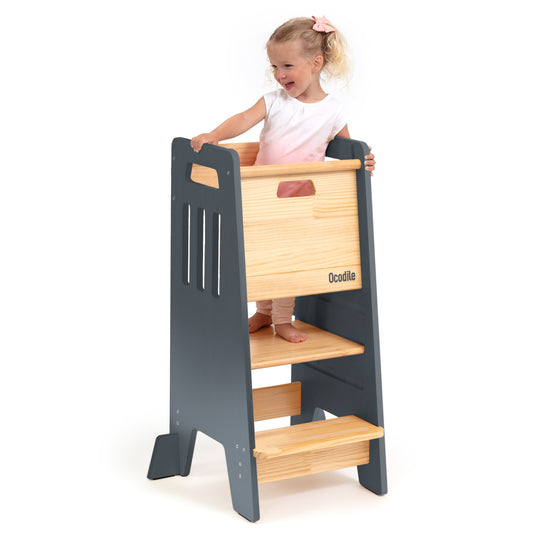
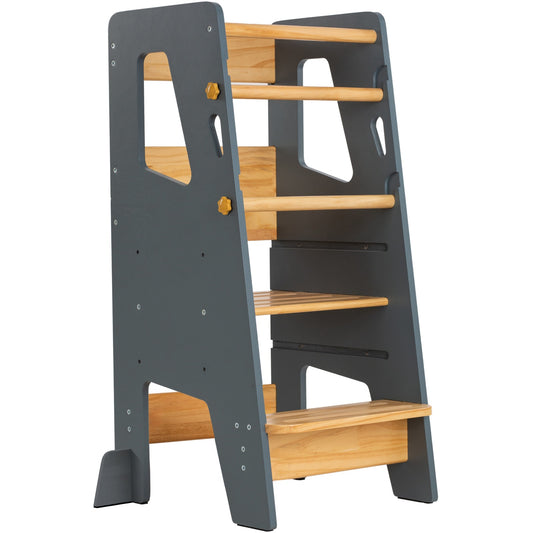
- Convertible step stool or tower: Child access during prep, then extra seating or tucked storage depending on the design.
The strongest examples solve two different problems at once. A fold-out surface doesn't just add workspace. It also lets you avoid leaving clutter on the main counter.
For broader examples, Endless Storage's furniture tips offer a useful way to judge whether a piece is helping circulation or just filling a corner.
One question before you buy
Ask this: what happens to this item when nobody is using it?
That question eliminates a lot of well-meaning purchases. A bar cart without a parking spot becomes an obstacle. A cute bistro table with splayed legs may look airy, but if chairs can't tuck in fully, the walkway shrinks all day long.
This visual shows the kind of flexible setup that works best when square footage is tight:
A family-specific trade-off
Parents often hesitate to buy a helper tower or child stool because it feels like adding one more object to an already crowded room. Sometimes that concern is valid. A bulky, single-purpose piece can absolutely make the kitchen harder to use.
But one well-designed, multi-use child piece can replace the unstable dining chair, the adult stool dragged across the floor, and the constant lifting of a child up to counter height. If it folds or does double duty, it often saves more friction than it adds.
That's the main return. Not just storage. Less improvising.
Designing a Safe and Accessible Kids Zone
Small kitchens either become family spaces or remain adult spaces with a child hovering at the edge. If you want a young child to participate safely, they need a consistent station, not occasional permission to stand on whatever chair is nearby.
A 2025 survey of 2,500 parents found that 68% cited “lack of safe kid involvement in cooking due to small home constraints” as a top frustration (parent survey on safe kitchen involvement). That frustration makes sense. Most kitchens weren't set up with child access in mind, especially smaller ones.

Build one helper station, not a free-for-all
A good kids zone is simple. It should sit near prep, outside the hot zone, and close enough for easy supervision. Most families do best with a helper tower or stable step solution positioned near the sink-side counter.
Use that station for tasks like:
- Washing produce: Safe, sensory, and easy to contain.
- Tearing lettuce or herbs: Productive without requiring sharp tools.
- Transferring ingredients: Children can move items from bowl to pan or tray with supervision.
- Simple mixing: Best done with a non-slip bowl and a clear stop point when the adult needs the space back.
If the child has a defined place, they're less likely to drift toward the stove or open random drawers.
Safety has to be physical, not verbal
Parents often rely on reminders. “Stand back.” “Don't touch that.” “Wait there.” In a tight kitchen, verbal rules help, but they can't compensate for poor placement.
Use a physical safety checklist:
| Area | Safer choice |
|---|---|
| Near the stove | Keep the child station out of this zone entirely |
| Counter edge | Move knives, hot pans, and glassware away from the accessible side |
| Lower cabinets | Reserve one low area for child-safe items, lock or relocate hazards |
| Cords and small appliances | Coil and secure when not in use |
| Cleaning supplies | Store high and closed, never under the sink if the child can open it |
If a setup only works when everyone behaves perfectly, it isn't a safe setup.
What to look for in a child access tool
A proper helper piece should be stable, easy to position, and realistic for your footprint. In a compact home, foldability matters because the kitchen can't permanently donate precious floor area to one function.
One option families consider is a kitchen helper learning tower, especially when they want a child-height station that can be brought in for prep time and moved aside afterward. The right choice depends on your kitchen width, your child's age, and whether the piece can live nearby without blocking circulation.
The developmental piece matters too
Children usually cooperate better when they have a real job. That doesn't mean letting them do everything. It means assigning one repeatable task and preparing the space so they can succeed at it.
A child who always washes cucumbers, tears basil, or sets napkins starts to understand the kitchen as a shared workspace. That lowers resistance and reduces wandering. In a small room, that's not just good for development. It's good design.
Your Blueprint for a Functional Family Kitchen
A small kitchen doesn't need to do less. It needs to do fewer things badly.
Families get the best results when they build around four clear moves. Protect the main working path. Pull storage upward instead of outward. Choose furniture that can change roles. Give children one safe, repeatable place to participate.
A simple way to prioritize changes
If your kitchen feels overwhelming, don't redo everything at once. Work in this order:
- Fix movement first: Clear the route between sink, stove, and fridge.
- Remove counter clutter next: Shift frequent items onto walls, rails, or cabinet interiors.
- Replace weak furniture: Trade bulky single-use pieces for foldable or mobile ones.
- Add the child station last: Once adult workflow is stable, place the helper zone where it won't interrupt it.
That order matters. Many parents start with the tower or stool because involving kids feels urgent. But if the adult path is still chaotic, the child station ends up in the wrong place and the whole idea feels harder than it should.
Small kitchens become peaceful when every person and every object has a home.
What success actually looks like
It doesn't look like a magazine kitchen with empty counters and one ceramic bowl of lemons. It looks like dinner getting made without constant shuffling. It looks like a child washing strawberries while you chop vegetables. It looks like fewer warnings, fewer collisions, and less resentment about the room itself.
That's the core promise of smart small space kitchen solutions. Not perfection. Function.
A compact kitchen can still become the center of family life. In many homes, it already is. It just needs better boundaries, better tools, and a layout that respects how families move.
If you're building a child-friendly kitchen in a tight footprint, Ocodile offers practical furniture designed around safe participation and everyday family use. Their approach is useful for parents who want children involved in daily routines without turning a small kitchen into a hazard zone.