



Kids Kitchen Helper Stool: The Ultimate Safety & Buying
Your toddler is at your elbow again, one hand on the counter, the other reaching for the spoon you're still using. The pan is sizzling, the sink is full, and your child wants to help right now, not later. That's the moment many families start looking for a kids kitchen helper stool, because the goal isn't just to keep a child busy, it's to bring them into the kitchen without turning every meal into a rescue mission.
A good stool can change the rhythm of that scene. It gives a child a controlled place to stand, a clearer view of what you're doing, and a way to join in without climbing a chair or hanging off the counter edge. The tricky part is that not every stool solves the same problem in the same way, especially when supervision, kitchen layout, and a toddler's impulse control all collide.
Parents usually want two things at once, more independence for their child and less anxiety for themselves. Those two goals can work together, but only if the stool is sized well, built well, and used with realistic rules. If you're comparing options and wondering what matters, ideas from Cooler Kitchen can be a helpful place to start thinking about kid-friendly kitchen activities, because the best stool is only useful when it supports real participation.
Why Every Parent Considers a Kitchen Helper Stool
The need usually shows up in a very ordinary moment. You're mixing batter or washing vegetables, and your child keeps asking to help, but a regular chair is too high, a step stool is too unstable, and the floor-to-counter gap is still too big for comfort. That's when a kids kitchen helper stool starts to make sense, because it gives a toddler a defined work zone instead of a precarious improvised perch.
A child who can stand securely at the counter can do more than watch. They can rinse produce, stir a bowl, move ingredients from one container to another, or observe the process closely enough to stay engaged. For many families, that matters as much as the practical help, because the kitchen becomes a place for participation instead of a place where children are constantly told to stay back.
The best stools are designed for exactly that middle ground. They don't turn the child into an independent cook, and they don't replace adult attention. They create a safer access point so your child can join the task while you keep control of the environment.
Practical rule: a kitchen helper stool should make participation easier, not make you feel like you've handed over the kitchen.
That's why buying decisions shouldn't stop at color or style. You'll want to think about safety design, size fit, materials, how the stool handles real-world mess, and what level of supervision is realistic in your home. You'll also want a clear sense of where the stool helps and where it doesn't, especially if your kitchen has tight corners, a busy cooktop, or slippery flooring.
What a Kids Kitchen Helper Stool Actually Is
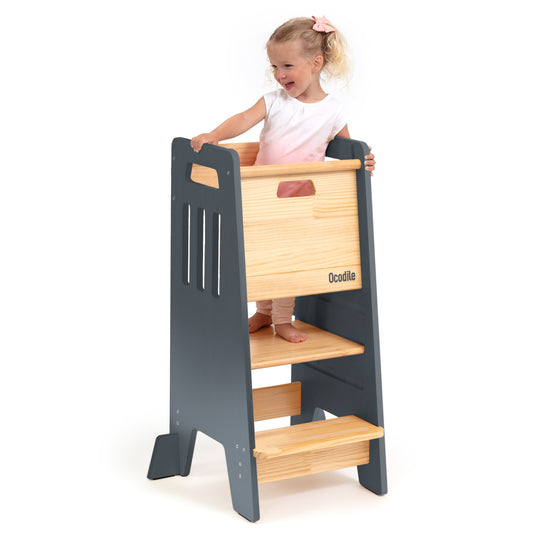
A kids kitchen helper stool is not just a taller step stool. It's a child-sized standing platform designed to bring toddlers up to counter height while keeping them inside a more controlled space. The important difference is the enclosure, because the child is meant to stand, not teeter on an open step or lean from a chair.

Most models rely on a few core features, an enclosed platform, side and back guardrails, and a broad base that helps the stool resist tipping. That structure matters because a toddler's center of mass shifts constantly, especially when they lean forward to look into a bowl or reach for a utensil. A helper stool is built to reduce the wobble that comes from those little, very normal movements.
The Montessori connection is easy to understand once you see the child in action. Practical life work is about letting children do real tasks in a prepared environment, not pretending to help while they sit off to the side. In a helper stool, a toddler can wash a cucumber, stir a batter, watch dough rise, or help move prepped ingredients from a tray to a bowl. Those are small jobs, but they feel meaningful to a child who wants to be included.
Most families start using one when a child can stand confidently and follow simple instructions, which often lines up with toddler independence rather than babyhood. A child at that stage doesn't need a seat for eating, they need a stable place to stand and a clear adult boundary around what's allowed.
A simple way to remember the difference, a regular step stool helps with height, while a helper stool is meant to support height plus containment. That extra containment is the feature parents are usually paying for, even if the product description doesn't say it plainly.
Safety Standards and What the Data Shows
Safety is the reason this category deserves more scrutiny than many buying guides give it. Consumer Reports documented 16 safety incidents reported to SaferProducts.gov between 2011 and 2024, mostly involving children aged 1 or 2, and said 13 of 16 towers failed a stability test with 35 pounds of weight applied in its review of toddler towers. The report noted no known fatalities, but the incidents included falls, tip-overs, split wood, loose screws, and entrapment hazards, which is a strong reminder that this product category depends on engineering, not optimism. Consumer Reports' toddler tower safety review makes the basic point clearly, stability and enclosure design are foundational.
A real-world recall reinforces the same lesson. In the U.S. market, 5,952 SDADI children's kitchen step stools were recalled after regulators warned they could collapse or tip over and had openings large enough for a child's torso to pass through, with 8 reports and 4 injuries tied to instability or tipping. That combination, collapse risk plus torso-sized openings, shows why a stool needs both structural strength and thoughtful spacing. The issue isn't only whether the stool stands up on day one, it's whether a moving toddler can be protected when they lean, twist, or try to climb out.

The design checks that matter most are straightforward. Look for a wide base footprint, secure guardrails, no torso-sized openings, and platform construction that doesn't flex under normal use. The stool should feel planted when a child shifts weight forward, because that's the exact moment most tip concerns start.
A good stool doesn't eliminate risk, it buys you time when a toddler makes a bad move.
One useful internal reference on this issue is Ocodile's stability testing methods, because stability is the feature that separates a safe-feeling stool from one that only looks sturdy in photos. If a manufacturer can't explain how the stool was tested, or if the product page hides the dimensions, treat that as a red flag rather than a detail to ignore.
Finding the Right Size and Age Fit
Fit is where a lot of families get confused, because a stool can be safe in theory and still be awkward in your kitchen. The child should stand high enough to reach the counter without hanging their torso too far forward, and low enough that their body stays inside the guardrails. A simple practical check is whether the child's waist stays at or below the front guardrail, while their arms can reach above it comfortably.
Platform adjustability is useful because toddlers grow quickly in posture, balance, and confidence even when their clothing size barely changes. Commercial models often offer 2 to 3 platform positions around 28.8 to 40 cm, or 12 to 18 in, with overall heights around 86 to 91.4 cm and footprints near 38.5 to 44 cm wide by 42 to 45 cm deep. Those dimensions matter because lower positions reduce the reach gap for smaller children, while a larger footprint improves resistance to tipping by widening the support base. The practical takeaway is simple, a stool that adjusts can stay useful longer, but the best setting is the one that keeps the child secure today. A model specification page with these dimensions shows how those ranges appear in the market.
| Size and Age Compatibility Guide | |||
|---|---|---|---|
| Child Age | Child Height | Platform Height | Overall Stool Height |
| Around toddler age | Smaller toddler build | Lower platform setting | Lower overall setting |
| Toddler to preschool range | Growing child | Middle platform setting | Mid-height frame |
| Older child within limit | Taller child | Higher platform setting | Full height frame |
Ocodile's height guide is useful if you're trying to match a helper stool to a specific counter or island, because counter height isn't the same in every home. If your kitchen island is unusually tall or your child is unusually small, the wrong stool can create the exact forward-leaning posture you're trying to avoid.
The easiest transition rule is behavioral and physical at the same time. If your child no longer fits comfortably inside the guardrail area, can't keep feet flat, or is over the stool's stated limit, it's time to stop using that model. A stool should fit the child's body, not force the child to fit the stool.
Setting Up and Using the Stool Safely
The safest stool still needs disciplined setup. Put it on a flat, level floor, not on a rug edge, a raised mat, or an uneven tile seam where the base can rock. Keep it away from burners, hot pans, knife zones, and sink edges where a quick reach could turn into a burn, cut, or splash hazard. This kitchen safety guide for toddlers is a useful companion if you're building rules for the whole room, not just the stool itself.

The supervision standard should be stricter than “I can see them from across the room.” An adult should stay within arm's reach while the child is inside the stool, because toddlers can lean, twist, and try to descend faster than you can cross a kitchen. That doesn't mean you have to hover in panic, it means your hands should be close enough to catch a foot slip or an impulsive climb.
Use simple, repeatable rules. The child gets in with help, stands with both feet planted, and stays inside the frame until an adult opens the exit. If they start leaning over the front guardrail, trying to turn sideways, or using the stool on a slippery or slanted surface, step in immediately and reset the task.
House rule: if the kitchen is hot, sharp, or crowded, the stool comes out only for the part of the task that is actually safe for a toddler.
The stool should support controlled participation, not unrestricted access. That means you can let a child wash berries, add pre-measured ingredients, or stir a cold mixture, but you shouldn't treat the stool as a license for open-ended kitchen roaming. Teaching those boundaries early makes the stool easier to use later, because the child learns that the platform is a work place, not a climbing structure.
Materials, Durability, and Maintenance
Material choice changes how a stool feels in daily life. Solid wood tends to feel steadier and more substantial, plywood can offer good structural performance when built well, MDF is usually a more budget-sensitive option but depends heavily on joinery and finish quality, and plastic can be easy to wipe down but may feel lighter and less planted under a moving child. In a kitchen, the best material is the one that keeps its shape, cleans easily, and doesn't develop looseness at the joints.
Finish matters more than many parents expect. A smooth, sealed surface is easier to clean after spills, and rounded edges matter because toddlers do grab, lean, and sometimes mouth furniture. If the stool will live near food prep, you want finishes that stay intact under repeated wiping rather than chipping into rough spots that invite splinters or wear.
Weight capacity only means something if the frame and joints support it. A sturdy material can still fail if the screws loosen or the connection points aren't reinforced well enough, which is why maintenance is part of safety, not just upkeep. Guidecraft's product information says its classic kitchen helper is made from solid hardwood and birch plywood and is rated for children 18 months and up with a 125 pounds support limit, a reminder that durable construction and stated capacity should travel together rather than be treated separately.
Regular checks are worth the time. Tighten visible screws, inspect the platform and guardrails for wobble, and look for chipped finish, split edges, or stress around hinges and folding points. If the stool starts to flex more than it used to, or if you hear a new creak when your child shifts weight, that's a reason to stop using it until you've inspected it properly.
Long-term value usually comes from buying once and maintaining well. A cheaper stool that loosens quickly can become a false bargain if it needs constant repairs or has to be retired early. A well-built stool can move from kitchen duty to sink duty to craft duty, which is exactly the kind of reuse families notice when the early toddler years get busy.
Key Buying Considerations and Red Flags
Start with the parts that affect safety before you think about style. A stool should have clear testing documentation, a stable base, and guardrails that keep the child centered without creating openings large enough for the torso to pass through. The current product page for Guidecraft notes that its Kitchen Helper models are tested to exceed child safety standards and are GREENGUARD GOLD Certified, which shows how manufacturers may communicate safety and indoor-air quality together, though every family still needs to inspect the actual model they're buying.

Then look at fit for your kitchen. A larger footprint usually gives better stability, but it takes up more floor space. A foldable model is easier to stash, especially in smaller kitchens, but folding hardware should feel solid, not flimsy. One internal reference worth checking is Ocodile's kitchen helper stool page, because the brand's adjustable kitchen stool helper is built around the same practical question families ask most, how to balance access with safety.
Pay attention to red flags that should stop a purchase. Thin-looking materials, vague weight limits, cheap-feeling plastic joints, and reviews that repeatedly mention wobble or locking problems are not minor cosmetic issues. If the product photos don't show the side openings clearly, assume the openings may be part of the risk, not just the design.
A short buying checklist helps when listings all start to blur together.
- Safety proof: Ask what testing was done and whether the model has a clear certification or safety statement.
- Guardrail design: Check that the rails hold the child in without creating climb-through openings.
- Base stability: Make sure the footprint looks wide enough for real toddler movement, not just still photos.
- Adjustability: Look for platform settings that match a growing child, not a one-size-fits-all height.
- Assembly clarity: If the instructions are confusing or the hardware feels loose during setup, that's a warning sign.
Reviews matter most when they mention actual use, not just packaging or color. A review that says a stool feels steady during climbing and standing is more useful than one that only praises how cute it looks. The safest purchase is the one that survives the kitchen, not the one that photographs well.
Common Questions Parents Actually Ask
Is a kitchen helper stool safer than a dining chair or a basic step stool? Usually, yes, because it's designed for counter-height participation with a more enclosed standing area. A chair or ordinary stool can still work in a pinch, but both are easier for a child to climb, slide, or tip, which is exactly what parents are trying to avoid.
What's the difference between a learning tower and a kitchen helper stool? In everyday use, the terms often overlap. Some families use learning tower for the Montessori-style standing platform and kitchen helper stool for the same category, but the key is the design, not the label.
Will this work in a small kitchen? It can, if the footprint fits your floor plan and you're realistic about where it lives when not in use. Foldable models help with storage, but folding only matters if the open stool is still stable enough to use confidently when you need it.
Parents also worry that a child will get too attached to the stool. In practice, that usually means the stool has become a useful routine, not a dependency problem. You can phase it out when the child no longer fits well, loses interest, or is ready to work at a different height with less enclosure.
Can it be used for more than cooking? Absolutely, and that flexibility is one reason families keep them. Sink access for handwashing, arts and crafts at a counter, or messy sensory play can all work if the activity itself is safe and the adult keeps the setup controlled.
If you want a stool that supports real kitchen participation without ignoring the safety trade-offs, Ocodile offers child-focused furniture built around independence, practical use, and familiar home spaces. Visit Ocodile to look at options that fit the way families cook, clean, and make things together.