



How to Encourage Independence: Build Confident Kids
Dinner is half-finished, the pan is hot, and your child wants to be part of everything. They want the spoon, the counter space, the job you're trying to rush through. In that moment, “independence” can sound like one more parenting ideal you're supposed to teach on top of everything else.
But in real family life, independence often makes things easier, not harder.
A child who can climb into bed, put dirty clothes in the hamper, carry a snack plate to the table, or wash hands with only a light reminder changes the tone of the day. You stop doing every small task for them. They stop waiting for rescue. Home feels more cooperative.
Why Fostering Independence Matters More Than Ever
Modern childhood gives kids fewer natural chances to practice autonomy than many parents had growing up. In England, 86% of primary school children traveled home alone in 1971, but by 2013 that figure had fallen to 25%. More recently, just 33.2% of children play outside unsupervised near their homes, according to Activity Alliance's summary of stifled childhood independence.
That shift matters because independence isn't just a personality trait. It's a set of behaviors children learn by doing. If daily life offers fewer chances to move freely, solve small problems, and manage simple responsibilities, parents have to build those opportunities on purpose.
That doesn't mean pushing kids too fast. It means noticing where dependence has become the default even when a child is ready for more. A child can't practice getting their cup, choosing pajamas, or helping with cleanup if every item is stored out of reach and every routine is adult-run.
Independence reduces friction at home
Parents often think of independence as a long-term goal. It is. But it also helps in the short term.
When children can participate in ordinary routines, family life usually gets smoother:
- Mornings feel less chaotic because your child knows what comes next.
- Transitions improve because they have an active role instead of being moved from task to task.
- Confidence grows through repetition because they see themselves as capable.
- Power struggles shrink because not every interaction is an adult command.
Practical rule: Don't treat independence as something separate from daily life. Build it into the life you already have.
If you've been wondering how to encourage independence without turning your home into a training program, start there. Look at the places where your child is always waiting for help. Those are often the clearest openings.
A lot of parents also find that confidence and independence grow together. If you want a helpful companion read, Ocodile's piece on building confidence in kids connects that emotional side with the practical side.
Create a Home Environment That Encourages Autonomy
Most advice about how to encourage independence starts with behavior. Tell them to try. Give choices. Praise effort. All of that helps, but the physical setup usually comes first.
If the toothbrush is too high, the sink is hard to reach, the coat hook is above eye level, and the kitchen is treated like a no-go zone, your child can't do much without an adult stepping in. The fastest way to build more independence is often to redesign the room, not lecture the child.
A useful principle is this: make the environment say “yes” more often than you do.
Build a yes space, not a perfect house
A yes space is an area where your child can move, choose, and participate safely with minimal correction. That doesn't require a Montessori showroom. It requires access, order, and safety.

A strong environment-led approach focuses on putting items within reach, using low hooks, and choosing age-appropriate furniture so children can practice tasks safely instead of waiting for constant rescue, as described in this guidance on simple ways to encourage independence at home.
Start with a quick room scan and ask:
| Area | What blocks independence | What helps |
|---|---|---|
| Bedroom | Clothes in deep drawers, bed too high, toys piled together | Low storage, simple categories, reachable bed |
| Entryway | Coat and shoes stored for adults | Low hook, basket for shoes, spot for bag |
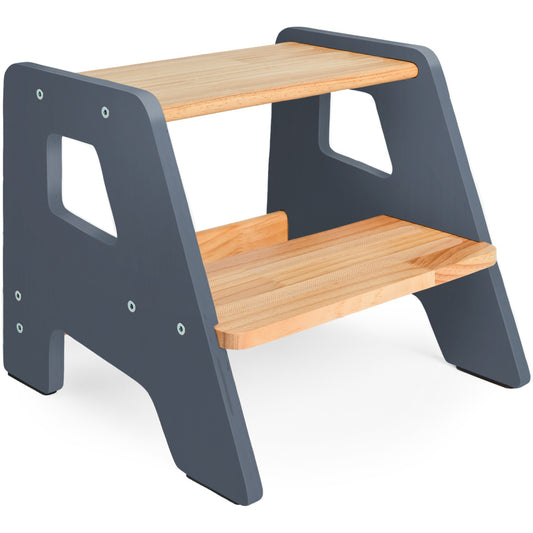
| Bathroom | No stable step, supplies hidden away | Step stool, towel hook, limited items in reach |
| Kitchen | Unsafe access, adult-only tools | Supervised standing access, child-sized tools, clear boundaries |
The bedroom is often the easiest place to start
The bedroom gives children repeated daily practice because they use it morning, rest time, and bedtime. A floor-level sleep setup, low shelves, and a small basket for tomorrow's clothes can do a lot of the teaching without constant reminders.
If you're reworking that space, this guide to a Montessori bedroom for toddler shows what accessible sleep and storage can look like in a real home. And if your child is moving out of a crib, a practical crib to bed transition guide can help you think through timing and safety before you change the room.
The kitchen can become a shared workspace
The kitchen is where many parents want more help and feel the most nervous about safety. That trade-off is real. Hot surfaces, sharp tools, and time pressure can make “helping” feel impossible.
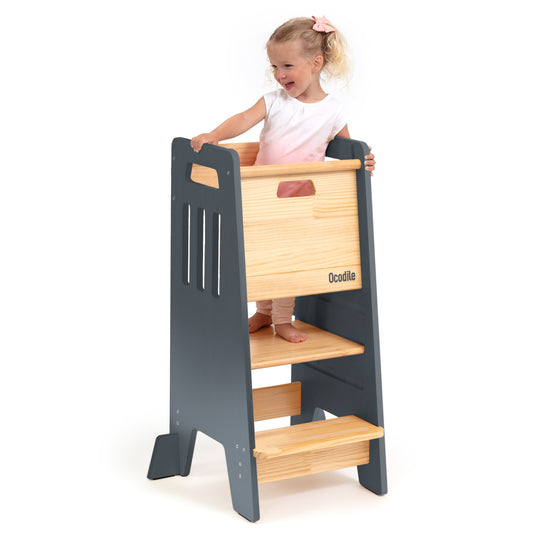
The answer isn't to let children wander into unsafe tasks. It's to create one defined participation zone. A sturdy learning tower, a cleared section of counter, and a short list of allowed jobs gives a child a legitimate place in the routine. They can rinse produce, stir batter, tear lettuce, transfer chopped fruit, or wipe spills.
One option parents use for this is an Ocodile standing tower, which gives young children a stable way to reach counter height so they can join kitchen routines with supervision. The point isn't the brand. The point is what the setup allows: fewer “don't touch” moments and more safe practice.
A well-prepared room reduces nagging because the room itself does some of the teaching.
Integrate Independent Skills into Daily Routines
Once the environment supports participation, the next job is to make independence repeatable. Children learn fastest inside routines they see every day. That's why the strongest gains usually happen in the ordinary parts of family life: getting dressed, washing hands, clearing dishes, packing a bag, tidying toys.

A common mistake is asking for the whole skill too soon. “Get ready for bed” sounds simple to an adult, but it includes many smaller actions. Children do better when you teach the routine in micro-steps, then gradually reduce help.
Guidance from ABA practice recommends task analysis, which means breaking a routine into small steps, teaching one at a time, and fading prompts after repeated success. Their example of a handwashing chart uses full modeling first, then partial prompts, then less support only after the child can do the sequence more independently. That's outlined in this article on building independence through ABA therapy.
Use task analysis for one stubborn routine
Pick one task that causes repeated friction. Then strip it down.
Instead of “get dressed,” try this:
- Choose the clothes together the night before
- Put underwear on
- Step into pants
- Pull up pants
- Put arms into shirt
- Pull shirt down
- Carry pajamas to the basket
At first, you might help with every other step. Then you stop helping with the part they've mastered. That's how real independence grows. Not in one leap, but in layers.
Here are a few routines where this works especially well:
-
Morning routine
Start with one anchor skill, like pulling back the blanket, carrying pajamas to the hamper, or putting toothbrush and toothpaste by the sink. -
Meals and snacks
Let your child carry a napkin, place one fork, wipe the table, or bring their cup to the sink. -
Cleanup
Use labeled bins, keep the categories simple, and teach where one type of item goes before expecting a full-room reset.
If you want a hands-on list of ideas, Ocodile's guide to Montessori practical life activities offers useful routine-based tasks that fit naturally into home life.
Visual supports help children know what to do next
Many children don't need more reminders. They need fewer words and a clearer sequence.
A simple picture routine by the sink or in the bedroom can reduce repeated prompting. For cleanup and chores, some families like to create a picture chore chart so the child can follow the task visually instead of relying on adult memory.
This kind of support is especially helpful when your child can do the task but forgets the order.
A short video can also help you think about participation in daily life from the child's perspective.
What works and what usually backfires
A few routine-building patterns are worth keeping in mind:
-
What works
Consistent sequence, same storage spot, brief prompts, and specific praise such as “You put your socks in the basket.” -
What backfires
Changing the process every day, stepping in too early, or continuing to prompt long after the child can do part of the routine alone.
The goal isn't faster completion. It's ownership.
Use Language That Empowers and Guides
The room matters. The routine matters. The words matter too.
Parents often weaken independence by talking too much during a task. A child reaches for the zipper and hears a stream of corrections. They pause to think and an adult fills the silence with instructions. Before long, the child learns that trying isn't their job. Waiting is.
Supportive language gives direction without taking over.
Offer fewer choices, not more
Children usually do better with 2 to 3 bounded options than with open-ended freedom. Child-development guidance recommends limited choices such as choosing between two shirts or packing one item into a bag because that supports planning and decision-making without overwhelming the child, as explained in Child Mind Institute's guidance on building independence in preschoolers.

That sounds small, but it changes the interaction. Instead of “What do you want to wear?” try “Do you want the red shirt or the green shirt?” Instead of “Clean up your toys,” try “Would you like to put away the blocks first or the cars first?”
Say this more often
You don't need scripts for every moment. A few reliable phrases go a long way.
“You can try first. I'll stay close.”
That sentence gives confidence and support at the same time. Here are more examples:
| Instead of | Try |
|---|---|
| “You're doing it wrong” | “Try turning it this way” |
| “Let me do it” | “Show me the part you want help with” |
| “Hurry up” | “What's your next step?” |
| “Good job” | “You carried your plate carefully” |
Specific feedback works better than vague praise because it tells the child what they did. “You remembered to hang your towel” reinforces the behavior. “Good job” is kind, but it's harder to repeat from.
Help without taking the task away
A child saying “I do it myself” is often asking for dignity as much as autonomy. If the task is safe, pause before stepping in.
You can guide without controlling:
-
Name the effort
“You're working hard to get that shoe on.” -
Point to one clue
“The heel goes at the back.” -
Offer shared problem-solving
“Do you want me to hold the shoe or hold your sock?” -
Protect the pace
“You can keep trying. We have time for one more try before I help.”
This kind of language keeps the child in the lead while still giving structure. That's the balance most families are looking for.
Troubleshoot Common Setbacks and Challenges
Even when your setup is solid, independence doesn't grow in a straight line. Children get tired, clingy, distracted, and frustrated. Parents do too. A child who carried their plate proudly all week may suddenly insist you do everything. That doesn't mean the process failed.
It usually means the demand is too high for that moment.
When a child resists doing what they can do
Sometimes resistance is about connection. A child may ask for help because they're hungry, overstimulated, or wanting closeness after a long day. In those moments, forcing independence often turns a small task into a battle.

Try adjusting the expectation instead:
-
Lower the task
If they can't do the whole cleanup, ask for one category. -
Keep the routine
Even if you help more today, use the same sequence. -
Stay calm about the mess
Early independence often looks slower and sloppier before it looks smooth.
A child can need comfort and still be learning independence. Those aren't opposites.
Don't confuse executive function struggles with laziness
A lot of common advice falls short because not every child who struggles with independence is avoiding responsibility. Some children have trouble planning, starting, remembering, or shifting between steps.
For neurodivergent children especially, a lack of independence may reflect executive function limits, not a lack of motivation. In that case, more external scaffolding often helps first. The CDC's parenting guidance emphasizes consistency, support, discussion, and gradually increasing autonomy, which aligns with using visual schedules, task chunking, and explicit modeling when independence is harder to access. That approach is described in the CDC's page on encouraging independence in teens.
A few signs you may need more scaffolding:
| What you see | What may help |
|---|---|
| Child wants to do it but doesn't start | Visual first step, model the beginning |
| Child loses track midway | Fewer steps at once, simple checklist |
| Child melts down during multi-step tasks | Chunk the routine and pause between parts |
| Child depends on verbal reminders | Replace some talking with pictures or setup changes |
What to do when parents are exhausted
Fatigue changes everything. On hard days, choose one essential routine to preserve and let the rest be simpler.
That might mean keeping independent handwashing but helping with pajamas. Or keeping toy cleanup but skipping the full kitchen helper routine. Consistency beats intensity. Children don't need a perfect system. They need a pattern they can trust.
The Lifelong Gift of Raising a Capable Child
A capable child isn't a child who never needs help. It's a child who expects to participate, trusts their own effort, and knows that trying is part of everyday life.
That's why how to encourage independence is really a question about design, rhythm, and relationship. The design is your home environment. The rhythm is your daily routines. The relationship is the way you speak and respond when your child tries, struggles, and tries again.
When those three parts work together, independence stops feeling like pressure. It becomes part of family culture. Your child learns that shoes go on by trying, spills get wiped by helping, choices come with limits, and adults stay nearby without taking over.
The long view matters
There will be seasons when progress looks obvious, and seasons when it doesn't. A child may master one routine and fall apart on another. That's normal.
What counts is the repeated message underneath it all:
- Your body can do things
- Your effort matters
- This home has room for you to participate
- Help is available, but it won't replace your own practice
If you want another thoughtful perspective on that bigger idea, Kubrio's guide on child agency is a useful read. It pairs well with an environment-first approach because agency grows best when children can act on their world in real, everyday ways.
The child who insists on pouring, sweeping, climbing up, and “doing it myself” can be inconvenient in the moment. They're also telling you something hopeful. They want to join life, not just be managed through it.
That impulse is worth protecting.
If you're rethinking your home to support more independence, Ocodile offers child-focused furniture like standing towers, floor beds, and step stools designed to help young children participate more safely in daily routines. A better setup won't do the parenting for you, but it can make independence much easier to practice.