

How to Maximize Small Spaces for a Growing Family
You're probably reading this while stepping over a toy kitchen, moving a laundry basket out of the hallway, and wondering how a home can feel both full of love and completely full of stuff.
That's the reality of family life in a small home. It's not a styling problem. It's a daily logistics problem. You need room to cook, work, rest, and keep a toddler safe, often in the same few square metres. And if you've ever looked up how to maximize small spaces and found polished rooms made for adults who own one chair and three ceramic bowls, you already know most advice misses the point.
A family home with young children has different rules. It needs to support movement, repetition, mess, calm, and independence. It should help your child reach what they need safely, and help you get through ordinary days without constantly rearranging furniture.
Embracing the Chaos A New Blueprint for Small Family Homes
Small homes can work beautifully for families, but only when you stop treating them like miniature versions of larger homes. A compact family home needs to do more than look tidy. It needs to absorb real life. That means shoes by the door, a snack setup a child can reach, somewhere to sit while you fold washing, and a kitchen arrangement that doesn't turn every meal into crowd control.
You're not imagining the pressure. Small-space living is now ordinary for a huge number of families. The global urban population reached 56% in 2020, up from 30% in 1950, and that shift has made space planning a daily skill for over 4.4 billion urban dwellers. The same source notes that 67% of urban apartment dwellers feel cramped, which is exactly why family-friendly layouts matter so much more than picture-perfect ones (urban small-space living data).
Why neat isn't enough
A neat room can still be hard to live in. If a child can't reach their cup, shoes, or books without asking for help every time, the room may look organised but it isn't functioning well. If you have to drag a chair into the kitchen three times a day so your child can watch or help, the setup is working against you.
That's where child-centred design changes everything. Instead of asking, “How do I hide more stuff?” ask, “How do we all use this room safely and easily?”
A family home works better when children can participate in it, not just be contained inside it.
A better target for small-space design
For growing families, the goal isn't minimalism for its own sake. The goal is fewer friction points.
That usually means:
- Safer access: children can reach everyday items without climbing unstable furniture
- Clearer routines: getting dressed, tidying up, and joining kitchen tasks feels straightforward
- Shared rooms that still work: one area can support adults and children at the same time
- Less visual stress: not empty, just calmer
If you're making bigger layout changes, it helps to browse thoughtful practical renovation tips that focus on flow, storage, and everyday use rather than surface-level styling.
A small home with children won't be serene all day. It can still feel intentional, safe, and surprisingly spacious when the room supports the people who live there.
Measure Twice Plan for a Toddler
Before buying baskets, shelves, or a new bed, pause and study how your home behaves. Not how it looks in photos. How it behaves between breakfast and bedtime.
In family homes, measurement isn't only about wall width. It's also about reach, movement, and sightlines. A low hook that works for a four-year-old won't help a toddler. A toy shelf placed near a walkway can turn a calm corner into a collision zone. Planning first saves money, and it prevents the common mistake of filling a small room with storage that blocks the very routines you're trying to improve.

Start with a rough family floor plan
You don't need software. A simple sketch on paper is enough. Mark the doors, windows, bulky furniture, and the paths everyone takes most often.
Then label the actions that happen every day:
-
Entry and exit
Shoes come off. Bags land somewhere. Coats pile up. -
Food prep and eating
Someone is cooking. Someone else is underfoot. A child wants to watch or help. -
Quiet time
Reading, naps, puzzles, feeding, or a reset after a loud morning. -
Active play
Building, climbing, dancing, rolling cars, moving bodies.
When you map actions instead of room names, dead space becomes easier to see. That awkward corner might not be useless. It might be the right place for books, coats, or a floor cushion.
Measure for real use
Families often measure furniture footprints and stop there. Go further.
Use this checklist:
- Measure toddler reach: Can your child hang a jacket, choose a book, or access one toy basket safely?
- Measure adult clearance: Can you open drawers or crouch beside a bed without twisting around another piece?
- Measure turning space: Prams, laundry baskets, and little scooters all need room.
- Measure eye contact lines: Can you see your child from the kitchen while they play or read?
If you're working out sleep arrangements, these toddler bed measurements are useful for comparing room fit before you commit to a setup.
Practical rule: If a piece forces everyone to sidestep around it several times a day, it's too big for the job, even if it technically fits.
Build zones without building walls
You don't need separate rooms for every function. You need enough definition that each activity has a logical home.
A simple way to plan is this:
| Zone | What it needs | What to avoid |
|---|---|---|
| Kitchen helper zone | stable standing access, clear floor, adult supervision | loose stools, cluttered benchtops |
| Quiet corner | soft seating, low books, calmer lighting | toy overflow, screens |
| Play area | open floor, contained toys, visible boundary | pathways through the middle |
| Entry station | low hooks, shoe spot, basket for essentials | deep storage that hides daily items |
This is how to maximize small spaces in a way that reduces stress. Not by squeezing in more furniture, but by making movement easier for the people who use the room all day.
Choose Furniture That Works Harder Than You Do
Bad furniture creates work. Good furniture removes it.
In a small family home, every piece needs a job. Ideally two jobs. Sometimes three. That's not about turning your home into a transformer set. It's about refusing to give floor space to anything that only works in one narrow scenario.

The pieces worth keeping
A lot of mainstream advice starts and ends with “get a sofa bed.” Sometimes that helps. Often it doesn't solve the actual family bottlenecks.
The better question is this: does the item reduce daily friction?
Furniture tends to earn its place when it does one of these things:
- Supports a routine: breakfast, dressing, tidying, reading, helping in the kitchen
- Replaces something bulkier: for example, one well-chosen piece may remove the need for extra baby gear
- Adapts as your child grows: not locked into one short phase
- Stays safe under repeated use: stable, wipeable, simple to move around
For a quick visual breakdown of options, this short video is a useful companion:
What works better than oversized nursery furniture
Some children's furniture takes over a room and then becomes obsolete fast. That's rough in a bigger house and even worse in a small one.
A more useful shortlist looks like this:
- Floor beds: easier for children to access on their own, and they keep the room visually low and open
- Storage benches: seating plus hidden storage near the entry or under a window
- Nesting tables: easy to pull out when needed, easy to tuck away
- Wall-mounted shelves: they free the floor for play and cleaning
- Foldable helper furniture: useful when active, invisible when not
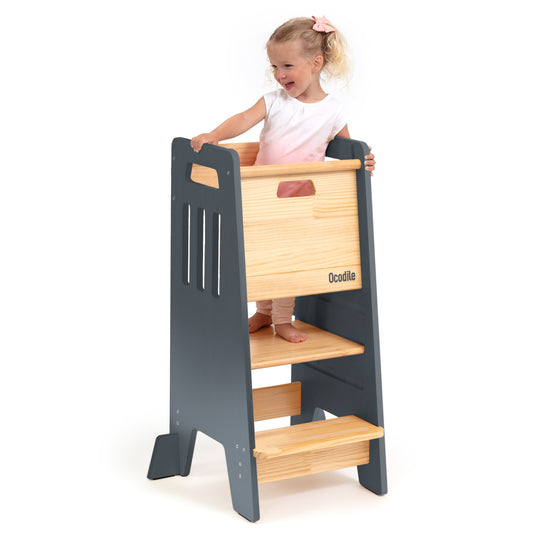
One factual example is Ocodile's foldable toddler helper tower. It gives a child a safer way to join kitchen tasks and can be tucked away in smaller homes when you need the floor back. That kind of piece often works better than relying on dining chairs or improvised stools for daily participation.
If your kitchen is the tightest room in the house, these small-space kitchen solutions offer a practical way to think through child access without overcrowding the room.
A simple filter before you buy
Use this before bringing any new furniture home.
- Can my child use it safely? Rounded edges, stable base, non-toxic finishes, no awkward climbing required.
- Will it still help in a year or two? If not, borrow it, buy second-hand, or skip it.
- Does it replace another item? New additions should solve a problem, not create a storage problem.
- Can I clean around it fast? If the answer is no, you'll resent it.
The right piece of furniture should make your day easier when you're tired, distracted, and carrying a plate in one hand.
Small-space homes usually feel better with fewer, smarter pieces. Not tiny furniture for the sake of tiny furniture. Just objects that respect the room they're in.
A Storage Strategy That Fosters Independence
Clutter feels heavier when children can't participate in managing it. If every toy, coat, cup, and book depends on an adult to reach, sort, or put away, the home starts to feel crowded even when it isn't technically full.
A better storage plan does three things at once. It lowers visual noise, uses height intelligently, and gives children access to the items they use every day.

A useful benchmark backs this up. A 2024 Houzz report found that 62% of small-space homeowners report 25-35% higher satisfaction after implementing vertical storage and multi-functional furniture, which can collectively reclaim up to 50% of lost floor space (small-space storage findings).
Layer one, rotate more than you display
Children don't need every toy out at once. In fact, many families find the opposite works better. Fewer visible options can make play calmer and cleanup faster.
Try a simple toy library approach:
- Keep a small active set out: a few baskets, puzzles, books, or building materials
- Store the rest out of sight: upper shelves, lidded bins, under-bed storage
- Swap items periodically: enough to refresh interest without flooding the room
This isn't about deprivation. It's about reducing the amount of visual information competing for attention.
Layer two, put adult storage above eye level
Small homes waste a lot of wall height. The trick is to use high storage for things children don't need daily, while keeping lower zones open and calm.
Think:
- seasonal clothes
- backup toiletries
- paperwork
- out-of-rotation toys
- spare bedding
Bathroom storage is often the first place families run out of room. If that's your sticking point, these ideas for maximise space in small bathrooms can help you reclaim awkward corners and narrow walls.
Layer three, give children ownership of daily items
This is the part most adult-focused guides skip. Your child should be able to reach the items they use often, and just as vital, return them.
A few high-impact examples:
- low hooks for jackets and small bags
- a tray or basket for shoes by the door
- front-facing book storage
- open low shelves for a small number of toys
- a reachable cup or snack area where appropriate
For toy zones, these toy storage organisers can help you think in categories rather than random bins.
Storage works best when it answers two questions. Where does this live, and who can put it back?
When children can take part in tidying, storage stops being only about containment. It becomes part of how the home teaches independence.
Carve Out Kid-Friendly Zones In Plain Sight
Children don't need to disappear into a separate playroom to have space of their own. In a small home, that separation usually isn't possible anyway. The better approach is to create visible, integrated zones inside the rooms the family already uses most.
That keeps the home connected. It also helps children understand where activities belong without making them feel pushed to the edges of family life.

The reading corner that doesn't take over the lounge
One of the easiest zones to build is a reading nook. It doesn't require a separate room. A living room corner can do the job.
Use a soft rug or floor cushion, a small forward-facing bookshelf, and a lamp or nearby natural light. Keep the selection limited. Too many books piled in baskets can make the corner feel messy instead of inviting.
What tends to work:
- one seat or floor cushion
- a handful of books facing outward
- one basket for soft toys or blankets
- a visual boundary such as a rug
What usually doesn't work:
- deep toy storage in the same corner
- mixed-purpose dumping zones
- oversized furniture that blocks the sightline from the sofa or kitchen
A child reads longer in a corner that feels settled. You'll also use it more if you can supervise from nearby without hovering.
A self-care station by the door
The second zone that changes daily life is an entry setup that belongs partly to your child. In this setup, independence becomes visible.
A small low mirror, reachable hooks, a narrow shoe spot, and a stable step stool can turn the front door area from a bottleneck into a routine station. Children start to connect the sequence. Shoes off. Jacket on hook. Hat in basket. Check face or hands. Leave the house.
Here's a simple comparison:
| Zone element | Helpful choice | Unhelpful choice |
|---|---|---|
| Mirror | mounted low and secure | loose standing mirror |
| Jacket storage | low hooks | high rail only adults can reach |
| Shoes | open tray or basket | deep cupboard with stacked items |
| Support | stable step stool | dining chair dragged from another room |
A child-friendly zone should be close enough to family activity that it gets used without a reminder.
The best part about these zones is that they don't need much square footage. They need clarity. A child can feel included, capable, and calm in a very small footprint if the room acknowledges their scale.
Simple Illusions Smart Hacks for a Bigger Feel
At 7:10 on a weekday morning, a small living room has to do a lot. One child is building on the floor, another is looking for shoes, and an adult is trying to clear breakfast dishes without stepping around visual clutter. In that kind of room, the best design tricks are the ones that make the space feel calmer while still standing up to real family use.
For families, a bigger feel comes from better sightlines, better light, and fewer visual interruptions. A room can look open and still work hard. It just needs choices that hold up to sticky hands, toy rotation, and the fact that young children use every surface at their height.
Use light and corners properly
Corners are often wasted in family homes, yet they can carry a surprising amount of function when they are planned carefully. A slim corner shelf for books, a small lamp, or a contained basket keeps storage off the main path and leaves the center of the room easier to use. Interior designers often point to corners as one of the simplest ways to add storage without making a room feel crowded.
Wall colour matters too, but durability matters just as much. Light colours usually help a room feel more open because they reflect natural light, but in a home with young children, the better choice is often a washable finish in a warm white, soft greige, or muted beige rather than a flat bright white that shows every mark. The room feels lighter, and parents are not repainting every year.
If you're exploring broader ideas around maximizing square footage in home designs, it helps to look at light, built-ins, and circulation as one system.
Small changes that help a room breathe
These are the adjustments I come back to most often in compact family homes:
- Choose light, washable wall colours: soft neutrals and warm pale tones reflect light and forgive everyday mess better than stark white.
- Mount what you can safely mount: wall lights, shelves, hooks, and televisions free floor space and make cleaning simpler.
- Use furniture with visible legs where possible: more visible floor usually makes a room feel less boxed in.
- Hang window treatments high and keep them simple: this draws the eye up and lets in more daylight while still protecting privacy.
- Add one secured mirror in a useful spot: it should catch light or reflect a window, not double the look of toy clutter.
- Keep large surfaces visually quiet: one clear coffee table or one calm section of countertop does more for the sense of space than extra decor ever will.
One trade-off is worth stating plainly. Open, airy rooms photograph well, but families still need enough enclosed storage to keep daily life from spilling into every corner. A small home feels bigger when fewer items are visible, even if the total amount stored stays the same.
What to skip
Some common small-space advice creates more work in homes with young children.
- Too many tiny decor items: they turn into dust-catching obstacles fast.
- Open shelving across every wall: it can look busy within a day unless the contents are tightly edited.
- Heavy dark curtains: they absorb light and make daytime rooms feel smaller.
- Furniture packed against every wall: a little breathing room often improves the layout more than pushing everything outward.
- Large mirrors placed low in high-traffic areas: they add maintenance and safety concerns if they are within reach of rough play.
A good rule is simple. If a space-saving idea makes supervision harder, cleaning slower, or the room less safe for a child who wants to participate independently, it is the wrong trick for a family home.
How to maximize small spaces well comes down to this. Make the room easier to live in, then make it look larger.
If you're trying to make a small home work better for real family life, Ocodile offers child-focused furniture designed for safe participation and independent routines. Their range includes pieces such as standing towers, floor beds, and step stools that can fit naturally into a home planned around both parents and young children.