



Confidence for Kiddos in the Kitchen 2026
Dinner usually starts the same way. You’re at the counter trying to chop onions before the pan gets too hot, and a small voice says, “Can I help?” A minute later, that child is dragging over a chair, reaching for the bowl, or wrapping themselves around your leg while you’re carrying something hot.
That moment feels inconvenient, but it’s often the opening parents are looking for. Kids want in because the kitchen is active, sensory, and real. They get to touch, pour, stir, smell, and see something useful happen because of their hands.
The challenge isn’t deciding whether kiddos in the kitchen is a good idea. It’s figuring out how to make it safe enough, calm enough, and practical enough that you’ll do it on an ordinary Tuesday. That’s where most advice falls short. It tells you what children can do, but not how to build a kitchen setup that lets them do it well.
Why Welcoming Kiddos in the Kitchen Matters
A child who asks to help with dinner is asking for a place in the work of family life.
That invitation is worth taking seriously. In the kitchen, children can see cause and effect in real time. They rinse grapes, and grapes are ready for the table. They stir muffin batter, and muffins come out of the oven. That kind of visible contribution builds confidence faster than a lot of parent-child activities because the result is concrete and shared.
Food habits start with participation
Children are often more open to tasting food they helped prepare. Researchers at the Nestlé Research Center found that children who took part in making a meal ate more of it, including more salad and chicken, than children who did not help (Nestlé Research Center study on child meal preparation and eating).
I see the same pattern at home and in family support work. A child may reject spinach on the plate, then happily sample it after tearing the leaves, spinning them dry, and adding dressing. Participation lowers resistance because the food is no longer unfamiliar. It is something they made.
A simple rule helps here. Give the job before the bite.
Development happens in the ordinary jobs
Kitchen tasks build hand control, sequencing, attention, and patience. They also teach children how to stay with a task from start to finish, which is harder than many adults remember. Washing produce, cracking eggs, peeling clementines, and transferring chopped ingredients all ask for focus without feeling like a lesson.
The trade-off is real. Kids learn best by doing, but they do not do well when they are stretched on tiptoe, gripping a slippery bowl, or working from an unstable chair. Independence in the kitchen is not just about assigning age-appropriate tasks. It depends on whether the space fits the child well enough for those tasks to be safe and repeatable.
That is why setup matters so much. Families who want more capable kitchen helpers usually need more than a list of chores. They need a child-height approach to access, reach, and supervision. A thoughtful Montessori kitchen setup for young children can make simple jobs possible without turning every meal into a rescue mission.
Independence grows from good conditions
Children do better when the environment gives them a fair shot. Stable footing, a defined workspace, and tools that match their size reduce the constant adult corrections that wear everyone out.
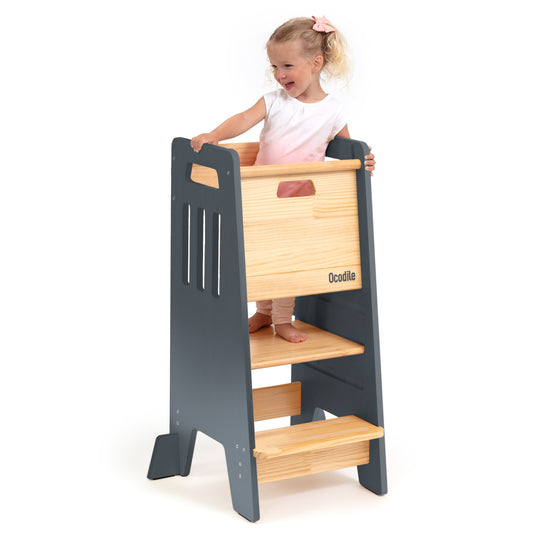
In practice, that means a child can focus on pouring, mixing, or spreading instead of worrying about balance. It also means the adult can coach instead of hovering over every movement. Standing towers help with that because they bring a child to counter height with more stability than a dining chair or a light step stool. The goal is not early independence at any cost. The goal is safe participation that a family can keep doing on a busy weeknight.
One more benefit gets overlooked. When children help prepare food, cleanup becomes part of the routine instead of a separate battle. Keeping a few supplies nearby, including child-safe cleaning products, makes it easier to teach wiping spills, washing surfaces, and leaving the space ready for the next meal.
Setting Up a Safe and Enabling Kitchen Space
A child-friendly kitchen shouldn’t feel like a hazard zone with a few activities squeezed in. It should feel like a yes space. That means you’ve already decided where your child can stand, what they can touch, and which tasks are in bounds.

Start with location, not tools
Pick one work zone first. Don’t place it in the busiest traffic lane near the oven door or where adults pivot with hot pots.
A good kid station usually has:
- Counter access: Enough height for mixing, rinsing, or arranging ingredients
- Open floor space: Room for an adult to stand close without crowding
- Distance from heat: Away from active burners, the oven door, and pan handles
- Simple sightlines: You should be able to see the child’s hands clearly
If your kitchen is small, the zone can still work. One stretch of counter, one side of the sink, or even a movable prep area is enough.
Build around stable access
Regarding access, many families make life harder than it needs to be. A chair can slide. A light step stool can tip when a child leans sideways to reach a bowl.
A standing tower or kitchen helper gives a child a more stable base at counter height. Ocodile’s standing towers are one example of furniture designed for this purpose, helping children stand securely alongside adults while they wash produce, stir ingredients, or help with prep. If you want ideas for layout, this guide to a Montessori kitchen setup is useful for thinking through reach, storage, and workflow.
A safe setup reduces the number of times you have to say “stop reaching” and increases the number of times you can say “your turn.”
Set boundaries before cooking starts
A 2026 study found that children identify fewer than 50% of injury-risk behaviors in the kitchen, while parents significantly overestimate their child’s safety awareness (PubMed summary of the 2026 children’s kitchen safety study). That gap matters. It means you can’t assume a child notices what’s risky just because they seem confident.
Use a short pre-cooking routine:
- Feet first: Child gets into their tower or station before tools appear.
- Hands checked: Clean hands, sleeves pushed back, hair secured if needed.
- Boundary reminder: “This counter is your space. The stove is my space.”
- Tool rule: One tool out at a time.
- Cleanup cloth ready: Keep a towel or sponge within reach from the start.
Remove hidden friction
The smoother the environment, the calmer the session.
Check these basics:
- Sharp storage: Knives, graters, peelers, and scissors stay out of reach until introduced
- Cord control: Move appliance cords away from the edge
- Breakables: Clear unnecessary glassware and heavy ceramics
- Floor safety: Wipe spills fast so the standing area stays dry
- Cleaning supplies: Keep kid-appropriate options available for quick wipe-downs
For families reviewing safer household options, this roundup of child-safe cleaning products can help you choose what to keep nearby for post-cooking cleanup.
Keep the setup visually simple
Children focus better when the station isn’t crowded. Put out the bowl, the spoon, and the ingredient they need now. Don’t place every ingredient in front of a toddler and expect restraint.
That small adjustment changes everything. Less grabbing. Less spilling. More actual learning.
A Guide to Kitchen Tasks by Age Group
A three-year-old standing safely at counter height can rinse strawberries for ten focused minutes. The same child, placed too low to see or asked to wait through a long recipe, is usually done in ninety seconds. Age matters, but setup matters just as much.
That is the gap many kitchen guides miss. They list tasks by birthday and stop there. In real family kitchens, children succeed when the job fits their development and the environment lets them do it with some independence. A standing tower, a stable bowl, pre-portioned ingredients, and one clear instruction often make the difference between helpful participation and chaos.
A practical rule has served my family well. Give children real work with a low cost for mistakes. Washing berries, tearing lettuce, stirring yogurt, and transferring chopped vegetables all count. They build skill because the task is genuine, and dinner survives if the work is uneven.

Toddlers ages 2 to 3
Toddlers do best with short, physical jobs they can repeat. They want to pour, move, drop, stir, and carry. Precision comes later.
Good jobs include:
- Rinsing produce
- Tearing lettuce or soft herbs
- Stirring cool ingredients in a wide bowl
- Transferring cut items from board to bowl
- Sprinkling cheese, oats, or herbs
- Handing over ingredients one at a time
The trade-off at this age is speed versus participation. A toddler can help, but the task needs to be set up for success. Use small amounts, heavier bowls that do not slide, and ingredients that are safe to touch and taste. Counter height matters too. A secure helper tower gives toddlers a stable place to work with both hands free, which is far more useful than balancing on a chair and reaching.
Preschoolers ages 4 to 5
Preschoolers usually want ownership. They can follow a short sequence, remember a rule, and handle simple tools with close supervision.
Try:
- Measuring pre-portioned dry ingredients
- Mashing bananas, avocado, or cooked potatoes
- Spreading soft toppings like hummus, cream cheese, or butter
- Cracking eggs into a separate bowl
- Peeling clementines or hard-boiled eggs
- Using a child-safe knife on soft foods like strawberries, bananas, or mushrooms
This is a strong age for visual structure. Put ingredients in the order they will be used. Mark a fill line on a cup. Offer one knife, one cutting board, and one bowl instead of a crowded station. Children this age often stay regulated when the task has a visible finish line.
For families comparing setups, this overview of a child’s kitchen helper can help you choose support that fits your child’s size, confidence, and daily routines.
Early grade-schoolers ages 6 to 8 and beyond
Children in this group can handle more responsibility, but that does not mean they are ready for full independence. They still need an adult nearby for sharp tools, heat, and timing.
Useful jobs include:
- Reading simple recipe steps aloud
- Measuring liquids and dry ingredients with light correction
- Cracking and whisking eggs
- Peeling soft vegetables
- Cutting soft foods with a beginner knife
- Mixing dough or batter
- Assembling simple snacks, lunches, or salads
- Following a short recipe with support
Children this age also benefit from recipes that produce a clear result quickly. If you want ideas that match their attention span, 10 fun recipes to make with kids offers options that work well for practice.
Parents often notice the same pattern I have seen at home. Children are more willing to taste food they helped prepare. That interest grows when the task felt manageable instead of stressful.
Quick reference table
| Age Group | Lower-risk tasks | Closer-supervision tasks | Skills developed |
|---|---|---|---|
| 2 to 3 years | Washing produce, tearing greens, stirring cool mixtures, transferring ingredients | Sprinkling near active prep, brief utensil use with hand-over-hand help | Fine motor control, sensory tolerance, sequencing, vocabulary |
| 4 to 5 years | Measuring pre-portioned ingredients, mashing, spreading, sorting ingredients | Cracking eggs, simple peeling, child-safe knife work on soft foods | Hand strength, early math, bilateral coordination, patience |
| 6 to 8 plus | Reading recipe steps, mixing, assembling snacks, gathering ingredients | Beginner knife work, supervised heat exposure, more independent prep | Planning, confidence, task completion, food literacy |
What usually doesn’t work
Some jobs create more frustration than learning.
Hold off on:
- Long waiting tasks, like proofing dough or recipes with several idle stages
- Very delicate work, like neat frosting or tiny decorative details
- Too many choices at once, especially for younger children
- Adult-paced expectations, where the child is expected to keep up with a rushed dinner timeline
Children do not need to complete a whole recipe to belong in the kitchen. One meaningful task, done safely and with the right setup, is enough.
From Supervisor to Mentor Teaching Kitchen Skills
Many parents start out hovering. That’s normal. The trouble starts when every movement gets corrected before the child can even try.
A better approach is mentorship. You stay close, but you teach with structure instead of constant interruption.

Say less, model more
Children learn kitchen skills best when they can watch a motion, copy it, and repeat it. Demonstrate first. Then hand over the tool.
Instead of saying, “No, not like that,” try:
- “Watch my hands first.”
- “Hold the bowl with one hand, stir with the other.”
- “Slow circles work better than fast ones.”
That style keeps the child engaged. It also preserves dignity, which matters if you want them to try again tomorrow.
Praise the process you want repeated
Generic praise fades quickly. Specific feedback teaches.
Use observations like:
- “You kept your fingers back while you spread that.”
- “You noticed the spill and reached for the towel.”
- “You waited until I finished pouring. That was careful.”
This mirrors what works in structured cooking education. The Kids in the Kitchen curriculum uses structured, behaviorally focused activities and repeated exposure, and it shows significant improvements in children’s healthy eating, food safety practices, and reduced intake of sweetened beverages (Kids in the Kitchen curriculum evaluation).
Treat mistakes as part of the lesson
The fastest way to shut down confidence is to react to spills like disasters.
If flour hits the floor, keep it factual. “The flour spilled. Bring the small broom.” If an egg shell drops into the bowl, say, “Let’s fish it out together.” That teaches recovery, not shame.
“Calm adults raise capable helpers.”
Scaffolding helps here. You give enough support for the child to succeed, then gradually step back as skill grows. If that term is new, this explanation of what is scaffolding in child development applies well to kitchen learning.
Choose recipes that match the teaching goal
Not every recipe is a teaching recipe. If you want to practice measuring, choose muffins, pancakes, or a simple quick bread. If you want to work on spreading, make toast, flatbread, or snack plates.
When you need fresh ideas that suit mixed ages, this list of 10 fun recipes to make with kids is handy because it gives you easy starting points without making the activity feel complicated.
A short visual demo can also help if your child learns best by watching.
Making Cleanup Part of the Fun
Cleanup decides whether kitchen help feels sustainable. If the cooking part is warm and collaborative but the aftermath feels punishing, children quickly learn to disappear when the last bite is served.
A better frame is simple. Cleanup is the final part of the job.
Give cleanup the same structure as cooking
Children do better when cleanup has visible tasks and a predictable order.
A simple sequence works well:
- Food away: Leftovers into containers, scraps into compost or trash
- Tools together: Bowls, spoons, and measuring cups to the sink or dishwasher area
- Wipe zone: Counter, tray, or table gets wiped
- Floor check: Sweep obvious crumbs
- Hands washed: End the activity clean
That sequence turns chaos into closure.
Match the job to the age
Toddlers can wipe a low surface, carry napkins to the table, or place silicone utensils in a bin. Preschoolers can spray water on the counter and wipe it dry, sort measuring spoons, or carry unbreakable dishes. Older children can scrape plates, load easy dishwasher items, and help sweep under their work area.
What matters is ownership. A child doesn’t need the whole cleanup. They need a real piece of it.
Kitchen habit: Don’t introduce cleanup as a punishment for making a mess. Introduce it as the respectful way to finish useful work.
Make it playful without making it fake
A short cleanup song helps. So does a race to find “three crumbs hiding on the counter.” Some children love using a small spray bottle of water to “paint-clean” a surface.
Keep the tone light, but keep the expectation real. If cleanup always gets skipped when adults get tired, children learn that the work only counts when it’s fun. The stronger lesson is that every family activity has an opening, a middle, and an end.
That rhythm is one reason kiddos in the kitchen can become a lasting family practice instead of a once-a-month project.
The Lifelong Benefits of Your Kitchen Adventures
Years later, the payoff often shows up in ordinary moments. A teenager makes eggs before school without asking for help. A college student can turn basic ingredients into dinner instead of relying on takeout. An adult feels at ease around food because the kitchen was a place to practice, not a place to be shooed away from.
Research on cooking skills and eating habits points in that direction, but the day-to-day pattern matters just as much. Children who spend real time helping in the kitchen tend to gain familiarity with ingredients, confidence with useful work, and a stronger sense that meals are something they can take part in, not just consume.
What lasts is bigger than recipe knowledge.
Children carry forward:
- Food familiarity: Whole foods look normal, not strange or intimidating
- Kitchen judgment: They begin to understand heat, tools, timing, and sequence
- Work stamina: They learn that useful tasks have a beginning, a middle, and an end
- Confidence through contribution: They can help in a real way and see the result
- Family connection: Food becomes tied to belonging, memory, and shared responsibility
I’ve seen this most clearly with children who were given genuine access early. A stable standing tower, one defined workspace, and tools sized for small hands can change the experience from “watch from over there” to “help from right here.” That shift matters. It gives children a safe way to repeat skills often enough that they become habits.
Independence does not appear all at once. It grows from dozens of small jobs done with support, then less support, then none.
That is the long-term value of welcoming kiddos in the kitchen. You are not only getting help with muffins or salad. You are raising a child who knows how to join family work, handle food with growing competence, and trust their own ability to learn practical skills.
Your Kitchen Helper Questions Answered
When should kids start using knives
Start with soft foods and a child-safe knife under close supervision. Watch grip, hand placement, and pace before increasing difficulty. Don’t treat knife use like a milestone to achieve early. Treat it like a skill to earn gradually.
What if my kitchen is tiny
Use one defined station instead of trying to make the whole kitchen child-friendly. A small stretch of counter, a stable helper, a bowl, and one task are enough. Small kitchens often work better because boundaries are easier to see.
What if my child loses interest after two minutes
That’s common, especially with younger children. Give very short jobs with a visible finish. Wash the grapes. Stir ten times. Sprinkle the cheese. Stop while it still feels successful.
What if my child is picky and won’t taste what they make
Keep participation separate from pressure. Let them wash, stir, arrange, and serve without requiring a bite. Interest usually grows faster when tasting stays low-pressure.
How do I cook dinner and supervise safely at the same time
Choose low-risk helper tasks on busy nights. Save new tools and more demanding jobs for calmer moments. If heat, rushing, and multitasking are all high, simplify. The safest kitchen session is the one you can stay present for.
Do I need special furniture
You need stable access, clear footing, and a setup that keeps a child at working height without wobbling or overreaching. Whatever tool you use should support those basics consistently.
If you’re ready to make kiddos in the kitchen feel practical instead of chaotic, explore Ocodile for child-focused furniture designed to support safe, everyday independence at home.