



Your Outside Mud Kitchen: A Parent's Guide to Building Fun
Your child is already doing the research for you. They're scooping dirt with a spoon, filling a bucket from the hose, lining up stones like cupcakes, and turning a corner of your yard into a pretend café. An outside mud kitchen takes that instinct and gives it a home.
What makes it worth the effort is that it does more than entertain. It gives children a place to mix, pour, sort, stir, and experiment without needing constant adult direction. That kind of play supports sensory exploration, hand control, problem-solving, and confidence. It also keeps the mess outdoors, which many parents appreciate just as much as the developmental value.
A good mud kitchen doesn't need to look fancy. It needs to be sturdy, well placed, easy to clean, and inviting enough that your child returns to it again and again.
The Magic of Mud Awaiting in Your Backyard
Outdoor mud kitchens grew out of the familiar indoor pretend kitchen, only moved into the garden where children can use mud, water, leaves, twigs, and utensils in open-ended role play. That simple shift matters. Outside, the materials are less scripted, the mess is more acceptable, and the play usually lasts longer.
Children don't need much encouragement to start. Give them a bowl, a spoon, water, and a patch of soil, and they'll invent soups, potions, pies, and deliveries. The mud kitchen turns that urge into a dedicated learning station.
What I like most is the balance. Children get freedom, but the activity has a clear place and a workable boundary. If you're also exploring natural play ideas for everyday outdoor learning, a mud kitchen fits beautifully because it connects sensory play, independence, and nature in one setup.
Mud play looks chaotic from a distance, but in practice it often leads to focused, absorbed work.
Planning Your Perfect Mud Kitchen
A mud kitchen works best when you plan it like a real outdoor station, not as leftover furniture pushed against a fence. Placement affects how often children use it, how messy it gets, and how much maintenance it needs.

Start with location
The first decision is where the kitchen will live. Close to the house usually wins. If it's too far from the back door, hose, or your line of sight, children tend to use it less and you'll enjoy it less too.
Check these points before you commit:
- Water access matters: A nearby hose, outdoor tap, or easy-to-carry watering can makes daily use much simpler.
- Partial shade helps: Full sun dries mud fast, heats metal tools, and can make the station uncomfortable.
- Ground conditions count: Soft soil gets muddy fast. Decking stays cleaner but may need a splash mat.
- Visibility reduces friction: If you can see the mud kitchen from a window or seating area, supervision feels easier.
If you're already thinking more broadly about outdoor zones, the way outdoor design professionals plan your Arizona outdoor kitchen can be surprisingly useful as a reference for traffic flow, sun exposure, and practical placement. The scale is different, but the planning logic is similar.
Size it for real use
Many parents go too big too early. Children usually need one work surface, one basin, and a few tools. More storage, more shelves, and more accessories can come later.
A quick planning framework helps:
| Priority | Keep it simple | Expand later |
|---|---|---|
| Space | One counter and one tub | Add shelf, hooks, or second basin |
| Water | Watering can or small container | Hose-fed setup or refill station |
| Storage | Crate or basket | Wall hooks and weather-safe bins |
| Seating | None needed | Stump seat or nearby bench |
Plan for long-term use
Mud kitchens aren't just toddler props. Montessori-inspired descriptions note that these spaces are typically used by children ages 1 to 7, and can support children well into primary school ages 5 to 8, with some 9- to 11-year-olds also participating, which shows they remain useful across multiple developmental stages according to Angi's overview of mud kitchens.
That long age range changes how I'd plan one. Build or buy with enough sturdiness for years, but keep the accessories flexible. Toddlers may only pour and scoop. Older children add menus, measurements, pretend shops, and more elaborate recipes.
Practical rule: Choose the location first, then the structure. Parents often do the reverse and regret it.
Choosing Your Path Build, Upcycle, or Buy
There isn't one right way to get an outside mud kitchen. The best route depends on your tools, budget, patience, and tolerance for imperfect projects. I've seen families succeed with all three.

Build if you want control
Building from scratch gives you the most freedom. You can set the height, add a real backsplash, fit a basin you already own, and make the storage match your child's age.
This path works well if you:
- already own basic tools
- can cut and assemble lumber accurately
- care about getting drainage and stability right
- don't mind spending time on sanding and sealing
The upside is customization. The downside is that small mistakes matter outdoors. A counter that isn't level, joints that trap water, or hardware that rusts will show up fast in real weather.
Upcycle if you enjoy problem-solving
Upcycling is often the most charming option. An old potting bench, changing table, sideboard, pallet setup, or low shelf can all become a mud kitchen with a basin and a few hooks.
What works well:
- old furniture with a sturdy frame
- pieces that already have shelves
- simple structures you can reinforce
What usually doesn't:
- flimsy pressed-board furniture
- anything swollen from prior water damage
- unstable pieces with narrow legs
Upcycling saves money and reduces waste, but it asks you to inspect materials carefully. Some pieces look solid indoors and fail quickly outside.
Buy if you want speed and predictability
Buying makes sense when you want a ready-made base and fewer unknowns. You can still modify it with real utensils, extra bins, a better water container, or a more useful layout.
Pre-made models are easiest for:
- busy households
- childcare settings
- grandparents creating a play zone
- families who want a cleaner visual finish
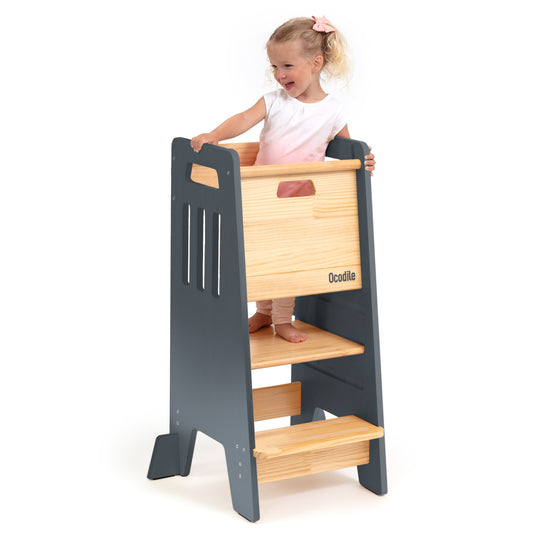
Some families also borrow ideas from indoor independence tools when planning outdoor stations. For example, an Ocodile foldable kitchen tower is designed for toddler kitchen interaction indoors, and while it isn't a mud kitchen, it reflects the same child-height, independence-first thinking that helps when choosing outdoor play furniture.
The trade-off that matters most
There's a real design tension in this category. The goal is open-ended nature play, but the object itself also has to function as safe, durable outdoor furniture. Parents need to think about stability, weather-resistant materials, drainage, and anchoring, especially as mud kitchens move from DIY novelty into more purpose-built outdoor equipment, as discussed in this coverage of mud kitchen design trade-offs.
That means the cheapest option isn't always the best value. A wobbly setup kills confidence fast. Children lean, climb, push, and drag tools across the surface. If the kitchen shifts under their hands, play changes from independent to high-risk supervision.
A simple decision guide
- Choose build if you want a long-term station designed for your space.
- Choose upcycle if you're budget-conscious and can reinforce what you find.
- Choose buy if you want convenience and a quicker path to use.
A mud kitchen doesn't need to be elaborate. It needs to survive weather, hold up under child use, and be easy to reset after messy play.
Gathering Your Essential Materials and Tools
Material choice decides whether your mud kitchen becomes a lasting fixture or a one-season project. Outdoors, water is the primary test. Mud itself isn't the problem. Repeated wetting, drying, pooling, and sun exposure are.
Choose wood for weather, not just looks
For durability, professional-grade mud kitchens use thermally modified wood or pressure-treated lumber, and construction guidance recommends 3-inch outdoor decking screws for primary joints plus weather-resistant stainless steel hardware to prevent corrosion. A backsplash extending 22+ inches above the work surface also helps protect structural wood from splash damage, based on guidance from Castle and Cubby's mud kitchen construction notes.
That gives parents a practical hierarchy:
- Best for long-term outdoor exposure: Thermally modified wood
- Strong and widely available: Pressure-treated lumber
- Use with caution: Untreated interior wood
- Avoid outdoors: MDF, particleboard, or laminated indoor furniture
If you're adding playful extras like water chutes or funnels, ideas from simple PVC pipe builds for kids can help you create removable features instead of drilling permanent attachments everywhere.
The parts worth buying well
Some components matter more than others. I'd spend carefully on the structure, hardware, and finish. Bowls and utensils can be thrifted.
Here's a practical shopping list:
- Framing lumber: Pick the outdoor-rated option your budget can handle.
- Deck screws: Use outdoor screws in the right length for your joints.
- Stainless steel hardware: Hinges, hooks, and fasteners corrode less and last longer.
- Basin or sink insert: Stainless bowls, heavy plastic tubs, or removable containers all work.
- Finish: Use a weather-resistant exterior finish suitable for children's furniture use.
- Sandpaper: Smooth surfaces are safer and easier to clean.
What works in the sink area
The basin should be removable if possible. That makes rinsing easier and helps with hygiene. Stainless steel bowls are durable and easy to scrub. Heavy plastic tubs are lighter and often easier for small hands, but they can discolor or crack over time.
A useful test is simple. If you can't remove, empty, and rinse the basin without annoyance, it'll become the part of the setup you avoid using.
Buy the hardware as if you're building a small outdoor bench, not a toy. That mindset leads to better decisions.
Ensuring Safety, Hygiene, and Weatherproofing
This is where many outside mud kitchen guides get too vague. Cute design ideas are easy. Day-to-day safety and cleanup are what determine whether the kitchen stays in use.

Safety starts with structure
Before you stock a single pan, check the basics:
- Sand every touch point: Counter edges, corners, shelf fronts, and handles should feel smooth.
- Test for wobble: Push from the front and both sides. If it shifts, reinforce it.
- Keep weight low: Heavy items stored low improve stability.
- Skip breakables: Metal, wood, and sturdy plastic are safer than glass.
- Watch the ground: A level surface matters. If you place the kitchen on tile or paving, make sure the area itself is secure. If you're installing or repairing a hard surface under the station, guidance on how to secure your outdoor tiles with Paving Supplies can help you think through adhesion and weather exposure.
For toddlers, supervision still matters, especially around water, small loose parts, and climbing behaviour. A well-built kitchen reduces risk. It doesn't replace adult judgment.
A mud-specific hygiene routine
A key practical question for parents is how to keep outdoor play kitchens hygienic. The most useful approach is to translate CDC-style handwashing and cleaning principles into a mud-kitchen routine for sinks, utensils, water tables, standing water, and soil handling, especially in shared environments such as preschools, as noted by Constructive Playthings' discussion of mud-kitchen hygiene gaps.
Here's the routine I recommend:
After each play session
- Empty standing water: Don't leave water sitting in basins or buckets.
- Rinse used utensils: A quick wash removes mud before it hardens.
- Wipe the main surface: Especially if children have been using shared tools.
- Sun-dry what you can: Drying helps prevent mildew and that stale smell outdoor bins can get.
Weekly or shared-setting reset
- Wash the sink insert thoroughly
- Clean frequently handled tools
- Check natural materials for mold or decay
- Replace any muddy water containers that stayed outside too long
If a child has cuts, allergies, or sensitive skin
Use extra caution with soil choice and plant add-ins. Avoid unknown plants, heavily treated soil, or materials that may irritate broken skin.
Children don't need a sterile mud kitchen. They need a managed one.
Weatherproofing through the seasons
Sun, rain, and freeze-thaw cycles wear down outdoor structures faster than active play does. Protecting the kitchen doesn't have to be complicated.
A simple seasonal approach works:
| Condition | What to do |
|---|---|
| Heavy rain | Tilt or drain removable containers, cover tools, check for pooling |
| Strong sun | Reposition if possible, inspect faded or rough surfaces |
| Cold weather | Store loose metal items if they become too cold to handle |
| Wet season | Recheck joints, screws, and finish more often |
The biggest weatherproofing mistake is ignoring drainage. If water sits anywhere in the worktop, sink area, or shelf corners, the kitchen will age quickly.
Igniting Play with Montessori-Inspired Activities
The best mud kitchens don't rely on adult entertainment. They invite children to begin. That's where Montessori-style thinking helps. Instead of directing play, you prepare the environment and let the child act on it.

A strong setup usually has three elements. Real tools, open-ended ingredients, and enough order that a child can find what they need without asking. That's why a few measuring cups, a whisk, a ladle, a strainer, and a tray often get more use than a pile of random toys.
If you already use Montessori practical life activities at home, the outside mud kitchen becomes a natural extension of that work. Pouring, transferring, sorting, scrubbing, and sequencing all appear outdoors in a freer, messier form.
Set the scene, then step back
A child doesn't need instructions for every session. A light prompt is enough.
Try these invitations:
- Potion table: Add petals, herbs, small jugs, and spoons.
- Bakery setup: Muffin tray, scoops, seed pods, and a “menu.”
- Stone wash station: Bowl of water, brush, colander, and tray.
- Soup kitchen: Ladle, pot, leaves, twigs, and pebbles.
- Mud construction area: Thicker mud, molds, and a flat tray for shaping.
What works best is restraint. Too many tools can scatter attention. A few carefully chosen items usually lead to deeper play.
Match the materials to the child
Toddlers often repeat the same action with pleasure. They pour, fill, dump, and stir. Preschoolers layer in story. They open a café, serve a sibling, or invent recipes with names. Older children often start experimenting. They compare mixtures, build channels, classify ingredients, and make the setup more systematic.
A rotating set of materials keeps interest fresh:
- From nature: leaves, petals, smooth stones, twigs, pinecones
- From the kitchen drawer: spoons, measuring cups, muffin tins, funnels
- For water play: jugs, ladles, basins, spray bottles
- For organizing: trays, baskets, labeled containers
Later in the day, when you want a fresh prompt without setting up much at all, this video offers a good visual example of child-led messy play in action.
Activities that pull in real skills
Some of the richest mud kitchen play looks like pretend play from a distance but includes real learning habits.
| Activity | What the child practices |
|---|---|
| Pouring between pitchers | Hand control and concentration |
| Washing stones or shells | Sequencing and care of materials |
| Mixing mud to different textures | Observation and cause-and-effect |
| Sorting leaves, petals, and pebbles | Classification and visual discrimination |
| Serving pretend meals | Social language and turn-taking |
Offer beautiful, usable objects in small numbers. Children often play longer when the environment feels intentional.
Frequently Asked Questions About Mud Kitchens
Is an outside mud kitchen safe for toddlers
It can be, if the setup matches the child. Keep the structure low and stable, use shallow water, avoid tiny chokeable items, and supervise closely. Smooth wood, rounded corners, and sturdy footing matter more than decorative extras.
What if I don't have a big backyard
You don't need one. A patio corner, balcony wall, deck edge, or even a compact tub-based setup can work. The key is a defined work surface, a manageable water source, and easy cleanup.
Can children use a mud kitchen in winter
Yes, if the weather is safe and the child is dressed for it. Snow, ice, and evergreen clippings can replace muddy play ingredients. Keep sessions shorter in cold conditions and store water so it doesn't sit and freeze in the structure.
How dirty should I let it get
Messy is fine. Neglected isn't. Let children mix, splash, and explore, but empty standing water, rinse tools, and reset the area regularly so the station stays appealing and low-risk.
Should I build one now or wait until my child is older
If your child already loves scooping, pouring, collecting, or pretend cooking, you can start now with a simple version. The most successful setups often begin small and improve through use.
If you're creating a home that supports independence indoors and out, Ocodile is worth a look. Their child-focused furniture is designed around safe participation in everyday family life, which fits naturally with the same thoughtful, practical approach that makes an outside mud kitchen work well.