



10 Essential Natural Play Ideas to Spark Your Child's Imagination
In a world saturated with digital distractions, fostering a genuine connection between children and the natural world has never been more vital. The instinct to explore, create, and learn through direct experience is innate in every child. Natural play isn't just about getting muddy; it's a powerful developmental tool that builds resilience, enhances sensory processing, and nurtures a lifelong appreciation for the environment.
This guide moves beyond generic advice to offer a comprehensive collection of actionable and engaging natural play ideas designed to spark curiosity and encourage independent exploration. We will explore ten distinct, enriching activities, from the quiet mindfulness of forest bathing to the creative chaos of a mud kitchen. Each idea is presented with practical tips and age-appropriate adaptations, ensuring you have everything you need to get started immediately.
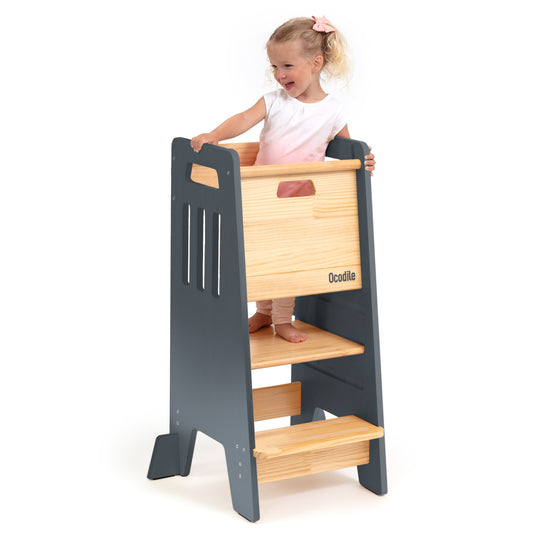
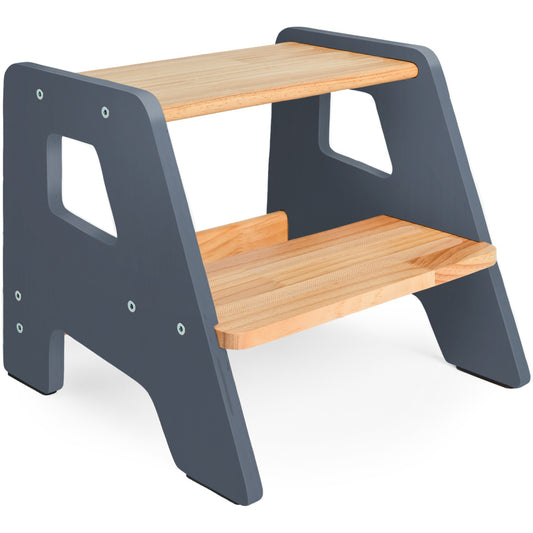
We will also highlight how thoughtfully designed tools, like Ocodile's standing towers and step stools, can empower your child to participate safely and confidently in activities like gardening or water play. To further encourage outdoor engagement and foster a natural environment for children, consider exploring some inspiring garden ideas that can transform your backyard into a haven for discovery.
Our goal is to provide a clear, practical roadmap for parents and caregivers. You will learn how to facilitate experiences that are not only fun but also crucial for cognitive, physical, and emotional growth. Let's embark on a journey to transform everyday moments into extraordinary adventures, nurturing your child's development one stick, stone, and leaf at a time.
1. Forest Bathing (Shinrin-Yoku)
Forest bathing, or Shinrin-Yoku, is a therapeutic Japanese practice centered on immersing oneself in the forest atmosphere. Unlike a destination-focused hike, this activity emphasizes slow, mindful movement and sensory engagement. It’s about being present and connecting with nature through sight, sound, smell, touch, and even taste (when safe). This practice is one of the most profound natural play ideas because it nurtures a deep, respectful relationship with the environment from a young age.
The goal is to absorb the forest’s ambiance, which research, notably by Dr. Qing Li, has shown can reduce stress, improve mood, and boost immune function. The practice has been formally adopted by the Japanese government and is gaining global recognition, with guided experiences available in national parks across Canada and forest therapy centers throughout Europe.
How to Practice Forest Bathing with Children
Getting started is simple. Find a safe, accessible patch of nature, whether it's a dense forest, a local park, or even a quiet backyard with a few trees. The key is to shift the focus from "doing" to "being."
- Slow Down the Pace: Encourage your child to walk slowly, almost aimlessly. Let them lead the way, stopping whenever something catches their interest. The journey itself is the activity.
- Engage All Five Senses: Prompt them with gentle questions. What colors do they see? What do the leaves sound like under their feet? Can they smell the damp earth or pine needles? What does the tree bark feel like?
- Encourage Quiet Observation: Find a comfortable spot to sit together in silence for a few minutes. Listen to the birds, the wind, or the rustling of small animals. This builds focus and appreciation for subtle natural wonders.
- Safe Exploration: For younger children, an Ocodile Step Stool can be a wonderful tool, allowing them to safely touch textured bark, examine leaves on a low branch, or peek into a bird's nest without being lifted.
Pro-Tip: Start with short, 20-minute sessions to match a child's attention span. Visiting the same spot throughout the year offers a beautiful, evolving lesson in seasonal changes, reinforcing the dynamic nature of the environment.
2. Mud Kitchen Play
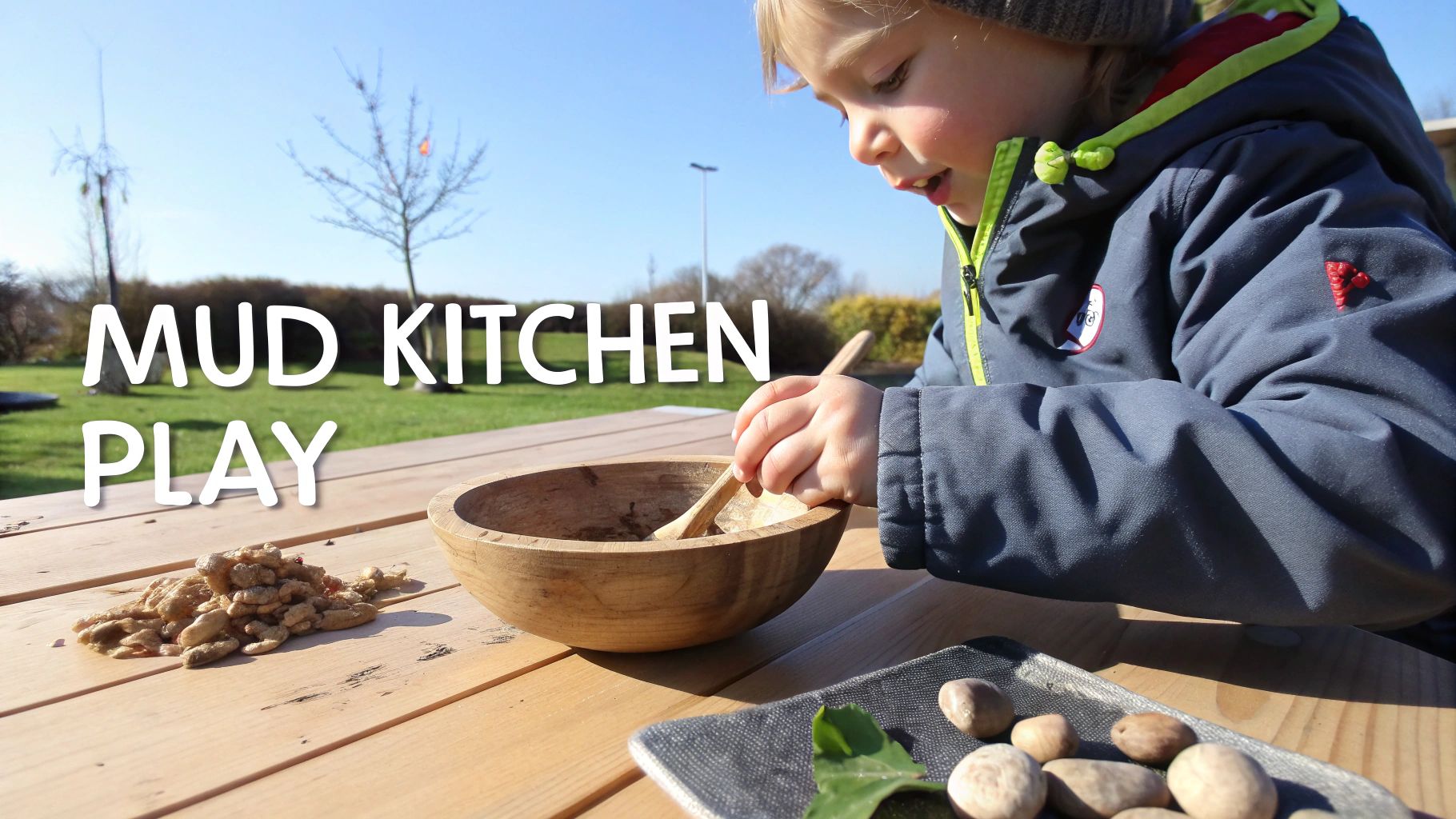
A mud kitchen is an outdoor creative station where children mix natural elements like soil, water, leaves, and twigs to concoct imaginative "dishes." It mirrors indoor kitchen play but moves the action outdoors, connecting children directly with sensory-rich materials. This activity is one of the most beloved natural play ideas because it seamlessly blends imaginative role-playing with tactile, hands-on learning, encouraging creativity and scientific curiosity.
The concept has been championed by Forest School educators across Europe and is a staple in Scandinavian outdoor childcare programs. Its popularity stems from its incredible versatility and developmental benefits, supporting everything from fine motor skills and early math concepts (measuring, counting) to complex social-emotional skills like collaboration and problem-solving.
How to Create a Mud Kitchen Experience
Setting up a mud kitchen can be as simple or elaborate as you wish. The essential ingredients are access to dirt, water, and a surface for mixing. The focus is on empowering children to lead their own play. If you are interested in creating your own, you can learn more about setting up an outdoor kids kitchen.
- Gather Loose Parts: Provide a collection of old pots, pans, spoons, and containers. Enhance the setup with natural loose parts like pebbles for "sprinkles," petals for "garnish," and sticks for "spoons."
- Establish a Safe Play Zone: Designate a specific area for mud play. Using an Ocodile Step Stool can help smaller children reach countertops or mixing bowls safely, ensuring children of different ages and heights can play together comfortably.
- Rotate Materials Seasonally: Keep the play exciting by introducing new elements with the changing seasons. Add fallen leaves and acorns in the autumn, or flower petals and fresh herbs in the spring.
- Embrace the Mess: Provide old clothes or waterproof smocks to reduce anxiety about getting dirty. This gives children the freedom to fully immerse themselves in the sensory experience without worry.
Pro-Tip: Focus on the process, not the product. Celebrate the splatters, the mixing, and the "recipes" your child creates. Documenting their creations with photos can be a wonderful way to reflect on their imaginative adventures later.
3. Loose Parts Play
Loose parts play is an open-ended, child-led approach that uses unstructured, natural, or recycled materials. Items like sticks, stones, pinecones, leaves, and fabric scraps become the building blocks for imagination, allowing children to move, combine, and design without a predetermined outcome. This concept, championed by architect Simon Nicholson, is one of the most empowering natural play ideas because it trusts the child as a capable and creative thinker.
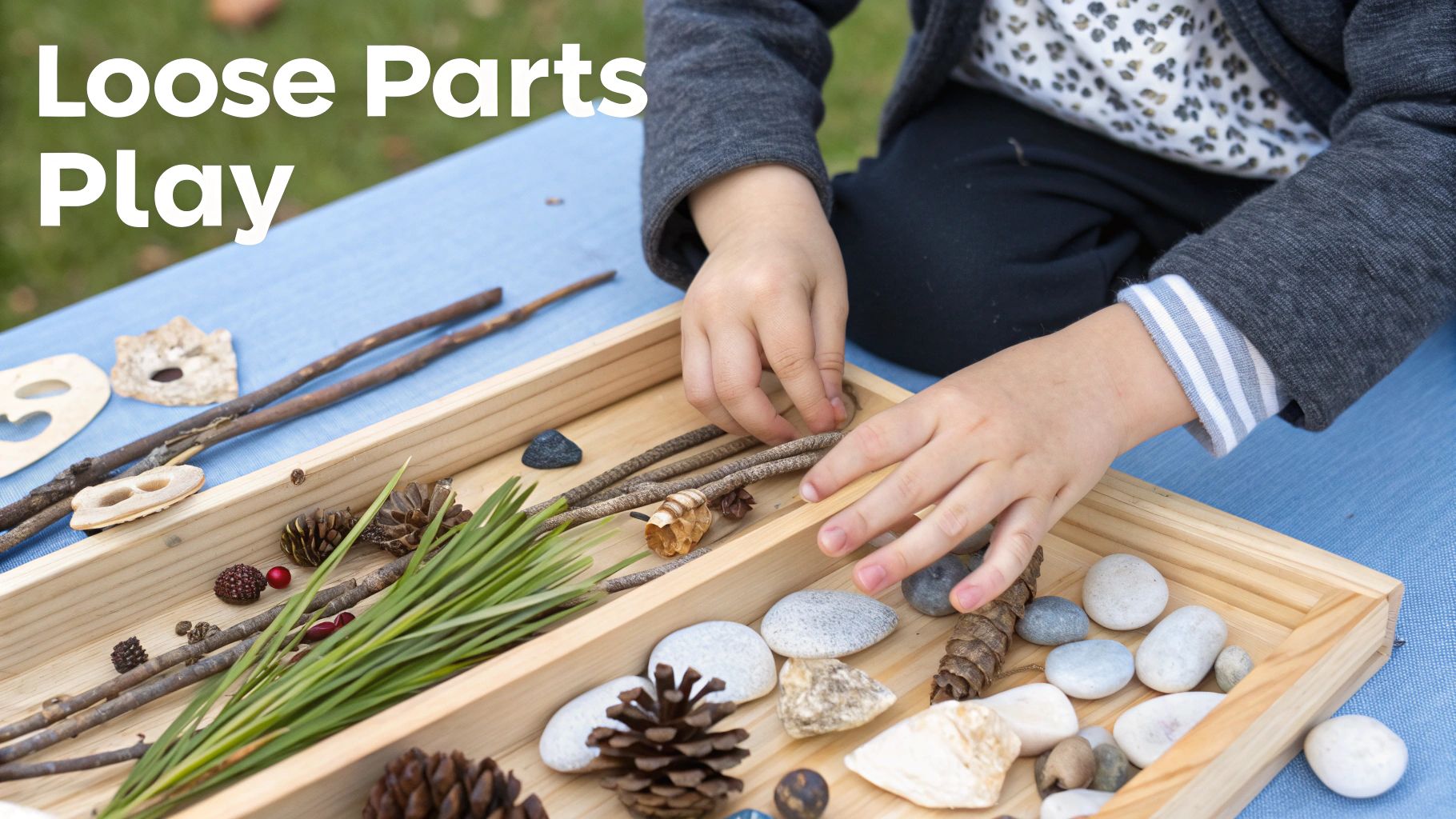
The "Theory of Loose Parts" suggests that the more variables and open-ended materials in an environment, the greater the potential for creativity and invention. This philosophy is a cornerstone of renowned educational approaches like the Reggio Emilia schools in Italy and is integral to UK Forest Schools, where nature provides the ultimate loose parts collection. The focus is on the process of discovery, not a finished product.
How to Introduce Loose Parts Play
The beauty of loose parts is its simplicity. You don't need expensive toys, just a collection of interesting, safe, and varied items. The goal is to provide the "what" and let your child decide the "how."
- Establish a Play Zone: Designate a specific indoor or outdoor area for loose parts play. This creates a predictable space for creativity and makes cleanup more manageable.
- Curate a Collection: Gather natural items like pebbles, shells, twigs, and leaves. Add recycled materials like cardboard tubes, bottle caps, and fabric scraps. Rotate items regularly to keep the collection inspiring.
- Model, Don't Direct: Show your child how a stick could be a magic wand or a stone could be a button, but avoid telling them what to build. Let their imagination lead the way.
- Accessible Storage: Use low, open shelving or baskets for storage. For smaller children, an Ocodile Step Stool is perfect for helping them safely access and tidy up their own collections on shelves, fostering a sense of responsibility and independence.
Pro-Tip: Document your child’s creations with photos. This validates their work and creates an opportunity to talk about their process later, building language and reflective skills. It shows that you value their imaginative efforts.
4. Water Play and Exploration
Water play is an elemental and deeply engaging activity that allows children to explore the properties of water in a sensory-rich environment. It involves interacting with water in various forms, from a simple basin to a natural stream, fostering scientific inquiry and imaginative scenarios. This hands-on experience is one of the most effective natural play ideas because it intuitively teaches concepts like volume, flow, cause and effect, and temperature.
The educational value of water play is championed by numerous early childhood philosophies, from Montessori's emphasis on sensory development to the curriculum-integrated stream tables found in Scandinavian forest schools. Natural water features in Japanese botanical gardens and beach school programs in coastal regions further demonstrate its global recognition as a cornerstone of developmental play. It is profoundly calming and provides a dynamic medium for learning.
How to Facilitate Water Exploration
Creating a stimulating water play environment can be done almost anywhere, from a backyard to a balcony. The focus is on providing tools and freedom for child-led discovery rather than structured lessons.
- Provide Diverse Materials: Offer a collection of tools like funnels, cups, sponges, tubes, and natural items such as stones, leaves, and flower petals. This encourages children to pour, measure, and observe how different objects interact with water.
- Establish Safety and Accessibility: Supervision is key. To ensure children can participate comfortably and independently, use an Ocodile Standing Tower at a water table or sink. This provides a stable, secure platform, allowing them to focus fully on their exploration without struggling to reach.
- Encourage Open-Ended Discovery: Let the child's curiosity guide the play. Avoid directing the activity with specific goals. Ask open questions like, "What do you think will happen if...?" or "I wonder which of these will float?"
- Integrate Natural Elements: Combine water with mud to make "potions," add sand to explore texture changes, or freeze small toys in ice blocks for a "rescue" mission. This connects the play directly to the natural world.
Pro-Tip: Rotate between warm, cool, and even colored water (using natural food dyes) to add a new sensory dimension to the experience. For indoor play, lay down waterproof mats or towels to define the play space and make cleanup manageable.
5. Nature Collections, Sorting, and Seasonal Journaling
This practice combines the joy of discovery with scientific thinking by encouraging children to gather, organize, and document natural treasures. It involves collecting fallen items like leaves, stones, and seed pods, sorting them by various attributes, and tracking environmental changes through seasonal journaling. This is one of the most engaging natural play ideas as it transforms a simple walk into a focused mission of observation and curation, fostering a deep, long-term connection to a specific place.
The approach is deeply rooted in educational philosophies like Reggio Emilia, where children's collections are honored and displayed, and the Forest School movement, which emphasizes place-based learning. By repeatedly visiting the same location, children witness the subtle and dramatic shifts of the seasons firsthand, building foundational skills in observation, classification, and scientific documentation championed by naturalists like Rachel Carson and John Muir.
How to Start a Nature Collection and Journal
The beauty of this activity lies in its simplicity and adaptability. You can start in your own backyard or a local park, gradually building a rich, personal archive of your natural world.
- Practice Sustainable Collecting: Teach children to be stewards of nature. Establish clear rules: only collect items that have already fallen, take only a few, and leave living plants and creatures undisturbed.
- Create a "Nature Museum": Designate a special shelf or area for displaying finds. Child-accessible shelves on Ocodile furniture work perfectly, allowing kids to arrange and rearrange their treasures independently. Rotate the collections seasonally to keep them relevant and engaging.
- Sort and Categorize: Provide trays or bowls and encourage sorting activities. Can they group items by color, texture, size, or shape? This simple act builds early math and science skills.
- Begin a Seasonal Journal: A simple notebook is all you need. Encourage drawing what they see, writing down observations, or even taking a photo from the same vantage point on each visit to document changes. An Ocodile Standing Tower can create a comfortable, elevated outdoor workstation for sketching and journaling.
Pro-Tip: Before heading out, review previous journal entries together. Ask predictive questions like, "What do you think the big oak tree will look like today?" This encourages critical thinking and builds excitement for observing long-term natural cycles.
6. Outdoor Gardening and Plant Care
Outdoor gardening is an immersive activity that introduces children to the full life cycle of plants, from seed to harvest. It’s far more than just digging in the dirt; it involves planning, nurturing, and developing a sense of responsibility for living things. This hands-on process is one of the most rewarding natural play ideas because it tangibly connects children to their food, ecological cycles, and the patient rhythms of nature.
The practice instills an understanding of where food comes from and fosters an appreciation for sustainable living. Initiatives like Jamie Oliver's kitchen garden projects and the widespread school gardens movement have popularized this approach, demonstrating its power to teach science, nutrition, and environmental stewardship. The goal is to empower children to become active participants in growing and caring for the world around them.
How to Practice Gardening with Children
Creating a garden space can be as simple as a few pots on a patio or as elaborate as a dedicated vegetable patch. The key is making the process accessible, engaging, and child-led.
- Start Small and Simple: Begin with easy-to-grow plants like sunflowers, lettuce, beans, or herbs to build confidence. Container gardening or raised beds are excellent for controlling soil quality and making the garden physically accessible for little ones.
- Involve Them in Every Step: Let children help choose the seeds, prepare the soil, plant, water, weed, and harvest. This complete involvement gives them a powerful sense of ownership and accomplishment.
- Establish Manageable Routines: Create a simple daily or weekly checklist for watering and weeding. An Ocodile Step Stool placed near a rain barrel or outdoor tap can provide safe, independent access for filling a small watering can, turning a routine task into a moment of empowerment.
- Connect Garden to Table: The cycle is only complete when children get to taste the fruits of their labor. Involve them in washing, preparing, and cooking the harvested produce. This often encourages even picky eaters to try new vegetables.
Pro-Tip: Document the garden's growth with photos or a simple sketchbook. This creates a visual timeline of their efforts and helps teach about seasonal changes and plant development. Celebrate both successes and failures, treating a wilted plant as a valuable learning opportunity about a plant's needs.
7. Tree Climbing and Exploration
Tree climbing is a classic childhood activity that involves safely ascending and exploring trees under appropriate supervision. It’s a powerful way for children to develop physical strength, balance, courage, and spatial awareness. This activity offers profound developmental benefits, as children learn to assess risk, manage fear, and build body confidence while feeling a unique connection to nature. Tree climbing is one of the most empowering natural play ideas, teaching self-reliance and resilience.
This approach has been systemized in various educational philosophies worldwide. Scandinavian forest schools, for example, have programs that systematically teach tree climbing, while UK Forest Schools implement strict supervision protocols to ensure safety. The value of this activity is recognized by play advocates like Tim Gill, who emphasizes its role in developing risk-assessment skills.
How to Introduce Tree Climbing Safely
The key to a positive tree climbing experience is starting small and building confidence through a supportive framework. The goal is not to reach the top, but to explore personal limits comfortably and safely.
- Start Low and Sturdy: Begin with trees that have low, strong, and easily accessible branches. Teach children how to identify a healthy tree and test a branch's strength before putting their full weight on it.
- Establish Clear Rules: Create simple, non-negotiable rules together, such as always maintaining three points of contact (two hands and one foot, or one hand and two feet), climbing down backward, and staying within a pre-agreed height limit.
- Encourage Self-Paced Progress: Allow children to decide how high they are comfortable climbing. Celebrate the attempt and the process, not just the height achieved. Resting on a low branch to observe the world from a new perspective is a success in itself.
- Provide a Safe Starting Boost: For smaller children, an Ocodile Step Stool can provide the initial height needed to reach the first branch independently, giving them a sense of ownership over the climb from the very start. Ground-based balance activities, like those practiced on a Pikler triangle, can also build foundational strength and coordination.
Pro-Tip: Integrate tree climbing into your regular outdoor time rather than making it a special, high-pressure event. This normalizes the activity and allows skills and confidence to develop organically over time.
8. Nature-Based Art and Creative Expression
Nature-based art uses materials found outdoors like leaves, stones, twigs, and mud as both the medium and the inspiration for creativity. Instead of structured crafts with a specific outcome, this activity encourages children to create temporary installations, land art, and ephemeral patterns. This process-oriented approach is a cornerstone of many natural play ideas, merging artistic development with a deep, sensory connection to the environment.
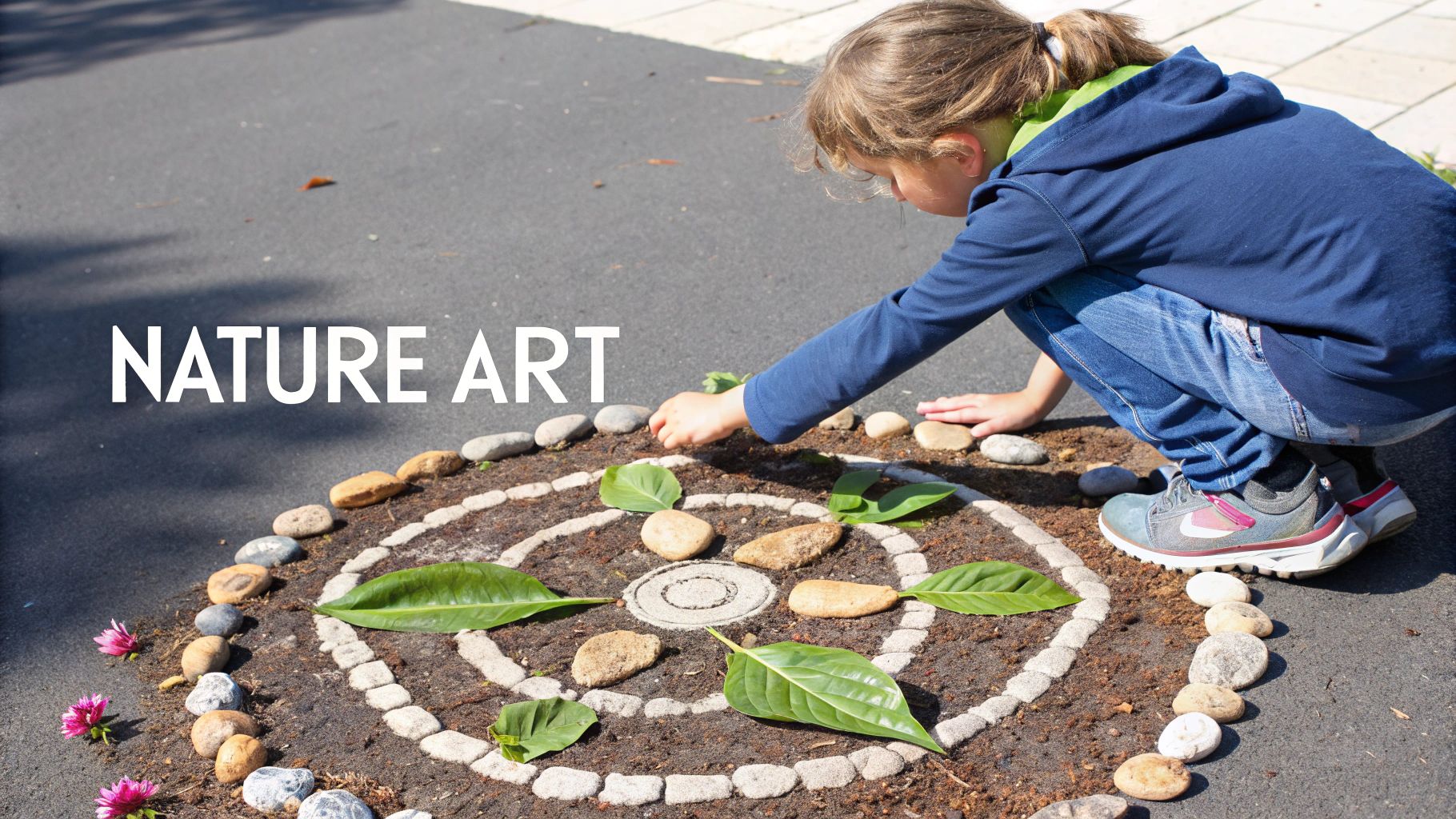
This method is famously championed by environmental artist Andy Goldsworthy and is a core component of educational philosophies like Reggio Emilia and the Forest School movement. These approaches value the child's innate curiosity and view nature as a "third teacher." By engaging in nature art, children learn about texture, color, pattern, and composition while also understanding concepts like impermanence and sustainable gathering.
How to Facilitate Nature-Based Art
The goal is to provide the opportunity and freedom for creation, not to direct it. Find a spot outdoors or bring a collection of natural treasures inside to an accessible workspace. Focus on the creative journey rather than a polished final product.
- Gather Sustainably: Teach children to collect only what has already fallen to the ground. This instills a sense of respect and stewardship for living plants and ecosystems.
- Create an Invitation to Play: Arrange natural items like petals, pebbles, and seed pods in a tray or on a mat. Add a few open-ended tools like non-toxic paint or clay to see what emerges.
- Embrace Impermanence: Much of this art, like a sand drawing or a leaf mosaic, is temporary. Take photos to document the creations, which helps children appreciate the beauty of the moment without needing to preserve the physical object.
- Provide a Stable Workspace: For indoor projects or detailed work, an Ocodile Standing Tower brings your child to counter height, giving them a dedicated and stable surface to arrange their natural treasures safely and comfortably.
Pro-Tip: Focus on sensory language during the process. Ask questions like, "What does that smooth stone feel like next to the rough bark?" or "I love the pattern you made with the light and dark leaves." This validates their exploration and builds their observational vocabulary.
9. Bug Hunting and Insect Observation
Bug hunting is a hands-on activity where children search for and observe insects in their natural habitats. Using simple tools like magnifying glasses and observation jars, children can gently examine these small creatures, learn their names, and discover their roles in the ecosystem. This practice is one of the most exciting natural play ideas as it transforms the backyard into a living laboratory, fostering scientific curiosity and respect for all life, no matter how small.
The activity combines outdoor exploration with scientific inquiry, a method championed by naturalists like John Muir and promoted by organizations such as the Audubon Society. Similar educational programs are integrated into forest school curriculums in the UK and nature-based schools in Japan, where insect observation is a key part of learning about biodiversity and ecological balance.
How to Practice Bug Hunting with Children
The goal is to encourage gentle curiosity, not capture. A successful bug hunt is about observation and discovery, emphasizing respect for the insects and their environment.
- Start with Common Critters: Begin by looking for easy-to-find insects like ants, ladybugs, or roly-polies to build confidence. Point out how they move, what they eat, and where they live.
- Use Gentle Tools: Equip your child with a magnifying glass and a clear, ventilated bug container for temporary observation. Teach them to observe gently and always release the creature back where they found it.
- Document the Findings: Encourage them to draw what they see in a nature journal or take photos. This helps develop observation skills and creates a record of their discoveries. You can create a simple identification chart together.
- Establish Ethical Guidelines: The most important rule is to be kind. Teach children to observe without harming and to handle insects with care if necessary. Always put logs and rocks back where they were found to protect microhabitats.
- Explore Different Habitats: Search under logs, on leaves, near flowers, and around outdoor lights. This teaches children that different insects live in different places and have unique needs.
Pro-Tip: To enrich your bug hunting, turn your yard into a bustling habitat. A practical guide to attracting pollinators can help you create a garden that invites bees, butterflies, and other fascinating insects for up-close observation.
10. Barefoot Walking and Sensory Ground Connection
Barefoot walking is a simple yet powerful practice of removing shoes to connect directly with the earth's varied surfaces. By walking on grass, soil, sand, or moss, children receive rich tactile feedback, stimulating nerve endings in their feet and enhancing their proprioceptive awareness. This activity is one of the most accessible natural play ideas, transforming any outdoor space into a sensory playground that builds physical strength and a mindful connection to the environment.
The practice, often called "earthing" or "grounding," is championed by advocates like Dr. Erica Barrett and foundational to many nature-based educational models. Scandinavian forest schools and German waldkindergartens often incorporate barefoot paths as standard, recognizing that direct contact with the ground develops stronger, more agile feet and a calmer nervous system. It encourages children to slow down and notice subtle details, like the coolness of damp soil or the texture of dry leaves.
How to Practice Barefoot Walking with Children
Creating a safe and enjoyable barefoot experience is key to unlocking its benefits. Start in a familiar, controlled environment and gradually introduce new textures as your child becomes more comfortable.
- Create a Safe Zone: Designate a specific "barefoot friendly" area in your yard or a local park that you have thoroughly inspected for sharp objects like rocks, glass, or thorns.
- Start Slow and Short: Begin with short 5-10 minute sessions on soft, friendly surfaces like grass or sand to allow their feet to adapt. Gradually increase the duration and introduce more complex textures like smooth stones or crunchy leaves.
- Talk About Textures: Engage their senses by asking questions. Is the grass cool or warm? Is the mud squishy? What does the moss feel like? This builds vocabulary and deepens their observational skills.
- Establish a Clean-Up Routine: Transitioning back indoors is a great opportunity for independence. An Ocodile Step Stool by the door can create a dedicated foot-washing station, allowing your child to safely reach the sink or a basin of water and wash their own feet, reinforcing hygiene and self-care.
Pro-Tip: Combine barefoot walking with other grounding activities. Try lying on the grass and watching the clouds, or sitting on the earth to examine insects and plants up close. For more ways to integrate sensory development, explore these ideas for Montessori stepping stones.
Comparison of 10 Natural Play Ideas
| Activity | 🔄 Implementation complexity | ⚡ Resource & space requirements | 📊 Expected outcomes (impact) | 💡 Ideal use cases | ⭐ Key advantages |
|---|---|---|---|---|---|
| Forest Bathing (Shinrin-Yoku) | 🔄 Low — guided slow walks, minimal setup | ⚡ Low — quality natural space needed | 📊 Mindfulness, stress reduction, sensory awareness — ⭐⭐⭐⭐ | 💡 Family nature time, Montessori sensorial sessions, calm-down activities | ⭐ Deep relaxation, low-cost, inclusive for all ages |
| Mud Kitchen Play | 🔄 Medium — build/play area + maintenance | ⚡ Moderate — outdoor space, tools, water access | 📊 Motor skills, imagination, practical life — ⭐⭐⭐⭐ | 💡 Early childhood outdoor classrooms, Forest School, messy play sessions | ⭐ High engagement, cheap (recycled materials), builds independence |
| Loose Parts Play | 🔄 Low–Medium — gather/rotate materials, storage system | ⚡ Low — reusable natural/recycled items + storage | 📊 Creativity, problem-solving, planning — ⭐⭐⭐⭐ | 💡 Open-ended play, maker spaces, mixed-age groups | ⭐ Extremely flexible, sustainable, fosters autonomy |
| Water Play and Exploration | 🔄 Medium — safety procedures and setup required | ⚡ Moderate — water source, containers, waterproofing | 📊 Scientific thinking, emotional regulation, motor skills — ⭐⭐⭐⭐ | 💡 Sensory tables, science exploration, warm-season outdoor play | ⭐ Calming, rich STEM opportunities, highly engaging |
| Nature Collections & Seasonal Journaling | 🔄 Low — routine visits and documentation | ⚡ Low — storage, journals, simple tools | 📊 Observation, classification, long-term connection — ⭐⭐⭐⭐ | 💡 Place-based curriculum, science journaling, repeated visits | ⭐ Builds sustained attention, low cost, archival learning |
| Outdoor Gardening & Plant Care | 🔄 Medium–High — planning, planting, ongoing care | ⚡ Moderate–High — soil, beds, tools, sunlight | 📊 Responsibility, biology understanding, nourishment — ⭐⭐⭐⭐ | 💡 School gardens, community plots, nutrition education | ⭐ Teaches cause-effect, long-term care, food connection |
| Tree Climbing & Exploration | 🔄 High — safety training, supervision, risk management | ⚡ Moderate — suitable trees, trained staff, liability prep | 📊 Physical strength, risk assessment, confidence — ⭐⭐⭐⭐ | 💡 Forest schools, adventure sessions, gross-motor curricula | ⭐ Powerful physical development and resilience-building |
| Nature-Based Art & Creative Expression | 🔄 Low — materials collection and facilitation | ⚡ Low — natural materials, display/photography supplies | 📊 Creativity, observation, emotional expression — ⭐⭐⭐⭐ | 💡 Art-focused outdoor sessions, seasonal projects, exhibitions | ⭐ Encourages creativity with minimal cost, celebrates impermanence |
| Bug Hunting & Insect Observation | 🔄 Low–Medium — guidance on ethics and tools | ⚡ Low — magnifiers, containers, ID guides | 📊 Close observation, scientific inquiry, ecological literacy — ⭐⭐⭐⭐ | 💡 Science units, biodiversity surveys, curious explorers | ⭐ Teaches respect for life, low-cost, year-round adaptable |
| Barefoot Walking & Sensory Ground Connection | 🔄 Low — prepare safe, inspected paths | ⚡ Very low — safe surfaces, hygiene practices | 📊 Proprioception, sensory integration, foot strength — ⭐⭐⭐ | 💡 Short sensory breaks, forest school routines, grounding activities | ⭐ Simple, free, powerful sensory benefits when safe conditions met |
Cultivating a Lifelong Love for the Natural World
As we’ve journeyed through these ten dynamic natural play ideas, a powerful theme emerges: the world outside our doors is not just a playground, but an unparalleled classroom, therapist, and artist’s studio, all rolled into one. From the quiet immersion of forest bathing to the boisterous creativity of a mud kitchen, each activity offers a unique pathway to holistic child development. These experiences are far more than simple ways to fill an afternoon; they are foundational building blocks for a resilient, curious, and well-adjusted child.
Moving beyond the screen and into the sensory-rich environment of nature provides benefits that structured, indoor activities simply cannot replicate. The unpredictable textures, sights, and sounds of the outdoors challenge a child’s brain to adapt, problem-solve, and innovate. A simple pile of leaves, sticks, and stones becomes a laboratory for loose parts play, teaching physics, engineering, and imaginative storytelling all at once. The focus required for bug hunting or journaling a seasonal nature collection cultivates patience and a keen eye for detail.
Embracing the Process, Not Perfection
One of the most crucial takeaways is the importance of shifting our mindset as parents and caregivers. The goal of natural play is not to create a perfect craft, build the most elaborate fort, or identify every single plant species. Instead, the true value lies in the process of exploration, discovery, and even failure.
The most profound learning happens when a child feels the freedom to get messy, to try a risky climb and assess their own limits, and to follow their curiosity down an unknown path. Our role is to facilitate this freedom safely.
This means embracing muddy clothes as a sign of a successful day, viewing a collection of “ordinary” rocks as a treasured accomplishment, and celebrating the wobbly, imperfect bird feeder they built themselves. When we prioritize the experience over the outcome, we send a clear message: your curiosity is what matters most.
Key Takeaways for Fostering Natural Play:
- Empower Independence: Provide tools and an environment that allow children to take the lead. This builds confidence and intrinsic motivation. For example, giving them their own small gardening tools or a dedicated collection bag gives them ownership of the activity.
- Observe and Support, Don't Direct: Step back and watch how your child interacts with the natural environment. Instead of saying, “Let’s build a fairy house,” try asking, “I wonder what we could create with these materials?” This open-ended approach sparks far more creativity.
- Integrate Nature into Daily Rhythms: Natural play doesn't have to be a grand, planned excursion. It can be as simple as a five-minute barefoot walk in the backyard after school, watering a porch plant together, or observing the clouds from a window. Consistency is more impactful than intensity.
- Create Accessible Opportunities: A supportive home environment is key. By using tools like an Ocodile standing tower, a child can safely participate in activities like washing vegetables from the garden at the kitchen sink or examining a fascinating leaf at counter height. A sturdy step stool can be the bridge that helps a small child reach the first branch of a climbing tree, safely initiating their adventure.
By thoughtfully weaving these natural play ideas into the fabric of your family life, you are giving an incredible gift. You are not just nurturing a love for the outdoors; you are cultivating critical thinking, emotional regulation, physical literacy, and a profound, lasting connection to the world. This connection fosters a sense of stewardship and wonder that will remain with them long after they’ve outgrown their mud-caked boots, shaping them into conscientious and grounded adults.
Ready to create a home environment that safely empowers your child's natural curiosity and independence? Explore the Ocodile collection of standing towers, floor beds, and step stools designed to bring children confidently into the heart of family life. Visit Ocodile to find the perfect piece to support your little explorer’s next great adventure.