



Platform Bed Full Size with Drawers: A Family Guide
A child's room can get crowded fast. One season it holds a toddler bed, a small basket of stuffed animals, and a few picture books. Then school starts, clothes multiply, hobbies spread across the floor, and suddenly the room needs to sleep a bigger kid while storing everything that used to fit elsewhere.
That's where a platform bed full size with drawers starts making sense. It solves two problems at once. It gives a growing child a bed that can last longer than a smaller frame, and it uses the footprint of the bed itself for storage instead of asking the room to hold another bulky dresser.
For families, that matters more than most buying guides admit. The question usually isn't just “Will it fit?” It's “Will the drawers open without hitting the closet door, will the frame hold up to real kid use, and will this layout make the room easier to clean and safer to move through every day?” Those are the decisions that make furniture helpful or frustrating.
The Smart Solution for a Growing Child's Room
A lot of parents reach the same point in the same way. You walk into your child's room at bedtime and there's no clear surface left. Pajamas are draped over a chair. Extra blankets are folded on the floor. Toys are shoved under the bed in random bins that don't slide well and collect dust. The room isn't necessarily large enough for a wider bed and a full dresser, but your child has already outgrown the idea of tiny furniture.
A full-size platform bed with drawers works because it answers a key problem. Families usually don't need more furniture. They need fewer pieces doing more jobs.
In a child's room, that changes daily life in practical ways. Under-bed drawers can hold spare sheets, off-season clothes, pajamas, or the overflow from a small closet. That frees up floor space for a reading corner, open play area, or just a safer walking path at night when someone gets up for water or a bathroom trip.
Practical rule: If a room feels cramped, don't start by adding storage units. Start by asking which existing piece can carry more of the storage load.
That's why this bed style often works so well in family homes. It doesn't rely on perfectly tidy habits. It builds order into the room itself. A child can learn where socks go, where blankets go, and where favorite books or soft toys belong, because the storage is right where they already are.
It also has a calmer feel than a room full of mismatched bins. The bed becomes part sleeping space, part storage base, and part layout solution. For parents trying to make one bedroom handle sleep, play, dressing, and growth over time, that's a strong combination.
Understanding the All-in-One Bed and Dresser
A platform bed is a bed with a supportive base that holds the mattress directly, rather than relying on a traditional box spring. For parents, that usually means a cleaner silhouette, a lower profile, and fewer separate parts to buy, move, or maintain.
When drawers are built into that frame, the bed stops being just a sleeping surface. It becomes an all-in-one unit that combines bed and storage in a single footprint.

Why this design has become common
This isn't a niche furniture idea anymore. As noted in this full storage platform bed category reference, retailers now present full storage platform beds as their own category, reflecting how built-in drawers have become a mainstream solution for organizing a 54 x 75-inch full-size sleeping area.
That matters because it changes how you shop. You're no longer choosing between “a bed” and “some storage.” You're choosing how integrated you want the room to be.
For a child's room, integration helps in three ways:
- Less visual clutter. Fewer standalone pieces means fewer crowded corners.
- Better use of floor area. The storage lives under the bed instead of next to it.
- Easier routines. Clothes, bedding, and small essentials stay close to where they're used.
If you're comparing bed styles, a practical companion read is this full captains storage bed guide, which helps show how different built-in-storage layouts serve different room setups.
What families gain from a lower, simpler setup
A lower bed profile often works better for children than a taller bed-plus-box-spring stack. Getting in and out feels easier. Making the bed is simpler. If your child is still building confidence with independence, lower sleeping surfaces usually support that better than raised furniture.
Later in the buying process, it helps to see the structure in action. This short video gives a useful visual sense of how platform construction and storage work together in real furniture.
A bed with drawers only works well when the storage is convenient enough that your child will actually use it.
That's the ultimate test. If drawers glide smoothly, open where they should, and hold the items your family reaches for most, the bed earns its place. If the storage is awkward, blocked, or too heavy for daily use, the idea is good but the execution isn't.
Planning Your Space for a Full Size Platform Bed
A full-size mattress measures 54 x 75 inches, but the bed frame around it takes up more room once drawers are built in. One listed example of a full-size platform storage bed gives overall dimensions of 78" L x 57.5" W x 37.5" H in this full platform bed product example. That difference matters because children don't live on the mattress footprint alone. They move around the frame, open drawers, and pass by the bed every day.

Measure the room like a parent, not like a catalog
Catalog dimensions tell you whether the furniture can physically enter the room. They don't tell you whether the room will work once the bed is assembled.
Use painter's tape on the floor and mark the full outer dimensions of the bed, not just the mattress area. Then mark the swing or pull path of anything nearby that can interfere, such as:
- Closet doors
- Bedroom doors
- Nightstands
- Toy chests
- Radiators or vents
After that, tape out the drawer opening zone. The biggest planning mistake I see is a family placing the bed against the “available wall” without checking whether the drawer can open fully once the room is in normal use.
Choose the side access before you choose the bed
A bed with drawers on one side works well when the other side sits against a wall. A bed with storage on both sides asks for more open room around it. That sounds obvious, but it often gets missed when families focus on storage capacity first.
If a drawer can only open partway, you haven't bought usable storage. You've bought frustration built into the frame.
This is also where thinking beyond the bedroom helps. For compact homes, ideas from other small-space categories can sharpen your eye for clearance and dual-use furniture. This UK guide to click clack sofa beds is useful for seeing how multi-function pieces succeed or fail based on access space, not just overall dimensions.
Plan around daily movement
Children don't move through rooms the way adults imagine on paper. They kneel on the floor to get dressed, leave books by the bed, and pull out pajamas quickly before bedtime. So the room needs circulation, not just fit.
If you're still comparing layouts, these full-size platform bed plans can help you visualize how frame proportions and storage placement affect the room before you buy.
A good layout leaves enough visible floor around the bed that the room still feels open. A bad layout turns every morning into a sequence of small obstacles.
Choosing Safe and Durable Bed Materials
For a child's room, material choice is never just about appearance. It affects how the bed feels under weight, how the drawers behave over time, and how well the frame handles the kind of use children put furniture through. Kids don't only sleep on beds. They sit on the edge, bounce onto the mattress, lean against the headboard, yank drawers open quickly, and climb in with piles of books and blankets.
That's why the strongest buying decisions usually come from looking at the bed as a structure, not a finish sample.

What mixed-material construction usually means
Some full-size storage beds use a pine wood frame with MDF components, and one market listing gives a 600 lb weight recommendation for that type of construction in this wood platform bed listing. That combination is common for a reason. Solid wood often handles the primary load-bearing jobs better, while MDF can simplify flat drawer faces or panels at a lower cost.
That doesn't make MDF automatically bad or solid wood automatically perfect. It means you need to know where each material is used.
A practical consideration is:
- Solid wood matters most in side rails, legs, slat supports, and joints.
- Panel materials matter most in how drawer boxes, fronts, and broad surfaces resist wear.
- Reinforcement matters everywhere because drawer beds experience repeated motion, not just static weight.
The failure points parents should check
Storage beds have their own weak spots. The common problems aren't mysterious. Drawers can sag, the cabinet base can rack out of square, and fasteners can loosen after repeated movement. Those issues matter more in a child's room because children tend to use the furniture hard and unevenly.
Look closely at these details before buying:
- Side rail strength. The rails should feel like structural members, not decorative trim.
- Cross-bracing or stable base construction. This helps the frame resist wobble.
- Full-depth drawer support. A drawer should be supported by proper runners, not by the face panel doing the work.
- Hardware quality. Repeated opening and closing exposes weak slides quickly.
What I'd avoid: a bed that looks sturdy from the front but hides thin drawer bottoms, shallow runners, or lightweight connection points.
Child safety goes beyond strength
Durability and safety overlap, but they aren't identical. A heavy bed can still have sharp corners. A sturdy frame can still use a finish you'd rather not bring into a child's room. In family furniture, those details deserve attention early, not after delivery.
If indoor air quality is part of your buying checklist, this non-toxic kids furniture guide is a helpful companion when comparing materials and finishes across children's furniture categories.
Rounded edges, smooth drawer action, and well-secured hardware all reduce the chance that a normal day turns into a preventable bump or pinch. In younger children's rooms, I'd also favor designs that don't create obvious climbing temptations through oversized cutouts or easy footholds.
Platform bed material comparison
| Material | Durability | Cost | Child Safety Consideration |
|---|---|---|---|
| Solid wood such as pine | Strong for load-bearing parts and easier to refasten when needed | Often higher than panel-heavy builds | Check for smooth sanding, rounded edges, and a child-conscious finish |
| Plywood or other engineered wood | Can be stable and useful in structural panels when well built | Often mid-range | Look for clean edge finishing and well-supported joints |
| MDF | Works best in non-structural panels and smooth painted surfaces | Often lower upfront cost | Watch for swelling risk if exposed to moisture and avoid relying on it for critical stress points |
A durable family bed isn't the one with the fanciest description. It's the one whose structure makes sense when you imagine your child using it every day for years.
Maximizing Storage with Different Drawer Designs
Not all storage beds store things the same way. Drawer count, drawer depth, and drawer placement all change how useful the bed feels in daily family life. The right design depends less on style and more on what your child needs to put away and how the room is arranged.
A platform bed guide notes that a full-size platform bed measures 54 x 75 inches, with a typical platform height of about 18 inches and roughly 9 inches of under-bed clearance, which helps explain why some designs use deep drawers or even hydraulic storage to turn the bed into a fuller space-saving system in this platform bed frame guide.

One-sided drawers vs access on both sides
Some families do best with two larger drawers on one side. That layout makes sense when the bed sits against a wall. It keeps storage accessible without wasting a side that will never open.
Other rooms can handle drawers on both sides. That can work beautifully in a larger shared bedroom or a guest room with open access around the frame, but it's less forgiving if furniture gets rearranged later.
A simple rule helps here:
- Against the wall. Prioritize one-sided drawer access.
- Centered or island placement. Consider multi-side access only if walkways stay comfortable.
- Tight room with lots of little items. More drawers can help with sorting.
- Room with bulky bedding or toy rotation. Fewer, larger drawers often work better.
Shallow storage and deep storage serve different jobs
A shallow drawer is easier for children to use independently. Clothes stay visible. Pajamas don't disappear under blankets. Small hands can reach the back more easily.
Deep drawers are better for spare duvets, seasonal clothing, or larger soft toys. The trade-off is that they become catch-all spaces if you don't assign them a purpose.
Give each drawer a role before the bed arrives. One for bedding, one for pajamas, one for daytime clothes, one for overflow toys. Families keep storage tidy more easily when the categories are fixed.
The hardware matters as much as the layout
Drawer performance often determines whether the bed still feels good after the novelty wears off. Smooth metal slides usually feel easier and more predictable than rough wood-on-wood movement. I'd also look for drawer stops, because a child can pull a heavily loaded drawer farther and faster than you expect.
If you want to understand the mechanics better, this guide to 10-inch drawer slides offers a useful way to think about runner behavior and why slide quality affects daily use.
For families living with limited square footage, broader small-home storage ideas can help you decide what should live in the bed versus elsewhere. This Orange Box Self Storage apartment guide is a good outside perspective on storing bulky, occasional-use items without overloading everyday furniture.
Considering Alternatives for Bedroom Storage
A full-size platform bed with drawers is strong for many families, but it isn't the only workable path. The right choice depends on your child's age, room layout, and how much flexibility you want later.
Loft beds
A loft bed frees the floor underneath for a desk, reading nook, or play zone. In the right room, that can be an efficient use of vertical space. The downside is everyday practicality. Younger children may not be ready for the height, and parents often find sheet changes, bedtime comfort, and nighttime wake-ups harder to manage.
Loft beds also ask more from the room visually. Even when they're well designed, they can make a small bedroom feel busier.
Standard bed plus separate storage
A regular bed frame with under-bed bins, a dresser, or a storage bench gives you flexibility. You can replace one piece without replacing the whole setup, and you can adapt the room more easily as your child grows.
The trade-off is that separate storage rarely uses space as neatly. Loose bins drift. Dressers consume wall space. Ottomans can become drop zones rather than organized storage.
Why many families still prefer the integrated option
For a child's room, an integrated storage bed often lands in the middle in a good way. It's easier to access than a loft bed and more cohesive than a standard frame plus extra storage pieces. That combination tends to suit real family routines, especially when the room has to support sleep, dressing, reading, and play all at once.
The best choice is the one that reduces friction. If furniture helps your child put things away, move safely, and grow into the room without another major overhaul too soon, it's doing its job.
Your Family-Focused Purchasing Checklist and FAQs
A full-size storage bed can solve a real family problem. It gives a growing child more sleeping space without asking you to give up half the room to a separate dresser. The catch is that the wrong bed creates new problems, especially in tight bedrooms where drawers, closet doors, and bedtime traffic all compete for the same floor space.
That is why the final check should focus on daily use, not showroom looks.
Shopping checklist
- Measure the full bed footprint. Go beyond mattress dimensions and map the outer frame on the floor with tape.
- Test drawer clearance where the bed will sit. Check swing space near doors, closets, radiators, and nightstands.
- Inspect the build, not just the color and finish. Look closely at joints, slats, drawer runners, and how firmly the base sits on the floor.
- Ask what finish is used. In a child's room, low-odor, child-safe finishes matter because kids sleep close to the frame and touch it constantly.
- Check corners and edge shape. Softer profiles are easier on shins, knees, and heads during rushed mornings and bedtime cleanup.
- Match the drawer layout to your room plan. One-sided drawers often work better in narrow rooms or when one side of the bed sits near a wall.
- Choose drawer depth by what your child will store. Pajamas, school clothes, extra bedding, and toys all fit best in different drawer sizes.
- Plan for cleaning from the start. Beds with awkward recesses and sticky drawer tracks tend to collect dust and frustrate parents later.
- Check weight limits and slat spacing. Both affect how well the bed holds up to years of climbing, sitting, and reading in bed.
- Consider who will use the drawers every day. A younger child needs handles and glide action that feel safe and manageable without pinched fingers.
Common questions parents ask
Do platform beds need a special mattress
Usually, no special mattress is required. The mattress does need to match the frame's support system and the manufacturer's instructions. Most platform beds are designed to support a mattress directly on slats or a solid base, so a box spring is usually unnecessary.
Is assembly realistic for one person
Sometimes, but I would not plan on it if the bed includes multiple drawers and a heavy base. A full-size storage bed has more parts to square up, more panels to hold steady, and more chances for drawers to sit unevenly if the frame shifts during assembly.
Two adults make the job easier and safer.
How do you clean under a bed with built-in drawers
You usually clean around it rather than under it. Dust tends to gather along the outer base, inside drawer corners, and in the track area. That is one reason good drawer movement matters in a family home. If drawers stick or come off track easily, routine cleaning becomes a chore and kids are less likely to put things away properly.
Is a lower platform bed safer for children
For many families, yes. A lower sleeping height reduces the distance of a fall and makes it easier for children to get in and out without help. It also helps parents during sheet changes, bedtime reading, and the middle-of-the-night moments that happen in real homes.
What if I am choosing between storage and a lower-profile bed
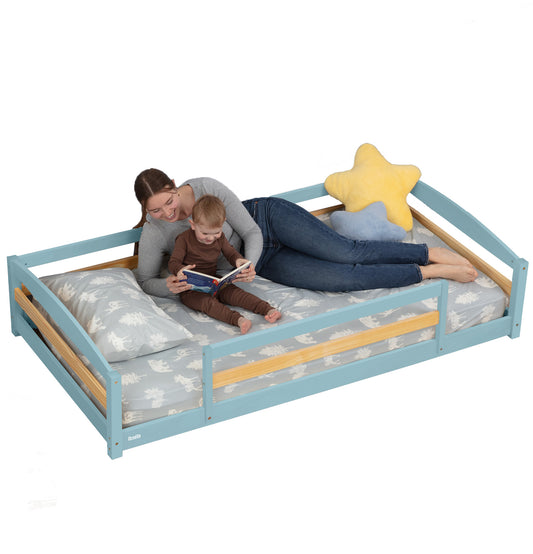
Start with the room's biggest constraint. If clothing storage is the main problem, built-in drawers may save enough floor space to avoid adding another piece of furniture. If safe access, independence, or a very open floor plan matters more, a lower-profile full-size platform bed, including Montessori-style options from brands such as Ocodile, can be a useful comparison point while you weigh storage against easier daily movement.
The best purchase is the one your child can use safely, your room can support comfortably, and your family can live with for more than one stage of growth.