



Playroom Organization Ideas: Create Calm & Fun
You walk into the play area after dinner, and your foot finds the one block that somehow escaped every cleanup attempt. There are puzzle pieces under the sofa, markers with no caps, a dress-up cape hanging from a lamp, and a child asking where the toy animals went. It can feel like the playroom isn’t just messy. It’s running the house.
Most parents don’t need a prettier bin system. They need a room that helps children play well, find what they need, and learn how to put it back. That’s why the most useful playroom organization ideas aren’t really about decluttering alone. They’re about building a space that supports attention, calm, and independence.
As an educator, I think of a playroom as a prepared environment. Children read a room long before they can explain what they need from it. If the space is crowded, noisy-looking, and hard to understand, many children bounce from toy to toy. If the room is simple, clear, and reachable, they settle in more easily.
That doesn’t mean your home has to look perfect. It means your child should be able to answer a few quiet questions with confidence: What can I do here? Where does it go? Can I do it by myself?
From Chaos to Calm A New Vision for Your Playroom
The turning point usually comes when parents stop asking, “How do I hide all these toys?” and start asking, “What do I want this room to teach?” That shift changes everything.
An organized playroom can teach patience, choice-making, independence, and respect for shared space. It can also reduce the daily friction that comes from too many visible options and no clear homes for anything. Children often do better when the room makes sense to them.
Start with function, not decoration
Before you buy baskets or move furniture, pause and look at how your child uses the room. Some children build on the floor for long stretches. Some move constantly and need open space. Some want a cozy corner and a small table for drawing. The goal is to match the room to real behavior, not an idealized version of family life.
Ask yourself:
- Which toys get used every day and deserve easy access
- Which activities create the most mess and need clearer limits
- Which materials need adult help and should live higher up
- Which parts of the room already work so you can build on them
Practical rule: If a child can’t see it, reach it, and understand it, that storage system is probably designed for adults, not children.
Labels help once you know what belongs where. If you want a simple family-friendly method, implementing Life Labels organization system can give you ideas for naming categories in a way children can follow.
Aim for a room your child can read
Children relax when the environment gives them clues. A low shelf with baskets of blocks says, “You can build here.” A small basket of books beside a cushion says, “You can rest here.” A tray with crayons and paper says, “This is for creating.”
That’s the heart of calm. Not less personality. More clarity.
Create Effective Play Zones for Focused Fun
A playroom works better when it feels a bit like a small workshop. Each part of the room has a job. One area invites reading. Another supports building. Another gives art supplies a contained place to land.
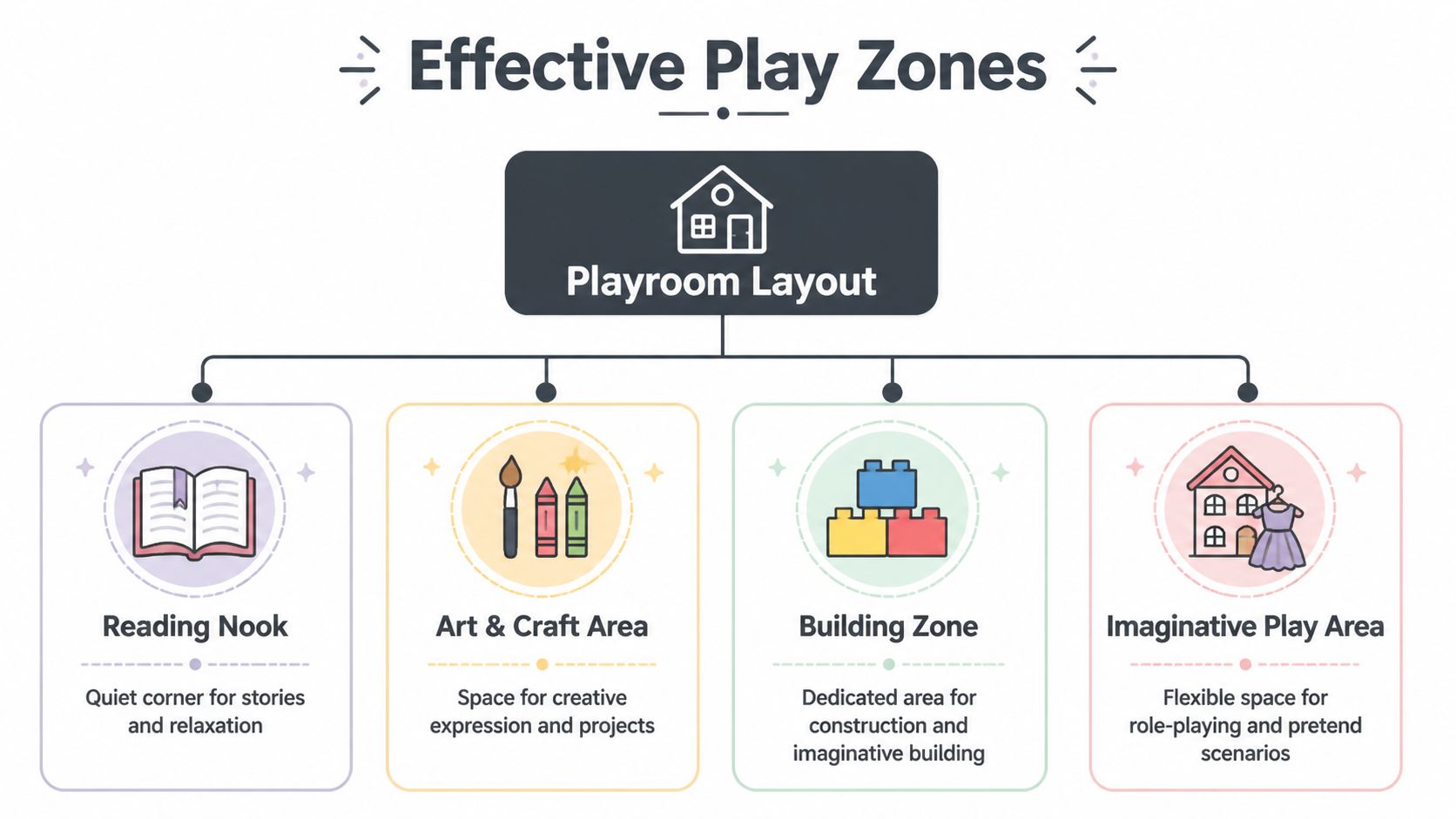
There’s good reason this helps. Zoning strategies utilize child developmental psychology by dividing spaces into distinct activity areas, which studies in environmental psychology indicate improve task focus and cleanup compliance by 40-60% in children aged 2-6 due to spatial boundary recognition that reduces cognitive overload from visual clutter (The Home Edit).
Four zones most families can use
You don’t need a huge room. Even a shared family area can hold clear mini-zones.
-
Reading nook
Put this in the quietest corner you have. A floor cushion, a small front-facing book display, and soft light go a long way. Keep only a modest number of books out so children can choose without feeling flooded. -
Art and craft area
This zone works best near a wipeable surface. Use a child-sized table if you have one, or dedicate one end of a family table. Store paper, crayons, and child-safe tools together so setup feels easy instead of complicated. -
Building zone
Blocks, magnetic tiles, train tracks, and construction toys need open floor space. A rug helps define the boundary and communicates to children, “Big creations stay here.” That simple cue can prevent mixed-up pieces from drifting all over the room. -
Imaginative play area
Pretend kitchens, dolls, dress-up clothes, puppets, and toy animals often work well together. Keep props visible but limited. Too many costume pieces and accessories can make pretend play harder, not richer.
Use furniture as quiet boundaries
Children don’t need walls between activities. They need visual cues.
A rug can separate building from reading. A low shelf can divide pretend play from art. A basket tucked beside a chair can anchor a book corner. If you’re planning the layout, these playroom furniture ideas for everyday family spaces can help you think about how shelving, seating, and surfaces shape behavior.
Try these boundary tools:
- Rugs: Define where an activity begins and ends.
- Low shelves: Separate spaces without blocking sight lines.
- Trays: Keep one activity contained and easy to return.
- Wall hooks: Hold dress-up items without eating floor space.
A child is more likely to stay with one activity when the room tells them where that activity lives.
Keep movement in mind
Place active zones where noise won’t interrupt quiet play. Put reading away from the busiest path. Give building toys enough room that children don’t have to clear the whole floor before they begin. Small changes in placement can make a room feel far more peaceful.
Choose Smart and Safe Storage Solutions
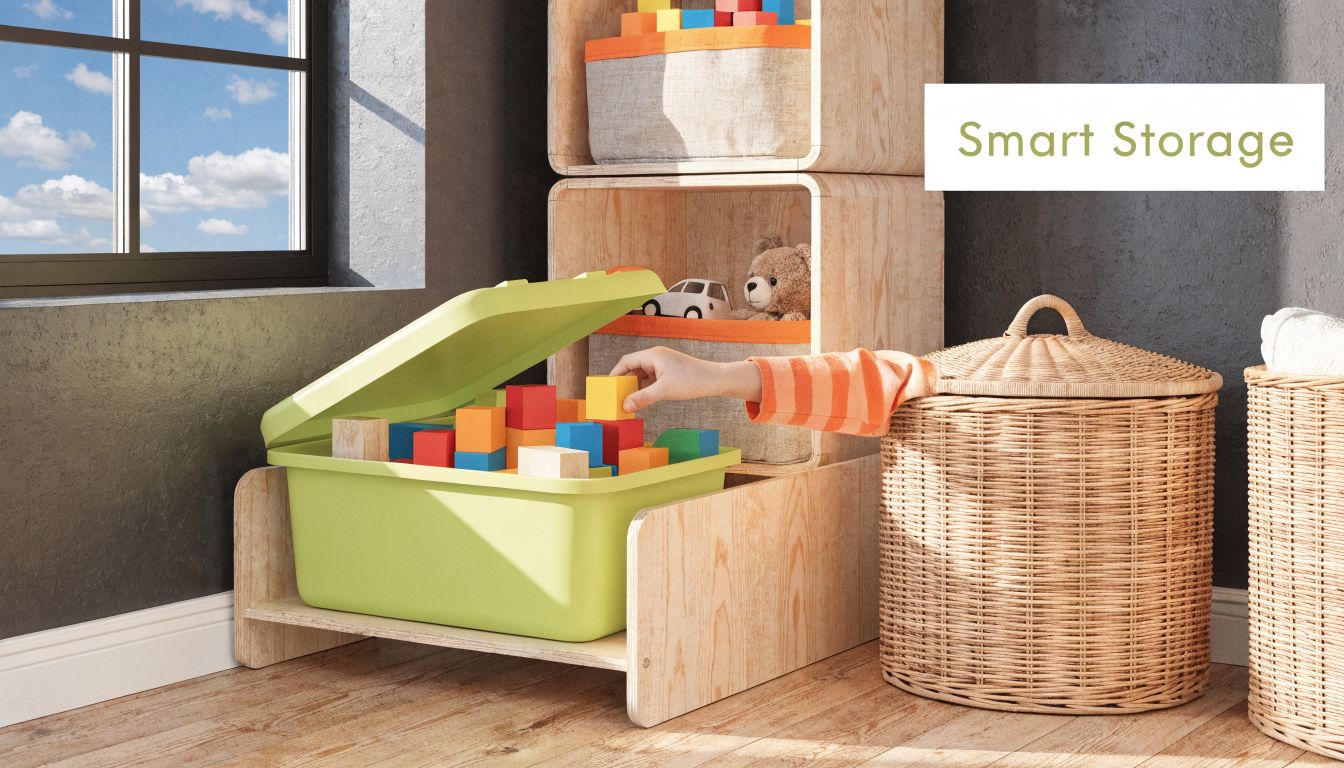
Storage should do two jobs at once. It should reduce visual clutter for adults and increase usable independence for children. If it only does the first job, cleanup still lands mostly on you.
What children actually need from storage
Very young children don’t sort the way adults do. A deep toy chest may seem convenient, but to a child it often becomes one big mystery pile. Open shelving and simple containers usually work better because children can see their options and return items with less help.
When storage systems are designed at child height and labeled with visual cues, children ages 2-5 demonstrate significantly higher cleanup participation rates. Furniture like step stools and standing towers can be integrated into playroom zones to improve accessibility and independence, addressing a common gap in organization guides (Nice and Neat Homes).
That means the most helpful systems are often the simplest:
- Open shelves for puzzles, baskets, and trays
- Clear bins when small parts need visibility
- Picture labels for pre-readers
- Baskets for soft toys, costumes, or larger loose items
Match the storage to the toy
Not every category needs the same container.
A puzzle belongs on a shelf where the child can slide it out. Blocks usually need a sturdy bin with a wide opening. Art supplies do better in smaller grouped containers so crayons don’t mix with stickers and glue. Dress-up clothes are easier to manage on low hooks than stuffed into a basket.
Here’s a practical method to consider:
| Toy type | Better storage choice | Why it works |
|---|---|---|
| Puzzles and games | Open shelf or vertical file-style holder | Children can see choices without dumping |
| Building toys | Wide bin or shallow basket | Easy to scoop out and return |
| Art supplies | Small containers inside one tray or caddy | Keeps one activity together |
| Dolls and pretend props | Basket plus a few hooks or a low shelf | Supports quick access and quicker reset |
| Books | Front-facing shelf or small ledge | Encourages browsing |
If you need more category-by-category inspiration, this guide to toy storage organizers for family homes is useful for comparing common setups.
Safety matters as much as function
Parents often focus on labels and containers first. I’d start with stability.
- Anchor tall furniture so shelves can’t tip if climbed.
- Choose smooth, sturdy materials that handle daily use.
- Keep heavier items low so children can access them safely.
- Store adult-supervised materials higher up and bring them down intentionally.
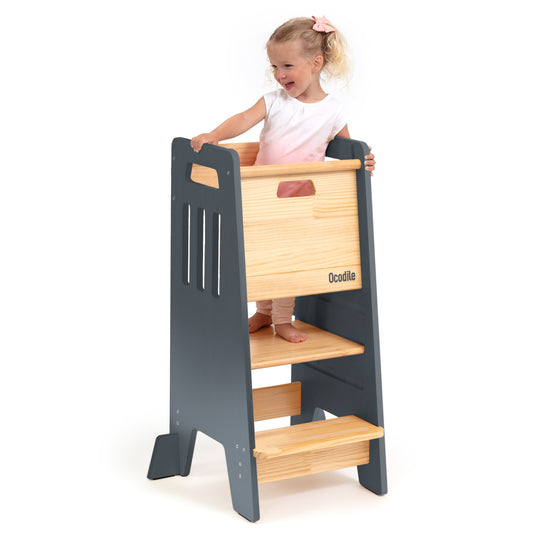
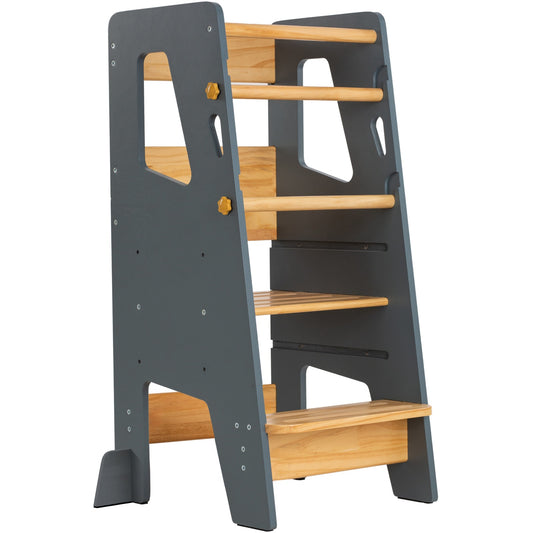
This is also where child-centric furniture can help. A single mention is enough here: an Ocodile step stool can help a young child reach shared shelves more safely when the room includes storage at more than one height.
For more ideas that fit real family life, this parents' guide to toy organization gives helpful examples of grouping toys by type and accessibility.
Embrace Montessori Principles for an Ordered Playroom
Montessori ideas often get reduced to a shopping list of beige toys and low shelves. The deeper point is much more human. The environment should show the child, “You belong here, and you’re capable.”
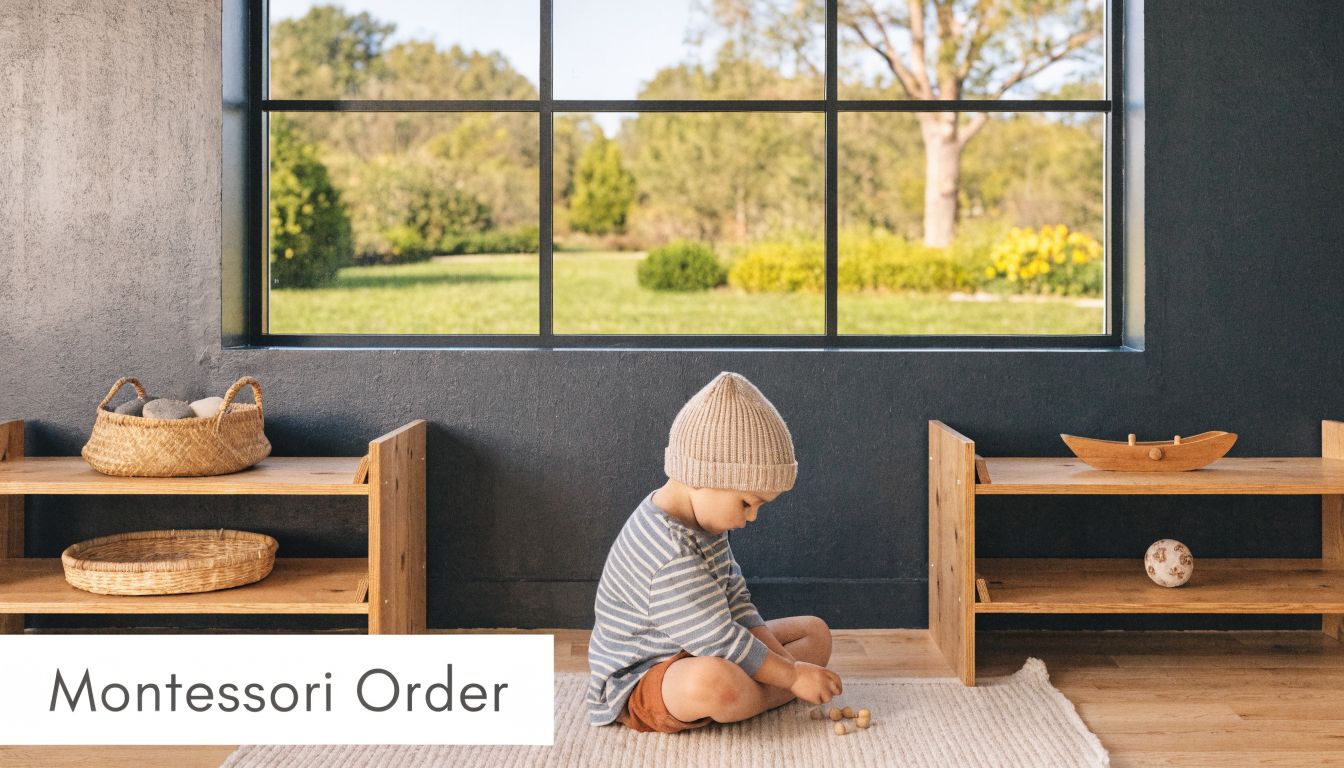
An ordered playroom supports that message. It respects the child’s need for beauty, predictability, and purposeful choice. It also respects the adult’s need for a home that feels livable.
Order gives children confidence
A Montessori-inspired room usually has fewer items visible at once, but each item is placed with intention. Children can see what’s available, choose it, use it, and return it. That loop matters. It teaches responsibility without constant lectures.
Three principles are especially useful in playroom organization ideas:
-
Everything has a home
Children can’t tidy what hasn’t been clearly assigned a place. -
The child should reach what they’re expected to use
Independence grows when access matches expectations. -
The room should invite real activity
Not all meaningful work looks like a toy. Watering a plant, folding a play cloth, or wiping a small table also belongs.
A well-ordered room often leads to calmer play because the child spends less energy searching and more energy doing.
Less on display often creates more play
Parents sometimes worry that putting fewer things out will make the room boring. In practice, the opposite often happens. When children aren’t overwhelmed by choices, they tend to use materials more thoroughly. A small set of blocks may inspire a long stretch of creative building. A limited book display can make story choice easier instead of harder.
If you want to see how this philosophy translates into room setup, these Montessori playroom ideas for practical home use can help you picture what “child-sized environment” really looks like.
A short visual explanation can also make these ideas easier to grasp:
Practical life belongs in the playroom too
One reason Montessori rooms feel different is that they make room for contribution. A child who can carry their own materials, reach a cloth to wipe a spill, or return a tray after use is learning more than cleanup. They’re learning competence.
That’s why the most helpful question isn’t “How do I make this room look tidy?” It’s “How do I make this room usable by my child?”
Implement a Simple Toy Rotation System
If your child has many toys and uses only a small portion of them at a time, rotation can bring immediate relief. It reduces visual noise, makes favorites feel fresh again, and helps you notice what your child frequently returns to.
Start with a gentle sort
Toy rotation doesn’t require a giant weekend overhaul. Start by pulling everything into broad categories. Think in activity types, not tiny labels.
Use categories like:
- Building such as blocks or magnetic tiles
- Pretend play such as dolls, animals, kitchen items
- Creative materials such as crayons, stickers, stamps
- Puzzles and thinking toys
- Books
- Sensory or fine motor items
Once sorted, choose a small number of categories to keep visible. Store the others in a closet, lidded bins, or another out-of-sight spot.
Keep the shelf edited, not empty
Children still need enough variety to stay engaged. A room with one option can feel restrictive. A room with everything out can feel chaotic. The sweet spot is usually a small, balanced selection.
A workable shelf might include:
- One building choice
- One pretend play setup
- One art invitation
- A few books
- One puzzle or tabletop activity
Don’t rotate because you “should.” Rotate when the room starts feeling noisy, ignored, or hard to reset.
Use a rhythm you can maintain
Some families rotate weekly. Others do it every couple of weeks or only when interest drops. The best system is the one you’ll continue.
Here’s a simple example:
| Week | Focus Category 1 (On Shelf) | Focus Category 2 (On Shelf) | Stored Category 1 | Stored Category 2 |
|---|---|---|---|---|
| Week 1 | Blocks | Farm animals | Train set | Dress-up clothes |
| Week 2 | Train set | Puzzles | Blocks | Dollhouse items |
| Week 3 | Dress-up clothes | Art tray | Farm animals | Building planks |
| Week 4 | Dollhouse items | Building planks | Puzzles | Art tray |
This table isn’t a rule. It’s a reminder that rotation can be very simple.
Watch your child, then adjust
A good rotation system responds to behavior. If your child returns to one toy category again and again, keep it out longer. If something hasn’t been touched through several rotations, it may belong in storage for a while, or it may be ready to leave your home.
Children also play differently by season, energy level, and stage of development. That’s normal. Rotation works because it gives the room permission to change with them.
Build Daily Routines for Lasting Tidiness
The families who keep a playroom manageable usually aren’t cleaning for hours. They’re repeating a few small habits every day.
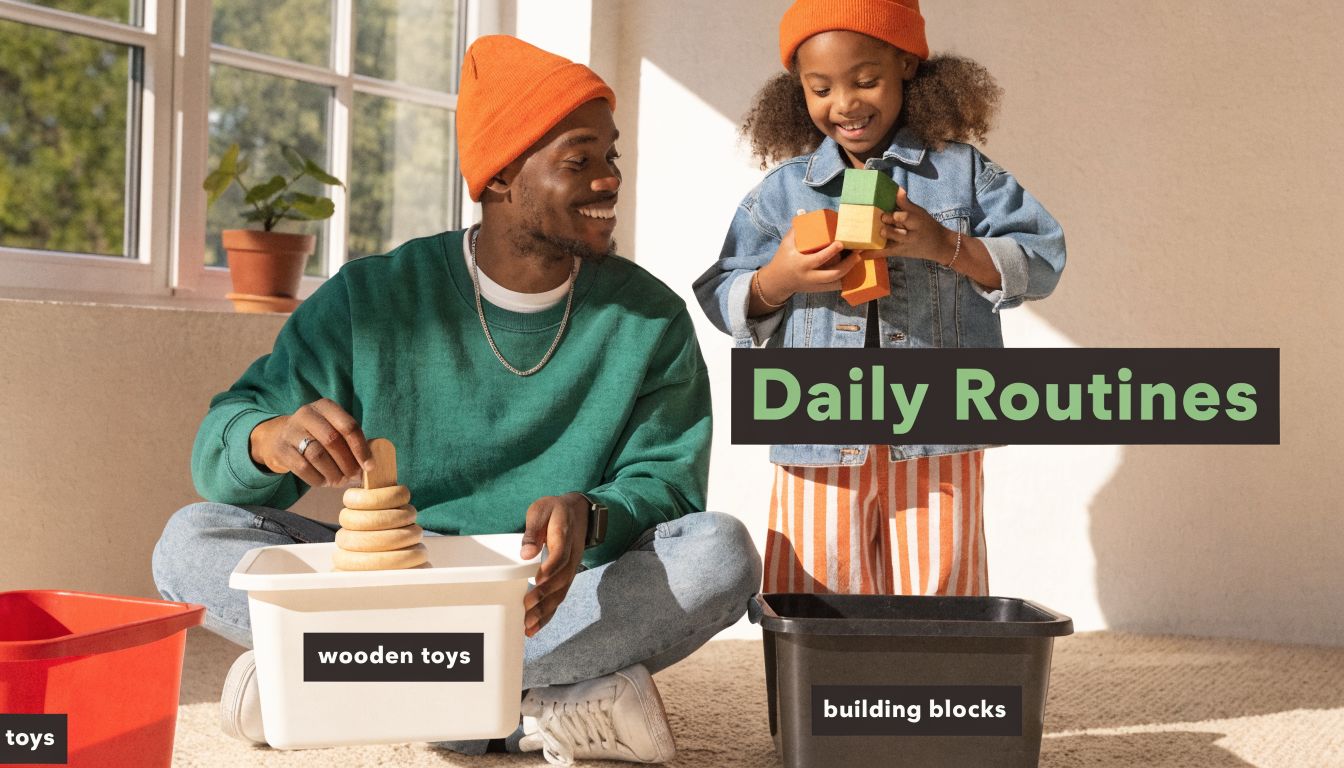
A typical evening might look like this. One child finishes building a tower. Another is still carrying toy food around the house. Before bath, the family does a short reset. Books go back to the basket. Blocks return to the shelf. Dress-up clothes go on hooks. It isn’t perfect, but the room is ready for tomorrow.
Keep cleanup short and predictable
Children do better with routine than with surprise. If cleanup happens at roughly the same time each day, they begin to expect it.
Try a simple rhythm:
- Before lunch: Reset one activity before starting another.
- Late afternoon: Quick room scan and gather wandering toys.
- Before bedtime: Family tidy-up for the whole space.
This works especially well when adults stay calm and specific. “Blocks in the blue bin” is easier for a young child to follow than “Clean this room up.”
Use language that supports cooperation
Cleanup doesn’t have to sound like punishment. You can frame it as care for the room.
Helpful phrases include:
- “Let’s put the animals back in their home.”
- “Your art table is ready for tomorrow once the crayons are back.”
- “You built so much today. Now the blocks get to rest.”
Children are more likely to join in when cleanup feels like part of play, not the abrupt end of it.
For families who like a broader home rhythm, these cleaning tips for Portland residents can help you think about how small recurring tasks keep any room from getting overwhelming.
Progress beats perfection
Some days your child will help eagerly. Some days you’ll do most of it yourself. That doesn’t mean the system failed. It means you’re raising children, not managing a showroom.
What matters is repetition. A short daily reset protects all the work you did when setting up the room.
Your Playroom Organization Questions Answered
How do I handle the flood of toys after birthdays and holidays
Don’t try to absorb everything at once. Pause before adding new toys to the room. Group gifts by type, decide what fits your space and your child’s stage, and store some items for later. If something replaces an older version of the same kind of toy, consider letting one go.
A simple family rule helps: new items need a clear home before they enter the play area.
What if I don’t have a dedicated playroom
You can still use strong playroom organization ideas in a living room, bedroom corner, or hallway nook. Think in zones, not rooms. A small rug can mark a building area. A basket beside a chair can become the reading spot. A low shelf in the dining area can hold art materials.
Children don’t need a large dedicated room. They need clear signals about what happens where.
How early can children start helping with cleanup
Very early, if the expectation matches their development. Toddlers can put blocks in a basket, return books to a bin, or carry a cloth to a low hook. Preschoolers can sort simple categories and reset a shelf with guidance.
Start with one clear task and repeat it often. Keep your language concrete and your expectations realistic.
What do I do about mixed ages in one space
Shared rooms need layered access. Put safe, simple materials low where younger children can reach them. Store small-part toys or more complex games higher up and bring them down intentionally for older siblings. Color-coded baskets or separate trays can also help each child understand what belongs to whom.
The goal isn’t total separation. It’s clarity and safety.
Should every toy be visible
No. Too much visibility can make the room harder to use. Keep out what your child can manage well and what supports the kinds of play you want to encourage. Store the rest neatly and rotate as needed.
A room that feels calm often has less on display than parents first expect.
My child dumps everything out. Does that mean the system isn’t working
Not always. Dumping can mean the bin is too mixed, the categories are unclear, or there are too many choices. It can also be developmentally normal, especially for younger children.
Look for the simplest fix first:
- Reduce volume in the bin
- Separate mixed categories
- Add a picture label
- Model how to choose one thing at a time
Most children do better once the room asks less of them.
A calm, usable play space doesn’t come from buying more storage. It comes from designing the room around how children live and learn. If you want child-centered furniture ideas that support independence at home, explore Ocodile.