



Woodworking Childrens Furniture: A Parent's Guide to Safety
You’re probably doing what many parents do at some point. You’re standing in a child’s room, or scrolling through furniture options late at night, trying to decide what belongs in this small space where so much life will happen. Sleep, play, reading, climbing, snack time, early independence. It all happens around the furniture you choose.
That’s why woodworking childrens furniture matters more than it may seem at first. A child’s chair isn’t just a chair. A bed isn’t just a bed. Each piece teaches something about safety, access, confidence, and daily rhythm. Good furniture supports the child who uses it. Poorly chosen furniture asks the child to adapt to the object.
Parents often get pulled in three directions at once. You want something safe. You want something beautiful enough to live with every day. You also want something that won’t feel wasteful after a short season of growth. Those goals can live together, but only if you know what to look for.
Creating a Safe and Inspiring Space for Your Child
A child’s room works best when it feels calm to you and usable to them. That sounds simple, but it changes how you evaluate every piece. Instead of asking, “Does this match the wall color?” you start asking, “Can my child use this safely without constant adult correction?”

That shift matters because children experience a room physically. They pull up on edges, lean their weight into tables, chew corners, drag stools, and test limits with complete sincerity. Furniture in a child-centered home has to meet that reality.
The broader market shows how many families are making this same choice. The global kids furniture market was valued at USD 33.93 billion in 2025 and is projected to reach USD 90.91 billion by 2033, while the wood segment holds the largest revenue share at 61.7% because of durability, appearance, and perceived safety, according to Data Bridge Market Research on the global kids furniture market.
Start with the room, not the product
Before buying anything, pause and look at how your child moves through the space.
- Sleeping area: Can your child reach the bed safely?
- Play zone: Is there open floor space for movement and toy rotation?
- Caregiver concern points: Could a dresser, shelf, or cabinet tip if climbed?
- Daily participation: Is there a place for your child to sit, read, or help nearby?
One of the easiest safety mistakes to overlook is wall anchoring. If your room includes taller storage, review this guide on how to secure furniture to the wall. For the hardware side of that job, parents often need straightforward, practical advice on mounting brackets so the anchoring method matches the wall and the furniture weight.
Practical rule: If a piece invites climbing, pulling, or hanging, treat anchoring as part of the furniture, not an optional extra.
A safe room shouldn’t feel restrictive. It should feel usable. That’s the difference between decorating for children and designing for them.
Why Wood Is the Gold Standard for Childrens Furniture
When parents ask me what material I trust most around young children, I start with wood. Not because it’s trendy, and not because it photographs well. I start there because material choice affects durability, repairability, feel, and the way a piece ages in family life.

Wood gives you a strong base to build from, especially when the furniture will be handled daily by small, active users. It holds fasteners well, tolerates repair better than many cheaper materials, and usually looks better with time rather than worse.
The buying pattern reflects that preference. The global kids wood furniture market is projected to grow from USD 12,337 million in 2021 to USD 19,884.1 million by 2025, driven by parents’ preference for durable, eco-friendly, and attractive pieces that can be passed down, according to Cognitive Market Research on the kids wood furniture market.
Durability changes the value equation
Parents often compare price tags without comparing lifespan. That’s understandable, but it can be misleading.
A wooden stool, table, or bed often makes sense because it can stay in family use through hard daily wear. It can survive dragging, bumping, standing, stacking books on top, and the occasional enthusiastic misuse that comes with childhood. If the design is straightforward, it can also be sanded, refinished, or repaired instead of discarded.
That long life shapes the emotional value too. Children build rituals around furniture. The same small chair used for snacks, watercolor painting, and first attempts at buttoning a sweater becomes part of family memory.
Wood feels better in a child’s environment
Parents usually notice appearance first, but children notice touch. Wood has warmth, visible grain, and slight variation. It feels less sterile than plastic and less harsh than some metal furniture. Those sensory qualities matter in rooms where children are learning how spaces feel, not just how they look.
Solid wood often behaves like a well-made kitchen tool. It’s simple, dependable, and pleasant to use every day.
That’s one reason many parents prefer natural finishes and visible grain over thick glossy coatings. The furniture feels more grounded and less disposable.
Not all “wood” is the same
Many people often get confused. A product description may say “wooden furniture,” but that can mean very different things.
A quick mental checklist helps:
- Solid wood: Strong, long-lasting, easier to refinish.
- Quality plywood: Often stable and practical when well made.
- Particleboard or MDF: More budget-friendly, but they raise extra questions about adhesives, edges, and emissions.
If you want a good example of why parents are drawn to natural material and simple proportions, this article on a natural wood toddler bed shows how wood supports a calmer, more child-scaled sleep space.
Wood isn’t automatically safer just because it’s wood. Good woodworking childrens furniture still depends on finish quality, joinery, surface prep, and honest manufacturing. But as a starting material, wood remains the strongest foundation for child-focused design.
Decoding Materials and Finishes for Ultimate Safety
This is the part many parents skip because the language sounds technical. It shouldn’t be technical. You’re really checking two things. First, what is the furniture made from? Second, what has been applied to its surface?
Those two answers tell you a great deal about whether a piece belongs near a teething toddler, a climbing preschooler, or a child who spends hours in close contact with it every day.

Start by separating solid wood from composite products
Solid wood is usually the easiest material for parents to understand. It’s lumber shaped into a product. Composite products are different. They’re made from fibers, particles, or layers bonded with adhesives.
That doesn’t automatically make them unsafe. It does mean you need better documentation.
Children’s furniture containing composite wood must comply with 40 CFR Part 770 (TSCA Title VI), which requires formaldehyde testing and documentation, as explained in ComplianceGate’s overview of United States children’s furniture regulations. For a parent, the practical takeaway is simple. If a brand uses composite wood, it should be able to explain compliance clearly and confidently.
Why finishes matter so much
Parents usually think about structure first. Children interact with the finish first. They touch it, lean against it, and sometimes put it in their mouths.
That’s why safety language around finishes needs to go beyond “painted” or “sealed.” A stronger benchmark is EN 71-3, because it tests the actual migration, or leaching, of 19 different heavy metals under conditions simulating ingestion, as described in Osmo’s explanation of the EN 71-3 wood finishing standard.
A finish can sound harmless in marketing copy and still leave parents with unanswered questions. A migration standard gives you a more useful answer because it focuses on what could transfer in real use.
What parents should ask before buying
Use direct questions. If a company can answer them plainly, that’s a good sign.
- Is the main material solid wood, plywood, MDF, or particleboard?
- If composite wood is used, can you explain formaldehyde compliance?
- What finish is on the surface?
- Does the finish meet a child-safety benchmark such as EN 71-3?
- Are the edges smooth and fully sealed?
If you’re trying to create a healthier overall room, not just buy one safer item, the same thinking applies to floors. Parents comparing coatings often find this guide on selecting healthy floor finishes for homeowners useful because floor finishes and furniture finishes affect the same indoor environment.
Safe doesn’t mean fragile
A common misunderstanding is that safer finishes must be delicate. In practice, many child-appropriate finishes are chosen because they can handle wiping, hand contact, spills, and ordinary family wear.
Look for a finish that balances these needs:
- Low odor after application
- Clear documentation
- Smooth, non-tacky feel
- Simple maintenance for scratches or wear
- Suitability for frequent touch
For a parent-focused overview of what these labels should mean in real life, this guide to non-toxic kids furniture is a helpful reference point.
Furniture safety works a lot like reading a food label. Short ingredient lists help. Clear testing language helps more. The less vague the answer, the more comfortable you can feel bringing that piece into your child’s daily space.
Designing for Independence and Growth
Children don’t just need furniture that fits their bodies. They need furniture that respects their stage of development. That’s where woodworking childrens furniture can become something bigger than storage or decor. It can shape daily independence.

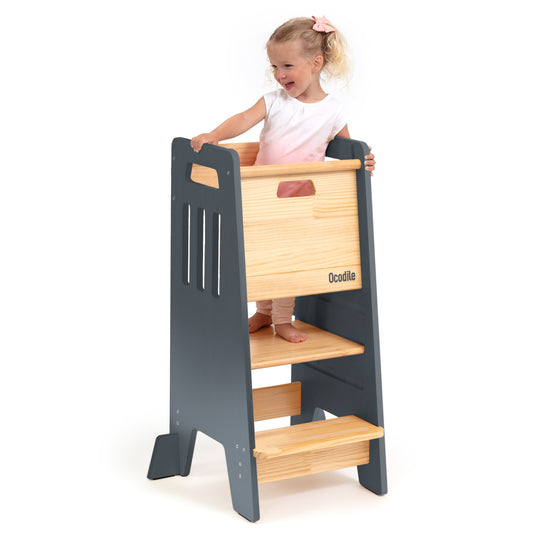
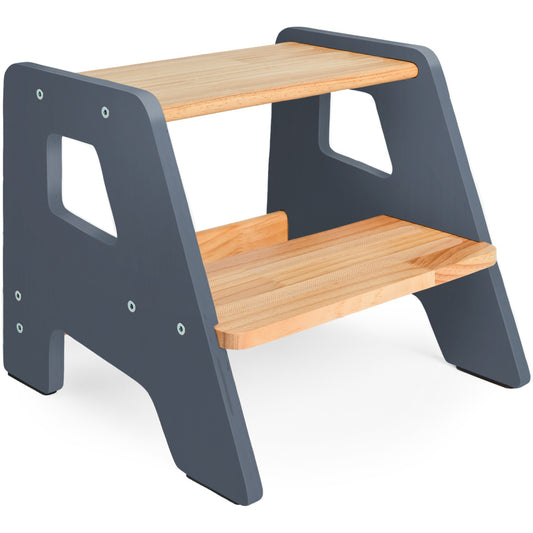
A well-sized table invites a child to sit down without help. A low bed lets them get in and out on their own. A stable step stool turns “watching from below” into “participating safely.” These aren’t small changes. They teach the child, every day, “You can do part of this yourself.”
The demand for longer-lasting, adaptable designs is clear. A 2025 Montessori International study found that 68% of parents actively seek lifespan-extending furniture, and a typical child outgrows static-sized pieces in 18 months, according to the referenced Montessori-aligned design resource.
Right size changes behavior
Adults often think a child will “grow into” furniture. In reality, oversized furniture tends to create dependence. Feet dangle. Surfaces sit too high. The child waits for lifting, repositioning, or supervision that wouldn’t be needed if the piece matched their scale.
That’s why child-sized design looks different from shrunken adult furniture. The best pieces account for movement patterns, not just height. They anticipate climbing, pivoting, reaching, and repeated use.
A few examples make this easier to spot:
- Floor beds support self-directed sleep transitions.
- Low shelves help children see and choose rather than ask.
- Small tables and chairs create a stable place for reading, drawing, or snacks.
- Step stools and learning towers bring children safely into family routines.
Children become more careful when furniture is usable, not intimidating. Good design lowers the need for constant correction.
Adjustability matters more than many parents expect
Static furniture works for one phase. Adjustable furniture works across phases.
That can mean a platform that moves to different heights, a stool with more than one standing level, or a table and chair set that remains comfortable as the child’s posture changes. The point isn’t novelty. It’s continuity. A familiar object that adapts often supports confidence better than replacing everything every time a child grows.
Here’s a practical example of child participation in action:
A child-centric home is built around access
A child-centered home doesn’t mean every object belongs to the child. It means the environment includes safe ways for the child to take part in ordinary life.
That might look like this:
- In the kitchen: A stable platform for washing produce or stirring batter
- In the bedroom: A bed low enough for independent entry
- In the living area: A reachable shelf with books displayed face-forward
- At mealtimes: A chair that supports upright sitting without strain
When parents use these design choices consistently, the room becomes more than tidy or stylish. It becomes legible to the child. They understand where to go, what they can reach, and how to participate safely.
That’s the deeper promise behind thoughtful design. It doesn’t just furnish a room. It gives a child a clearer relationship with their home.
Making the Right Choice Buying vs DIY
It is Saturday morning. Your child is pulling a chair to the counter because they want to help wash fruit, and you are deciding whether the safer answer is a project in your garage or a finished piece from a company that builds for this exact moment.
That decision is about more than budget or pride in making something yourself. It shapes how your child moves through the home. A well-made piece supports safe participation. A poorly planned one can create hesitation, wobble, or wear that shows up only after months of climbing, leaning, and daily use.
DIY can be immensely satisfying. Buying can be the wiser choice. The better path is the one that gives your child a dependable object they can trust with their body, not just a piece that looks good on day one.
Children’s furniture asks more of a design than adult furniture often does. A child does not use a stool like an adult uses a stool. They climb onto it from the side, drag it across the floor, stand near the edge, and repeat that pattern every day. Good design accounts for that kind of real behavior. Good construction does too.
If you build your own piece, you are taking on several jobs at once. You are choosing materials, planning dimensions, checking stability, selecting a finish, sanding every contact surface, and deciding whether the final result still feels safe after repeated use. Earlier in the article, we covered the added compliance questions that can come with certain engineered wood products. That paperwork and material verification are routine for experienced manufacturers. For a one-off home build, they can be difficult to confirm with confidence.
Where DIY makes sense
DIY is often a good fit when you already have solid woodworking skills and a clear reason to build instead of buy.
- You need custom dimensions: Useful for an unusual nook, a narrow kitchen, or a child who falls between standard sizes
- You want direct material control: You can choose the exact lumber, hardware, and finish
- You are comfortable evaluating structure: You know how to judge joinery, racking resistance, and long-term stability
- You value repairability: A piece you built is often easier for you to maintain over time
In the best cases, a DIY project reflects the home around it. It can solve a real problem beautifully.
Where buying often makes more sense
Buying is often the stronger choice when you want consistency and less guesswork.
A good manufacturer repeats the same build many times, which means weak points are more likely to show up and get corrected. That matters in children’s furniture. Small details, like the radius of a corner, the grip under a foot, or the way a finish holds up to constant wiping, make a difference in daily life.
At Ocodile, this is the part of the work that parents do not always see, but children feel. The product needs to invite independence without asking a child to take unsafe risks. That means the proportions have to suit a child’s body, the surfaces need to feel predictable under hand and foot, and the structure has to stay steady during ordinary exploration. The philosophy is simple. A child-centered home should give children safe ways to join family life.
Decision Guide for Buying vs. DIY Children's Furniture
| Factor | Buying (e.g., Ocodile) | DIY Project |
|---|---|---|
| Material sourcing | Brand handles supplier selection and consistency | You must verify every board, panel, and finish |
| Safety documentation | Often provided as part of the product process | You need to gather and understand it yourself |
| Structural design | Usually refined through repeated production and revision | Depends on your design skill and build accuracy |
| Time | Faster path to a finished piece | Requires planning, tools, build time, and finishing time |
| Customization | Limited to offered models and options | High, if you can execute safely |
| Peace of mind | Comes from a repeatable process and quality control | Comes from your own judgment and verification |
A simple way to decide is to ask one question. Do you want to build furniture, or do you want to use furniture that has already been carefully worked out for a child’s daily routines?
Both answers are valid. What matters is honesty about your tools, time, and experience. The right choice is the one that gives your child a stable, durable, clearly designed place to practice independence at home.
Your Checklist for Choosing the Best Furniture
A good furniture checklist should help you cut through marketing language fast. If a product is right for your child, you should be able to answer a small set of practical questions without guessing.
Check the material first
Ask what the piece is made from in plain terms.
- Solid wood: Usually the clearest material story
- Plywood: Can be a smart, stable option when well made
- MDF or particleboard: Ask extra questions about adhesives and compliance
If the answer sounds vague, keep asking. “Wooden” is not a complete answer.
Check the surface your child will touch
The finish should be described specifically. You want more than “painted with safe paint.”
Ask:
- What coating is used?
- Is it intended for children’s furniture?
- Can the company explain its safety standard clearly?
- Will the surface hold up to wiping and daily use?
A trustworthy answer is usually calm, direct, and specific.
Look closely at construction details
Experienced parents often make their fastest judgment here. They run a hand over the edge. They test the wobble. They inspect corners.
Use a quick physical checklist:
- Rounded edges reduce harsh contact points.
- Smooth sanding matters on rails, corners, and handholds.
- Sturdy joinery keeps the piece from loosening under repeated use.
- Stable stance helps prevent rocking and tipping during ordinary movement.
- No loose small parts in high-contact areas.
Furniture for children should feel boring in the best way. No surprises, no sharp spots, no awkward wobble.
Ask whether the design serves your child now
The best-looking piece can still be the wrong piece if it doesn’t match your child’s stage.
Consider:
- Can your child get on, off, or into it safely?
- Does it encourage participation instead of waiting?
- Will it still work as your child grows?
- Does it fit the actual room, not just the product photo?
A child-centric home is built one sensible decision at a time. The strongest choices usually share the same traits. Honest materials, documented safety thinking, calm design, and proportions that respect the child who uses them.
If you keep returning to those four ideas, you’ll make better decisions whether you’re choosing a floor bed, a step stool, a small table, or your child’s first reading chair.
If you want furniture that reflects those principles in daily life, Ocodile builds child-focused pieces designed around safe exploration, independence, and family routines. Their collection is a useful place to start if you’re looking for wooden furniture that feels thoughtful, practical, and made for real childhood.