



10 Foot Tension Rod: A Parent's Guide to Safe Setup
You're probably looking at a wide opening right now and thinking a 10 foot tension rod would be the easiest fix. Maybe it's for a playroom curtain, a shared bedroom divider, a blackout panel for naps, or a renter-friendly way to soften a big opening without drilling into the wall.
That instinct makes sense. Tension rods are convenient, clean-looking, and familiar. But at 10 feet, they stop being a simple hardware choice and start becoming a safety decision.
In a home with young children, the main question isn't just “Will it fit?” It's “Will it stay put when the room is busy, the walls aren't perfect, and somebody tugs on the fabric?” That's where most generic guides fall short. They show the twist-to-install step, but they don't spend enough time on slippage, sagging, off-square walls, or what happens when a child treats a curtain like part of the playground.
A long tension rod can work. It just needs to be approached with more caution than the packaging usually suggests.
Planning Your 10 Foot Span Before You Buy
A ten-foot opening can look straightforward until you measure it. In family homes, it rarely is. Walls lean a little, trim projects out farther than expected, baseboards interrupt the line, and textured paint reduces grip.
That matters because a tension rod relies on compression and friction. If the two end points don't give the rod a clean, stable place to press, holding power drops fast. Real-world discussions around angled walls and uneven spaces show the challenge clearly: the limiting factor often isn't just rod length, but installation geometry, and people end up needing hooks or angled supports to prevent slippage, especially in homes where children may interact with the setup, as reflected in this discussion of angled walls and uneven openings.
Measure more than width
Start with the width, but don't stop there. Check the opening at the top, middle, and bottom. If those measurements differ, the rod won't be pressing evenly once installed.
Also inspect these details:
- Wall surface: Smooth painted trim usually grips better than dusty texture or slick tile.
- Contact height: Make sure both rod ends will land on the same plane, not one on trim and one on drywall.
- Obstructions: Baseboards, crown details, window casing, and nearby shelving can all interfere.
- Curtain path: Confirm the fabric can hang freely without rubbing furniture, toy storage, or door swings.
A parent often starts with the curtain choice first, but for a 10-foot run, the wall condition should lead the decision.
Match the rod to the job
A decorative sheer panel asks much less from the rod than blackout fabric or a room divider curtain. If the curtain will be opened and closed often, that repeated movement adds stress even when the fabric itself isn't especially heavy.
Practical rule: Treat a 10-foot setup as an active part of the room, not as static decor.
That's especially true in children's spaces. A curtain near a reading nook may get brushed by shoulders. A divider in a shared room may get pulled open quickly. A “temporary” setup often becomes part of daily life.
Plan for family behavior, not ideal behavior
This is the part many buying guides skip. Children don't use rooms gently or predictably. They hide behind curtains, lean on fabric, and grab whatever is at hand when they lose balance.
Before buying, ask yourself:
- Will a child be able to reach the fabric easily?
- Will this curtain sit in a high-traffic path?
- Does the opening have any unevenness that could let one end slip first?
- If the rod falls, what's underneath it?
If you're using the rod as part of a broader space-saving setup, it helps to think about the room as a whole. Ocodile's ideas for small space kitchen solutions are a useful reminder that compact homes work best when every element is planned around real movement, not just dimensions on paper.
How to Choose a Genuinely Strong 10 Foot Tension Rod
At this span, product listings can be misleading. Many rods technically extend to ten feet, but that doesn't mean they're equally stable there. Adjustable length and safe working length are not the same thing.
One long-span product example reaches 41–126 inches, uses a 1.26-inch diameter, and is advertised to hold 26 pounds, according to this 10-foot tension rod product video. That's useful not because it guarantees performance in every home, but because it shows what serious long-span design looks like: a larger tube diameter and higher-load construction, not a skinny rod stretched to its limit.

What to compare before you buy
A quick side-by-side check helps filter out weak options:
| Feature | Better choice for 10 feet | What to avoid |
|---|---|---|
| Diameter | Large-diameter tube | Thin rod near full extension |
| Mechanism | Twist-lock or other robust tightening system | Basic spring-only feel |
| End caps | Wide, grippy contact points | Small, hard, slick ends |
| Use case | Light curtains over a very stable opening | Heavy drapes on imperfect walls |
Diameter matters most because long rods don't just need tension. They need stiffness. A rod can press firmly against the walls and still bow in the middle if the tube is too narrow.
Read product claims with healthy skepticism
If I were reviewing a rod for a children's room, I'd ignore decorative wording and scan for four practical signs:
- A stated diameter: If the listing hides this, that's not a good sign for a long span.
- A specific weight claim: Vague “heavy duty” language isn't enough.
- Clear photos of the end caps: Grip surfaces matter.
- A realistic use case: Look for examples with light curtains rather than oversized claims.
A long rod that reaches ten feet only solves one problem. It still has to resist bowing, slipping, and daily handling.
If your curtain will be opened frequently across a wide window or divider, it's also worth comparing non-tension systems. Families considering wider openings sometimes look at motorized curtain rod options when they want smoother operation and a more fixed setup than a pressure-mounted rod can provide.
What usually works and what usually doesn't
Often workable
- Lightweight curtains
- Stable wall-to-wall recesses
- Openings with smooth, even contact points
- Setups where adults handle the curtain gently
Often disappointing
- Thick blackout curtains across the full span
- Textured or slightly uneven walls
- Spaces where children pull, swing, or hide behind the curtain
- Rods chosen only because they “extend to 10 feet”
The best buying mindset is simple. Don't ask whether the rod can reach ten feet. Ask whether it still looks overbuilt at ten feet.
A Secure Installation Guide for Parents
A ten-foot rod can look secure at bedtime and be on the floor by breakfast after one hard tug on the curtain. In a child's room, installation has to account for real use, not careful adult use.
Start with the opening itself. Measure the width in a few spots, not just once across the middle. Older homes often have walls or trim that are slightly out of parallel, and that small difference matters with a long tension rod. If one end cap lands on a slick painted patch, rounded trim, or uneven tile line, the rod can slowly walk downward even if it felt tight during setup.

Install it in this order
-
Clean both contact points
Wipe away dust, soap residue, and furniture polish. Tension rods rely on friction, and a slightly slippery wall finish can undermine the whole setup. -
Check the surface shape
Flat, solid contact points hold better than curved trim or heavily textured walls. If the end caps cannot sit flush on both sides, stop and reconsider the location. -
Pre-adjust the rod on the floor
Set the rough length before lifting it. That gives better control and reduces the temptation to overtwist the rod while balancing on a stool. -
Create firm compression
The rod should go in with noticeable resistance. If it drops into place too easily, it usually is not tight enough for a wide span. -
Level it before adding fabric
A slight tilt puts more force on one end cap. Over time, that side often becomes the failure point. -
Hang the curtain evenly
Spread the panels across the rod instead of loading one side first. Uneven weight can twist a long rod during the first few minutes of use.
Check the wall, not just the rod
Parents often focus on the rod's advertised strength and miss the bigger weak point. The wall surface has to provide consistent grip across both ends.
Glossy paint, soft drywall corners, thick caulk lines, and trim with decorative profiles all reduce contact. In those conditions, a long rod may hold light fabric for a while, then slip when a child pulls sideways or runs through the curtain. That is why I treat a test fit as only the beginning.
If you are already reviewing room safety, Ocodile's guide on how to secure furniture to wall for child safety follows the same practical rule. If a child can grab it, climb near it, or yank on it, install for that force from day one.
A short visual demo can also help if you're installing this alone:
What a secure rod feels like
Test it before the room goes back into use.
- Press upward at the center: A safe install should feel firm, with only slight movement.
- Push the curtain sideways by hand: The rod should stay put instead of creeping at one end.
- Tap near each end cap: Any immediate shift means the contact point is not reliable enough.
- Open and close the curtain several times: Rotation, scraping, or a change in level are early warning signs.
- Recheck it the next day: Long rods sometimes settle after the fabric has been hanging for several hours.
One final rule matters in kids' spaces. If you would feel nervous seeing your child grab the curtain with both hands, the setup is not finished yet.
Reinforcing Your Rod for Unpredictable Kids
In a children's space, reinforcement is not optional. A long tension rod may hold a curtain without issue for days, then fail the first time a child grabs the panel while turning, hiding, or pulling up from the floor.
That risk gets overlooked because many guides focus on fit and installation mechanics. But manufacturer-style guidance is much more cautious: spring and tension rods are meant to hold very little weight, and the risk of sagging or failure rises as length increases, as noted in this technical overview of spring tension rods. For a 10 foot tension rod, that warning matters.

Why “it seems fine” isn't a safety standard
Parents see a rod holding fabric and understandably assume the setup is stable. But visible stability under still conditions isn't the same as safe performance in a lively room.
A child introduces forces the product listing doesn't describe well:
- quick sideways yanks
- repeated tugging at the same edge
- body weight transferred accidentally through the curtain
- impact from toys, doors, or rough play nearby
Those aren't edge cases in family homes. They're normal conditions.
Safety note: If you need predictable holding power, build the setup for contact, not just for curtains.
Reinforcements that make sense
The best reinforcements are usually small and discreet. They don't need to make the rod look industrial. They just need to reduce the chance of a sudden slip.
Consider a combination like this:
- Adhesive grip pads or wall cups under each end cap to create a more stable landing point on slick walls
- A center support to reduce downward bowing and keep the rod from working loose over time
- Curtain clips or stops that keep the fabric from bunching and creating one heavy pull zone
- Restricted placement so the curtain doesn't invite climbing, hiding, or swinging
What I would not rely on is friction alone in a busy child's room if the span is close to ten feet.
Safer ways to think about the setup
A reinforced rod works best when the curtain is treated as a soft screen, not as an active divider that gets dragged back and forth all day.
That means:
- choose lighter fabric
- keep the hem off the floor so little feet don't snag it
- avoid dramatic pooling
- place furniture so the curtain isn't the handhold nearest a child's path
If you want a family-friendly room divider, the rod needs to be part of a larger safety plan. The curtain should not become the easiest thing to grab in the room.
Troubleshooting a Slipping or Sagging Rod
You usually get a warning before a 10 foot tension rod lets go. A parent pulls the curtain closed with one hand while holding a toddler with the other. The rod shifts a little. Later, one end sits lower, the fabric drags unevenly, and the middle starts to dip.
Treat that as a safety issue, not just a nuisance.
With extra-long tension rods, slipping and sagging rarely come from one cause. The usual mix is uneven walls, too much fabric weight, weak end contact, or a rod that is stretched too close to its limit. In a home with children, even a small loss of grip matters because kids tug, hide behind curtains, and use nearby surfaces for balance. We design around that kind of real behavior in children's rooms, and it changes how I judge a “minor” rod problem.
If the rod is slipping at the ends
Start at the wall, not the middle of the rod. End slip means the rod is losing friction where it meets the surface.
Check these points:
- Remove the rod and inspect the end caps for dirt, hardening, flattening, or cracks
- Clean the contact area on both walls so the rod presses against a dry surface without dust or residue
- Reset the rod with firmer compression so both ends seat evenly
- Look closely at trim, paint buildup, and texture changes that can make one side grip less than the other
If one side slips again after a careful reset, assume the opening is slightly out of square or the surface is too slick for reliable friction. At that point, repeated tightening is not a real fix. It only raises the chance of a sudden release later.

If the middle is sagging
A sagging center points to bending, not just poor tension. The rod may still be gripping the walls while the tube itself is deflecting under load.
Use this quick diagnosis table:
| Symptom | Likely cause | Better fix |
|---|---|---|
| Ends stay put, center dips | Rod stiffness is too low for the span | Add a center support or reduce curtain weight |
| Whole rod drops after the curtain moves | End grip is uneven | Reinstall and improve wall contact |
| Rod twists when fabric slides | Locking mechanism is not holding firmly | Reset, lock, and test with the curtain fully open and closed |
| One side creeps downward | One wall surface is less flat or less grippy | Add support or move the rod to a better contact point |
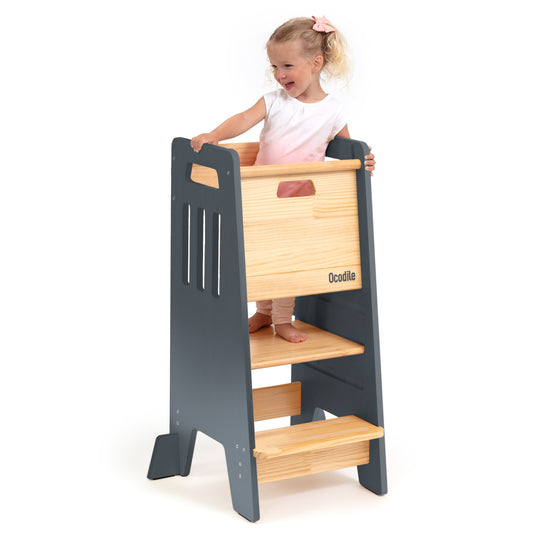
Children make center sag more serious. A bowed rod changes how the curtain hangs, which can create a low spot that invites pulling. The same pattern shows up around kid-height products in other parts of the home. Any setup near active children needs to account for grabbing and side loads, much like the stability concerns parents consider with a kitchen helper learning tower.
Practical fixes for imperfect walls and busy rooms
Real homes have patched drywall, rounded corners, heavy trim, and paint that feels smooth in one spot and chalky in another. A long tension rod notices all of it.
These fixes usually help:
- Shift the rod to a flatter contact area if trim or wall texture is uneven
- Swap one heavy panel for lighter panels to reduce bending in the center
- Add a discreet middle support if the rod is near its maximum span
- Use small wall cups or grip pads only if they create a more stable seat and do not encourage overloading the rod
One more practical rule. If the rod keeps drifting after you clean it, reset it, and reduce the load, stop troubleshooting and reassess the setup. In a child's room, a rod that repeatedly slips or sags is telling you it does not have enough safety margin for daily use.
When to Choose an Alternative to a Tension Rod
A tension rod isn't automatically the right answer just because you don't want to drill. Sometimes the safer decision is to stop forcing a renter-friendly solution into a job that needs fixed hardware.
That doesn't mean tension rods are flawed in principle. The concept is well established. Tension rods have a much longer history than modern décor trends. Architectural history notes their use in canopies and awnings in the nineteenth century, and the broader principle later became important in bridges and buildings as materials improved, as described in this history of tension rods in architecture. The principle is sound. The limit in household use is that a rod depends on the friction and compression it can create between two surfaces.
Situations where a fixed solution is safer
A bracket-mounted rod or track usually makes more sense when:
- The curtain is heavy and meant to block light or divide a room fully
- Children use the area actively and may grab the fabric often
- The opening is imperfect with angled walls, uneven surfaces, or awkward trim
- The curtain will be opened and closed many times a day
- You need long-term reliability, not a temporary workaround
This is one of those moments where “damage-free” can become the wrong priority. A few carefully planned mounting points may be the safer choice than a no-drill setup that needs constant monitoring.
Challenge the usual assumption
The common assumption is that if a rod extends to ten feet, it should work across ten feet. In practice, families need a stricter standard.
Ask these questions instead:
- Can this setup tolerate child contact?
- Will it remain stable if the curtain is pulled sideways repeatedly?
- Do the walls give the rod a trustworthy surface to press against?
- Would I feel comfortable standing under it while adjusting the curtain with one hand and holding a child with the other?
If the answer to any of those is no, a more secure mounting system is the responsible call.
That same thinking shows up in other family products too. For example, a kitchen helper learning tower only makes sense when it's stable under real child movement, not just when it looks tidy in the room. Curtain hardware deserves the same honesty.
A 10 foot tension rod can still be the right tool. But the right setup is usually modest in ambition: lighter fabric, better support, predictable use, and reinforcement that respects how children move through a room. If you need something stronger than that, choosing a bracketed rod isn't overbuilding. It's good judgment.
If you're designing a child-friendly room and want solutions built around real family use, not showroom assumptions, explore Ocodile. Their approach centers on safe, practical products for everyday home life, which is exactly the mindset that leads to better decisions in spaces children use every day.