




 - Monica
 - Lindsay

Childrens Climbing Sets: A Complete Buyer's Guide (2026)
Your child has climbed the sofa again.
You reach out on instinct, half ready to catch them, half amazed by how determined they are. One minute they are stacking couch cushions into a “mountain.” The next, they are testing the arm of the chair like it is a summit. Most parents know this feeling well. Pride, worry, and one big question: How do I support this without turning my living room into a hazard zone?
That urge to climb is not random mischief. For many young children, it is a natural part of learning how their body works in space. They push, pull, balance, reach, slip a little, and try again. That is development in motion.
Purpose-built climbing equipment has been part of childhood for a long time. Climbing structures have been a key part of child development for over a century, beginning with the invention of the jungle gym in 1920 by Sebastian Hinton in Chicago (history of the jungle gym). Modern childrens climbing sets bring that same core idea indoors in a way that feels calmer, safer, and more suited to home life.
Parents shopping for a first set often run into the same problems. The options all look similar at first glance. Product pages talk about “Montessori” without explaining what that means in daily use. Safety claims can sound reassuring while leaving out the most important detail: what standards the product meets.
A good guide should do more than list products. It should help you understand why certain features matter, what fits your child right now, and what questions are worth asking before you buy. That is what this guide is for.
From Couch Cushion Forts to Confident Climbers
A toddler who climbs the sofa is usually not trying to be difficult. They are practicing.
They are learning how much force to use, where to place a foot, when a surface feels too slippery, and how to shift weight without toppling over. Adults often see a risky moment. The child feels a challenge that matches a skill they are trying to build.

Why children keep seeking climbing challenges
Climbing gives children something many toys do not. It offers immediate feedback from the body.
If they lean too far, they feel it. If they grip well, they move forward. If they hesitate, they pause and solve the problem. This is one reason childrens climbing sets can feel so satisfying to a young child. The activity is active, sensory, and self-correcting.
Many parents first notice the need during indoor days. Maybe the weather is bad. Maybe your child has endless energy before dinner. Maybe your careful toy rotation has failed, and the coffee table has become the main attraction. A climbing set can redirect that energy into a more useful pattern.
Why a real climbing set helps more than improvised climbing
A sofa was not designed for climbing. A sturdy climbing frame is.
That distinction matters. Childrens climbing sets give your child a place where climbing is expected. The handholds, angles, and surfaces are more predictable. Your child gets a “yes” space instead of hearing “down, please” all day.
Practical shift: When climbing has a safe home indoors, many families find it easier to set clear boundaries about where climbing is and is not allowed.
This is also why modern climbing sets fit so naturally with Montessori-inspired homes. They respect a child’s drive to move and explore. Instead of stopping the behavior, you shape the environment so the behavior can happen more safely and more independently.
The result is not just a busier child. It is often a more confident one. A child who can climb up, turn around, and come back down on their own is building much more than strength. They are building judgment.
What Exactly Are Modern Childrens Climbing Sets
Modern childrens climbing sets are best understood as developmental playgrounds for the home.
They are not miniature versions of an old park structure. They are smaller, lower, and more intentional. Each piece usually supports a few core abilities at once: climbing, balancing, pulling up, crawling through, sliding, or rocking.
The main forms you will see
The best-known format is the Pikler Triangle. It looks simple because it is simple. A sloped frame with evenly spaced bars invites children to pull up, climb, and descend at their own pace.
An arch climber has a curved shape. Some children climb over it. Others use it as a rocker when flipped, or as a tunnel when draped with fabric. A ramp or reversible board often adds another layer. One side may be smoother for sliding. The other may offer grip for climbing.
These pieces work together like building blocks for gross motor development. One piece teaches basic movement. A combination teaches sequencing, route planning, and confidence.
If you want a visual sense of how wooden climbers are commonly used in homes, this guide to wooden climbing toys gives useful examples of the different forms.
Why the design looks so minimal
Parents sometimes assume simple means limited. With climbing sets, the opposite is often true.
A loud toy with one fixed function gets old fast. A plain climbing frame asks the child to do more of the mental work. They decide where to start, how high to go, whether to crawl under, or whether to turn it into a fort. That is one reason these sets hold attention over time.
The Montessori connection comes from this same idea. The equipment does not entertain the child. It invites the child to act.
What children learn besides climbing
Climbing is the obvious skill. Less obvious are the hidden lessons.
A child on a frame is constantly making small decisions:
- Body planning: Where does my foot go next?
- Risk assessment: Is this too high for me right now?
- Problem-solving: Can I go around instead of over?
- Persistence: I slipped. Can I try again a different way?
These are the roots of physical literacy. The child learns what their body can do, how to adjust, and when to stop. That matters well beyond playtime.
What modern sets are not
They are not a substitute for supervision.
They are also not a license to rush a child into harder movement. A good climbing set works best when the adult chooses an appropriate structure, places it well, and then lets the child progress gradually.
That is a subtle but important point. The value of childrens climbing sets is not in pushing performance. It is in giving children a consistent place to practice movement with freedom and reasonable limits.
Choosing Your Perfect Set Types and Materials
Buying your first climbing set gets easier when you split the decision in two. First, choose the type. Then choose the material.
Parents often mix these together and get stuck. They start by asking, “Wood or plastic?” when the better first question is, “What kind of movement do I want this to support?”
Start with the shape
A Pikler Triangle suits children who are learning to pull up, climb steadily, and come back down with control. It is often the most straightforward starting point.
An arch gives a different experience. It can be climbed over, rocked with supervision when used that way, or turned into imaginative play furniture. It tends to feel softer and more open-ended.
A combo set brings several pieces together, such as a triangle, arch, and ramp. That gives more variety and can grow with a child’s changing interests.
For parents comparing setups, this overview of a Pikler triangle climbing set can help you picture how one format works in daily family life.
Then consider how the material changes the experience
Material affects feel, maintenance, appearance, and long-term use.
Wood is common in Montessori-style homes because it feels warm, blends into living spaces, and usually offers a steady grip. Plastic can be lighter and easier to wipe down. Metal is more common outdoors or in public play settings, where a different level of durability may be the priority.
Here is a practical comparison.
Climbing Set Material Comparison
| Material | Pros | Cons | Best For |
|---|---|---|---|
| Wood | Feels sturdy, looks calm indoors, often fits Montessori spaces well | Can feel heavier, may need more careful finish inspection | Families who want long-term indoor use and home-friendly design |
| Plastic | Lightweight, easy to move, simple to clean | Can feel less stable depending on design, often less visually subtle in shared rooms | Casual indoor play or families who want a lighter piece |
| Metal | Strong and durable, familiar in larger climbing structures | Often less suited to cozy indoor spaces, can feel more institutional | Outdoor setups or more commercial-style environments |
What to look for in wooden childrens climbing sets
Not all wooden sets feel the same in use.
Look closely at the finish and the edges. A good wooden frame should feel smooth in the hand, not rough or splinter-prone. Rounded edges matter because children do not move in straight lines. They twist, slip, and bump into the frame from odd angles.
Also pay attention to the hardware. A beautiful frame with awkward joints or exposed fasteners is not a thoughtful design. What you want is a structure that feels quiet and secure when your child uses it.
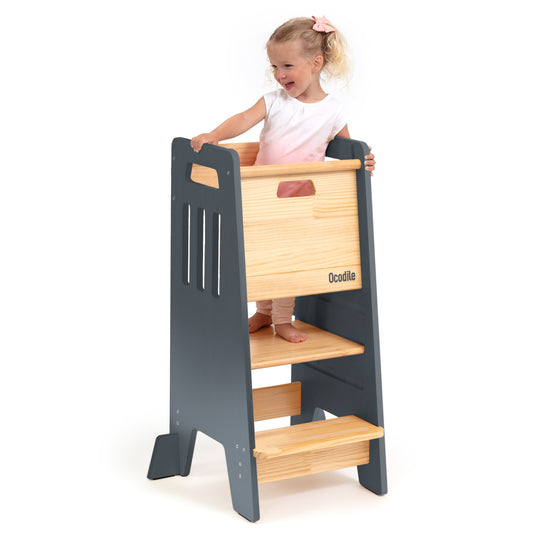
One example in this category is Ocodile’s Climbing Set for Kids, a wooden climbing structure designed for toddlers, with extra safety bars and assembly guidance available through the brand’s product materials. That is useful if you want a home setup with a clear focus on practical use.
A helpful test: Ask yourself whether the climber looks like something your child can approach independently, or something they will need constant lifting onto. The first option usually has more lasting value.
Match the set to your home, not just your child
A large combo set can look appealing online, but it may overwhelm a small room.
A foldable frame can make more sense if the play area shares space with family life. An arch may be a better fit if you want one piece that can work for movement and imaginative play. A triangle with ramp may suit a child who repeats the same challenge over and over.
When in doubt, choose the set that gives your child a clear next step, not the one with the most parts.
Matching a Climbing Set to Your Child's Development

Your child spots the climbing frame in the living room, puts one hand on the bar, and pauses. That little pause tells you a lot. A good fit feels inviting, not confusing. It gives a child one clear next step they can try on their own.
That is why age ranges only help so much. Development moves in patterns, not neat calendar boxes. One two-year-old may still be practicing balance with both feet planted wide apart, while another is already planning a route across a triangle and ramp. Montessori practice follows the child, and that same idea works here. Start with the skills your child is showing today, then choose a set that supports the next small layer of growth.
For the youngest climbers
Infants and young toddlers need equipment that feels close to the ground and easy to read. Their bodies are still learning a basic sequence. Pull up. Shift weight. Reach. Steady. Try again.
Safety standards for public-use play equipment for children ages 6 to 23 months restrict climbing element heights to under 32 inches and prohibit features like rung ladders (ASTM F2373 overview). That standard is written for public-use equipment, but the developmental lesson carries over well at home. Early climbers do better with very low structures that support pulling to stand, cruising, crawling through, and stepping over.
Helpful features at this stage include:
- Low height: A short distance to the floor gives beginners room to practice without turning every wobble into a big fall.
- Open access: Wide entry points let children approach from different angles as they figure out how their body fits through space.
- Gentle surfaces: A mild ramp or low arch supports whole-body exploration before true climbing skill is in place.
Parents often buy for the child they expect in six months. That can backfire. If the first challenge feels too big, the set becomes furniture instead of a tool for growth.
For toddlers building control
Toddlers usually learn through repetition. They do not get bored as quickly as adults expect. Going up the same side five times is often serious practice.
A simple triangle, arch, or low combo set works well because it offers a clear problem with a clear solution. The structure acts a bit like a staircase for motor planning. The child starts to predict, "Hand here, foot there, shift weight, come down." That repeated sequence builds coordination, balance, and confidence.
This is also a good stage to watch how your child gets off the equipment, not just how they get on. Descending asks for body awareness, impulse control, and patience. Many children can climb higher than they can climb down.
For preschoolers ready for planning and variation
Preschoolers often want more than a single route. They may connect pieces, change direction halfway through, or turn the climber into a bridge, cave, or obstacle course. That wider range of use fits Montessori thinking well. One simple object can support movement, choice, and imagination without flashing lights or scripted play.
Cognitive growth becomes easier to see here. A preschooler may stop, look at the bars, test one foot, then choose another path. Researchers at Harvard's Center on the Developing Child explain that physical play helps build the brain systems that support attention, working memory, and self-regulation during early childhood (serve and return and active play in early development). Climbing gives children a practical way to rehearse those skills because every route asks for planning, adjustment, and control.
For this age, useful features often include a ramp board, more than one climbing angle, or pieces that can be rearranged. If you are comparing options such as Ocodile, ask a simple question. Does the design allow the child to solve movement problems independently, or does it mainly create a taller structure?
Use these signs instead of only age labels
Watch your child with the set, or with similar play at home. Couch cushions, a low step stool, and a sturdy ottoman can reveal a lot.
- They can start without being lifted every time. Independence is a strong clue that the challenge matches their current stage.
- They repeat the activity by choice. Repetition usually means the task is productive, not overwhelming.
- They can come down with some control. Safe descent is one of the clearest signs that a structure is manageable.
- They pause and study the next move. That moment of hesitation is healthy. It shows the task is stretching skill without tipping into panic.
- They use the whole structure, not one tiny part of it. If a child only hangs on one bar and avoids the rest for weeks, the setup may be too advanced or poorly matched.
Development works in layers
Climbing skill usually grows in a simple sequence. First comes exploration. Then coordination. After that comes sequencing, planning, and imaginative use.
That progression is why one "perfect for all ages" promise should make you cautious. A well-matched set supports the child you have now and still leaves room for one next challenge. It does not rush the process.
As you compare models, look beyond appearance and check whether the brand clearly explains testing and setup. Safety transparency matters just as much as design. If a company makes its guidance easy to review, including how to secure nearby furniture to the wall in the play area, that usually reflects a more thoughtful approach to home use. The floor setup matters too. If you are placing a set in a playroom, these playset foundations ideas can help you assess whether the surface underneath supports stable, predictable use.
The right childrens climbing set does not push a child forward before they are ready. It gives them a safe place to practice the skills that are already beginning to emerge.
Safety First Installation and Placement Guide
A safe climbing set can become unsafe in a poor location.
That sounds obvious, but many home accidents happen around the equipment, not because of the core structure itself. A slippery rug, a nearby table edge, loose hardware, or a cramped setup can turn a good purchase into a stressful one.

Know the two safety ideas that matter most
The first is appropriate height.
For toddler climbing structures, safety standards summarized from ASTM and CPSC guidance set a maximum height of 4 feet and a minimum 6-foot fall zone in all directions, and these specifications are intended to reduce injuries because falls account for over half of playground incidents (playground equipment safety standards).
The second is clear space.
Parents often focus on the climber itself and forget the landing area. The open area around the set matters just as much as the frame. If a child slips sideways into a shelf or radiator, the climber did not fail. The room setup did.
Set it up like a use zone, not a corner toy
Try this practical checklist before first use:
- Choose a level surface: Wobble starts at the floor.
- Clear nearby furniture: Keep hard edges and breakable items well away from the climber.
- Use soft landing support: A quality mat or appropriate surface helps absorb falls.
- Check wall proximity: Children often swing their legs wider than adults expect.
- Tighten all hardware fully: Recheck after assembly and at regular intervals.
If your play area includes an outdoor or semi-outdoor structure, resources on playset foundations can help you think through stable base support and placement principles.
Treat assembly as part of safety
Parents sometimes rush this part because the child is excited. Slow down.
Follow the manufacturer’s instructions in order. Do not substitute random screws or skip a bracket because “it seems solid enough.” Once assembled, press on the frame from multiple angles before inviting your child to climb.
If your climbing set sits near dressers, shelves, or other tall furniture, secure those separately too. This guide on how to secure furniture to wall is useful because climbing play tends to increase movement throughout the whole room.
Good supervision is active but calm: Stay close enough to help if needed, but avoid constantly repositioning the child. Too much interference can make movement less safe, not more.
What certification language should look like
Parents deserve more than vague statements like “kid-safe” or “tested materials.”
A responsible brand should clearly tell you what standards the product meets, what age range it is designed for, and any setup requirements. Rounded edges, stable construction, and non-toxic finishes matter, but so does transparency about how those claims are supported.
When a product page hides the details, ask for them. If the answer is unclear, keep looking.
Unlocking Potential With Montessori Play Ideas
Your child climbs to the top of the triangle in the morning, then crawls underneath it after lunch with a book and a blanket. That shift matters.
Montessori play uses one simple object in many purposeful ways. A good climbing set supports the child's own ideas instead of teaching one fixed routine. That is part of what gives it staying power in a home.

Use the climber as a flexible work space for play
Children learn through repetition, but they also learn through variation. A triangle that is only for climbing can lose its appeal faster than a triangle that sometimes becomes a cave, a tunnel, or a lookout post.
You can drape a light blanket over the frame and add a small pillow for a quiet reading corner. You can place a few stuffed animals underneath and turn it into a rescue station. A ramp can become a road for toy cars, a slide for balls, or a path for carefully carrying an object from top to bottom.
These small changes build real skills. Your child is testing gravity, distance, balance, planning, and self-control while feeling like they are playing. Research from the CDC notes that regular physical activity supports children's brain health, including attention and learning, which helps explain why active play often leads to better focus later in the day.
Montessori-style ideas that work well at home
Start simple. One prompt is enough.
- Obstacle path: Place floor cushions, tape spots, or soft stepping stones near the climber so your child can move in a sequence.
- Carry and climb: Invite your child to bring a beanbag, doll, or small basket up and down the structure. This adds concentration to movement.
- Under and over practice: Crawl under the arch, step around, then climb back across. This helps children understand space and direction.
- Quiet nook: Add fabric and a few books to create a calm retreat for rest, browsing, or independent time.
If you are new to Montessori, the key idea is simple. Prepare the space, show the possibility, then let the child do the work. The climbing set acts like a low, child-sized laboratory where the body and mind learn together.
Keep your role present, but not controlling
Parents often wonder how much to “teach” here. Usually, less is more.
A short invitation such as “Can the bear get to the ramp?” gives your child a starting point without taking over the play. Then watch. You may notice problem-solving, route planning, or repeated practice of one hard movement. That repetition is often a sign of learning, not boredom.
For families reducing passive entertainment, climbing equipment also fits nicely into a wider routine of hands-on play. This guide to best toys and activities to encourage screen-free play offers useful ideas for building days that feel engaging without relying on a screen.
A short demonstration can also help you picture how open-ended movement play works in a home setting:
A healthy pattern to look for: Your child returns to the set for different reasons across the week. One day it is for climbing. Another day it is for hiding, pretending, carrying, or resting.
This often represents the lasting long-term value of childrens climbing sets. The structure stays simple, and your child keeps finding new ways to grow with it.
Your Ultimate Childrens Climbing Set Buying Checklist
When parents feel overwhelmed by options, I suggest ignoring the marketing language and checking five things.
If a product meets these five, it is usually worth serious consideration. If it fails even one, pause before buying.
1. Safety certification transparency
This is the first thing I would check.
A significant gap exists in the market because major retailers often fail to specify which safety certifications their climbing sets hold. Parents should prioritize brands that clearly document compliance with standards like ASTM F963 or EN71 (retailer certification gap).
If the product page says “safe” but does not show what that means, ask. You are not being difficult. You are being careful.
2. Fit for your child right now
Do not buy for an imaginary future child.
Buy for the child who lives in your house today. A slightly simpler climber that gets daily use is better than an advanced one that sits untouched because it feels intimidating.
3. Material and finish quality
Run your eye over every detail in the photos.
Do the edges look rounded? Does the surface appear smooth? Are there clear close-ups of the joints, bars, and finish? Good materials matter, but so does careful execution.
4. Footprint and room placement
Measure before you fall in love.
Think about the climber plus the clear use area around it. Also think about what the room becomes when the set is in use. Can your child move around it freely? Can you supervise without constantly shifting furniture?
5. Maintenance and long-term practicality
A good climbing set should be easy to live with.
Use this short maintenance list after purchase:
- Check hardware regularly: Movement loosens things over time.
- Wipe surfaces gently: Keep the frame clean without damaging the finish.
- Inspect for wear: Look for rough spots, cracks, or anything that changes how the structure feels.
- Reassess placement: As your child grows, their movement patterns change.
Quick questions to ask before clicking buy
- What standards does this product comply with?
- What ages or developmental stages is it designed for?
- Is the setup realistic for my room?
- Can my child use it independently with supervision?
- Does the brand explain assembly and care clearly?
A climbing set is not just another toy purchase. It shapes how your child moves, explores, and tests limits at home. The right choice feels steady, understandable, and easy to trust.
If you want a childrens climbing set from a company that focuses on child-friendly furniture, practical home use, and transparent safety-minded design, take a look at Ocodile. Their approach fits families who want movement tools that support independence without turning the home into a cluttered play zone.