



Playing Blocks for Kids: The Complete Guide
You may be looking at a half-built tower on the living room floor right now. A few blocks are lined up with great seriousness, one is being used as a “phone,” and another has just been dropped off the sofa to see what happens. To an adult, it can look simple, repetitive, or messy.
To a child, it's meaningful work.
When children play with blocks at different ages, they test spatial concepts like weight, balance, and cause and effect, practicing deep focus without constant entertainment. A 2021 study shows that 3-year-olds' block-building complexity correlates with spatial skills, demonstrating that how children build matters for developing mathematics and spatial visualization.
That's why blocks stay in homes for years while many other toys come and go. A good set can meet a baby who wants to bang and mouth, a toddler who wants to stack and crash, and a preschooler who wants to build a zoo, a road, or a whole city. Value isn't in getting a child to “use them correctly.” It's in knowing how to support the next step, without taking over.
The Timeless Magic of a Simple Block
A child crouches over a small pile of blocks and starts with one careful choice. Then another. Then a third. The tower leans, falls, and gets rebuilt with the same concentration adults usually reserve for recipes, tools, or maps. That scene is familiar in homes and classrooms because block play meets children exactly where they are.
One child wants to stack as high as possible. Another wants to line blocks into a road. Another puts animals inside a block fence and tells you the tiger is sleeping. It all counts. Those small decisions are where early planning starts.
Parents often ask whether blocks are still “worth it” when there are so many louder, brighter toys available. They are. Blocks ask more from the child, and that's a good thing. The toy doesn't perform for them. The child has to imagine, test, adjust, and try again.
Blocks are one of the few toys that grow with a child instead of telling the child exactly what to do.
That's also why many families come back to wooden blocks even after trying trendier options. If you want a practical comparison of shapes, uses, and what makes a set more versatile at home, this parent's guide to wooden blocks is a helpful companion.
What makes blocks different
Blocks are simple, but they're not limited. They can become:
- A motor activity when your child carries, stacks, and balances them
- A thinking activity when they solve “why did that fall?”
- A language activity when they describe tall, under, next to, or behind
- A calming activity when repetitive building helps them settle
That blend is the magic. A plain block can become a bridge, a wall, a cake, a garage, or a step in a plan your child made on their own.
More Than Just Toys The Power of Block Play
Blocks have lasted because adults across generations noticed something important. Children don't just enjoy them. They learn through them.
Historically, references to alphabet blocks appear in the 1600s in the writings of John Locke, and the modern educational foundation is often traced to Friedrich Fröbel in the 19th century, when he introduced wooden “Fröbel Gifts” to teach shapes and balance, as noted in this history of building blocks. That long timeline matters. It tells us blocks weren't kept around by accident.

Why they still matter now
Modern parents often want toys that do more than one job. Blocks are one of the clearest examples of open-ended play because they don't lock a child into a script. A child can build alone, with siblings, or with you. They can use the same set in a quiet corner or across a whole rug.
If you want a broader look at why that matters in everyday family life, this piece on open-ended play gives useful context.
There's also a practical reason blocks stay relevant. They combine easily with other materials. Scarves become rivers. Wooden animals become story starters. Cars create roads and traffic problems to solve. If you'd like ideas for those kinds of additions, this guide to loose parts play is worth reading.
The main types you'll see
Not all blocks play the same way. That isn't a problem. It just means each type supports a slightly different kind of work.
| Type | Works well for | Trade-off |
|---|---|---|
| Wooden unit blocks | Balance, symmetry, open-ended building, long-term use | Heavier, louder on hard floors |
| Foam blocks | Safer large movement, younger children, floor builds | Less precise for detailed balance work |
| Plastic interlocking blocks | Connection, hand strength, simple construction | More guided than classic open-ended stacking |
| Magnetic tiles | Flat and upright structures, light play, visual building | Children can rely on magnets instead of learning balance the same way |
Practical rule: If you want one set that lasts the longest, choose blocks that leave room for many answers instead of one finished model.
That's the lasting power of block play. It isn't old-fashioned. It's durable learning disguised as fun.
How Blocks Build Brains at Every Age
Children don't play with blocks the same way at every stage, and they shouldn't. What looks basic to us is often exactly the right level of challenge for them. The key is to match the activity to what their hands, eyes, and attention can manage.
A 2021 study found that 3-year-olds' block-building complexity was associated with both concurrent and later spatial skills, and experimental work showed children in structured block-play groups could make larger gains in mathematics achievement and spatial visualization than control groups, according to this peer-reviewed study of block play research. That doesn't mean every child needs formal lessons with blocks. It means the way children build matters.
Babies and young toddlers
For younger children, block play starts as sensory exploration. They grasp, mouth, bang, drop, and knock over what we build. That can feel destructive to adults, but it's useful practice. They're learning how objects feel, what happens when they act on them, and how their own body can make change happen.
Try activities like:
- Two-block tapping to build hand coordination
- Fill and dump baskets so your child can remove and replace pieces
- Short towers for knocking down because falling is part of the lesson
- Large floor blocks for carrying from one spot to another
At this age, less is often better. Too many pieces can scatter attention.
Toddlers who are ready to stack and sort
This is when many children start repeating actions on purpose. They stack, line up, sort by color or shape, and place one piece “inside” or “under” another object. Those little experiments are early math and spatial language in action.
A useful shift here is to offer tiny challenges without correcting too much. You might say, “Can this one make a bridge?” or “Which one is flatter?” That keeps the child thinking while still leading the play.
What tends to work
- Rows and roads to create order
- Simple bridges using two supports and one top piece
- Matching games with similar shapes
- Container play with blocks moved in and out of baskets
What usually doesn't
- Over-explaining while the child is busy building
- Giving the answer too quickly when a tower falls
- Offering delicate sets too early when the primary need is movement
Let toddlers repeat the same build again and again. Repetition is often how they refine control and understanding.
Preschoolers and older children
This is when block play often becomes much richer. Children begin planning structures before they build them. They create enclosures for animals, roads for vehicles, and homes for figures. They also start negotiating if they build with siblings or friends, which adds turn-taking, compromise, and shared problem solving.
Look for these signs that your child is ready for more complexity:
- They return to a build after it falls
- They talk about what they're making before it exists
- They combine blocks with stories, figures, or vehicles
- They try to solve stability issues on their own
At this stage, blocks stop being only objects to stack. They become tools for ideas.
Your Guide to Choosing Safe and Engaging Blocks
Buying blocks sounds simple until you're staring at dozens of options online. Wood, foam, plastic, magnetic, painted, natural, big, tiny, themed, plain. The right choice depends less on trends and more on how your child will use them.
A strong set should do three jobs well. It should feel safe in your home, suit your child's stage, and stay interesting beyond the first week.

Start with material and feel
Material changes the play experience. Wooden blocks usually offer satisfying weight and clear feedback when children test balance. Foam blocks are useful when children still throw often or when you want safer large-scale floor play. Plastic blocks can be very practical, especially when easy cleaning matters.
If you're comparing classic options for home use, this overview of wooden building toys can help narrow your thinking.
Use this quick guide:
- Choose wood if you want durability, open-ended shapes, and stable building
- Choose foam if your child is very active and still learning body control around others
- Choose plastic if you want lighter pieces and easier wash-down care
Safety isn't just about labels
Parents often focus on finish and materials first, and that matters. But safe block play also depends on size, edge shape, and supervision level.
Look for:
- Age-appropriate size so younger children aren't handling pieces that are too small
- Smooth edges and surfaces that won't splinter or scratch
- Solid construction that won't chip easily with regular use
- Simple shapes at first if your child gets frustrated by fiddly pieces
A beautiful set that's too advanced often gets ignored. A sturdy, straightforward set usually gets used.
Buy for progression, not just today
The most helpful question isn't “Will my child like this now?” It's “Can this grow with them?”
A good set leaves room for progression:
| Child's stage | What to look for |
|---|---|
| Early play | Larger pieces, easy grasping, simple shapes |
| Emerging builders | Rectangles, squares, arches, enough pieces for towers and bridges |
| More advanced play | Variety in shapes, add-ons, space for storytelling and group builds |
If a set only supports one kind of outcome, children usually move on quickly. If it supports many kinds of play, they come back with new ideas.
From Simple Stacks to Complex Cities
The best way to keep blocks engaging is to let the challenge grow with the child. Many parents stop at “build a tower,” but there's a whole progression after that. When you know the next few steps, block play stays fresh for much longer.

The natural progression
Start where success is easy. Then add one new problem.
-
Stack and knock down
This is the beginning. Children learn placement, force, and anticipation. -
Build rows and walls
Lining pieces side by side helps children control spacing and direction. -
Make bridges
Two supports and one top block create a new concept. Now the child is thinking about span and stability. -
Create enclosures
A fence for animals or a garage for cars introduces inside and outside. -
Build connected scenes
Roads, homes, towers, and small neighborhoods invite planning and storytelling. -
Move into large floor builds
Bigger blocks and more open space encourage carrying, squatting, crawling, and walking around structures.
That last step is often missed. Many adults still think of blocks as mainly a sit-down toy. In practice, block play can include plenty of whole-body movement when children build on the floor, carry pieces across a room, crawl through layouts, and maneuver around what they've made.
How to keep blocks from getting boring
Interest often drops when the environment stays exactly the same. Expert practice recommends adding modular add-ons, loose parts, ramps, and mixed materials so children can move from simple stacking to more complex problem solving, as described in this block play add-on guide.
Try introducing just one fresh element at a time:
- Vehicles if your child loves motion and roads
- Animals or people if your child prefers storytelling
- Ramps and boards for rolling, sliding, and testing speed
- Natural pieces like pinecones or smooth stones for texture and pretend play
- Fabric pieces to become roofs, rivers, tunnels, or beds
Some children don't outgrow blocks. They outgrow unchanging setups.
A simple weekly rhythm
If you want more engagement without buying more right away, rotate the invitation:
- One day set out only blocks
- Another day add cars
- Later in the week add animals and a cloth
- On the weekend move block play to open floor space for bigger building
That small change often brings back concentration and imagination quickly.
Fostering Independence the Montessori Way
A child can have excellent blocks and still struggle to use them well if the setup works against them. In this context, many home play areas often fall short. The pieces are stored too high, dumped into one deep bin, or placed in a busy walkway where every build gets interrupted.
Expert guidance recommends sorting blocks by shape and size on open, low-traffic shelving so children can see, choose, and return materials without adult mediation. That kind of setup reduces friction and supports sustained engagement in self-directed planning, as described in this block center guidance.
Why the environment matters
Montessori practice values independence, order, and self-correction. Blocks fit beautifully into that approach when we make the materials accessible and the expectations clear.
A child who can reach the shelf, choose a basket, and return pieces after play learns more than cleanup. They learn that they can manage their own work. That confidence carries into the building itself. Instead of waiting for an adult to hand over the “right” piece, they scan, compare, and decide.
What to change at home
You don't need a perfect playroom. A few simple shifts make a big difference.
- Use low storage so your child can access blocks without asking
- Sort by type rather than tossing every shape into one container
- Keep the area calm by placing blocks away from the busiest traffic path
- Define the building zone with a rug or mat so structures have a place to stay
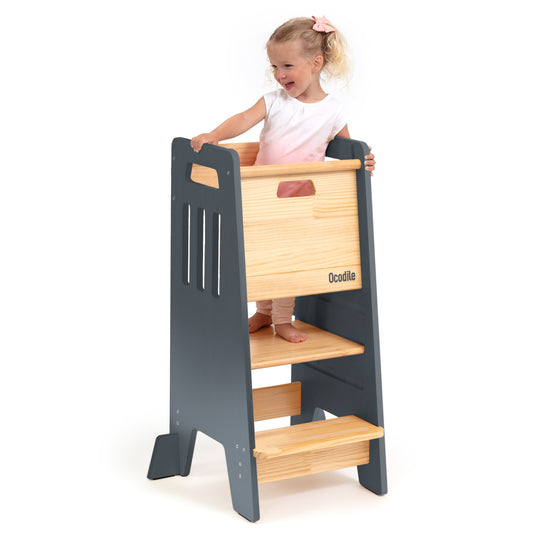
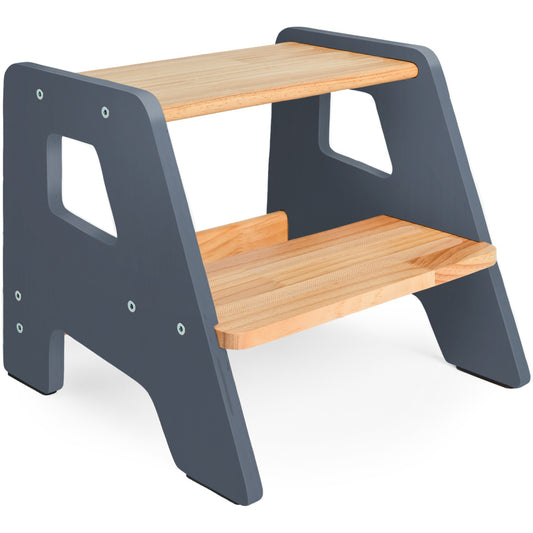
One practical option in homes where children need help reaching shelves or returning baskets is a sturdy step stool or helper tower used nearby, depending on the room and routine. Ocodile makes children's wooden stools and toddler towers designed to support safe participation in everyday home spaces.
A child who can access materials independently usually plays longer and asks for less rescue.
What adults should do less often
Independence doesn't mean leaving a child alone with no support. It means offering help carefully.
Try to avoid:
- Choosing every piece for them
- Correcting the design because it “should” look different
- Cleaning up before they've had a chance to restore order themselves
When the setup is thoughtful, children do more for themselves. That's the point.
Keeping Your Block Collection Tidy and Thriving
Blocks are easy to love and easy to scatter. The trick is creating a storage system that supports play instead of shutting it down. If cleanup is too complicated, children won't keep up with it. If storage is too hidden, they won't choose the blocks as often.
A good system is visible, simple, and easy to reset.
Storage that children can actually use
Use shallow baskets, trays, or bins your child can carry. Group similar pieces together so cleanup becomes matching, not guessing. If you want ideas that work well for family spaces with lots of small materials, these Stitch Mingle storage solutions offer adaptable organization ideas you can apply to toys too.
You can also explore practical toy storage organizers if you're trying to create a more child-friendly play area at home.
A few habits help:
- Use one rug or mat to define where building happens
- Return blocks by category instead of aiming for perfect visual order
- Leave an unfinished build briefly if your child is still working on it
- Limit overflow by rotating extra pieces out of sight
Basic care by material
Maintenance doesn't need to be fussy.
- Wooden blocks should be kept dry and checked for rough spots or wear
- Plastic blocks are usually the easiest to wipe clean after regular use
- Foam blocks benefit from prompt surface cleaning so they stay pleasant to handle
The goal is simple. Keep the collection safe, inviting, and ready for tomorrow's play.
If you're building a home environment that supports independence, movement, and open-ended play, Ocodile offers child-focused furniture designed to help families create practical spaces where children can explore safely and participate more confidently in everyday life.