



Wooden Building Toys: A Parent's Complete Guide
You may be reading this while your child is on the floor beside you, stacking a few blocks into a wobbly tower. They place one more piece on top, hold their breath, and wait. The tower falls. They laugh, rebuild, and try again.
That simple moment can look small from the outside. In early childhood, it is anything but small. A child is testing weight, balance, patience, grip strength, planning, and imagination all at once.
That is why wooden building toys have stayed relevant for generations. They do not flash, sing, or direct the play. They hand the work of thinking back to the child.
More Than Just Blocks The Timeless Appeal of Wooden Toys
A wooden block can be a bridge before breakfast, a zoo by lunchtime, and a birthday cake after dinner. Children do not need instructions to begin. They need space, time, and a few solid pieces they can trust in their hands.
That is part of the lasting appeal of wooden building toys. They are simple enough for a young child to understand quickly, but open enough to keep growing with that child over time. A toddler may stack and knock down. A preschooler may sort by shape and build a garage. An older child may design a whole town.
Why simple toys keep children's attention
Many parents notice that the toys with the fewest built-in features often invite the most thought. A plain wooden rectangle does not tell a child what it is. The child decides.
That choice matters. When children invent the purpose of the object, they practice flexible thinking. They also stay active in the play instead of becoming passive watchers.
A set of wooden building toys also tends to fit naturally into family life. They can live in a basket in the living room, come out during quiet time, or turn into part of a bedtime story. They do not require batteries, charging, or a special script.
A long history with a clear purpose
These toys are not just charming leftovers from the past. They were created with learning in mind. Friedrich Fröbel, an educationalist, designed the first modern building blocks in the 19th century for indoor play to develop children's cognitive and motor skills, which was a major shift at a time when children had largely played outdoors. By 1913, educator Caroline Pratt standardized block sizes, and that system is still used in schools today, as described in the cultural history of building block toys from Stadtmuseum Berlin.
That history helps explain why wooden building toys still feel so useful. They were not invented as decoration. They were built as tools for learning through the hands.
Key takeaway: Good wooden toys do less for the child, so the child can do more with them.
Parents sometimes worry that a simple toy will be boring. In practice, the opposite is often true. The less a toy performs, the more room a child has to create, test, narrate, and repeat.
The Developmental Magic Unlocking Skills with Wooden Toys
Children often look like miniature architects when they build. They study the base, test the top piece, adjust a crooked wall, and step back to see if their plan makes sense. Wooden building toys turn abstract skills into something children can touch.

Hands learn before words do
Before a child can explain balance, they can feel it. They notice that a wide piece under a narrow one works better than the reverse. They learn that careful placement matters.
This is one reason block play supports fine motor control. Picking up a block, turning it, lining it up, and placing it gently all strengthen hand muscles and coordination. Those same physical skills support daily tasks like using utensils, putting on shoes, and later holding crayons and pencils with control.
Thinking grows through trial and error
Wooden building toys are excellent for problem-solving because they give immediate feedback. If the structure leans, the child sees it. If the tower collapses, the child gets another chance to figure out why.
Children also build spatial reasoning as they compare sizes, rotate shapes, and picture where a piece might fit. You can see this happen when a child pauses with a block in midair, turns it, and tries a new angle.
For parents who want a broader look at how open-ended materials support learning, this piece on educational wooden toys offers helpful ideas.
Open-ended play strengthens imagination
A wooden arch can be a tunnel. Then it becomes a rainbow. Then it is a doorway to a castle. This kind of symbolic play is one of the richest parts of early childhood.
Because wooden building toys do not lock children into one outcome, they support:
- Storytelling: A child builds a house, then invents who lives there.
- Role play: Blocks become food at a pretend market or beds in a doll hospital.
- Flexible thinking: The same pieces solve different creative problems each day.
This matters in everyday family life. A child who can imagine a new use for a block is practicing the same mental flexibility they use when routines change or when they need to find another way to solve a challenge.
Social learning happens block by block
Block play can be wonderfully social. Two children building together must negotiate space, explain ideas, and respond when their plans differ.
One child says, "Let's make a road." The other wants a tower. They work it out. That moment includes communication, compromise, and shared attention.
Building also teaches emotional balance
Not every tower survives. That is part of the lesson.
When a child rebuilds after a crash, they practice persistence. When they slow down to place a top piece carefully, they practice focus. When they feel disappointed and then try again, they practice emotional regulation.
Try this observation: Watch your child during block play without stepping in too quickly. You may notice planning, frustration, adjustment, and pride all within a few minutes.
That is the hidden power of wooden building toys. The learning is woven into the play, so children stay engaged while doing the work of development.
Choosing Safe and Sustainable Wooden Toys A Guide to Standards
Buying wooden building toys can feel straightforward until you start reading labels. Solid wood, hardwood, non-toxic finish, water-based paint, FSC-certified. The words blur together quickly.
A good way to simplify the decision is to focus on three things first. Construction, finish, and stability.

What parents should check first
Start with the toy in your hand, or with detailed product photos if you are shopping online.
Look for these signs:
- Smooth surfaces: Pieces should feel sanded and finished without rough edges.
- Rounded corners: Especially for younger children, softer edges reduce bumps and make handling easier.
- Secure construction: Parts should not wobble, separate, or feel brittle.
- Clear finish information: Choose toys described as using child-safe, low-odor finishes.
- Appropriate size: Small loose parts are not a good fit for very young children.
Parents who want more ideas on materials and eco-conscious choices can read about sustainable wood toys.
What the newer safety guidance means in plain language
Safety standards can sound technical, but the practical meaning is simple. Large wooden playpieces should stay stable during real child use.
According to the wooden toy safety standard update summary, the EN 71-1:2025 revision imposes stricter requirements to reduce tipping hazards. It notes that large playpieces must pass revised stability protocols to prevent overturn, and that hardwoods such as beech have a compressive strength of 50 to 60 MPa and offer 30% better fatigue resistance than soft pines in repeated assembly cycles.
For a parent, this translates to a few practical shopping insights.
How to apply the standard when you shop
You do not need to memorize technical language. Use the ideas behind it.
Favor stable designs
A toy with a broad, steady base is usually easier and safer for children to use than one that looks top-heavy or decorative but fragile.
Notice the wood type
Hardwoods often handle repeated use more gracefully. If a product mentions beech or another sturdy hardwood, that can be a helpful sign of durability.
Think about real play, not display
Children lean, stack unevenly, rebuild quickly, and sometimes bump their creations with enthusiasm. Choose wooden building toys made for that reality, not just for a shelf photo.
Shopping tip: If a large wooden piece looks beautiful but seems easy to tip with a small push, treat that as useful information.
Sustainability should support safety, not compete with it
Parents sometimes feel they must choose between natural materials and practical safety. In well-made toys, those goals can work together. Solid wood, careful joinery, and child-safe finishes should all support everyday use.
The best wooden building toys are not only pleasant to look at. They are dependable in a child's hands. That dependability is what makes free play feel safe enough to be meaningful.
Finding the Perfect Fit Selecting Toys for Your Childs Age
The best wooden building toys are not always the most elaborate ones. The best choice is the one your child can use with confidence right now.
A one-year-old and a five-year-old may both love blocks, but they use them very differently. Age guides help, but it is even more helpful to look at what your child is working on developmentally. Are they grasping, stacking, pretending, planning, or building with a clear goal?
A simple way to match toys to stage
For younger toddlers, the priority is handling. They need pieces that are easy to grip, easy to release, and satisfying to stack or line up.
For preschoolers, the challenge can increase. They often want pieces that allow more varied structures, roads, enclosures, or pretend scenes.
Older children usually enjoy complexity. They may want symmetry, balance, architectural details, or interlocking elements that let them hold a plan in mind.
Wooden Building Toy Recommendations by Age
| Age Group | Developmental Focus | Recommended Toy Types | Safety Considerations |
|---|---|---|---|
| 1 to 2 years | Grasping, stacking, cause and effect, hand-eye coordination | Large basic blocks, chunky cubes, simple shape blocks | Choose larger pieces, smooth edges, and sturdy finishes; avoid small parts |
| 2 to 3 years | Early problem-solving, sorting, simple pretend play | Rectangles, arches, ramps, nesting shapes, basic vehicle-compatible blocks | Check for stable stacking and durable surfaces that handle frequent dropping |
| 3 to 4 years | Imaginative play, planning, language growth, cooperative building | Mixed-shape block sets, bridges, houses, town pieces, simple interlocking sets | Look for well-finished edges and pieces sized for active group play |
| 5 years and up | Complex design, symmetry, persistence, multi-step building | Architectural sets, detailed construction kits, advanced pattern or structure sets | Choose strong materials and inspect for wear if the set is used often |
What this looks like at home
A young toddler may spend a long time filling and dumping a basket of blocks. That is not lesser play. It is exactly the right kind of experiment for that stage.
A child in the next stage may build a short wall, drive a toy animal around it, knock it over, and build again. The building and the pretend play begin to merge.
By the preschool years, children often care a great deal about what the structure means. They may announce, "This is the fire station," and then work carefully to make the building match their idea.
Common mismatches that frustrate children
Sometimes parents buy a set that is too advanced because it looks impressive. The child loses interest, not because they dislike wooden building toys, but because the materials ask for skills they do not yet have.
Watch for these signs of a mismatch:
- Too complex: Your child wants to build but cannot easily connect, balance, or place the pieces.
- Too limited: Your child keeps repeating the same short pattern and seems ready for more variety.
- Too delicate: The set works better for display than for active child use.
- Too small: Handling the pieces creates tension instead of fluency.
A useful rule: If your child can start using the toy without repeated adult correction, you are probably close to the right level.
Choose for the child you have today
It is tempting to buy for the child you think your child will become in a few months. Sometimes that works. Often, it creates shelf clutter.
A better approach is to choose wooden building toys that offer one easy entry point and some room to grow. That might mean a basic set with a few arches and planks rather than a highly specialized kit. Children usually show you when they are ready for the next layer of challenge.
Beyond the Basics Creative Play and Learning Activities
A basket of blocks does not need much adult direction, but a few thoughtful invitations can refresh play when it starts to feel repetitive. The goal is not to control the activity. The goal is to open a new door.
One morning, you might place a few toy animals beside the blocks. Suddenly the child is not just building. They are designing a barn, a bridge, or a hiding place.
Story builds
Try starting with a sentence instead of an instruction.
Say, "The bear needs a place to sleep before the rain comes." Then pause.
Some children build a house. Others build a cave, a fence, or a whole village. The story gives the blocks purpose without limiting imagination.
Blueprint play
Older preschoolers often enjoy drawing before building. Fold a sheet of paper into simple boxes and sketch a tower, a road, or a room.
Then let your child decide how closely to follow the plan. Some children love matching the drawing. Others use it as a starting point and change everything.
Early math without worksheets
Wooden building toys naturally invite early math thinking. You can sort pieces by size, compare lengths, make patterns, or count how many blocks are needed to reach a certain height.
Keep it conversational:
- "Which one is longer?"
- "Can you find two that match?"
- "What happens if we make a pattern?"
The learning stays grounded in action, which is how young children understand best.
A short visual break can spark new ideas for your next play session.
Small-world setups
Blocks become more engaging when they join the rest of a child's play world. Add scarves for rivers, wooden figures for families, or toy vehicles for deliveries and rescues.
A child who is less interested in stacking may become very interested in building a garage for cars or an animal shelter. The structure matters because the story matters.
Quiet-time challenges
If your child enjoys gentle structure, offer a simple prompt on a card or slip of paper:
- Build something tall
- Make a bridge
- Create a place to hide a toy
- Use only curved pieces
- Build with a friend
These prompts work well during quiet afternoons, classroom free play, or transitions when a child needs a focused activity.
Keep the invitation light: Offer the idea, then step back. Children often do more creative work when adults resist the urge to improve the plan.
The beauty of wooden building toys is that one set can support dozens of kinds of play. A toy that can become a city, a pattern game, a rescue scene, or a bedtime story earns its place in family life.
Creating an Independent Play Space With Safe Furniture
Parents often buy wonderful toys and then wonder why play still feels interrupted, messy, or adult-directed. The missing piece is often the environment. Children build longer and more confidently when the space around them supports independence.
That is especially true with wooden building toys. They need a surface, reachable storage, enough floor area, and furniture that lets children participate safely in daily life.
Why the environment matters so much
A notable guidance gap exists around combining wooden building toys with Montessori-style furniture. A 2025 Etsy seller survey found that 68% of Montessori parents were looking for "furniture-compatible block kits" but could not find options, highlighting an underserved niche for systems that turn standing towers and floor beds into safe building zones, as noted in this discussion of the wooden block set and the Montessori furniture gap.
That gap makes sense. Most advice talks about blocks on their own. Families live in real homes where play happens in kitchens, bedrooms, and shared living spaces.
Kitchen spaces can become supervised building zones
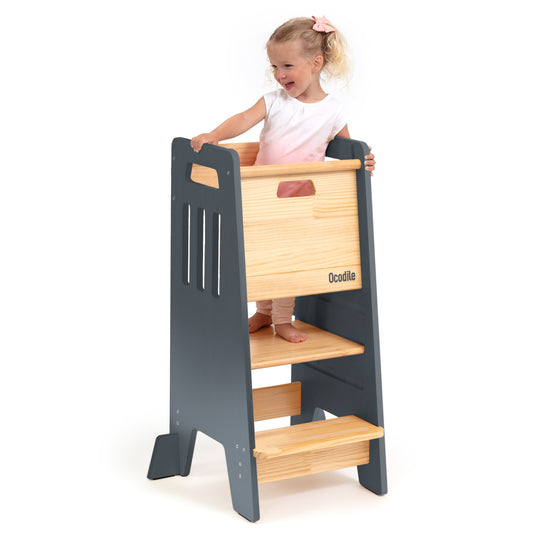
A standing tower can do more than bring a child up to counter height for cooking. In a supervised setting, it can also create a contained building station.
A child can work on a small arrangement of blocks while you prepare food nearby. That setup supports proximity without requiring constant entertainment. The child feels included in family life and still has meaningful work of their own.
Keep the activity simple in this kind of space:
- Use a tray or mat: It visually defines the building area.
- Offer a limited number of pieces: Fewer blocks can improve focus.
- Choose stable surfaces: Avoid crowded or slippery setups.
Floor-level spaces invite longer play
A low, open area often works best for bigger structures. A floor bed room or a calm play corner can offer the kind of accessible surface where a child can leave a project in place for a while.
That matters for children who like to return to their ideas. If every structure must be cleared immediately, some children stop attempting larger builds. A dedicated low space tells the child their work can continue.
How to create an invitation to play
You do not need a perfect Montessori room. Small changes help.
Keep materials visible
A low shelf or basket lets children choose blocks independently instead of asking for them every time.
Protect movement
Leave enough room for walking around the structure. Children need to view their building from different sides.
Pair furniture with purpose
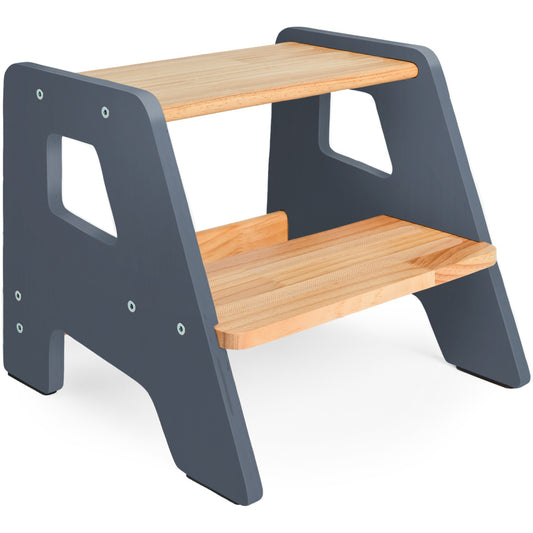
A stool near a low shelf, a mat near a basket of blocks, or a reachable surface for small builds can make the play feel more self-directed.
Practical rule: If a child can get the materials, use them, and put them away with little help, the setup is supporting independence.
When parents think about wooden building toys and furniture as one connected system, the home becomes easier for children to use well. The toy does part of the work. The environment does the rest.
Caring for Your Toys to Ensure a Lifetime of Play
Wooden building toys can last a long time, but they are not maintenance-free. If parents treat them as indestructible, the pieces may dry out, roughen, or splinter with heavy use.
That point matters because the trade-off is real. A 2025 Good Housekeeping test found that 22% of wooden sets splintered after two years of heavy use, compared with 5% for reinforced plastics. The same test also found 0% phthalates in wood versus 12% in budget plastics, which highlights the balance between maintenance needs and material safety, as summarized by Uncle Goose's discussion of wooden toy durability and safety.
Simple care that makes a difference
A little routine care goes a long way.
- Wipe gently: Use a lightly damp cloth, then dry the pieces promptly.
- Inspect often: Check for rough spots, cracks, or edges that no longer feel smooth.
- Store thoughtfully: Keep blocks in a dry basket, tray, or low shelf rather than piled in a damp corner.
- Rotate when needed: Resting a heavily used set now and then can help you notice wear before it becomes a problem.
Families looking for ideas to keep blocks tidy can explore these wooden toy storage solutions.
Know when to repair and when to retire
If a block develops a rough edge, remove it from play until you decide whether it can be safely refinished or should be discarded. Parents do not need to panic over every sign of wear, but they should take texture changes seriously.
Best habit: Run your hand over the blocks every so often. Your fingers usually catch a problem before your eyes do.
Well-cared-for wooden building toys reward that effort with years of meaningful use. The maintenance is part of what turns a toy from a quick purchase into a lasting family material.
Conclusion Building a Foundation for Lifelong Learning
Wooden building toys ask children to do something powerful. They invite them to think, test, imagine, adjust, and try again.
That invitation supports much more than play. It supports hand skills, early reasoning, creativity, language, persistence, and confidence. It also gives parents a way to bring learning into ordinary family moments without making childhood feel over-managed.
The strongest results come from the full picture. Choose toys that fit your child's stage. Look for safe materials and stable construction. Offer fresh play ideas without taking over. Shape the home so children can reach, use, and return to their materials with increasing independence.
When simple toys and thoughtful spaces work together, children often show us how capable they already are. A few well-made blocks, used in the right environment, can help build habits of curiosity that last far beyond the early years.
Ocodile creates child-friendly furniture that helps families turn everyday spaces into safer, more independent learning environments. If you want to pair wooden building toys with practical pieces like standing towers, floor beds, and step stools, explore Ocodile for ideas that support confident play at home.