



Quality Assurance Process for Child Furniture
A toddler climbs into a learning tower while you're preparing dinner. You steady the frame with one hand and notice the plywood, dowels, joints, and finish beneath your child's fingers. A quiet question appears: were these parts properly checked, or were they just assembled and sold?
That worry isn't neurotic. It's the right starting point. Child furniture gets climbed on, leaned against, chewed, bumped, and used far more energetically than many adults expect. A reliable answer doesn't come from a slogan. It comes from a documented quality assurance process that makes problems less likely before a tower, floor bed, or shelf reaches your home.
Table of Contents
- The Moment Parents Start Asking About Quality
- What Quality Assurance Means for Child Furniture
- The Six Stages Behind Every Safe Piece
- Standards, Certifications, and What Each One Actually Covers
- Safety Tests That Catch the Risks You Cannot See
- When Something Goes Wrong and How It Gets Fixed
- A Parent's Checklist for Evaluating Any Child Furniture Brand
- Why This Process Matters Every Single Day
The Moment Parents Start Asking About Quality
A child shifts position on a learning tower while you prepare food. One foot lifts slightly, the frame moves, and you look more closely at the joints, rails, and finish. Questions follow: was the structure checked for stability, can the surface handle daily contact, and were the parts made to one consistent specification?
Those questions matter because children test furniture in ways adults may not predict. A toddler can pull on a rail, twist a knob, lean sideways, or climb higher than expected. A dependable maker accounts for those actions before the product leaves the workshop.
What happens before the box arrives
Quality work starts with decisions recorded on paper or in a controlled digital system. The maker reviews the design, approves materials, sets production instructions, performs inspections, and documents safety tests. If a part or finished piece falls outside the approved specification, the team identifies affected items, investigates the cause, and records the correction.
The same sequence applies to a learning tower, floor bed, or small stool. The measurements and risks differ, while the need for a repeatable method remains. Parents should not have to take furniture apart to learn whether the maker worked from controlled drawings, checked incoming materials, and inspected the finished piece.
Ask a brand how it proves control, rather than accepting a general description of quality. A useful answer should connect the design, materials, workmanship, testing, and records.
The history of formal quality systems explains why these practices use shared terms. The UK's BS 5750 was published in March 1979 as the world's first quality management systems standard. ISO adopted that work in 1987 to create the ISO 9000 family, the first internationally harmonized quality assurance framework. ISO 9001 later became one of the world's most widely adopted quality systems, with more than 1.2 million certified organizations globally, as DQS explains in its history of ISO 9001.
For a parent, the label matters less than the habits behind it. Can the brand show what it approves, what it checks, and what happens when a result is wrong? Those questions turn a broad promise into something you can evaluate before purchase.
What Quality Assurance Means for Child Furniture
Quality assurance is the planned, documented system used to prevent defects. It covers the decisions made before production, the controls used during production, and the evidence retained afterward. Quality control is narrower. It checks a product or process to find out whether it meets the approved requirement.
For example, quality assurance defines the approved radius for a tower edge, the permitted material specification, and the inspection method. Quality control measures an actual edge, checks the supplied plywood, or tests an assembled sample. QA builds the system. QC verifies that people are following it.
Prevention versus detection
A final inspection can catch a loose dowel. It can't undo every risk created by an unclear drawing, an unqualified supplier, or a tool that has drifted out of adjustment. That's why the process begins with design controls and continues through sourcing, assembly, testing, corrective action, and traceability.
Child furniture needs this prevention-first approach because children often use products in unpredictable ways. An adult may notice that a piece is unstable and step away. A young child may keep climbing, pull sideways, or place weight where the designer didn't expect it.
Standards vocabulary gives the workshop a shared language. ASTM requirements help define product-specific safety expectations, CPSIA addresses certain children's product risks, and ISO 9001 provides a management-system framework for documented processes, audits, corrective action, and continual improvement. These references don't replace practical judgment. They help turn that judgment into repeatable instructions and evidence.
For a useful distinction between inspection activity and broader quality controls, see this Genpire quality control overview. The important takeaway is simple: a written program should explain what gets checked, who checks it, what counts as a failure, and what happens next.
The Six Stages Behind Every Safe Piece
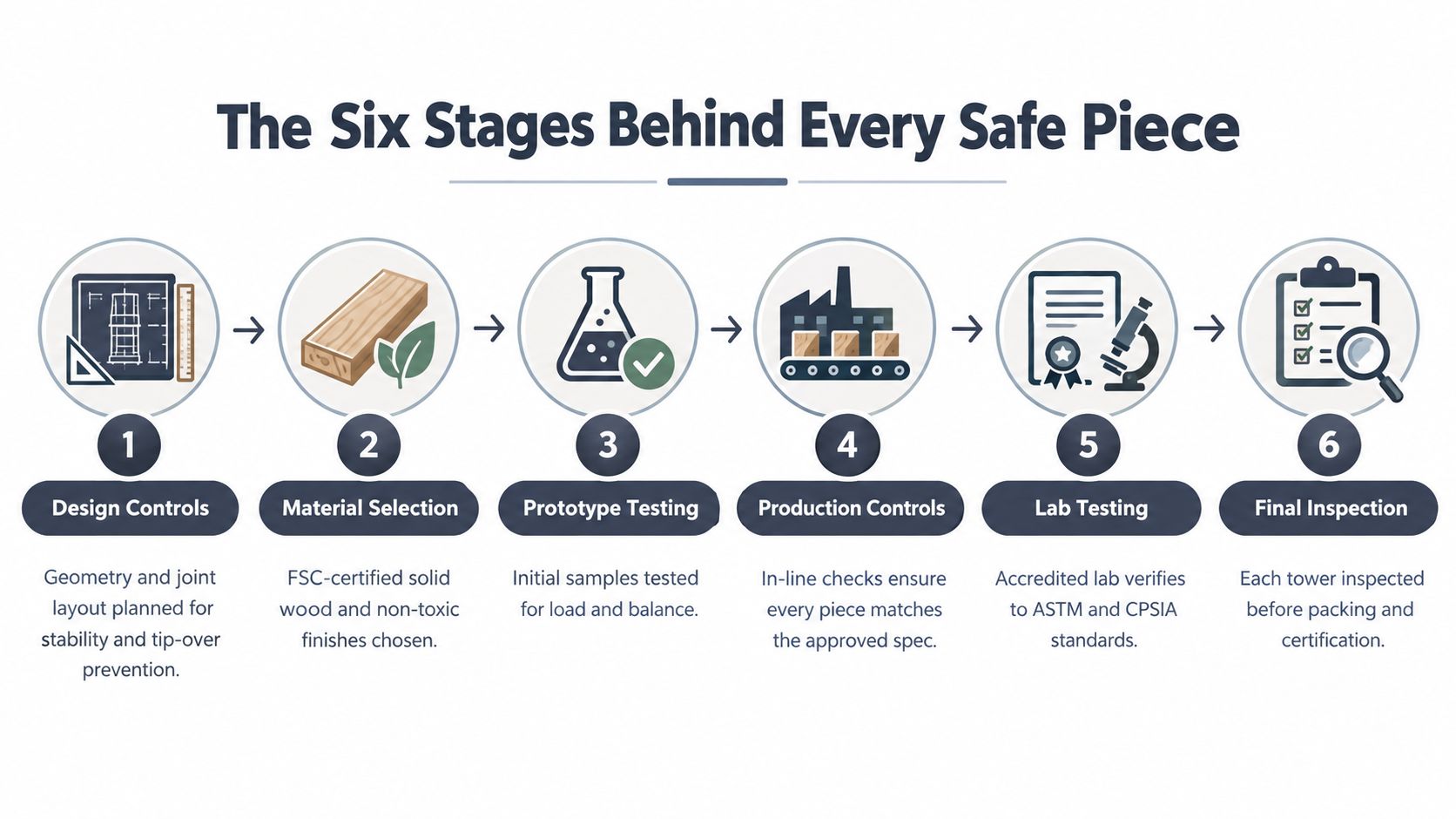
A child-furniture quality assurance process can be understood as six connected stages. Each one answers a different question before the product reaches a family room.
1. Design controls
Before cutting wood, the team reviews the tower's geometry, joint layout, opening dimensions, and fall height. For a tower, the design review considers stability and tip-over prevention against ASTM F2017 and the relevant CPSIA small-parts rule. The approved drawing becomes the reference for production, not a suggestion that each craftsperson interprets differently.
2. Material sourcing
The maker qualifies suppliers and defines what incoming materials must meet. That may include FSC-certified birch plywood, GREENGUARD finishes, and inspections of moisture content and formaldehyde emissions. A material certificate is useful only when the delivered material is checked against it.
3. In-process inspections
Checks happen during cutting, sanding, and assembly. A worker verifies dowel fit, edge radius, hole placement, and joint glue-up while correction is still practical. If a part is wrong before finishing, the team can rework or reject it without allowing the problem to travel further down the line.
4. Safety testing
Production samples are assessed for stability, static load, edge sharpness, and small-parts pull resistance. A sampling plan matters because the goal isn't to prove that one impressive prototype passed. It's to confirm that manufactured pieces continue to match the approved design.
5. Corrective action
When a deviation appears, the team opens a CAPA record, reviews the root cause, and decides whether the piece needs rework or scrap. The record should connect the problem to evidence, the responsible process, and a verified fix.
6. Traceability
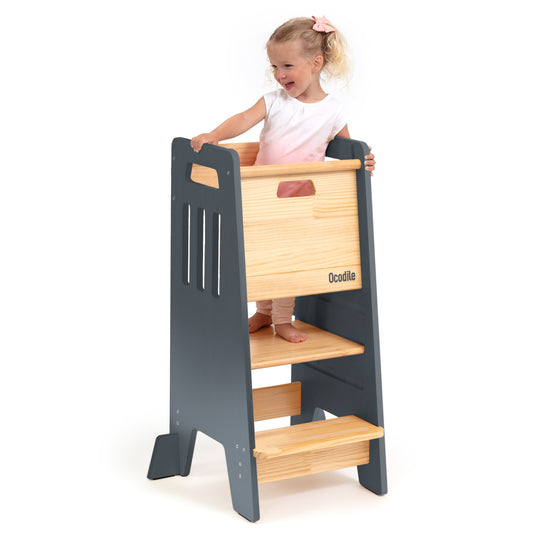
A batch code can link the unit to its wood lot, finish batch, inspector, and ship date. That makes a future investigation specific instead of speculative. A Standing Toddler Tower with Sliding Safety Door, for example, should be governed by the same kind of controlled checks that support its purpose, helping children climb independently and join household activities.
Standards, Certifications, and What Each One Actually Covers
A parent may see several logos beside a learning tower and assume they describe one complete safety check. Each mark answers a different question. A quality program works more like a layered checklist: one layer examines how the brand controls its work, another examines the product, and others focus on materials or the wood supply chain.
ISO 9001 covers the management system behind production. An audit examines whether the brand defines processes, keeps records, reviews failures, and improves its controls. An ISO 9001 certificate therefore supports confidence in the way work is managed, but it does not prove that a particular tower withstands every condition in a child's room.
ASTM standards address product-specific physical safety requirements. They help define how an item such as a toddler bed or high chair should perform during relevant use and abuse conditions. CPSIA covers children's product requirements, including limits related to lead and phthalates. It addresses material and finish risks that a stability check cannot reveal.
GREENGUARD Gold focuses on chemical emissions from materials and finishes. It concerns off-gassing that may not be visible during a physical inspection. FSC chain of custody follows a wood claim through the supply chain. It helps verify the material's source and handling, rather than proving that a joint is strong.
| Standard or Certification | Primary Risk It Addresses | What Evidence to Ask For |
|---|---|---|
| ISO 9001 | Weak or inconsistent management processes | Current certificate, audit scope, documented corrective-action system |
| ASTM | Product-specific physical safety risks | Named standard, applicable product scope, test report |
| CPSIA | Certain children's product material risks | Children's Product Certificate and supporting test results |
| GREENGUARD Gold | Chemical emissions from materials and finishes | Certificate covering the actual product or materials |
| FSC | Unverified responsible-wood and supply-chain claims | Chain-of-custody documentation for the supplied wood |
ISO 9001 is a useful benchmark for a mature quality system, provided the certificate applies to the relevant organization and scope. Ask for the current certificate and read what it covers. A certificate for a different site, activity, or product does not answer the question you intended to ask.
For material-focused questions, non-toxic children's furniture guidance can help parents separate finish concerns from structural testing. Ask which document addresses which risk. A logo without a product scope, date, or report gives less information than clear, product-specific evidence.
Safety Tests That Catch the Risks You Cannot See
A furniture sample can look beautiful and still fail an important safety question. Testing turns abstract reassurance into a physical challenge. The strongest programs test production samples, because a prototype only proves what happened to that prototype.
| Test Category | What It Actually Checks |
|---|---|
| Stability | Whether a learning tower stays upright when a young child leans, shifts, or pulls sideways |
| Static load | Whether a floor bed frame can support an adult's weight together with a jumping child |
| Finish adhesion | Whether the finish remains attached through handling, teething, and saliva exposure |
| Edge and corner sharpness | Whether a rounded edge is sufficiently smooth if a child falls against it |
| Small-parts or choking hazard | Whether a detachable knob or component presents a risk, including assessment with the 35 mm cylinder test for children under three |
Stability testing deserves special attention because children don't use furniture in tidy, predictable sequences. A tower may be safe when a child stands centered and less stable when the child reaches toward a bowl. Parents can find a practical explanation of stability testing methods and use that language when asking a brand what it has evaluated.
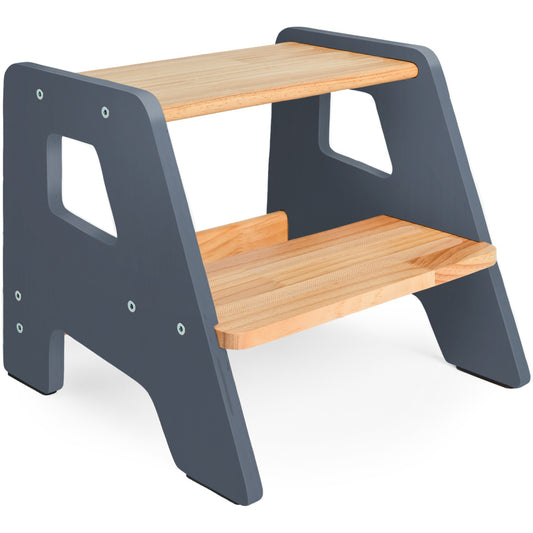
A 2-Step Wooden Stool for Toddlers (Step Stool for Children Ages 2+) is used for everyday independence, helping a child reach sinks, toilets, beds, and kitchen counters. That use makes secure footing, smooth edges, and reliable construction practical concerns, not decorative details.
Testing also needs repetition. A passing result is a point in time. A continuing quality assurance process checks again after a material change, hardware swap, tool adjustment, or finish-batch change.
When Something Goes Wrong and How It Gets Fixed
A useful example starts with a tower sample that rocks on a flat floor. The inspector doesn't tighten a screw and move on. The line pauses, the affected lot is quarantined, and the nonconformance is recorded with photographs, the batch number, and the inspection result.
The team then asks why the movement appeared. A 5-Whys review might reveal that a jig had worn. A fishbone review might also identify an unclear drawing, a change in hardware, or an assembly instruction that allowed too much variation.
From defect to verified correction
The correction could involve replacing the jig, revising the drawing, retraining the assembler, or reworking affected pieces. The team produces a new sample and repeats the relevant check. Only after the result meets the approved requirement should the CAPA record be closed.
Documentation becomes more valuable than polished language. A clean CAPA history shows that the maker can detect an issue, contain it, understand its cause, and verify that the fix works. It also helps the next production run avoid repeating the same mistake.
A defect found and controlled inside the workshop is information the process can use. A defect discovered by a child's family is a failure of containment.
Parents can also ask how the brand handles support after purchase. Policies such as extended warranty options don't replace safety controls, but they can reveal whether a company has thought about ownership beyond the shipping carton. An Adjustable Foldable Kitchen Tower adds another practical question, since its compact design folds flat for storage in small spaces. Moving parts deserve the same controlled inspection as fixed joints.
A Parent's Checklist for Evaluating Any Child Furniture Brand
Before buying, ask for documents rather than broad assurances. A Children's Product Certificate should correspond to the exact product. Test reports should identify the applicable standard and come from an appropriately accepted or accredited laboratory. FSC or GREENGUARD records should cover the relevant wood or finished product, not merely a similar material.
A simple verification sequence
- Name the standard: Check that the report identifies the current ASTM or CPSIA requirement that applies to the product.
- Match the product: Cross-check the product name, model description, materials, and configuration against the CPC and test report.
- Check the laboratory: Look up the laboratory named in the report and confirm that its scope supports the testing described.
- Ask specific questions: Request clarification when a brand uses “safe,” “non-toxic,” or “certified” without naming the risk covered.
- Observe the product: Look for wobble, exposed fasteners, unfinished edges, strong unexplained odors, or missing age guidance.
A brand that answers clearly is easier to evaluate than one that sends only marketing images. Parents building a broader registry can also use this registry must-haves guide for Australian parents as a practical reminder to think about safety and suitability alongside appearance.
Read reviews with the same discipline. One complaint may describe an isolated event. A repeated pattern of wobble, missing hardware, inconsistent finish, or difficult support deserves more attention than a long list of comments about color. Praise for appearance is pleasant. Consistent references to construction, instructions, and dependable quality are more useful.
Why This Process Matters Every Single Day
A quality assurance process matters on the ordinary mornings when a child climbs, reaches, rests, and climbs down again. Design controls reduce preventable risks. Material checks protect against unsuitable inputs. In-process inspections catch variation early, while testing, CAPA, and traceability give the workshop a way to respond when reality differs from the approved plan.
The process also has to keep moving. A new hardware supplier, a changed finish, a revised drawing, or a production adjustment can require fresh review. ISO 9001's global adoption shows how widely organizations use structured quality management, while the continuing loss of certifications shows that a certificate isn't a substitute for daily control.
Recent audit findings in GMP and GLP reviews reported documentation and data-integrity issues in 78% of audits, compared with environmental monitoring in 44% and change control in 33%, as reported by The FDA Group's audit findings. That makes one habit especially valuable: ask a brand how it records tests, handles CAPA, and proves that its claims apply to the product you're considering.
For Ocodile, that means looking at Montessori-inspired furniture through practical questions about independence, stability, materials, and documented quality. Visit Ocodile to explore child furniture designed for everyday family use and ask the team the specific safety and quality questions that matter to your home.