




 - Monica
 - Lindsay

Water Activity Table: A Parent's Guide to Safe Fun
You searched for a water activity table, and instead of cute toddler setups, you may have landed on technical pages about moisture in food. That's a frustratingly common search detour. Parents usually aren't looking for lab measurements. You're probably looking for a simple, engaging way to help your child play, learn, and stay busy without another screen.
That confusion makes sense. In food science, water activity (aw) is a measure of the water available for microbial growth, and FDA guidance notes that controlling a food to aw 0.85 or below is a critical safety benchmark, which is why the phrase can pull up scientific material instead of children's play ideas (FDA water activity guidance).
For families, though, the term almost always points to a water play table. That's the child-height sensory table you fill with a small amount of water, then pair with cups, scoops, funnels, boats, or simple household tools. It looks playful on the surface, but it can do much more than keep a child occupied for a few minutes.
A good water table helps children practice real skills through repetition. They pour, spill, try again, compare containers, test what floats, and start noticing patterns. You don't need a complicated setup for that. You need a safe space, a few simple tools, and an adult who understands that play is often how young children make sense of the world.
Your Search for a Water Activity Table
If your search results felt mixed up, you didn't do anything wrong. The phrase water activity table belongs to two completely different worlds. One is food manufacturing. The other is early childhood play.

Why the term gets confusing
In technical food guidance, water activity refers to moisture availability. For parents, that's usually not relevant unless you're reading labels or food safety documents. What you likely want is a kids water play table, the raised basin children use for splashing, pouring, and experimenting.
That small wording difference matters because it changes the entire search result.
Practical rule: If you're shopping for a child's product, add words like kids, toddler, sensory, or water play table to your search.
What parents are usually hoping to find
Most families searching this term want one of these things:
- A screen-free activity that can hold a toddler's attention
- A sensory setup that feels open-ended instead of overly structured
- A practical outdoor or kitchen-adjacent toy that doesn't require elaborate prep
- A Montessori-aligned option that lets a child do real hands-on work
That's why water tables show up so often in homes, preschools, and play-based classrooms. They offer freedom within limits. A child gets room to explore, and you still keep the activity contained.
Why this matters in a Montessori-style home
Montessori-minded parents often look for activities that support independence, concentration, and purposeful movement. Water play fits beautifully when it's presented thoughtfully. A child can carry tools, fill and empty containers, wipe spills, and help with cleanup. That turns “messy play” into everyday practical learning.
The key is seeing the table as more than a summer toy. It can become a repeat-use learning station that grows with your child's interests, as long as safety stays at the center.
What Is a Kids Water Play Table
A kids water play table is a raised, shallow sensory station designed for children to explore water with their hands and simple tools. It's usually set at child height, which makes it easier for toddlers and preschoolers to stand comfortably and work without climbing into the play area.
More than a bucket of water
A regular tub can hold water, but a purpose-built water table changes how children interact with it. Many models include built-in channels, cups, ramps, wheels, spinners, or pouring spots. Those features create movement and response. A child pours water at one point and immediately sees it spin, travel, or collect somewhere else.
That instant cause-and-effect cycle is a big part of the appeal. A water play table is a sensory system where repeated pouring, spinning, and routing of water creates immediate feedback loops, strengthening fine motor control, hand-eye coordination, and early scientific reasoning about volume, gravity, and motion (AquaWorx overview of water play tables).
The basic parts to look for
Most water tables include a few core elements:
- A shallow basin for safe, contained water play
- A raised base or legs so children can stand and reach comfortably
- Play accessories such as scoops, cups, funnels, boats, or spinners
- A durable surface that can handle repeated use and cleaning
Some are very simple. Others have multiple sections so one side can hold water while another side holds shells, stones, or floating toys.
How it differs from a kiddie pool
A kiddie pool encourages whole-body play. A water table encourages hand work. That distinction matters. At a water table, children focus on transferring, testing, sorting, comparing, and observing. The body is active, but the hands and eyes do most of the learning.
Here's a simple comparison:
| Setup | Best for | Typical child action |
|---|---|---|
| Water table | Sensory play and early learning | Pouring, scooping, comparing, experimenting |
| Bucket or bin | Low-cost casual play | Splashing, filling, dumping |
| Kiddie pool | Cooling off and large-movement play | Sitting, wading, full-body splashing |
A good water table doesn't have to be fancy. It just needs to be child-accessible, easy to clean, and simple enough that your child can do most of the play without adult rescue every minute.
Why educators keep using them
Teachers and caregivers return to water tables because children rarely “finish” with them. The same basin can become a pouring station one day, a floating experiment the next, and a pretend car wash after that. The setup stays familiar, but the learning changes with the materials you add.
That flexibility is what makes the water activity table such a useful term for parents to understand correctly. Once you know you're looking for a sensory play tool, the search gets much easier.
The Developmental Magic of Water Play
Children don't need worksheets to begin learning science and math. They need repeated chances to notice what happens when they act on the world. Water play offers exactly that. Educational research highlights water tables as core sensory-learning centers that support early science and math concepts like floating and sinking, volume, and cause-and-effect, and the NAEYC recommends that sand and water areas be available to children daily (DuPage Children's Museum on water table learning).

Fine motor growth happens in small motions
The first thing many parents notice is hand work. A child grips a cup, tips a pitcher, squeezes a sponge, or uses a dropper. Those actions may look simple, but they build precision and control.
Water play supports:
- Hand-eye coordination as children aim into containers
- Finger strength through squeezing, pinching, and grasping
- Bilateral coordination when one hand steadies and the other pours
These are the same foundational body skills children later use for dressing, drawing, and handling tools.
Early science starts with curiosity
Water is wonderfully honest. Children get immediate answers. A full container becomes empty. A light object floats. A heavy object might sink. A wheel spins faster when more water hits it.
That's why water tables work so well for early reasoning. Children aren't memorizing facts. They're testing ideas with their own hands.
Some of the best early science questions sound very ordinary: “Why did that sink?” “Which cup holds more?” “How can I make the wheel move?”
If your family also enjoys larger outdoor water setups, it can help to think about scale. A water table supports focused sensory learning. A backyard pool supports broader water play and cooling off. For families considering both, this guide to installing a 10 ft round pool offers a practical look at what a bigger setup involves.
Language and social skills grow during shared play
Water tables often bring children together naturally. One child pours while another waits for a turn with the funnel. They negotiate tools, narrate what they're doing, and react to each other's discoveries.
You'll hear language like:
- “Mine is full.”
- “This one is bigger.”
- “Your boat is stuck.”
- “Let's make rain.”
That kind of talk matters. Shared sensory play encourages communication because children have something concrete to discuss in the moment. It also creates small chances to practice patience and cooperation.
Sensory regulation can be part of the appeal
For some children, water play is lively and exciting. For others, it's settling. The sound, movement, and repetition can help a child stay engaged without needing constant novelty. If you're building out a broader sensory space, Ocodile's ideas for a sensory table in preschool-style play at home can help you think beyond one single activity.
A child who resists tabletop tasks may stay with water work for a surprisingly long time because the feedback is immediate and meaningful. They can see the result of every action.
How to Choose the Right Water Table
Some water tables are simple and sturdy. Others are full of moving parts. Neither is automatically better. The right choice depends on your child's age, your available space, and how much setup and cleaning you're realistically willing to do.
When choosing a water table, buyers should consider that basin depth, material resistance, and accessory complexity should match the child's age. Simpler, lower-profile units are better for young toddlers, while multi-channel tables support more advanced, cooperative play (Jonti-Craft sand and water table guidance).
Start with your child, not the product page
A very young toddler often does best with a lower, simpler table. They usually want to scoop, dump, and repeat. They don't need a busy design with lots of detachable pieces.
An older preschooler may stay engaged longer with pathways, wheels, and multi-step pouring features. Those added elements can support longer play sequences and shared use with siblings or friends.
A simple comparison for buyers
| What to compare | Simpler table | More complex table |
|---|---|---|
| Best for | Younger toddlers, quick setup | Older preschoolers, group play |
| Cleanup | Easier | More parts to rinse and dry |
| Play style | Repetitive pouring and scooping | Cause-and-effect, routing, collaboration |
| Storage | Usually easier | Often bulkier |
Material and location matter more than many parents expect
If the table will live outdoors, choose materials that can handle sun and repeated washing. If you plan to use it indoors, look closely at how easy the basin is to empty and wipe down. Smooth surfaces are usually less fussy to maintain than heavily textured ones.
Consider these questions before buying:
- Will it stay outside or move in and out?
- Can you empty it completely after use?
- Are the edges smooth and rounded?
- Can your child reach the whole basin without climbing?
Buying lens: A water table should fit your home routine. If it's hard to clean, awkward to move, or too tall for your child, it won't get used often.
Don't overlook size and walking space
Parents sometimes focus only on table dimensions. Think about the space around it too. Children step sideways, reach, bend, and carry cups back and forth. A cramped setup creates more spills and more frustration.
Balcony or small patio families often do well with compact models or even a one-basin design. A larger yard can handle a wider setup for sibling play.
A DIY option can work well
You don't have to buy a branded table immediately. A large plastic storage bin placed on a stable child-height surface can function as a basic sensory station if safety is addressed carefully. Keep water shallow, remove the setup after play, and avoid unstable furniture.
A DIY version is useful when:
- You want to test interest first
- You need a lower-cost starting point
- You have limited storage
- You prefer rotating sensory bins instead of keeping one permanent table
That said, a purpose-built table is usually easier to clean and more comfortable for children to use independently. If your goal is lasting, regular use, that convenience can matter.
Inspiring Montessori Aligned Activities
Montessori-style water play works best when it feels purposeful, calm, and child-led. You don't need novelty for novelty's sake. A few everyday tools can create rich learning if the setup invites repetition and independence.

Pouring station with real kitchen tools
You'll need small pitchers, cups, a sponge, and a shallow amount of water.
Set out two or three containers with different shapes. Show your child how to pour slowly, wipe a spill with the sponge, and return tools neatly to the tray or table edge. This is simple, but it's one of the strongest practical life exercises because it combines concentration, control, and cleanup.
Sink or float basket
Gather a few safe household items such as a spoon, cork, leaf, measuring cup, or toy boat. Invite your child to place one item in the water at a time and observe what happens.
Keep your language light. You don't need to quiz. Try comments like, “You noticed that stayed on top,” or “That one dropped to the bottom.”
Transfer work with spoons and ladles
If your child isn't ready for free pouring, begin with transfer work. Put water in one basin and place an empty container next to it. Offer a spoon, ladle, or small scoop.
This slows the activity down and often helps children who get overexcited by splashing.
For parents building practical life routines beyond water play, Ocodile's guide to Montessori practical life activities pairs nicely with these kinds of setups.
Wash the animals or kitchen items
Place a few plastic animals, large shells, or child-safe utensils in the basin. Add a soft brush or cloth. Children often love the “real work” feeling of washing objects one by one.
This activity works especially well for children who enjoy order. They can scrub, rinse, and place each item in a basket to dry.
A quick visual example can help if you want to see a calm setup in action:
Funnel and tubing exploration
Use funnels, cups, and any water-safe routing pieces your table includes. Let your child test how water moves through different paths. If the table has built-in channels or spinners, those features are at their best.
Water play becomes more Montessori-aligned when the adult prepares the environment carefully, then steps back enough for the child to repeat and refine.
Nature-based water table
Add leaves, smooth stones, flower petals, or floating herbs from the garden. This creates a beautiful sensory invitation without lots of plastic extras. It also helps children notice texture, smell, and change in a gentler way.
Bubble whisk station
Add a small amount of child-safe soap and provide a whisk, spoon, or brush. This can be very engaging, but it works best as an occasional variation rather than the daily default since it adds more cleanup.
If you want the table to stay fresh without buying many accessories, rotate tools instead of reinventing the whole setup. New containers, different spoons, or natural materials are often enough.
Setup Safety and Maintenance Best Practices
Parents usually worry about three things with a water activity table. The floor will get slippery. The basin will get dirty. The child will need constant rescuing from chaos. Those concerns are reasonable, but they're manageable when you set clear routines from the start.
Public health guidance emphasizes that shared water can spread germs. The decision to use a water table is less about the toy itself and more about establishing maintenance routines for draining, cleaning, and sanitizing the basin between uses (Community Playthings on making the most of water play).

Safety starts before the water goes in
Choose a spot with stable footing. Outdoors, that might be level pavers or a patio. Indoors, it may be tile with a towel or splash mat nearby. Avoid placing the table where a child has to lean across uneven ground or back into furniture.
Keep the water shallow and stay close. Young children need active supervision around water play, even when the basin looks small and harmless.
For outdoor sessions in sunny weather, think beyond the table itself. Shade, clothing, and timing matter too. This kids' beach sun protection guide is useful because the same sun-safety habits apply to backyard water play.
A simple hygiene routine that actually works
You don't need a complicated system. You do need consistency.
- Use fresh water each session. Don't leave yesterday's water sitting in the basin.
- Empty the table right after play. Standing water invites grime and makes cleanup harder.
- Wash and sanitize the basin between uses. Focus on the areas children touch most.
- Let accessories dry fully. Cups, funnels, and toys should dry before storage.
Shared water stays safer when adults treat cleanup as part of the activity, not as an optional extra at the end.
Teach the cleanup as part of the lesson
A Montessori-aligned home doesn't separate play from responsibility. After water play, children can help carry cups, place tools in a basket, wipe the rim, and wash hands. If your child is learning home routines, a broader guide to how to childproof your home can help you create spaces where that independence is safer and easier.
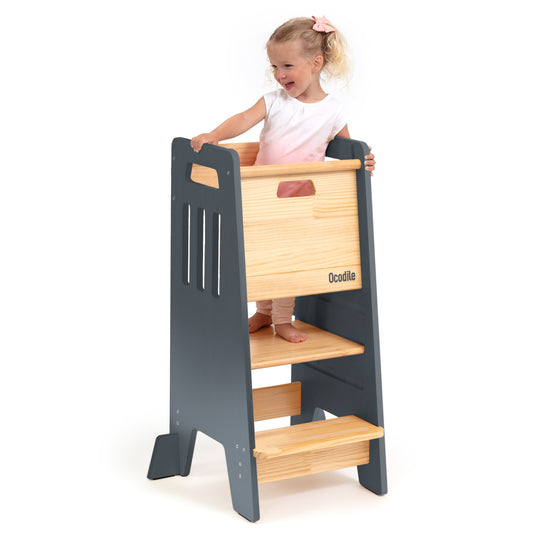
One practical support can be a stable child step stool or learning tower at the sink so a child can rinse cups or wash hands with supervision. Ocodile makes furniture for that kind of supported participation in family routines.
Watch for the real trouble spots
The water table itself usually isn't the biggest issue. The trouble starts around it.
Pay attention to:
- Slippery ground from repeated splashes
- Mouthed water tools that need more frequent cleaning
- Cracks or worn surfaces that are harder to sanitize
- Overloaded basins with too many accessories
Children also stay more regulated when the environment is calm. Too many extras can turn a focused sensory activity into frantic dumping.
A short maintenance checklist
| Task | When to do it | Why it matters |
|---|---|---|
| Drain basin | After each use | Helps prevent stagnant water and mess |
| Wipe and sanitize | Between uses | Reduces contamination risk |
| Dry accessories | After washing | Helps prevent moldy storage |
| Inspect for wear | Regularly | Keeps edges and surfaces safe |
Once these habits become routine, water play feels much easier. Most families find that the stress drops quickly when setup and cleanup follow the same predictable pattern every time.
Embrace the Splash and Foster Independence
A water activity table can start as a simple search term and become one of the most useful learning tools in your home. Used well, it supports concentration, movement, problem-solving, and joyful repetition. Used safely, it also teaches children that fun and responsibility belong together.
The goal isn't a perfect setup. It's a prepared environment where your child can explore with confidence, help care for their space, and build independence through everyday play.
If you're creating a home that supports safe exploration and practical independence, Ocodile offers child-focused furniture designed to help young children take part in daily family life with more confidence and support.