



Wooden Blocks Stacking: Montessori & Milestones
Your child is on the floor with a fresh set of blocks. One goes in the mouth. One gets banged on the coffee table. One lands on your foot. Then, for a brief moment, your toddler carefully places one block on top of another and looks up like they’ve discovered magic.
That tiny moment matters more than most parents realize.
I’ve watched block play in classrooms, at kitchen tables, and in my own living room. Wooden blocks stacking looks simple, but it asks a child to do a lot at once. They have to steady their hand, judge space, notice balance, and try again when the tower falls. That’s a rich kind of learning.
The Timeless Power of a Simple Wooden Block
A good set of wooden blocks often becomes the toy that stays out all day. Children return to it in short bursts, then in long periods of deep focus. A baby may start by holding and tapping. A toddler may build a tower, knock it down, and rebuild it with complete seriousness.

Why blocks have lasted so long
Wooden blocks aren’t a trend. Their modern educational history began in the 19th century when Friedrich Fröbel, the founder of kindergarten, designed the first “building bricks.” By 1913, Caroline Pratt developed systematic unit blocks, which were standardized in size and varied in shape, and those blocks are still used in schools today, as described in this brief cultural history of building block toys.
That long history tells us something important. Adults have kept returning to blocks because children keep learning from them.
A block doesn’t flash, sing, or tell a child what to do. The child has to supply the idea. That’s why the same basket of blocks can become a tower, a road, an animal house, or a pretend birthday cake in one afternoon.
What children are really practicing
When children work on wooden blocks stacking, they aren’t only making tall towers. They’re building early habits that support later learning.
- Hand control helps them place one piece carefully instead of dropping it.
- Visual judgment helps them line up edges and notice when a block leans.
- Problem-solving begins when the tower falls and they try a different approach.
- Creativity grows because there’s no single correct result.
Wooden blocks give children a rare kind of play. It’s open-ended, physical, and calm at the same time.
Why this fits Montessori so well
Montessori homes and classrooms value simple materials, order, independence, and real concentration. Blocks fit naturally into that approach.
A child can see the material clearly, carry it themselves, and repeat the work as often as they want. There’s no battery to interrupt them and no script to follow. The learning comes from the hands.
That’s one reason block play has stayed central for so many families. It respects the child’s pace while still offering a meaningful challenge.
Your Child's Stacking Journey Age by Age
You set two wooden blocks in front of your baby. One gets banged on the floor. One gets mouthed. A few months later, that same child is carefully placing one block on top of another and holding their breath to see if it stays. That is how stacking usually begins. Slowly, physically, and through repetition.
For parents, it helps to see stacking as a journey of control and balance, not a race to build the tallest tower. A child is learning how their hands move, how objects meet, and why some towers stand while others tip. That early lesson in physics is simple but powerful. A block that sits flat is more stable than one placed on an edge, just as a chair stands best when all four legs meet the floor.

From 6 to 12 months
At this stage, babies often explore blocks with their whole body. They grasp, switch a block from one hand to the other, drop it, tap it, and listen to the sound. Those actions are the groundwork for stacking later.
A steady hand starts with broad practice. Before a child can place one block neatly on another, they need to learn, "How hard do I hold this?" and "What happens when I let go?"
From 12 to 18 months
This is often the season of first towers. Your toddler may stack one block, pause, line up the next one, and then squeal when it stays up.
Success will come and go. That is normal. Young toddlers are still coordinating their eyes and hands, and they are only beginning to understand balance. If the top block is off-center, even a little, gravity takes over quickly.
Here is a simple way to read what you may notice:
| Age range | What you may see |
|---|---|
| Around 12 months | One block placed on another, or close attempts |
| By 15 months | A 2-block tower becomes common for many toddlers |
| By 16 to 18 months | More consistent stacking of 2 to 3 blocks |
One developmental milestone review found that 15% of infants can stack one block at 10 months, more than 75% of toddlers can build a 2-block tower by 15 months, over half can build a 5-block tower by 18 months, and by age 3 children are generally expected to stack 6 or more blocks, according to this developmental milestone review.
From 18 to 24 months
Now you often see more intention. Children slow their hands down, watch the edges, and make small corrections before letting go. They are starting to notice a rule that adults use without thinking. A wide, flat base gives the tower a better chance of staying up.
This is also the age when frustration can rise. A toddler knows what they want the tower to do, but their hands cannot always match the plan yet. That gap is part of learning.
A reassuring rule: look for steady progress over time, not perfect performance on one afternoon.
From 2 to 3 years
By now, many children move beyond straight towers. They may still stack high, but they also begin making rows, enclosures, bridges, and simple pretend settings. The play becomes more thoughtful because the child is no longer focused only on "Can I stack this?" They are asking, "What am I building?"
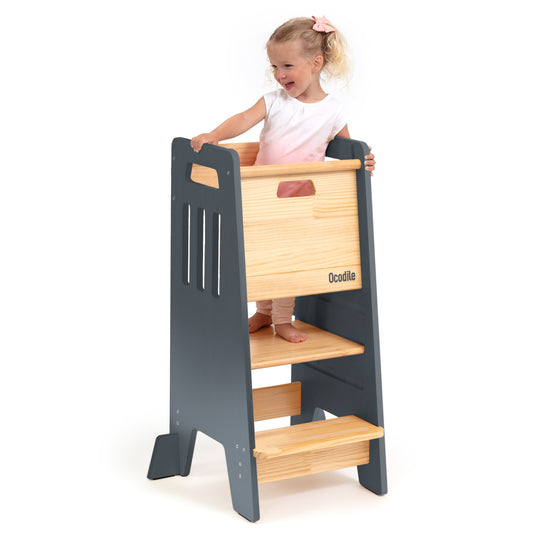
That shift fits Montessori beautifully. Repetition is still there, but now it serves a purpose chosen by the child. A calm, orderly setup helps that happen. Low open shelves, a child-sized table, and easy-to-carry baskets let children choose blocks independently and return to the work again and again. Furniture designed for children, such as Ocodile pieces, can support that independence by giving block play a defined place that feels accessible and inviting.
If you want a wider view of what children tend to practice across the early years, this guide to child development stages by age is a helpful companion.
When not to worry too quickly
Children do not all approach blocks in the same way. One child stacks. Another lines blocks up carefully. Another carries them from one room to another like treasured cargo.
All of that counts as meaningful work. Transporting builds coordination. Lining up supports visual order. Dropping and watching teaches cause and effect. In Montessori terms, the child is still following an inner plan, even when it does not look like tower-building yet.
Montessori Activities to Inspire Your Little Builder
A child doesn’t need complicated instructions to get more from block play. They need a calm setup, a small invitation to begin, and enough time to repeat the action.
That’s the heart of Montessori. Prepare the environment. Offer the material. Let the child discover.

Start with a prepared space
Children concentrate better when the space is simple.
Try this setup:
- Use a defined work area such as a low rug or child-sized table.
- Offer a small number of blocks instead of the whole bin.
- Keep the shelf orderly so the child can return the blocks independently.
- Limit distractions like loud toys nearby or a television in the background.
A steady surface matters. Wobbly trays and soft bedding make wooden blocks stacking harder than it needs to be.
How adults can guide without taking over
Children learn more when we show just enough.
Research on block play explains that the thinking involved in stacking includes spatial reasoning, planning, and error correction. It also notes that adult guidance with demonstrations and size-language such as “larger” and “balance” leads to better outcomes than unguided play, as described in this article on how wooden blocks promote child development.
That doesn’t mean building the tower for your child. It means offering a light scaffold.
“I’m putting the larger block at the bottom.”
“This one is leaning.”
“You found a way to balance it.”
Those short comments help children connect action with language.
Activity ideas that grow with your child
Some children get stuck because adults offer only one kind of challenge. Towers are wonderful, but they aren’t the only meaningful work with blocks.
Line them up
Invite your child to place blocks in a straight row from left to right.
This supports visual order and hand control. It’s also a gentle entry point for children who resist tower building.
Build a tower with a purpose
Try “Let’s make a tower for the bear to look out from.”
Pretend play gives the task meaning. Many toddlers will work longer when the structure belongs to a toy animal or tiny figure.
Sort by shape or size
Ask your child to make one pile of long blocks and one pile of short blocks, or one basket of squares and one of rectangles.
This strengthens observation and classification without feeling academic.
Make a bridge
Place two blocks apart from each other and show how one block can go across the top.
This is often easier for frustrated children because it uses balance in a different way. It also introduces early architectural thinking.
Copy a simple model
Build a small structure with three or four pieces and let your child recreate it.
Keep it short. The aim is attention and visual matching, not testing.
Bringing Montessori into daily family life
Montessori doesn’t live only on a play shelf. It also lives in ordinary family routines.
If your child likes working near you, practical life activities can support the same concentration and independence they use with blocks. This collection of Montessori practical life activities gives families good ideas for extending that rhythm into the rest of the day.
A child who feels included, capable, and trusted often brings that same calm focus back to their block work.
Solving Common Stacking Struggles and Frustrations
Every child hits a rough patch with blocks. Some knock towers down before they’ve even tried to build. Some place one crooked block, watch it fall, and decide the whole activity is impossible.
That doesn’t mean block play isn’t for them. It usually means the challenge needs adjusting.

If your child only wants to knock towers over
Knocking down is part of learning. It teaches cause and effect, sound, force, and turn-taking.
You can work with that instead of against it.
- Build together and say, “My turn to build, your turn to crash.”
- Use short towers so your child gets more chances to repeat the sequence.
- Add a signal like clapping before the crash so the child practices waiting.
Many children move from destroyer to builder once they trust that knocking down won’t be taken away.
If your child gets frustrated quickly
Look first at difficulty. A task that’s too hard creates discouragement faster than any pep talk can fix.
Try changing one thing:
| Problem | Easier adjustment |
|---|---|
| Tower falls immediately | Start with larger, flatter blocks |
| Child rushes placement | Model slow hands and a pause before letting go |
| Child quits after one fall | Build only 2 pieces, then stop while it still feels successful |
Try this phrase: “It fell. Let’s see what the blocks are telling us.”
That language shifts the moment away from failure and toward observation.
The simple physics parents can teach
Children don’t need a lecture on engineering, but they can understand balance.
The key idea is that a tower stands when the weight stays over the base. If the top block sticks out too far, the whole structure tips. One educational resource explains that by staggering blocks, children learn to keep the center of gravity over the bottom block. That simple principle can turn play into an early lesson in structural thinking, as noted in this guide to wood building blocks.
Here’s how to say it in child language:
- “The bottom has to hold the top.”
- “This block is hanging too far over.”
- “Let’s move it back to the middle.”
If your child isn’t interested at all
Interest often changes when the context changes.
A few ways to reopen the invitation:
- Put blocks near toy animals, dolls, or cars.
- Offer blocks on a tray instead of a crowded toy shelf.
- Join in, building your own small tower without asking the child to copy.
- Move the activity to a different place, such as the kitchen floor while you cook.
Sometimes the problem isn’t the blocks. It’s the setup, timing, or pressure around them.
Choosing Safe and Effective Wooden Blocks
Not all blocks feel the same in a child’s hand. Some slide too easily. Some are too light to give useful feedback. Some are rough, bulky, or awkward to grip.
If you’re buying a first set, quality matters because it directly affects how successful the play feels.
What makes a block easier to use
Research on toddler movement during stacking tasks notes that blocks in the 2 to 4 cm width range support motor control well because they’re easy to grasp while still stable enough for building. The same research also notes that wooden blocks provide superior tactile feedback compared with plastic, helping children refine precise hand movements in this study on stacking and motor development.
That tactile feedback matters. Children learn through their hands. A solid wooden block gives clearer information about weight, pressure, and contact.
What to look for before you buy
Use this checklist when comparing sets:
- Smooth finish so little hands can explore safely without rough edges.
- Simple shapes for beginners, especially cubes and rectangles that sit flat.
- Manageable size that fits the child’s hand comfortably.
- Child-safe materials with finishes intended for children’s products.
- A basket or tray for storage so the blocks stay visible and easy to return.
If you’re comparing options, this collection of wooden building toys is useful for noticing the kinds of features that support open-ended play.
Safety matters as much as learning
As a parent and educator, I always pair toy choice with basic safety readiness. Even during calm play, children can trip, mouth materials, or bump into furniture. If you work with young children at home or professionally, having a paediatric first aid certificate is one of the most practical ways to feel prepared.
A well-made block set should invite concentration, not make the child work around poor design.
How to store blocks in a Montessori-friendly way
Don’t hide blocks in a deep toy chest.
A shallow basket or low shelf works better because the child can see the pieces, choose them independently, and put them away with less help. That order supports calmer play and makes block work feel like a real activity, not clutter.
Building Skills That Reach Beyond the Tower
When a child stacks wooden blocks, you’re seeing more than a tower grow. You’re watching attention, persistence, hand control, and reasoning come together in one small act.
That’s why this kind of play keeps showing up in strong early childhood environments. It respects the child’s pace while still asking a lot from them. They have to notice, predict, adjust, and try again.
I also think block play reminds parents of something we need to hear often. Simple doesn’t mean small. A few blocks, a clear space, and time to repeat can do meaningful developmental work. If you enjoy reading more about the power of play in nurturing young minds, it pairs beautifully with this idea.
Children don’t need constant entertainment. They need materials that let them think with their hands. That’s where some of the best learning begins.
Frequently Asked Questions About Block Play
By the time parents reach this point, the biggest questions are usually practical ones. How many blocks should I set out. What if my child throws them. Do I need an expensive set for this play to matter.
A simple answer helps. Offer fewer blocks than you think you need. A small group of blocks often supports deeper focus because the child can see each piece, choose with intention, and repeat the same action without visual overload. For many toddlers, six to ten well-made blocks are plenty for a satisfying round of play.
If your child starts throwing blocks, read that as information first. Some children are testing cause and effect. Some are seeking heavy movement. Some are tired or overstimulated. Stay close, lower the number of blocks, and model one clear action such as placing a block in a row or building a two-block tower. If the throwing continues, pause the block work and offer a safer job for the body, such as carrying cushions, rolling a ball, or dropping beanbags into a basket. Then return to blocks later.
The question about cost comes up often too. Price does not guarantee a better experience. What matters most is good design. Look for smooth edges, child-safe finishes, shapes that sit flat, and sizes that fit comfortably in small hands. A modest set that is balanced and easy to grip often teaches more than a large decorative set that tips, slides, or frustrates the child.
The environment matters just as much as the material. Montessori practice reminds us that children work best in a space that is calm, ordered, and scaled to their bodies. A low shelf, a child-sized table, or a clear floor area helps a child return to block play independently and care for the materials afterward. Families who want to support that kind of rhythm at home often find that Ocodile furniture fits naturally into the routine, especially when you want building play, daily independence, and family life to happen in the same prepared space.