



Apartment Kitchen Furniture: A Family-Friendly Guide
You're probably standing in your kitchen right now thinking, “There's nowhere to put anything, and somehow my child still wants to help make lunch.”
That's apartment life. The counter is small, the cabinets are awkward, the table might also be your desk, and every new item has to earn its place. Add young kids, and the challenge shifts. You don't just need more storage. You need a kitchen that works for adults, feels safe for children, and still lets everyone move without bumping into each other.
The good news is that apartment kitchen furniture doesn't have to be fancy to be effective. It just needs to match real family life. The most useful pieces are the ones that help you cook, clean, store, and include your child without making the room feel tighter. That's where a more thoughtful approach helps.
Rethinking Your Space with Core Kitchen Principles
A cramped kitchen can make you feel like the room is the problem. Often, the problem is that the furniture inside it only serves one purpose. In apartments, every shelf, cart, stool, and cabinet has to do more than one job, or it starts taking space without giving enough back.
This matters beyond your own home. The broader kitchen-furniture market was valued at USD 194 billion in 2023 and is projected to grow at over 4.5% annually through 2032, while North America held a 36% share in 2023, according to kitchen furniture and fixture market data from GM Insights. That tells us a lot of families are looking for compact, functional solutions, especially in urban homes where apartment living is common.

Start with function before furniture
Before buying anything, look at what happens in your kitchen each day. Breakfast prep. Packing lunches. Washing produce. Stacking dishes. Handing your toddler a banana while you stir a pot. When you think in routines instead of objects, better furniture choices become obvious.
Three principles usually solve most apartment kitchen problems:
- Multifunctionality means one item supports more than one task. A rolling cart can hold produce, act as prep space, and move aside when you need floor room.
- Vertical use means walls, tall shelving, and upper storage carry more of the load so counters can stay usable.
- Zones mean similar tasks stay together. Prep tools near prep space. Cleaning supplies near the sink. Child-safe items in one easy-to-reach spot.
Practical rule: If a piece only stores one category of items and creates a traffic problem, it probably isn't the right piece for an apartment kitchen.
Think in layers, not square footage
Parents often get stuck focusing only on floor space. But small kitchens work better when you think upward and inward. Empty wall height, the side of a cabinet, the end of a counter, or a narrow gap beside the fridge can all support smarter apartment kitchen furniture choices.
A simple way to assess your kitchen is to ask:
- What must stay on the counter every day
- What can move upward
- What can live on a mobile piece
- What should be accessible to children
- What should stay completely out of reach
For bigger layout ideas, this expert guide to small kitchen remodels is useful because it helps connect furniture choices to workflow, not just appearance. If you want more ideas specifically for compact homes, these small-space kitchen solutions can help you spot overlooked opportunities.
A family kitchen needs one more zone
Kitchens are often thought of in three kitchen zones: prep, cook, and clean. With kids, there's a fourth one. Call it the family zone. It might be one low shelf for cups and snacks, a child-safe stool by the counter, or a small section of open workspace where your child can wash fruit or help stir batter.
That shift changes everything. You stop asking, “How do I fit more in here?” and start asking, “How can this room support daily life better?”
Choosing Smart Furniture Materials and Styles
Once the layout makes sense, materials matter. Many parents find this frustrating. A piece can look perfect online, then chip, wobble, stain, or become annoying to clean after a week of real meals, spills, and little hands.
The broader market for kitchen furniture was valued at around USD 160 billion in 2023, and one report projected online channels to grow at 4.54% CAGR through 2031, reflecting how many shoppers now look for modular and ready-to-install options digitally, as noted in Dataintelo's kitchen furniture market report. Buying online is convenient, but it also means you need a sharper eye for material quality.

What works well in a busy family kitchen
Here's a practical comparison for apartment kitchen furniture.
| Material | Works well for | Watch out for |
|---|---|---|
| Solid wood | Stools, helper towers, shelves, carts | Needs care around moisture |
| Birch plywood | Lightweight but sturdy pieces, painted or natural finishes | Edges and finish quality vary |
| Bamboo | Light-use shelving, compact accessories, warm modern look | Can show wear if finish is thin |
| Laminate | Easy-clean surfaces, budget-friendly storage pieces | Can feel less durable over time |
| Stainless steel | Utility carts, food-prep surfaces, hygienic zones | Shows fingerprints and can feel cold |
| Glass | Doors or accents that make a room feel lighter | Less forgiving with kids |
Choose for cleanup, not just color
Parents often choose style first and regret it later. In a real apartment kitchen, the better question is, “Can I wipe this down quickly after yogurt, tomato sauce, or sticky fingers?” Smooth sealed surfaces are easier to live with than anything overly textured, prominently grooved, or delicate.
A few smart checks before you buy:
- Edges: Rounded edges are easier on hips, shoulders, and kids' foreheads in narrow kitchens.
- Finish: Sealed wood and quality laminate usually handle everyday mess better than raw or rough surfaces.
- Weight: Heavy furniture can feel stable, but it may be hard to move in a rental. Very light furniture may slide too easily.
- Hardware: Drawers and hinges need to feel solid, especially if children are tempted to lean or tug.
The prettiest finish in the listing photo isn't always the finish you'll enjoy after six months of weeknight dinners.
Keep the style calm
In a small apartment, too many competing materials can make the kitchen feel crowded even when it's tidy. Try choosing one main tone for larger furniture, then one accent material. For example, warm wood plus white, or soft black plus pale oak. That keeps the room visually quiet.
If you have kids, calm style helps for another reason. When the room already feels orderly, you don't need to hide every family-friendly item. A low snack shelf or child stool can belong in the kitchen without making it feel messy.
Measure Twice for a Perfect Furniture Fit
Buying furniture without measuring is one of the fastest ways to waste money in an apartment. The problem usually isn't just the width of the item. It's the path it takes into the home, the room it needs once drawers open, and the way people move around it every day.

Kitchen guidelines give you a few useful anchors. Standard base cabinets are commonly 34.5 inches high, or 36 inches with countertop, and the standard clearance from countertop to wall cabinet bottom is about 18 inches, according to NYCHA apartment kitchen design guidance. The same guidance also notes an accessible reach zone of roughly 40 to 140 cm above the floor, which is helpful when you're planning for both adults and children.
Measure the room like a real user
A good measuring session isn't just about walls. It's about movement.
Take these measurements before you shop:
- Wall width and depth for the furniture itself
- Doorways and hallways so the piece can enter your apartment
- Drawer and door swing space so cabinets and appliances can open fully
- Walking path between counters, table edges, carts, and stools
- Reach height for what you want adults or children to access
A kitchen works like a small dance. You pivot from sink to counter, turn toward the stove, step back to open a drawer, then someone else walks in asking for water. Furniture should support that rhythm, not interrupt it.
Use the tape outline trick
One of the simplest methods is to mark furniture dimensions on the floor with painter's tape. Do the same for doors or drawers in their open position. Then walk through your normal routine.
Try these quick tests:
- Pretend to unload groceries from the doorway.
- Open the oven and stand where you would place a hot tray.
- Pull out a drawer while another person passes behind you.
- Stand a child beside you where a helper stool or tower might go.
If a piece fits only when everything is closed and nobody else is in the room, it doesn't really fit.
Pay attention to upper storage too
Parents often focus on floor furniture and forget wall-mounted or tall pieces. But upper shelves and wall cabinets can create reach problems. If frequently used items land too high, you end up stretching awkwardly or cluttering the counters with things you should be storing away.
For family use, put everyday adult items in the most comfortable reach range. Put child-safe basics lower. Store breakables, sharp tools, and heat-related items well outside the child zone.
Essential Furniture Pieces to Maximize Your Kitchen
Not every apartment needs the same furniture. The right piece depends on the daily problem you're trying to solve. That's why it helps to think in mini scenarios instead of shopping categories.
In rentals, that choice gets even more specific. Guidance around awkward kitchen storage often misses the renter's reality. In apartments where drilling is restricted, freestanding solutions need to balance stability, weight limits, and lease compliance, as discussed in this article on blind corner kitchen cabinet ideas and retrofit storage approaches.
For the kitchen with no landing space
You come home with groceries, and there's nowhere to set bags except the stove or sink. A rolling cart or compact island solves that problem immediately. It gives you a landing surface, adds closed or open storage, and can move when you need more floor area.
Look for one with lockable wheels if children are nearby. Open lower shelves can hold mixing bowls or produce baskets, while the top works for prep.
For the strange narrow gap
There's often a slim area beside the fridge, near a doorway, or at the end of a cabinet run that feels too small to matter. That's exactly where a slim pantry tower or narrow freestanding shelf earns its place. It won't hold everything, but it can absorb oils, lunch containers, wraps, or snack baskets that otherwise crowd your main cabinets.
For the eat-work-prep overlap
In many apartments, one surface has to serve every purpose. A wall-mounted folding table or drop-leaf table can help if you need a temporary eating or prep surface that disappears after use. It isn't glamorous, but it can free up the room for movement when the meal is done.
For the awkward corner
Corners don't always need more hidden storage. Sometimes they need a job. A small corner shelf, a compact work table, or even a stable child station can be more useful than trying to cram in one more organizer. If you're comparing layout ideas, these smart kitchen storage and layouts show how different pieces solve different space problems.
The best furniture piece is often the one that removes a daily annoyance, not the one that stores the most.
For renters who can't drill
A lot of apartment kitchen furniture advice assumes you can anchor, mount, or rebuild. Many renters can't. That's why freestanding shelves, countertop cabinets, portable drawer units, and stable carts matter so much. They let you add structure without altering the apartment.
For families, the key question is simple. Will this piece stay steady if a child bumps it, leans on it, or reaches toward it? If the answer feels uncertain, keep looking.
Designing a Family-Friendly and Montessori Kitchen
A kitchen can be efficient and still exclude children. That happens when every useful thing is too high, every surface is adult-only, and the only role a child gets is “stay out of the way.” In a family apartment, that setup often creates more stress, not less.
A Montessori approach changes the question. Instead of asking how to keep children out of the kitchen, you ask how to let them participate safely. That doesn't mean turning your kitchen into a classroom. It means choosing apartment kitchen furniture that supports independence in small, realistic ways.

Small-space guidance increasingly recognizes that corners and compact layouts can serve more than storage. In family apartments, a corner may work better as a child-accessible task area than as hidden cabinet space, as explored in this piece on awkward kitchen angles and multifunctional use.
Independence starts with access
Children are more cooperative when they can do part of the routine themselves. That might mean reaching their cup, carrying a placemat, washing fruit, or helping mix pancake batter. Furniture plays a direct role here.
A child-friendly setup often includes:
- Low open storage for a few safe dishes, napkins, or snacks
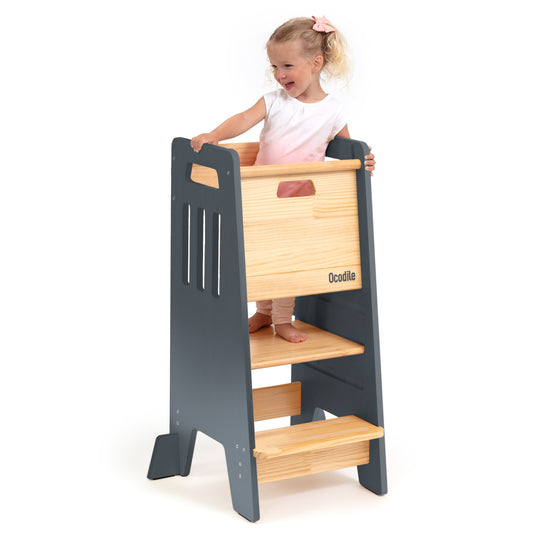
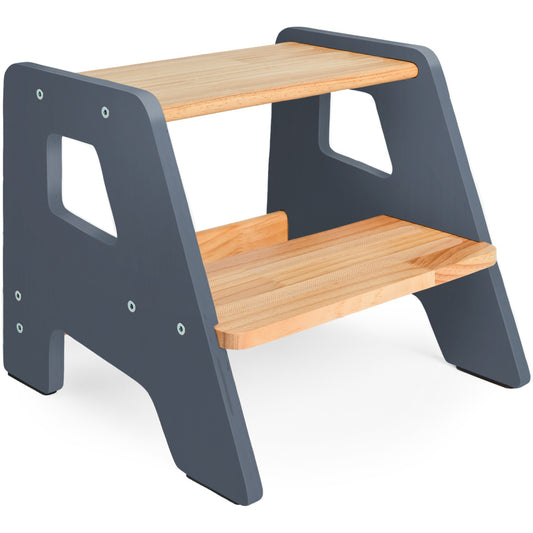
- A stable step stool or learning tower for supervised counter participation
- One small work surface where a child can peel, stir, or assemble simple food
- Easy-clean materials because spills are part of the learning
For parents who want examples of how this looks in real life, this Montessori kitchen setup guide gives practical ideas for creating access without creating chaos.
Safety and participation can work together
Parents sometimes hear “child-accessible kitchen” and imagine more mess, more danger, and one more thing to manage. The opposite is often true when the setup is intentional. A child with a defined workspace and safe tools is less likely to wander toward risky areas looking for involvement.
That's why furniture choice matters so much. A helper tower needs to feel stable. Low shelving should hold only safe items. Edges should be smooth, surfaces easy to wipe, and the child zone clearly separated from the stove, kettle, and knife storage.
One option families use in small kitchens is a foldable adjustable kitchen tower from Ocodile, which folds flat for storage and is designed for child use in the home kitchen. In an apartment, that kind of piece can be useful because it supports participation without permanently claiming floor space.
This short video shows the general idea of child participation in the kitchen in a very concrete way.
A useful child zone is small on purpose
You do not need a full kid kitchen inside your actual kitchen. One defined area is enough. A corner of the counter with a helper tower. A low shelf with a cutting board, small towel, and child cup. A basket with produce to wash. That's plenty.
Try this simple setup:
| Area | Adult use | Child use |
|---|---|---|
| Counter edge away from heat | Prep and assembly | Supervised stirring or washing |
| Low shelf | Overflow storage avoided | Cups, napkins, safe snacks |
| Corner nook | Often underused | Small task area or stool parking |
A family-friendly kitchen doesn't give children full access. It gives them meaningful access.
Why this matters in an apartment
In a larger home, children can participate somewhere else. In an apartment, the kitchen is often one of the main shared spaces. Designing it for both adults and children reduces friction across the whole day. Meals get easier. Transitions feel calmer. Kids learn routines by being included.
And for many parents, that's the primary goal. Not just fitting more into a small room, but making the room support family life better.
Arranging Your Furniture for Safety and Flow
A good layout feels calm because each piece supports movement. You shouldn't have to slide sideways past a cart, move a stool every time you open a drawer, or worry that your child's helper tower sits too close to heat.
Build around your real path
Watch your normal sequence at dinner time. You wash vegetables, turn to chop, pivot to cook, then carry dishes to the sink. Arrange furniture to support that order. Keep prep support near prep space. Keep bulky storage out of the main walking lane. Park movable pieces where they can help without blocking.
Use these placement checks:
- Keep the stove zone clear of child furniture, including stools and towers.
- Place mobile carts at the edge of the workflow, not in the middle of it.
- Avoid climbable setups near sharp tools, hot appliances, or upper cabinets.
- Store child items together so children know where their things belong.
Treat open floor space as useful space
Parents often feel pressure to fill every gap. Don't. In a small kitchen, breathing room is functional. It gives you safer turns, easier cleanup, and fewer collisions with kids underfoot.
If you're reviewing your layout with toddler safety in mind, this guide to kitchen safety for toddlers is a helpful companion to furniture planning.
Clear pathways are part of your storage strategy. They protect the room from becoming harder to use every time you add something.
A strong apartment kitchen furniture plan doesn't end with buying the right pieces. It ends when the room supports cooking, cleanup, movement, and family participation without constant rearranging.
If you want family-focused furniture ideas that support child independence without taking over a small home, Ocodile offers practical options designed for everyday life with young children. Their approach fits apartment living well because it centers on safety, participation, and pieces that work within real family routines.