



A Parent's Guide to the Wall Organizer Kitchen
Breakfast starts in the dark. Someone wants oatmeal, someone else needs a clean water bottle for school, and the counter has become a holding zone for unopened mail, crayons, a lunchbox, and the one lid that never seems to match the right cup. You reach for the spatula and hit a stack of mixing bowls. A child squeezes past your knees. Another is asking for help right where the dishwasher door opens.
That's the moment most families start looking at the wall.
A good wall organizer kitchen setup isn't just about making the room look tidier. In a family home, it can change how the kitchen works hour by hour. It gets daily-use items off the counter, gives important tools a stable home, and reduces the frantic searching that turns normal mornings into friction. Major retailers now carry dedicated wall-mounted kitchen storage assortments, which shows this isn't some niche trick. It's an established way to use vertical space in kitchens that need to do a lot every day.
For parents, the key question isn't whether wall storage looks nice. It's whether it's safe, reachable, easy to maintain, and flexible enough to keep up as children grow. That's where many guides fall short. They show pretty rails and open shelves, but they skip the part that matters most in a busy household: what should go on the wall, how it should be mounted, and how to keep that system from becoming another hazard.
From Kitchen Chaos to Calm Control
Most family kitchens don't become cluttered because people are careless. They become cluttered because the room is carrying too many jobs at once. It's a cooking space, homework station, snack bar, package drop zone, and cleanup center. When storage doesn't match that reality, every flat surface gets recruited.
I've seen the same pattern in home after home. The things used most often end up homeless. Water bottles sit beside the toaster. Lunch supplies get buried behind serving platters. Cooking oils hover near the stove because there's nowhere better for them. Then parents buy a few countertop containers, and the kitchen feels even tighter.
What changes when the wall starts working
A wall organizer kitchen system gives the room another storage layer between the countertop and the upper cabinets. That's why the category has become mainstream in major retail markets. Stores such as IKEA, Target, and The Container Store all maintain dedicated wall-storage or wall-organizer kitchen assortments, signaling that this is now a standard kitchen storage solution rather than a niche add-on, as shown by The Container Store's wall-mounted kitchen selection.
The benefit for families is practical, not theoretical:
- Counters open up so meal prep has a clear landing zone.
- Frequently used items stay visible instead of disappearing into deep cabinets.
- Daily routines speed up because tools return to the same place every time.
If your kitchen is small, that wall strategy works even better when paired with other compact-space ideas. Trademaster Construction shares useful solutions for small kitchen clutter that fit the same goal: reducing pressure on the surfaces you use most.
A calmer kitchen usually doesn't come from storing more. It comes from storing the right things in the right height range.
What a parent-friendly setup actually solves
The strongest wall systems don't try to hold everything. They hold the items that create the most repeat stress. Think cooking utensils, lunch-packing supplies, water bottles, lightweight containers, paper towels, and the small extras that otherwise wander.
That's the shift from chaos to control. You stop treating the wall as decoration and start treating it as working storage. In a family kitchen, that distinction matters.
Assessing Your Family's Real Kitchen Needs
A family kitchen reveals its problems during the rush. Breakfast dishes stack up by the sink, water bottles gather near the fridge, lunch supplies spread across the counter, and one drawer keeps jamming because everyone shoves the same items back in a hurry. That is the moment to study, before you buy a single hook or shelf.

Run a clutter audit before you shop
Watch the kitchen during the busiest parts of a normal week. Skip the tidy, reset version of the room. Look at it when school bags are on the floor, someone is asking for a snack, and dinner prep is starting.
Use a short checklist:
- What do you reach for every day?
- What stays on the counter because putting it away takes too many steps?
- Where do backups and pileups form near the sink, stove, or island?
- What do your children ask for over and over that could live in one clear, safe spot?
- Which items must stay out of a child's reach every time?
Write your notes by zone. “Lunch setup by the fridge” gives you a better plan than “food storage.” “Breakfast station near the toaster” is more useful than “plates and bowls.” Good wall storage supports how your family moves through the room, not how a store groups products.
Separate daily-use items from occasional items
The wall should hold the items that save time and reduce repeat mess. Families often waste prime wall space on things they use once in a while, then wonder why the system feels crowded from day one.
A simple filter helps. Wall storage earns its place when the item is:
- Used often
- Light or moderate in weight
- Safe in an open, visible system
That usually points to spatulas, measuring spoons, dish brushes, reusable bags, lunchbox tools, kid cups, or lightweight containers with lids that stay put. It usually rules out cast iron, heavy stacks of dishes, breakable glass at child height, and anything sharp.
Safety decides more than style here. If a child can tug it, climb toward it, or knock it down, it needs a different home.
Ready-made system or DIY build
Most families end up choosing between a ready-made wall system and a custom DIY setup. Both can work. The better choice depends on your wall, your budget, and how specific your storage problem is.
| Option | Works well when | Trade-off |
|---|---|---|
| Ready-made rails, shelves, and baskets | You want compatible parts and a faster setup | Less flexibility with sizing |
| DIY wall storage | You need exact dimensions or a solution for an awkward wall | More measuring, more planning, more installation risk |
In my experience, ready-made systems suit busy households because parts are easier to add, move, or replace when routines change. DIY can solve odd corners well, but mistakes matter more. A shelf that is slightly too deep can crowd a walkway. A rail placed too low can turn scissors, peelers, or graters into a child-access problem.
Practical rule: Choose the system that fits the mess your family creates most often.
Build your must-have list
Before you shop, make a short list of what the organizer must do in your kitchen.
- Give children safe access to approved items such as cups, snack bins, or lunch containers
- Keep sharp, hot-zone, and breakable items out of reach
- Use surfaces that wipe clean near food prep
- Contain small items so they do not slide, tip, or scatter
- Protect clear prep space on the counters you rely on every day
This step saves money and prevents a common mistake. Families buy a wall organizer for looks, then try to force their routine into it. The better approach is the reverse. Define the pressure points first, then choose a setup that solves them safely and with less daily friction.
Choosing Safe Materials for a Healthy Home
A wall organizer kitchen may look simple, but material choice affects everything from cleaning to durability to how safe the system feels in a house with children. Major retailers market wall organizers as both functional and decorative, offering a range of materials that reflects demand for systems that clear clutter and support busy household routines, as discussed in these wall organizer kitchen ideas.

Comparing the common options
Here's the short version. No material is perfect. The right choice depends on what you're storing, how rough daily use is, and how much maintenance you'll tolerate.
| Material | Where it tends to work | What to watch |
|---|---|---|
| Wood | Warm-looking shelves, dry storage, visible family zones | Needs a finish that cleans easily |
| Metal | Rails, hooks, baskets near active prep areas | Sharp edges and hard corners matter |
| Plastic | Lightweight bins and kid-access storage | Can stain, warp, or look worn faster |
| Bamboo | Family-friendly visual style with easy wipe-down potential | Quality varies a lot |
Wood and bamboo in family kitchens
Wood works well when you want the organizer to feel integrated with the rest of the kitchen instead of looking purely utilitarian. But not every wood product belongs near daily splashes and sticky hands. A sealed finish is easier to wipe down and less likely to trap grime.
Bamboo often appeals to families because it feels softer visually than metal and lighter than many thick wood pieces. In practice, sealed bamboo works best in kitchens where the organizer is both storage and part of the room's look. I'd avoid porous, rough, or cheaply finished pieces that are difficult to sanitize after food splatters.
Metal and plastic in high-use zones
Metal earns its place near the stove or sink because it handles repeated use well and doesn't mind steam the way some other materials do. The downside is physical. Thin wire baskets and stamped metal shelves can have edges that are unpleasant at adult hip height and worse at child head height. Rounded corners matter more than people think.
Plastic works well for modular bins, removable trays, and low-access kid zones because it's light and easy for children to handle. It's especially useful when you want a child to carry a bin of cups, snack containers, or coloring tools without much weight. The trade-off is feel and longevity. Some plastic pieces clean well for years. Others scratch, stain, or crack under hard family use.
In a house with young children, the safest material isn't the one that photographs best. It's the one you can clean quickly, trust daily, and live with at full speed.
A simple material test before buying
Use this quick filter:
- Touch the edges. If they feel harsh in the store, they'll feel worse in a rush.
- Check the finish. If it seems hard to wipe, it probably is.
- Think about the user. Adult-only storage can handle heavier materials. Kid-access storage should stay lighter.
- Match material to zone. Splash area, prep area, and child area don't need the same construction.
If you're choosing between a beautiful option and a forgiving option for a family kitchen, the forgiving option usually wins.
A Blueprint for Secure Wall Organizer Installation
This is the part that deserves more attention than it gets. Families often focus on what the organizer will hold and forget that the wall connection is the whole system. A nice shelf mounted badly is still a hazard.
Start with placement. Experts recommend installing kitchen wall units 50 to 60 cm above the worktop for safe workflow and to reduce head collisions. The same technical guidance notes that mounting directly into structural studs with 35 mm deep anchors has a success rate of over 92%, while mounting on hollow drywall without reinforcement has a 34% failure rate under loads exceeding 15 kg, according to Berloni's kitchen wall unit guidance.

Place it where people actually move
A wall organizer kitchen setup should support your workflow, not force awkward reaching. Over the main prep zone usually works better than over a tight pass-through. Near the stove can work for utensils, but only if the system won't create crowding or put dangling items in a child's path.
Keep these practical checks in mind:
- Head clearance matters. If adults lean into the counter and clip the shelf, it's too low or too deep.
- Reach matters. If you need to stretch for everyday tools, the system will be ignored.
- Traffic matters. Don't mount where children routinely squeeze through while you cook.
Fasteners decide whether the setup is safe
This is not the place to improvise. Studs are the safest anchor points because they carry the load through the structure of the wall. Drywall alone is a weak plan for family kitchens, especially when baskets, jars, and constant grabbing add movement over time.
A practical install sequence looks like this:
- Mark the working zone above the counter, not just the visual center of the wall.
- Use a stud finder and confirm stud positions before you drill.
- Map the organizer width so the heaviest points align with secure mounting points.
- Check the loaded depth of shelves or baskets, not only the empty frame.
- Drill accurately and use the mounting hardware specified for the wall type.
- Test for movement before loading anything.
For families who are already reviewing other home anchoring tasks, Ocodile has a useful guide on how to secure furniture to the wall. The principles overlap: stable attachment, correct hardware, and no shortcuts around child safety.
Don't judge an installation by whether it feels firm empty. Judge it by whether it stays firm after repeated reaching, wiping, loading, and accidental bumps.
A short visual walkthrough can help if you're planning placement and hardware.
What usually goes wrong
The most common mistakes are predictable. People mount too high because they're chasing a clean look. They choose shelves that project too far into the work zone. Or they load an organizer as if all wall hardware is equal.
If you rent, the safest answer may be a lighter-duty setup with tightly controlled contents rather than a large multi-shelf unit. If you own, it's still worth slowing down and installing for the actual load, not the imagined one. In a family kitchen, that difference matters.
Designing a Kid-Friendly and Functional Layout
Once the organizer is mounted securely, the main design work begins. The smartest wall organizer kitchen layouts are zoned by user, not just by object. Adults need speed. Kids need safe access. The wall can do both if you divide it intentionally.
Create zones by height and purpose
Think in bands.
The lowest practical band should hold only items you're comfortable letting a child touch. That might mean plastic cups, napkins, snack containers, bibs, or coloring supplies if the kitchen doubles as an activity space. Such an arrangement helps families support independence without inviting chaos.
The middle band is usually prime adult territory. Put your highest-frequency tools there: spatulas, measuring spoons, dish brush, oils if safe for your household setup, and the bits you reach for while cooking on autopilot.
The highest band is your control zone. Use it for anything breakable, sharp, hot-related, or too tempting for curious hands.
Use containment, not just display
Open wall storage looks tidy when every item behaves. Real family kitchens need containment. Bins, cups, shallow baskets, and dividers keep one bumped object from taking down the whole system.
That organizing principle shows up in other storage formats too. Strategic placement and internal division improve efficiency. Houzz notes that using dividers in 12 to 18 inch wide cabinets can increase storage density by 27%, a useful principle when adapting a wall unit for compact, categorized storage in active kitchens, as described in this Houzz storage guide.
What that means on the wall:
- Group like with like. Lunchbox parts together. Baking tools together.
- Use small containers for loose items. Don't let packet mixes, clips, or straws float around open shelves.
- Limit each zone. If a section holds too many categories, it becomes visual noise.
Give children a place, not full access
There's a difference between child-friendly and child-open. A good family layout gives children a few predictable choices within safe limits. That might be a lower bin for their plates and cups or a small rail for aprons and washcloths.
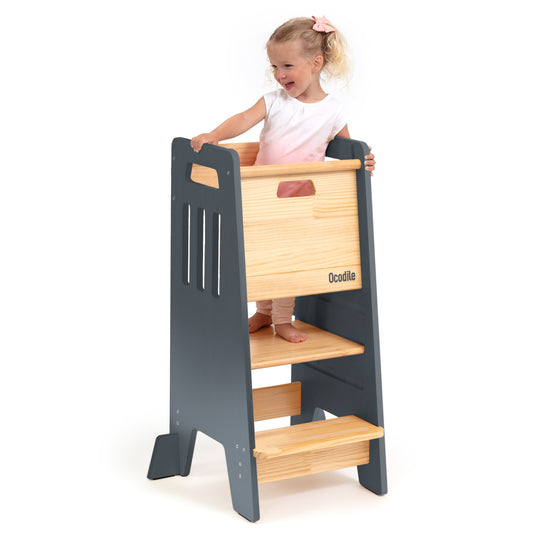
If your goal is independence, a nearby support tool can help without turning the whole kitchen into a climbing invitation. Families who want a child to safely participate at counter height often look at options such as a kitchen helper or standing tower. If you're thinking through wall-based access and activity zones together, these toy storage wall ideas are also useful for understanding how to make vertical storage more reachable and more orderly for kids.
The safest family kitchen isn't the one that hides children from the room. It's the one that gives them a defined place in it.
A well-zoned layout reduces friction for everyone. Adults stop hunting for essentials. Children stop scattering into every drawer. The room starts working like a shared space instead of a contested one.
Long-Term Maintenance and Evolving Child Safety
Saturday morning is when many wall systems subtly fail. Someone grabs lunch containers in a hurry, a child drags a stool over to help, steam from breakfast is still hanging in the room, and no one notices the loose bracket until a shelf starts to shift. A wall organizer kitchen stays safe because families keep checking it.
That long-term upkeep matters more in a family kitchen than in a styled photo. Weight changes. Children test limits. Daily wiping introduces moisture around hardware. Manufacturers also warn that wall storage has to stay within its rated capacity and stay properly mounted to the wall type, as noted in IKEA's guidance for wall storage installation and maximum load.

Check the system before it becomes a problem
A quick monthly inspection is usually enough. Tie it to something you already do, like changing the family calendar or deep-cleaning the fridge.
Use a simple checklist:
- Tighten hardware: Check screws, brackets, anchors, and visible fasteners.
- Review the load: Remove weight if baskets or shelves have collected heavier items over time.
- Watch for movement: Tilting shelves, sagging rails, and hooks that no longer sit flush need immediate attention.
- Inspect while cleaning: Wiping the wall organizer is the best time to spot cracks, rust, rough edges, or swollen material from moisture.
A safe wall organizer should feel solid every time you touch it. Any wobble is a repair signal, not something to monitor later.
Children change faster than storage does
The organizer that worked for a toddler can become risky for a determined preschooler. Then the same setup may frustrate a school-age child who wants more independence and starts pulling over a chair to get it.
Adjust the wall as your child grows:
| Child stage | What changes | What to do |
|---|---|---|
| Toddler | Reaching and grabbing increase | Move glass, sharp tools, and cleaning items farther from access points |
| Preschooler | Climbing and imitation start | Remove tempting tools from lower visible zones and reduce anything that looks like a handhold |
| School-age | Independence expands | Give children approved items they can use alone, while keeping heat, blades, and heavy objects restricted |
If you are reviewing kitchen routines as well as storage, Ocodile's guide to kitchen safety for toddlers helps connect wall organization decisions to the way children behave in a busy home.
Keep the system useful or it will slowly fall apart
Families stop maintaining organizers that no longer match real life. That is the part many articles miss.
A wall zone built for bottles and bibs rarely works well once the kitchen shifts to lunch packing, snack bins, permission slips, and water bottles. If the system becomes annoying to use, people start overloading the wrong shelf, hanging items where they do not belong, or leaving daily supplies on the counter instead. That is when safety and function both slip.
Review the setup every season or after a major routine change. Ask a few plain questions. Are children trying to reach things they should not have? Are adults storing heavy items on a hook because the right spot is inconvenient? Is anything now stored low enough to invite climbing?
Reworking the wall is normal family maintenance. It means the kitchen is being used hard, not that the first plan was wrong.
A family-safe kitchen is never finished. It gets checked, edited, and reset as children grow and routines change.
If you're building a kitchen that supports both safety and independence, Ocodile offers child-focused home solutions designed for everyday family routines. Their approach fits well with the same principles behind a thoughtful wall organizer kitchen: secure design, practical use, and giving children a safe way to participate in shared spaces.